Stewart Section 9.1: Modeling with Differential Equations

11 questions

--:--
0 / 11
Stewart Section 9.1: Modeling with Differential Equations 0/11
1 Differential Equations - Verification · Level 2
Show that \(y = \dfrac{2}{3} e^x + e^{-2x}\) is a solution of the differential equation \(y' + 2y = 2e^x\).
2 Differential Equations - Verification · Level 2
Verify that \(y = -t \cos t - t\) is a solution of the initial-value problem \(t \dfrac{d y}{d t} = y + t^2 \sin t\), \(\quad y(\pi) = 0\)
3 Differential Equations - Verification · Level 3
(a) For what values of \(r\) does the function \(y = e^{r x}\) satisfy the differential equation \(2y'' + y' - y = 0\)?
(b) If \(r_1\) and \(r_2\) are the values of \(r\) that you found in part (a), show that every member of the family of functions \(y = a e^{r_1 x} + b e^{r_2 x}\) is also a solution.

Enter your answer directly below each part above.

4 Differential Equations - Verification · Level 3
(a) For what values of \(k\) does the function \(y = \cos k t\) satisfy the differential equation \(4y'' = -25y\)?
(b) For those values of \(k\), verify that every member of the family of functions \(y = A \sin k t + B \cos k t\) is also a solution.

Enter your answer directly below each part above.

5 Differential Equations - Verification · Level 3
Which of the following functions are solutions of the differential equation \(y'' + y = \sin x\)?
(a) \(y = \sin x\)
(b) \(y = \cos x\)
(c) \(y = \dfrac{1}{2} x \sin x\)
(d) \(y = -\dfrac{1}{2} x \cos x\)

Enter your answer directly below each part above.

6 Differential Equations - Verification · Level 3
(a) Show that every member of the family of functions \(y = (\ln x + C) / x\) is a solution of the differential equation \(x^2 y' + x y = 1\).
(b) Illustrate part (a) by graphing several members of the family of solutions on a common screen.
(c) Find a solution of the differential equation that satisfies the initial condition \(y(1) = 2\).
(d) Find a solution of the differential equation that satisfies the initial condition \(y(2) = 1\).

Enter your answer directly below each part above.

7 Differential Equations - Analysis · Level 3
(a) What can you say about a solution of the equation \(y' = -y^2\) just by looking at the differential equation?
(b) Verify that all members of the family \(y = 1 / (x + C)\) are solutions of the equation in part (a).
(c) Can you think of a solution of the differential equation \(y' = -y^2\) that is not a member of the family in part (b)?
(d) Find a solution of the initial-value problem \(y' = -y^2\), \(\quad y(0) = 0.5\)

Enter your answer directly below each part above.

8 Differential Equations - Analysis · Level 3
(a) What can you say about the graph of a solution of the equation \(y' = x y^3\) when \(x\) is close to 0? What if \(x\) is large?
(b) Verify that all members of the family \(y = (c - x^2)^{-\dfrac{1}{2}}\) are solutions of the differential equation \(y' = x y^3\).
(c) Graph several members of the family of solutions on a common screen. Do the graphs confirm what you predicted in part (a)?
(d) Find a solution of the initial-value problem \(y' = x y^3\), \(\quad y(0) = 2\)

Enter your answer directly below each part above.

9 Differential Equations - Population Models · Level 3
A population is modeled by the differential equation \( \dfrac{d P}{d t} = 1.2 P \left(1 - \dfrac{P}{4200}\right) \)
(a) For what values of \(P\) is the population increasing?
(b) For what values of \(P\) is the population decreasing?
(c) What are the equilibrium solutions?

Enter your answer directly below each part above.

10 Differential Equations - Analysis · Level 4
The Fitzhugh-Nagumo model for the electrical impulse in a neuron states that, in the absence of relaxation effects, the electrical potential in a neuron \(v(t)\) obeys the differential equation \( \dfrac{d v}{d t} = -v[v^2 - (1 + a)v + a] \) where \(a\) is a positive constant such that \(0 < a < 1\).
(a) For what values of \(v\) is \(v\) unchanging (that is, \(d \dfrac{v}{d} t = 0\))?
(b) For what values of \(v\) is \(v\) increasing?
(c) For what values of \(v\) is \(v\) decreasing?

Enter your answer directly below each part above.

11 Differential Equations - Analysis · Level 3
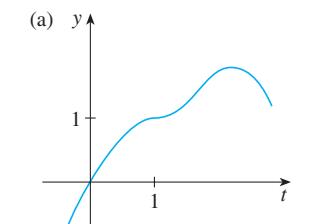
Explain why the functions with the given graphs can't be solutions of the differential equation \( \dfrac{d y}{d t} = e^t (y - 1)^2 \)
question image

Answered: 0 / 11