Stewart Precalc 6e Section 3.3: Dividing Polynomials

76 questions

--:--
0 / 76
Stewart Precalc 6e Section 3.3: Dividing Polynomials 0/76
1 Concept - Division Terminology · Level 1
If we divide the polynomial \(P\) by the factor \(x - c\) and we obtain the equation \(P(x) = (x - c) Q(x) + R(x)\), then we say that \(x - c\) is the divisor, \(Q(x)\) is the ______, and \(R(x)\) is the ______.
2 Concept - Factor and Remainder Theorems · Level 1
(a) If we divide the polynomial \(P(x)\) by the factor \(x - c\) and we obtain a remainder of \(0\), then we know that \(c\) is a ______ of \(P\).
(b) If we divide the polynomial \(P(x)\) by the factor \(x - c\) and we obtain a remainder of \(k\), then we know that \(P(c) = \) ______.

Enter your answer directly below each part above.

3 Skill - Polynomial Division · Level 2
Use either synthetic or long division to divide \(P(x)\) by \(D(x)\), and express \(P\) in the form \(P(x) = D(x) \cdot Q(x) + R(x)\), where \(P(x) = 3x^2 + 5x - 4\), \(D(x) = x + 3\).
4 Skill - Polynomial Division · Level 2
Use either synthetic or long division to divide \(P(x)\) by \(D(x)\), and express \(P\) in the form \(P(x) = D(x) \cdot Q(x) + R(x)\), where \(P(x) = x^3 + 4x^2 - 6x + 1\), \(D(x) = x - 1\).
5 Skill - Polynomial Division · Level 3
Use either synthetic or long division to divide \(P(x)\) by \(D(x)\), and express \(P\) in the form \(P(x) = D(x) \cdot Q(x) + R(x)\), where \(P(x) = 2x^3 - 3x^2 - 2x\), \(D(x) = 2x - 3\).
6 Skill - Polynomial Division · Level 3
Use either synthetic or long division to divide \(P(x)\) by \(D(x)\), and express \(P\) in the form \(P(x) = D(x) \cdot Q(x) + R(x)\), where \(P(x) = 4x^3 + 7x + 9\), \(D(x) = 2x + 1\).
7 Skill - Polynomial Division · Level 3
Use either synthetic or long division to divide \(P(x)\) by \(D(x)\), and express \(P\) in the form \(P(x) = D(x) \cdot Q(x) + R(x)\), where \(P(x) = x^4 - x^3 + 4x + 2\), \(D(x) = x^2 + 3\).
8 Skill - Polynomial Division · Level 3
Use either synthetic or long division to divide \(P(x)\) by \(D(x)\), and express \(P\) in the form \(P(x) = D(x) \cdot Q(x) + R(x)\), where \(P(x) = 2x^5 + 4x^4 - 4x^3 - x - 3\), \(D(x) = x^2 - 2\).
9 Skill - Express as Quotient + Remainder/Divisor · Level 2
Use either synthetic or long division to divide \(P(x)\) by \(D(x)\), and express the quotient \(P(x)/D(x)\) in the form \(\dfrac{P(x)}{D(x)} = Q(x) + \dfrac{R(x)}{D(x)}\), where \(P(x) = x^2 + 4x - 8\), \(D(x) = x + 3\).
10 Skill - Express as Quotient + Remainder/Divisor · Level 2
Use either synthetic or long division to divide \(P(x)\) by \(D(x)\), and express the quotient \(P(x)/D(x)\) in the form \(\dfrac{P(x)}{D(x)} = Q(x) + \dfrac{R(x)}{D(x)}\), where \(P(x) = x^3 + 6x + 5\), \(D(x) = x - 4\).
11 Skill - Express as Quotient + Remainder/Divisor · Level 3
Use either synthetic or long division to divide \(P(x)\) by \(D(x)\), and express the quotient \(P(x)/D(x)\) in the form \(\dfrac{P(x)}{D(x)} = Q(x) + \dfrac{R(x)}{D(x)}\), where \(P(x) = 4x^2 - 3x - 7\), \(D(x) = 2x - 1\).
12 Skill - Express as Quotient + Remainder/Divisor · Level 3
Use either synthetic or long division to divide \(P(x)\) by \(D(x)\), and express the quotient \(P(x)/D(x)\) in the form \(\dfrac{P(x)}{D(x)} = Q(x) + \dfrac{R(x)}{D(x)}\), where \(P(x) = 6x^3 + x^2 - 12x + 5\), \(D(x) = 3x - 4\).
13 Skill - Express as Quotient + Remainder/Divisor · Level 3
Use either synthetic or long division to divide \(P(x)\) by \(D(x)\), and express the quotient \(P(x)/D(x)\) in the form \(\dfrac{P(x)}{D(x)} = Q(x) + \dfrac{R(x)}{D(x)}\), where \(P(x) = 2x^4 - x^3 + 9x^2\), \(D(x) = x^2 + 4\).
14 Skill - Express as Quotient + Remainder/Divisor · Level 3
Use either synthetic or long division to divide \(P(x)\) by \(D(x)\), and express the quotient \(P(x)/D(x)\) in the form \(\dfrac{P(x)}{D(x)} = Q(x) + \dfrac{R(x)}{D(x)}\), where \(P(x) = x^5 + x^4 - 2x^3 + x + 1\), \(D(x) = x^2 + x - 1\).
15 Skill - Long Division Quotient and Remainder · Level 2
Find the quotient and remainder using long division: \(\dfrac{x^2 - 6x - 8}{x - 4}\).
16 Skill - Long Division Quotient and Remainder · Level 2
Find the quotient and remainder using long division: \(\dfrac{x^3 - x^2 - 2x + 6}{x - 2}\).
17 Skill - Long Division Quotient and Remainder · Level 3
Find the quotient and remainder using long division: \(\dfrac{4x^3 + 2x^2 - 2x - 3}{2x + 1}\).
18 Skill - Long Division Quotient and Remainder · Level 3
Find the quotient and remainder using long division: \(\dfrac{x^3 + 3x^2 + 4x + 3}{3x + 6}\).
19 Skill - Long Division Quotient and Remainder · Level 3
Find the quotient and remainder using long division: \(\dfrac{x^3 + 6x + 3}{x^2 - 2x + 2}\).
20 Skill - Long Division Quotient and Remainder · Level 3
Find the quotient and remainder using long division: \(\dfrac{3x^4 - 5x^3 - 20x - 5}{x^2 + x + 3}\).
21 Skill - Long Division Quotient and Remainder · Level 3
Find the quotient and remainder using long division: \(\dfrac{6x^3 + 2x^2 + 22x}{2x^2 + 5}\).
22 Skill - Long Division Quotient and Remainder · Level 3
Find the quotient and remainder using long division: \(\dfrac{9x^2 - x + 5}{3x^2 - 7x}\).
23 Skill - Long Division Quotient and Remainder · Level 3
Find the quotient and remainder using long division: \(\dfrac{x^6 + x^4 + x^2 + 1}{x^2 + 1}\).
24 Skill - Long Division Quotient and Remainder · Level 4
Find the quotient and remainder using long division: \(\dfrac{2x^5 - 7x^4 - 13}{4x^2 - 6x + 8}\).
25 Skill - Synthetic Division · Level 2
Find the quotient and remainder using synthetic division: \(\dfrac{x^2 - 5x + 4}{x - 3}\).
26 Skill - Synthetic Division · Level 2
Find the quotient and remainder using synthetic division: \(\dfrac{x^2 - 5x + 4}{x - 1}\).
27 Skill - Synthetic Division · Level 2
Find the quotient and remainder using synthetic division: \(\dfrac{3x^2 + 5x}{x - 6}\).
28 Skill - Synthetic Division · Level 2
Find the quotient and remainder using synthetic division: \(\dfrac{4x^2 - 3}{x + 5}\).
29 Skill - Synthetic Division · Level 2
Find the quotient and remainder using synthetic division: \(\dfrac{x^3 + 2x^2 + 2x + 1}{x + 2}\).
30 Skill - Synthetic Division · Level 2
Find the quotient and remainder using synthetic division: \(\dfrac{3x^3 - 12x^2 - 9x + 1}{x - 5}\).
31 Skill - Synthetic Division · Level 2
Find the quotient and remainder using synthetic division: \(\dfrac{x^3 - 8x + 2}{x + 3}\).
32 Skill - Synthetic Division · Level 2
Find the quotient and remainder using synthetic division: \(\dfrac{x^4 - x^3 + x^2 - x + 2}{x - 2}\).
33 Skill - Synthetic Division · Level 2
Find the quotient and remainder using synthetic division: \(\dfrac{x^5 + 3x^3 - 6}{x - 1}\).
34 Skill - Synthetic Division · Level 2
Find the quotient and remainder using synthetic division: \(\dfrac{x^3 - 9x^2 + 27x - 27}{x - 3}\).
35 Skill - Synthetic Division · Level 3
Find the quotient and remainder using synthetic division: \(\dfrac{2x^3 + 3x^2 - 2x + 1}{x - \dfrac{1}{2}}\).
36 Skill - Synthetic Division · Level 3
Find the quotient and remainder using synthetic division: \(\dfrac{6x^4 + 10x^3 + 5x^2 + x + 1}{x + \dfrac{2}{3}}\).
37 Skill - Synthetic Division · Level 2
Find the quotient and remainder using synthetic division: \(\dfrac{x^3 - 27}{x - 3}\).
38 Skill - Synthetic Division · Level 2
Find the quotient and remainder using synthetic division: \(\dfrac{x^4 - 16}{x + 2}\).
39 Skill - Remainder Theorem Evaluation · Level 2
Use synthetic division and the Remainder Theorem to evaluate \(P(c)\), where \(P(x) = 4x^2 + 12x + 5\), \(c = -1\).
40 Skill - Remainder Theorem Evaluation · Level 2
Use synthetic division and the Remainder Theorem to evaluate \(P(c)\), where \(P(x) = 2x^2 + 9x + 1\), \(c = \dfrac{1}{2}\).
41 Skill - Remainder Theorem Evaluation · Level 2
Use synthetic division and the Remainder Theorem to evaluate \(P(c)\), where \(P(x) = x^3 + 3x^2 - 7x + 6\), \(c = 2\).
42 Skill - Remainder Theorem Evaluation · Level 2
Use synthetic division and the Remainder Theorem to evaluate \(P(c)\), where \(P(x) = x^3 - x^2 + x + 5\), \(c = -1\).
43 Skill - Remainder Theorem Evaluation · Level 2
Use synthetic division and the Remainder Theorem to evaluate \(P(c)\), where \(P(x) = x^3 + 2x^2 - 7\), \(c = -2\).
44 Skill - Remainder Theorem Evaluation · Level 3
Use synthetic division and the Remainder Theorem to evaluate \(P(c)\), where \(P(x) = 2x^3 - 21x^2 + 9x - 200\), \(c = 11\).
45 Skill - Remainder Theorem Evaluation · Level 3
Use synthetic division and the Remainder Theorem to evaluate \(P(c)\), where \(P(x) = 5x^4 + 30x^3 - 40x^2 + 36x + 14\), \(c = -7\).
46 Skill - Remainder Theorem Evaluation · Level 3
Use synthetic division and the Remainder Theorem to evaluate \(P(c)\), where \(P(x) = 6x^5 + 10x^3 + x + 1\), \(c = -2\).
47 Skill - Remainder Theorem Evaluation · Level 3
Use synthetic division and the Remainder Theorem to evaluate \(P(c)\), where \(P(x) = x^7 - 3x^2 - 1\), \(c = 3\).
48 Skill - Remainder Theorem Evaluation · Level 4
Use synthetic division and the Remainder Theorem to evaluate \(P(c)\), where \(P(x) = -2x^6 + 7x^5 + 40x^4 - 7x^2 + 10x + 112\), \(c = -3\).
49 Skill - Remainder Theorem Evaluation · Level 3
Use synthetic division and the Remainder Theorem to evaluate \(P(c)\), where \(P(x) = 3x^3 + 4x^2 - 2x + 1\), \(c = \dfrac{2}{3}\).
50 Skill - Remainder Theorem Evaluation · Level 3
Use synthetic division and the Remainder Theorem to evaluate \(P(c)\), where \(P(x) = x^3 - x + 1\), \(c = \dfrac{1}{4}\).
51 Skill - Remainder Theorem Evaluation · Level 3
Use synthetic division and the Remainder Theorem to evaluate \(P(c)\), where \(P(x) = x^3 + 2x^2 - 3x - 8\), \(c = 0.1\).
52 Skill - Polynomial Evaluation Comparison · Level 3
Let \(P(x) = 6x^7 - 40x^6 + 16x^5 - 200x^4 - 60x^3 - 69x^2 + 13x - 139\). Calculate \(P(7)\) by (a) using synthetic division and (b) substituting \(x = 7\) into the polynomial and evaluating directly.
53 Skill - Factor Theorem Verification · Level 2
Use the Factor Theorem to show that \(x - c\) is a factor of \(P(x)\) for the given value of \(c\), where \(P(x) = x^3 - 3x^2 + 3x - 1\), \(c = 1\).
54 Skill - Factor Theorem Verification · Level 2
Use the Factor Theorem to show that \(x - c\) is a factor of \(P(x)\) for the given value of \(c\), where \(P(x) = x^3 + 2x^2 - 3x - 10\), \(c = 2\).
55 Skill - Factor Theorem Verification · Level 3
Use the Factor Theorem to show that \(x - c\) is a factor of \(P(x)\) for the given value of \(c\), where \(P(x) = 2x^3 + 7x^2 + 6x - 5\), \(c = \dfrac{1}{2}\).
56 Skill - Factor Theorem Verification · Level 3
Use the Factor Theorem to show that \(x - c\) is a factor of \(P(x)\) for the given values of \(c\), where \(P(x) = x^4 + 3x^3 - 16x^2 - 27x + 63\), \(c = 3, -3\).
57 Skill - Zero Verification and Finding Other Zeros · Level 3
Show that the given value of \(c\) is a zero of \(P(x)\), and find all other zeros of \(P(x)\), where \(P(x) = x^3 - x^2 - 11x + 15\), \(c = 3\).
58 Skill - Zero Verification and Finding Other Zeros · Level 4
Show that the given values of \(c\) are zeros of \(P(x)\), and find all other zeros of \(P(x)\), where \(P(x) = 3x^4 - x^3 - 21x^2 - 11x + 6\), \(c = \dfrac{1}{3}, -2\).
59 Skill - Find Polynomial with Given Zeros · Level 2
Find a polynomial of the specified degree that has the given zeros. Degree 3; zeros \(-1, 1, 3\).
60 Skill - Find Polynomial with Given Zeros · Level 2
Find a polynomial of the specified degree that has the given zeros. Degree 4; zeros \(-2, 0, 2, 4\).
61 Skill - Find Polynomial with Given Zeros · Level 2
Find a polynomial of the specified degree that has the given zeros. Degree 4; zeros \(-1, 1, 3, 5\).
62 Skill - Find Polynomial with Given Zeros · Level 2
Find a polynomial of the specified degree that has the given zeros. Degree 5; zeros \(-2, -1, 0, 1, 2\).
63 Skill - Find Polynomial with Constraint · Level 3
Find a polynomial of degree 3 that has zeros \(1, -2\), and \(3\) and in which the coefficient of \(x^2\) is \(3\).
64 Skill - Find Polynomial with Integer Coefficients · Level 3
Find a polynomial of degree 4 that has integer coefficients and zeros \(1, -1, 2\), and \(\dfrac{1}{2}\).
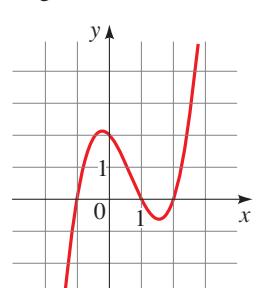
65 Skill - Find Polynomial from Graph · Level 3
Find the polynomial of the specified degree whose graph is shown. Degree 3.
question image
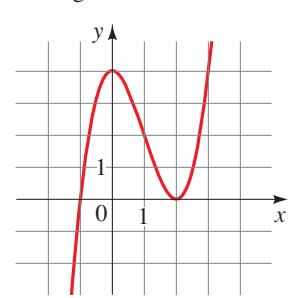
66 Skill - Find Polynomial from Graph · Level 3
Find the polynomial of the specified degree whose graph is shown. Degree 3.
question image
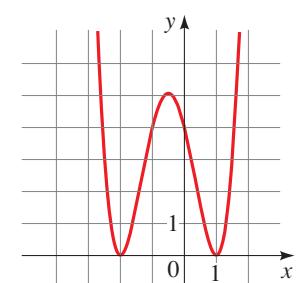
67 Skill - Find Polynomial from Graph · Level 4
Find the polynomial of the specified degree whose graph is shown. Degree 4.
question image
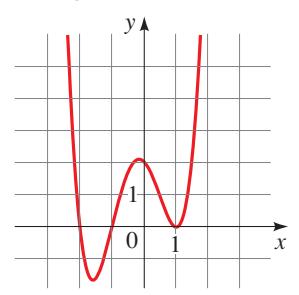
68 Skill - Find Polynomial from Graph · Level 4
Find the polynomial of the specified degree whose graph is shown. Degree 4.
question image
69 Discovery - Impossible Division · Level 4
Suppose you were asked to solve the following two problems on a test: (A) Find the remainder when \(6x^{1000} - 17x^{562} + 12x + 26\) is divided by \(x + 1\). (B) Is \(x - 1\) a factor of \(x^{567} - 3x^{400} + x^9 + 2\)? Obviously, it's impossible to solve these problems by dividing, because the polynomials are of such large degree. Use one or more of the theorems in this section to solve these problems without actually dividing.
70 Discovery - Nested Polynomial Form · Level 3
Expand \(Q\) to prove that the polynomials \(P\) and \(Q\) are the same: \(P(x) = 3x^4 - 5x^3 + x^2 - 3x + 5\), \(Q(x) = (((3x - 5)x + 1)x - 3)x + 5\). Try to evaluate \(P(2)\) and \(Q(2)\) in your head, using the forms given. Which is easier? Now write the polynomial \(R(x) = x^5 - 2x^4 + 3x^3 - 2x^2 + 3x + 4\) in nested form, like the polynomial \(Q\). Use the nested form to find \(R(3)\). Do you see how calculating with the nested form follows the same arithmetic steps as calculating the value of a polynomial using synthetic division?
71 Example - Long Division of Polynomials · Level 2
Divide \(6x^2 - 26x + 12\) by \(x - 4\).
72 Example - Long Division of Polynomials · Level 3
Let \(P(x) = 8x^4 + 6x^2 - 3x + 1\) and \(D(x) = 2x^2 - x + 2\). Find polynomials \(Q(x)\) and \(R(x)\) such that \(P(x) = D(x) \cdot Q(x) + R(x)\).
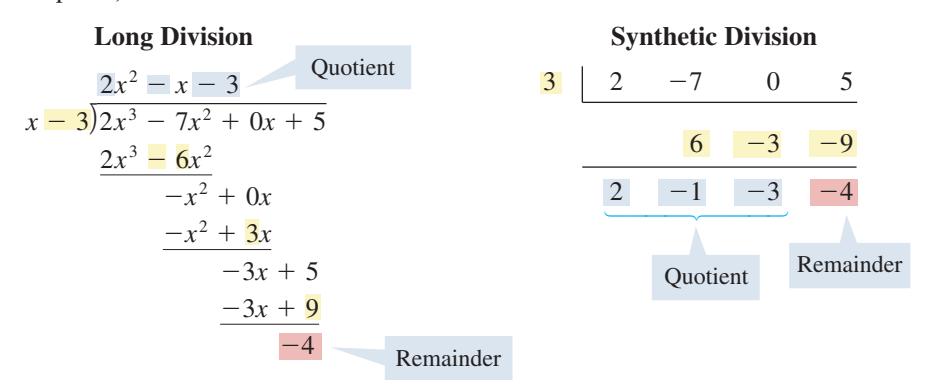
73 Example - Synthetic Division · Level 3
Use synthetic division to divide \(2x^3 - 7x^2 + 5\) by \(x - 3\).
question image
74 Example - Remainder Theorem · Level 3
Let \(P(x) = 3x^5 + 5x^4 - 4x^3 + 7x + 3\).
(a) Find the quotient and remainder when \(P(x)\) is divided by \(x + 2\).
(b) Use the Remainder Theorem to find \(P(-2)\).

Enter your answer directly below each part above.

75 Example - Factor Theorem · Level 3
Let \(P(x) = x^3 - 7x + 6\). Show that \(P(1) = 0\), and use this fact to factor \(P(x)\) completely.
76 Example - Finding Polynomial with Specified Zeros · Level 2
Find a polynomial of degree 4 that has zeros \(-3\), \(0\), \(1\), and \(5\).

Answered: 0 / 76