Stewart 9e Section 1.3: New Functions from Old Functions

70 questions

--:--
0 / 70
Stewart 9e Section 1.3: New Functions from Old Functions 0/70
1 Transformation equations · Level 1
Suppose the graph of \(f\) is given. Write equations for the graphs that are obtained from the graph of \(f\) as follows.
(a) Shift 3 units upward.
(b) Shift 3 units downward.
(c) Shift 3 units to the right.
(d) Shift 3 units to the left.
(e) Reflect about the \(x\)-axis.
(f) Reflect about the \(y\)-axis. (g) Stretch vertically by a factor of 3. (h) Shrink vertically by a factor of 3.

Enter your answer directly below each part above.

2 Describing transformations · Level 1
Explain how each graph is obtained from the graph of \(y = f(x)\).
(a) \(y = f(x) + 8\)
(b) \(y = f(x + 8)\)
(c) \(y = 8 f(x)\)
(d) \(y = f(8 x)\)
(e) \(y = -f(x) - 1\)
(f) \(y = 8 f(\left(\dfrac{1}{8}\right) x)\)

Enter your answer directly below each part above.

3 Matching transformations to graphs · Level 2
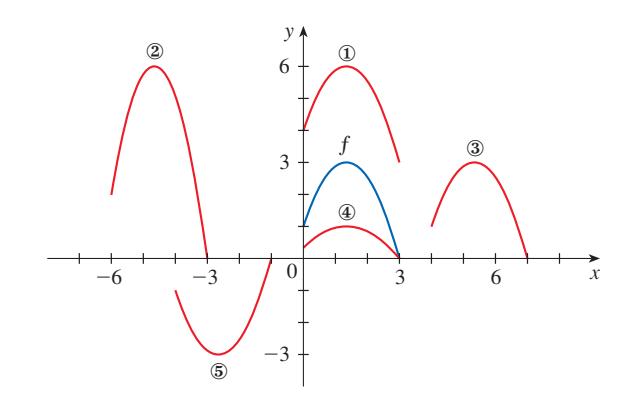
The graph of \(y = f(x)\) is given. Match each equation with its graph and give reasons for your choices.
question image
(a) \(y = f(x - 4)\)
(b) \(y = f(x) + 3\)
(c) \(y = \left(\dfrac{1}{2}\right) f(x)\)
(d) \(y = -f(x + 4)\)
(e) \(y = 2 f(x + 6)\)

Enter your answer directly below each part above.

4 Drawing transformed graphs · Level 2
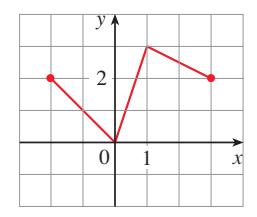
The graph of \(f\) is given. Draw the graphs of the following functions.
question image
(a) \(y = f(x) - 3\)
(b) \(y = f(x + 1)\)
(c) \(y = \left(\dfrac{1}{2}\right) f(x)\)
(d) \(y = -f(x)\)

Enter your answer directly below each part above.

5 Horizontal transformations · Level 2
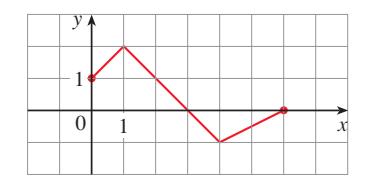
The graph of \(f\) is given. Use it to graph the following functions.
question image
(a) \(y = f(2 x)\)
(b) \(y = f(\left(\dfrac{1}{2}\right) x)\)
(c) \(y = f(-x)\)
(d) \(y = -f(-x)\)

Enter your answer directly below each part above.

6 Inferring transformations from graph · Level 3
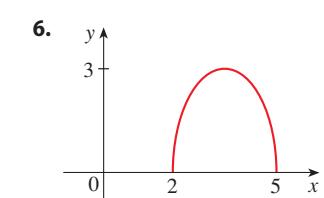
The graph of \(y = \sqrt{3 x - x^2}\) is given. Use transformations to create a function whose graph is as shown.
question image
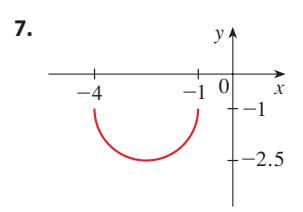
7 Inferring transformations from graph · Level 3
The graph of \(y = \sqrt{3 x - x^2}\) is given. Use transformations to create a function whose graph is as shown.
question image
8 Sketching using transformations · Level 2
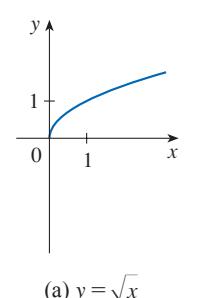
(a) How is the graph of \(y = 1 + \sqrt{x}\) related to the graph of \(y = \sqrt{x}\)? Use your answer and Figure 4(a) to sketch the graph of \(y = 1 + \sqrt{x}\).
(b) How is the graph of \(y = 5 \sin(\pi x)\) related to the graph of \(y = \sin(x)\)? Use your answer and Figure 6 to sketch the graph of \(y = 5 \sin(\pi x)\).

Enter your answer directly below each part above.

9 Graphing by transformation · Level 1
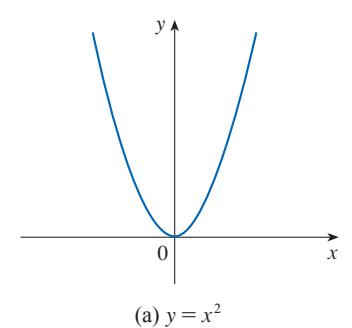
Graph the function by hand, not by plotting points, but by starting with the graph of one of the standard functions, and then applying the appropriate transformations. \(y = 1 + x^2\)
10 Graphing by transformation · Level 1
Graph \(y = (x + 1)^2\) by transformations.
11 Graphing by transformation · Level 1
Graph \(y = |x + 2|\) by transformations.
12 Graphing by transformation · Level 2
Graph \(y = 1 - x^3\) by transformations.
13 Graphing by transformation · Level 1
Graph \(y = \dfrac{1}{x} + 2\) by transformations.
14 Graphing by transformation · Level 2
Graph \(y = -\sqrt{x} - 1\) by transformations.
15 Graphing by transformation · Level 2
Graph \(y = \sin(4 x)\) by transformations.
16 Graphing by transformation · Level 2
Graph \(y = 1 + 1/x^2\) by transformations.
17 Graphing by transformation · Level 2
Graph \(y = 2 + \sqrt{x + 1}\) by transformations.
18 Graphing by transformation · Level 2
Graph \(y = -(x - 1)^2 + 3\) by transformations.
19 Graphing by transformation · Level 2
Graph \(y = x^2 - 2 x + 5\) by transformations.
20 Graphing by transformation · Level 2
Graph \(y = (x + 1)^3 + 2\) by transformations.
21 Graphing by transformation · Level 2
Graph \(y = 2 - |x|\) by transformations.
22 Graphing by transformation · Level 3
Graph \(y = 2 - 2 \cos(x)\) by transformations.
23 Graphing by transformation · Level 3
Graph \(y = 3 \sin\left(\dfrac{x}{2}\right) + 1\) by transformations.
24 Graphing by transformation · Level 3
Graph \(y = \left(\dfrac{1}{4}\right) \tan\left(x - \dfrac{\pi}{4}\right)\) by transformations.
25 Graphing by transformation · Level 3
Graph \(y = |\cos(\pi x)|\) by transformations.
26 Graphing by transformation · Level 3
Graph \(y = |\sqrt{x} - 1|\) by transformations.
27 Modeling daylight with sine · Level 4
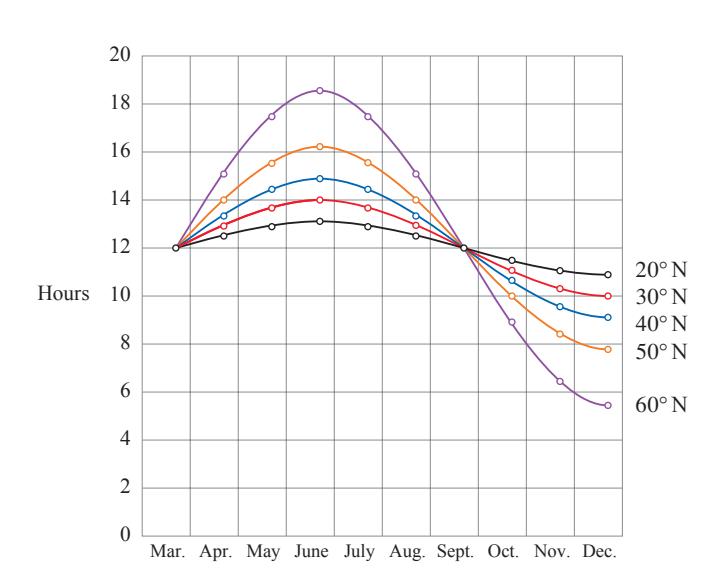
The city of New Orleans is located at latitude \(30^{\circ}\) N. Use Figure 9 to find a function that models the number of hours of daylight at New Orleans as a function of the time of year. To check the accuracy of your model, use the fact that on March 31 the sun rises at 5:51 AM and sets at 6:18 PM in New Orleans.
28 Modeling variable star brightness · Level 3
A variable star is one whose brightness alternately increases and decreases. For the most visible variable star, Delta Cephei, the time between periods of maximum brightness is 5.4 days, the average brightness (or magnitude) of the star is 4.0, and its brightness varies by \(\pm 0.35\) magnitude. Find a function that models the brightness of Delta Cephei as a function of time.
29 Modeling tidal depth · Level 4
Some of the highest tides in the world occur in the Bay of Fundy on the Atlantic Coast of Canada. At Hopewell Cape the water depth at low tide is about 2.0 m and at high tide it is about 12.0 m. The natural period of oscillation is about 12 hours and on a particular day, high tide occurred at 6:45 AM. Find a function involving the cosine function that models the water depth \(D(t)\) (in meters) as a function of time \(t\) (in hours after midnight) on that day.
30 Modeling respiration · Level 3
In a normal respiratory cycle the volume of air that moves into and out of the lungs is about 500 mL. The reserve and residue volumes of air that remain in the lungs occupy about 2000 mL and a single respiratory cycle for an average human takes about 4 seconds. Find a model for the total volume of air \(V(t)\) in the lungs as a function of time.
31 Composing with absolute value · Level 3
(a) How is the graph of \(y = f(|x|)\) related to the graph of \(f\)?
(b) Sketch the graph of \(y = \sin(|x|)\).
(c) Sketch the graph of \(y = \sqrt{|x|}\).

Enter your answer directly below each part above.

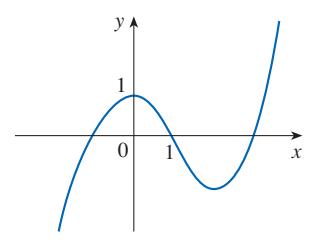
32 Reciprocal of a function · Level 3
Use the given graph of \(f\) to sketch the graph of \(y = \dfrac{1}{f}(x)\). Which features of \(f\) are the most important in sketching \(y = \dfrac{1}{f}(x)\)? Explain how they are used.
question image
33 Function operations and domains · Level 3
Find (a) \(f + g\), (b) \(f - g\), (c) \(f g\), and (d) \(\dfrac{f}{g}\) and state their domains. \(f(x) = \sqrt{25 - x^2}\), \(g(x) = \sqrt{x + 1}\)
34 Function operations and domains · Level 3
Find (a) \(f + g\), (b) \(f - g\), (c) \(f g\), and (d) \(\dfrac{f}{g}\) and state their domains. \(f(x) = 1/(x - 1)\), \(g(x) = \dfrac{1}{x} - 2\)
35 Composition and domains · Level 3
Find the functions (a) \(f \circ g\), (b) \(g \circ f\), (c) \(f \circ f\), and (d) \(g \circ g\) and their domains. \(f(x) = x^3 + 5\), \(g(x) = \sqrt[3]{x}\)
36 Composition and domains · Level 3
Find the functions (a) \(f \circ g\), (b) \(g \circ f\), (c) \(f \circ f\), and (d) \(g \circ g\) and their domains. \(f(x) = \dfrac{1}{x}\), \(g(x) = 2 x + 1\)
37 Composition and domains · Level 3
Find the functions (a) \(f \circ g\), (b) \(g \circ f\), (c) \(f \circ f\), and (d) \(g \circ g\) and their domains. \(f(x) = \dfrac{1}{\sqrt{x}}\), \(g(x) = x + 1\)
38 Composition and domains · Level 3
Find the functions (a) \(f \circ g\), (b) \(g \circ f\), (c) \(f \circ f\), and (d) \(g \circ g\) and their domains. \(f(x) = x/(x + 1)\), \(g(x) = 2 x - 1\)
39 Composition with trigonometric · Level 3
Find the functions (a) \(f \circ g\), (b) \(g \circ f\), (c) \(f \circ f\), and (d) \(g \circ g\) and their domains. \(f(x) = \dfrac{2}{x}\), \(g(x) = \sin(x)\)
40 Composition and domains · Level 4
Find the functions (a) \(f \circ g\), (b) \(g \circ f\), (c) \(f \circ f\), and (d) \(g \circ g\) and their domains. \(f(x) = \sqrt{5 - x}\), \(g(x) = \sqrt{x - 1}\)
41 Triple composition · Level 2
Find \(f \circ g \circ h\). \(f(x) = 3 x - 2\), \(g(x) = \sin(x)\), \(h(x) = x^2\)
42 Triple composition · Level 2
Find \(f \circ g \circ h\). \(f(x) = |x - 4|\), \(g(x) = 2^x\), \(h(x) = \sqrt{x}\)
43 Triple composition · Level 2
Find \(f \circ g \circ h\). \(f(x) = \sqrt{x - 3}\), \(g(x) = x^2\), \(h(x) = x^3 + 2\)
44 Triple composition · Level 3
Find \(f \circ g \circ h\). \(f(x) = \tan(x)\), \(g(x) = x/(x - 1)\), \(h(x) = \sqrt[3]{x}\)
45 Decomposition (f ∘ g) · Level 2
Express the function in the form \(f \circ g\). \(F(x) = (2 x + x^2)^4\)
46 Decomposition (f ∘ g) · Level 2
Express the function in the form \(f \circ g\). \(F(x) = \cos^2(x)\)
47 Decomposition (f ∘ g) · Level 2
Express the function in the form \(f \circ g\). \(F(x) = \sqrt[3]{x}/(1 + \sqrt[3]{x})\)
48 Decomposition (f ∘ g) · Level 2
Express the function in the form \(f \circ g\). \(G(x) = \sqrt[3]{x/(1 + x)}\)
49 Decomposition (f ∘ g) · Level 2
Express the function in the form \(f \circ g\). \(v(t) = \sec(t^2) \tan(t^2)\)
50 Decomposition (f ∘ g) · Level 2
Express the function in the form \(f \circ g\). \(H(x) = \sqrt{1 + \sqrt{x}}\)
51 Triple decomposition · Level 3
Express the function in the form \(f \circ g \circ h\). \(R(x) = \sqrt{\sqrt{x} - 1}\)
52 Triple decomposition · Level 3
Express the function in the form \(f \circ g \circ h\). \(H(x) = \sqrt[8]{2 + |x|}\)
53 Triple decomposition · Level 3
Express the function in the form \(f \circ g \circ h\). \(S(t) = \sin^2(\cos(t))\)
54 Triple decomposition · Level 3
Express the function in the form \(f \circ g \circ h\). \(H(t) = \cos(\sqrt{\tan(t)} + 1)\)
55 Composition from a table · Level 2
Use the table to evaluate each expression.
\(x\) 1 2 3 4 5 6
\(f(x)\) 3 1 5 6 2 4
\(g(x)\) 5 3 4 1 3 2
(a) \(f(g(3))\)
(b) \(g(f(2))\)
(c) \((f \circ g)(5)\)
(d) \((g \circ f)(5)\)

Enter your answer directly below each part above.

56 Composition from a table · Level 2
Use the table to evaluate each expression.
\(x\) 1 2 3 4 5 6
\(f(x)\) 3 1 5 6 2 4
\(g(x)\) 5 3 4 1 3 2
(a) \(g(g(g(2)))\)
(b) \((f \circ f \circ f)(1)\)
(c) \((f \circ f \circ g)(1)\)
(d) \((g \circ f \circ g)(3)\)

Enter your answer directly below each part above.

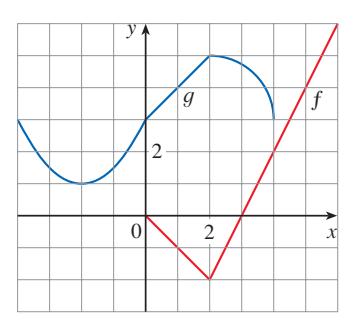
57 Composition from graphs · Level 3
Use the given graphs of \(f\) and \(g\) to evaluate each expression, or explain why it is undefined.
question image
(a) \(f(g(2))\)
(b) \(g(f(0))\)
(c) \((f \circ g)(0)\)
(d) \((g \circ f)(6)\)
(e) \((g \circ g)(-2)\)
(f) \((f \circ f)(4)\)

Enter your answer directly below each part above.

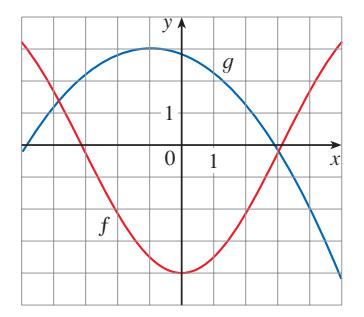
58 Composition graph estimation · Level 3
Use the given graphs of \(f\) and \(g\) to estimate the value of \(f(g(x))\) for \(x = -5, -4, -3, ..., 5\). Use these estimates to sketch a rough graph of \(f \circ g\).
question image
59 Composition modeling (area) · Level 2
A stone is dropped into a lake, creating a circular ripple that travels outward at a speed of 60 cm/s.
(a) Express the radius \(r\) of this circle as a function of the time \(t\) (in seconds).
(b) If \(A\) is the area of this circle as a function of the radius, find \(A \circ r\) and interpret it.

Enter your answer directly below each part above.

60 Composition modeling (volume) · Level 2
A spherical balloon is being inflated and the radius of the balloon is increasing at a rate of 2 cm/s.
(a) Express the radius \(r\) of the balloon as a function of the time \(t\) (in seconds).
(b) If \(V\) is the volume of the balloon as a function of the radius, find \(V \circ r\) and interpret it.

Enter your answer directly below each part above.

61 Composition modeling (distance) · Level 3
A ship is moving at a speed of 30 km/h parallel to a straight shoreline. The ship is 6 km from shore and it passes a lighthouse at noon.
(a) Express the distance \(s\) between the lighthouse and the ship as a function of \(d\), the distance the ship has traveled since noon; that is, find \(f\) so that \(s = f(d)\).
(b) Express \(d\) as a function of \(t\), the time elapsed since noon; that is, find \(g\) so that \(d = g(t)\).
(c) Find \(f \circ g\). What does this function represent?

Enter your answer directly below each part above.

62 Example - Transformations of $sqrt(x)$ · Level 2
Given the graph of \(y = \sqrt{x}\), use transformations to graph \(y = \sqrt{x} - 2\), \(y = \sqrt{x - 2}\), \(y = -\sqrt{x}\), \(y = 2 \sqrt{x}\), and \(y = \sqrt{-x}\).
question image
63 Example - Completing the square and shifting · Level 2
Sketch the graph of the function \(f(x) = x^2 + 6 x + 10\).
question image
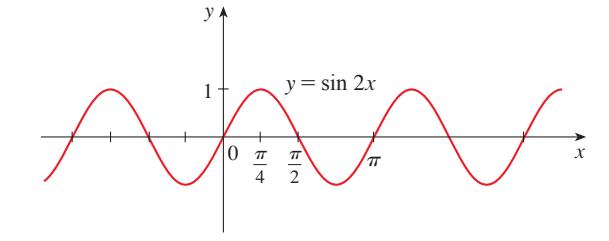
64 Example - Trigonometric transformations · Level 2
Sketch the graph of each function.
question image
(a) \(y = \sin(2 x)\)
(b) \(y = 1 - \sin(x)\)

Enter your answer directly below each part above.

65 Example - Modeling daylight with sine · Level 3
Figure 9 shows graphs of the number of hours of daylight as functions of the time of the year at several latitudes. Given that Philadelphia is located at approximately \(40^{\circ}\) N latitude, find a function that models the length of daylight at Philadelphia.
question image
66 Example - Absolute value of a function · Level 2
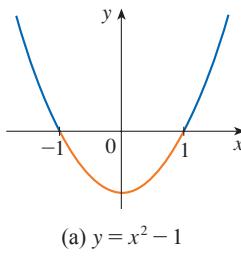
Sketch the graph of the function \(y = |x^2 - 1|\).
question image
67 Example - Composition of polynomials · Level 2
If \(f(x) = x^2\) and \(g(x) = x - 3\), find the composite functions \(f \circ g\) and \(g \circ f\).
68 Example - Composition with domains · Level 3
If \(f(x) = \sqrt{x}\) and \(g(x) = \sqrt{2 - x}\), find each function and its domain.
(a) \(f \circ g\)
(b) \(g \circ f\)
(c) \(f \circ f\)
(d) \(g \circ g\)

Enter your answer directly below each part above.

69 Example - Triple composition · Level 2
Find \(f \circ g \circ h\) if \(f(x) = x/(x + 1)\), \(g(x) = x^{10}\), and \(h(x) = x + 3\).
70 Example - Decomposition of functions · Level 2
Given \(F(x) = \cos^2(x + 9)\), find functions \(f\), \(g\), and \(h\) such that \(F = f \circ g \circ h\).

Answered: 0 / 70