TMUA Practice Paper 1

20 questions

0 / 20
TMUA Practice Paper 1 0/20
1 Polynomials · Level 3
It is given that the expansion of \((a x + b)^3\) is \(8x^3 - p x^2 + 18 x - 3 \sqrt{3}\), where \(a\), \(b\) and \(p\) are real constants. What is the value of \(p\)?
A
\(-12 \sqrt{3}\)
B
\(-6 \sqrt{3}\)
C
\(-4 \sqrt{3}\)
D
\(-\sqrt{3}\)
E
\(\sqrt{3}\)
F
\(4 \sqrt{3}\)
G
\(6 \sqrt{3}\)
H
\(12 \sqrt{3}\)
2 Polynomials · Level 3
The expression \(3x^3 + 13 x^2 + 8 x + a\), where \(a\) is a constant, has \((x + 2)\) as a factor. Which one of the following is a complete factorisation of the expression?
A
\((x+2)(x-1)(3x-2)\)
B
\((x+2)(x+1)(3x-2)\)
C
\((x+2)(x+1)(3x+2)\)
D
\((x+2)(x-3)(3x+2)\)
E
\((x+2)(x+3)(3x-2)\)
F
\((x+2)(x+3)(3x+2)\)
3 Differentiation · Level 3
A line is drawn normal to the curve \(y = \dfrac{2}{x^2}\) at the point on the curve where \(x = 1\). This line cuts the \(x\)-axis at \(P\) and the \(y\)-axis at \(Q\). The length of \(P Q\) is
A
\(\dfrac{3 \sqrt{5}}{2}\)
B
\(\dfrac{3 \sqrt{17}}{4}\)
C
\(\dfrac{7 \sqrt{17}}{4}\)
D
\(\dfrac{35}{4}\)
E
\(\dfrac{35 \sqrt{5}}{2}\)
F
\(\dfrac{3 \sqrt{17}}{2}\)
4 Sequences and Series · Level 3
The sequence \(a_n\) is defined by the rule: \(a_n = (-1)^n - (-1)^{n-1} + (-1)^{n+2}\) for \(n \geq 1\). Find the value of \(\displaystyle\sum_{n=1}^{39} a_n\)
A
\(-39\)
B
\(-3\)
C
\(-1\)
D
\(0\)
E
\(1\)
F
\(3\)
G
\(39\)
5 Integration · Level 3
What is the total area enclosed between the curve \(y = x^2 - 1\), the \(x\)-axis and the lines \(x = -2\) and \(x = 2\)?
A
\(\dfrac{4}{3}\)
B
\(\dfrac{8}{3}\)
C
\(4\)
D
\(\dfrac{16}{3}\)
E
\(12\)
F
\(16\)
6 Algebraic Manipulations · Level 3
\(P\), \(Q\), and \(R\) are each mixtures of red and white paint. The percentage by volume of red paint in \(P\) is 30%. The percentage by volume of red paint in \(Q\) is 20%. The mixtures \(P\), \(Q\), and \(R\) are combined in the proportion \(12 : 5 : 3\) respectively. If the resulting mixture contains 25% by volume of red paint, what percentage by volume of mixture \(R\) is red paint?
A
25%
B
23%
C
\(13 \dfrac{1}{3}%\)
D
\(19 \dfrac{1}{2}%\)
E
\(9 \dfrac{3}{4}%\)
F
It is impossible to achieve this result.
7 Counting and Probabilities · Level 3
60% of a sports club's members are women and the remainder are men. This sports club offers the opportunity to play tennis or cricket. Every member plays exactly one of the two sports. - \(\dfrac{2}{5}\) of the male members of the club play cricket; - \(\dfrac{2}{3}\) of the cricketing members of the club are women. What is the probability that a member of the club, chosen at random, is a woman who plays tennis?
A
\(\dfrac{1}{5}\)
B
\(\dfrac{7}{25}\)
C
\(\dfrac{1}{3}\)
D
\(\dfrac{11}{25}\)
E
\(\dfrac{3}{5}\)
8 Trigonometric Equations · Level 3
Find the maximum angle \(x\) in the range \(0^{\circ} \leq x \leq 360^{\circ}\) which satisfies the equation \(\cos^2(2x) + \sqrt{3} \sin(2x) - \dfrac{7}{4} = 0\)
A
\(30^{\circ}\)
B
\(60^{\circ}\)
C
\(120^{\circ}\)
D
\(150^{\circ}\)
E
\(210^{\circ}\)
F
\(240^{\circ}\)
G
\(300^{\circ}\)
H
\(330^{\circ}\)
9 Coordinate Geometry · Level 3
The line segment joining the points \((3, 3)\) and \((7, 5)\) is a diameter of a circle. This circle is translated by 3 units in the negative \(x\)-direction, then reflected in the \(x\)-axis, and then enlarged by a scale factor of 4 about the centre of the resulting circle. The equation of the final circle is
A
\((x-2)^2 + (y-4)^2 = 320\)
B
\((x-2)^2 + (y+4)^2 = 320\)
C
\((x-2)^2 + (y-4)^2 = 80\)
D
\((x-2)^2 + (y+4)^2 = 80\)
E
\((x-2)^2 + (y-4)^2 = 20\)
F
\((x-2)^2 + (y+4)^2 = 20\)
10 Curve Sketching · Level 3
How many solutions does the equation \(x \tan x = 1\) have in the interval \(-2 \pi \leq x \leq 2 \pi\)?
A
\(0\)
B
\(1\)
C
\(2\)
D
\(3\)
E
\(4\)
F
\(5\)
G
\(6\)
11 Exponentials and Logarithms · Level 3
The real roots of the equation \(4^{2x} + 12 = 2^{2x+3}\) are \(p\) and \(q\), where \(p > q\). The value of \(p - q\) can be expressed as
A
\(\dfrac{3}{4}\)
B
\(1\)
C
\(4\)
D
\(-\dfrac{1}{2} + \log_10 \dfrac{3}{2}\)
E
\(\dfrac{\log_10 3}{\log_10 4}\)
F
\(\dfrac{\log_10 3}{\log_10 2}\)
12 Differentiation · Level 3
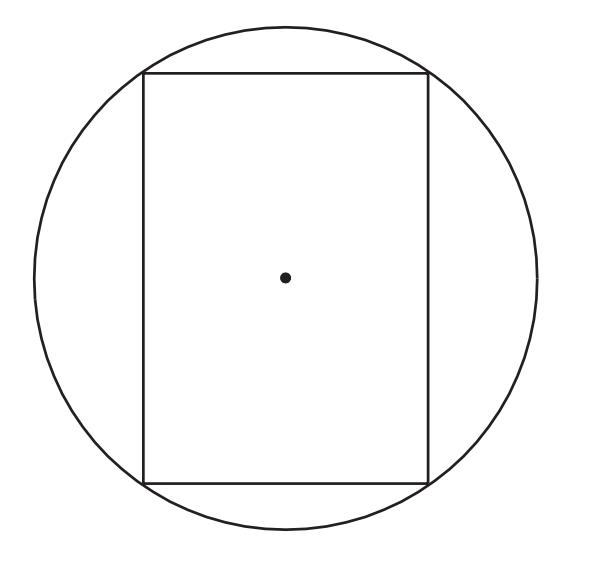
A right circular cylinder is contained within a sphere of radius 5 cm in such a way that the whole of the circumferences of both ends of the cylinder are in contact with the sphere. The diagram shows a planar cross section through the centre of the sphere and cylinder. [diagram not to scale] Find, in cubic centimetres, the maximum possible volume of the cylinder.
question image
A
\(250 \pi\)
B
\(500 \pi\)
C
\(1000 \pi\)
D
\(\dfrac{250 \sqrt{3}}{3} \pi\)
E
\(\dfrac{500 \sqrt{3}}{9} \pi\)
F
\(\dfrac{1000 \sqrt{3}}{9} \pi\)
13 Polynomials · Level 3
How many real roots does the equation \(3x^5 - 10 x^3 - 120 x + 30 = 0\) have?
A
\(1\)
B
\(2\)
C
\(3\)
D
\(4\)
E
\(5\)
14 Sequences and Series · Level 3
The terms of an infinite series \(S\) are formed by adding together the corresponding terms in two infinite geometric series, \(T\) and \(U\). The first term of \(T\) and the first term of \(U\) are each 4. In order, the first three terms of the combined series \(S\) are \(8\), \(3\), and \(\dfrac{5}{4}\). What is the sum to infinity of \(S\)?
A
\(\dfrac{32}{5}\)
B
\(\dfrac{20}{3}\)
C
\(\dfrac{64}{5}\)
D
\(\dfrac{40}{3}\)
E
\(16\)
F
\(32\)
15 Differentiation · Level 3
The least possible value of the gradient of the curve \(y = (2x + a)(x - 2a)^2\) at the point where \(x = 1\), as \(a\) varies, is
A
\(-\dfrac{49}{4}\)
B
\(-8\)
C
\(-\dfrac{25}{4}\)
D
\(\dfrac{7}{4}\)
E
\(\dfrac{47}{16}\)
16 Exponentials and Logarithms · Level 3
Given the simultaneous equations \(\log_10 2 + \log_10 (y - 1) = 2 \log_10 x\) \(\log_10 (y + 3 - 3x) = 0\) the values of \(y\) are
A
\(\dfrac{5}{2} \pm \dfrac{3 \sqrt{5}}{2}\)
B
\(3 \pm \sqrt{3}\)
C
\(7 \pm 3 \sqrt{3}\)
D
\(3, 9\)
E
\(1, 13\)
17 Trigonometric Equations · Level 3
It is given that \(y = (1 + 2 \cos x) \cos 2x\) for \(0 < x < \pi\) The complete set of values of \(x\) for which \(y\) is negative is
A
\(0 < x < \dfrac{\pi}{4}, \dfrac{2 \pi}{3} < x < \dfrac{3 \pi}{4}\)
B
\(0 < x < \dfrac{\pi}{4}, \dfrac{3 \pi}{4} < x < \pi\)
C
\(0 < x < \dfrac{2 \pi}{3}, \dfrac{3 \pi}{4} < x < \pi\)
D
\(\dfrac{\pi}{4} < x < \dfrac{2 \pi}{3}, \dfrac{3 \pi}{4} < x < \pi\)
E
\(\dfrac{\pi}{4} < x < \dfrac{2 \pi}{3}\)
F
\(\dfrac{\pi}{4} < x < \dfrac{3 \pi}{4}\)
18 Differentiation · Level 3
The function \(\dfrac{1 - x}{\sqrt[3]{x^2}}\) is defined for all \(x \neq 0\). The complete set of values of \(x\) for which the function is decreasing is
A
\(x \leq -2, x > 0\)
B
\(-2 \leq x < 0\)
C
\(x \leq 1, x \neq 0\)
D
\(x \geq 1\)
E
\(-2 \leq x \leq 1, x \neq 0\)
F
\(x \leq -2, x \geq 1\)
19 Polynomials · Level 3
The coefficient of \(x^3\) in the expansion of \((1 + 2x + 3x^2)^6\) is equal to twice the coefficient of \(x^4\) in the expansion of \((1 - a x^2)^5\). Find all possible values of the constant \(a\).
A
\(\pm 2 \sqrt{2}\)
B
\(\pm \sqrt{17}\)
C
\(\pm \sqrt{34}\)
D
\(\pm 2 \sqrt{17}\)
E
There are no possible values of \(a\).
20 Solid Figures · Level 3
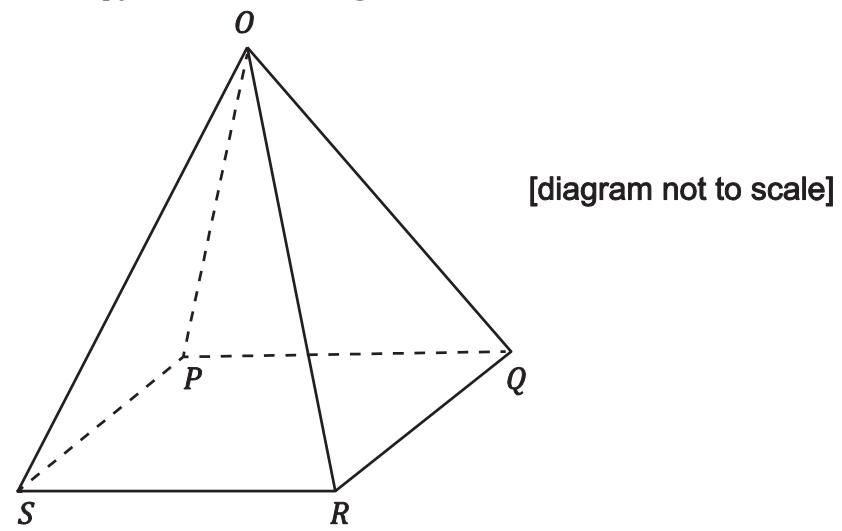
The diagram shows a square-based pyramid with base \(P Q R S\) and vertex \(O\). All the edges of the pyramid are of length 20 metres. Find the shortest distance, in metres, along the outer surface of the pyramid from \(P\) to the midpoint of \(O R\).
question image
A
\(10 \sqrt{5 - 2 \sqrt{3}}\)
B
\(10 \sqrt{3}\)
C
\(10 \sqrt{5}\)
D
\(10 \sqrt{7}\)
E
\(10 \sqrt{5 + 2 \sqrt{3}}\)

Answered: 0 / 20

0 / 20