TMUA 2019 Paper 2

20 questions

0 / 20
TMUA 2019 Paper 2 0/20
1 Algebraic Manipulations · Level 3
Find the coefficient of the \(x^4\) term in the expansion of \(x^2 \left(2x + \dfrac{1}{x}\right)^6\)
A
\(15\)
B
\(30\)
C
\(60\)
D
\(120\)
E
\(240\)
2 Polynomials · Level 3
\((2x + 1)\) and \((x - 2)\) are factors of \(2x^3 + p x^2 + q\). What is the value of \(2p + q\)?
A
\(-10\)
B
\(-\dfrac{38}{5}\)
C
\(-\dfrac{22}{3}\)
D
\(\dfrac{22}{3}\)
E
\(\dfrac{38}{5}\)
F
\(10\)
3 Basis of Logic · Level 3
\(a\), \(b\) and \(c\) are real numbers. Given that \(a b = a c\), which of the following statements *must* be true?
I. \(a = 0\)
II. \(b = 0\) or \(c = 0\)
III. \(b = c\)
A
none of them
B
I only
C
II only
D
III only
E
I and II only
F
I and III only
G
II and III only
H
I, II and III
4 Mathematical Proofs · Level 3
Consider the following conjecture: *If* \(N\) is a positive integer that consists of the digit 1 followed by an odd number of 0 digits and then a final digit 1, *then* \(N\) is a prime number. Here are three numbers:
I. \(N = 101\) (which is a prime number)
II. \(N = 1001\) (which equals \(7 \times 11 \times 13\))
III. \(N = 10001\) (which equals \(73 \times 137\)) Which of these provide(s) a counterexample to the conjecture?
A
none of them
B
I only
C
II only
D
III only
E
I and II only
F
I and III only
G
II and III only
H
I, II and III
5 Basis of Logic · Level 3
Consider the following statement about the positive integers \(a\), \(b\) and \(n\): \((*)\): \(a b\) is divisible by \(n\) The condition 'either \(a\) or \(b\) is divisible by \(n\)' is:
A
*necessary* but *not sufficient* for \((*)\)
B
*sufficient* but *not necessary* for \((*)\)
C
*necessary* and *sufficient* for \((*)\)
D
*not necessary* and *not sufficient* for \((*)\)
6 Logic of Arguments · Level 3
A student attempts to solve the equation \(\cos x + \sin x \tan x = 2 \sin x - 1\) in the range \(0 \leq x \leq 2 \pi\). The student's attempt is as follows: \(\cos x + \sin x \tan x = 2 \sin x - 1\) So \(\cos x - \sin x + \sin x \tan x - \sin x = -1\) (I) So \((\sin x - \cos x)(\tan x - 1) = -1\) (II) So \(\sin x - \cos x = -1\) or \(\tan x - 1 = -1\) (III) So \((\sin x - \cos x)^2 = 1\) or \(\tan x = 0\) (IV) So \(2 \sin x \cos x = 0\) or \(\tan x = 0\) (V) So \(x = 0, \dfrac{\pi}{2}, \pi, \dfrac{3 \pi}{2}, 2 \pi\) (VI) Which of the following best describes this attempt?
A
It is completely correct
B
It is incorrect, and the first error occurs on line (I)
C
It is incorrect, and the first error occurs on line (II)
D
It is incorrect, and the first error occurs on line (III)
E
It is incorrect, and the first error is that extra solutions were introduced on line (IV)
F
It is incorrect, and the first error is that extra solutions were introduced on line (V)
G
It is incorrect, and the first error is not eliminating the values where \(\tan x\) is undefined on line (VI)
7 Mathematical Proofs · Level 3
For which one of the following statements can the fact that \(12^2 + 16^2 = 20^2\) be used to produce a *counterexample*?
A
If \(a\), \(b\) and \(c\) are positive integers which satisfy the equation \(a^2 + b^2 = c^2\), and the three numbers have no common divisor, then two of them are odd and the other is even.
B
The equation \(a^4 + b^2 = c^2\) has no solutions for which \(a\), \(b\) and \(c\) are positive integers.
C
The equation \(a^4 + b^4 = c^4\) has no solutions for which \(a\), \(b\) and \(c\) are positive integers.
D
If \(a\), \(b\) and \(c\) are positive integers which satisfy the equation \(a^2 + b^2 = c^2\), then one is the arithmetic mean of the other two.
8 Inequalities · Level 3
\(a\), \(b\) and \(c\) are real numbers with \(a < b < c < 0\) Which of the following statements *must* be true?
I. \(a c < a b < a^2\)
II. \(b(c + a) > 0\)
III. \(\dfrac{c}{b} > \dfrac{a}{b}\)
A
none of them
B
I only
C
II only
D
III only
E
I and II only
F
I and III only
G
II and III only
H
I, II and III
9 Counting and Probabilities · Level 3
A large circular table has 40 chairs round it. What is the smallest number of people who can be sitting at the table already such that the next person to sit down *must* sit next to someone?
A
\(9\)
B
\(10\)
C
\(13\)
D
\(14\)
E
\(19\)
F
\(20\)
10 Plane Geometry · Level 3
\(P Q R S\) is a quadrilateral, labelled anticlockwise. Which one of the following is a *necessary* but *not sufficient* condition for \(P Q R S\) to be a parallelogram?
A
\(P Q = S R\) and \(P S\) is parallel to \(Q R\)
B
\(P Q = S R\) and \(P Q\) is parallel to \(S R\)
C
\(P Q = Q R = S R = P S\)
D
\(P R = Q S\)
11 Sequences and Series · Level 3
An arithmetic series has \(n\) terms, all of which are integers. The sum of the series is 20. Which of the following statements *must* be true?
I. The first term of the series is even.
II. \(n\) is even.
III. The common difference is even.
A
none of them
B
I only
C
II only
D
III only
E
I and II only
F
I and III only
G
II and III only
H
I, II and III
12 Counting and Probabilities · Level 3
Most students in a large college study Mathematics. A teacher chooses three different students at random, one after the other. Consider these three probabilities: \(R = P(\text{At least one of the students chosen studies Mathematics})\), \(S = P(\text{The second student chosen studies Mathematics})\), \(T = P(\text{All three of the students chosen study Mathematics})\) Which of the following is true?
A
\(R < S < T\)
B
\(R < T < S\)
C
\(S < R < T\)
D
\(S < T < R\)
E
\(T < R < S\)
F
\(T < S < R\)
13 Integration · Level 3
A student approximates the integral \(\displaystyle\int_{a}^{b} \sin^2 x d x\) using the trapezium rule with 4 strips. The resulting approximation is an overestimate. Which of the following is/are necessarily true?
I. If the student approximates \(\displaystyle\int_{-b}^{-a} \sin^2 x d x\) in the same way, the result will be an overestimate.
II. If the student approximates \(\displaystyle\int_{a}^{b} \cos^2 x d x\) in the same way, the result will be an underestimate.
A
neither of them
B
I only
C
II only
D
I and II
14 Differentiation · Level 3
Consider the following statements about the polynomial \(p(x)\), where \(a < b\):
I. \(p(a) \leq p(b)\)
II. \(p'(a) \leq p'(b)\)
III. \(p''(a) \leq p''(b)\) Which of these statements is a *necessary* condition for \(p(x)\) to be increasing for \(a \leq x \leq b\)?
A
none of them
B
I only
C
II only
D
III only
E
I and II only
F
I and III only
G
II and III only
H
I, II and III
15 Exponentials and Logarithms · Level 3
The numbers \(a\), \(b\) and \(c\) are each greater than 1. The following logarithms are all to the same base: \(\log(a b^2 c) = 7\), \(\log(a^2 b c^2) = 11\), \(\log(a^2 b^2 c^3) = 15\) What is this base?
A
\(a\)
B
\(b\)
C
\(c\)
D
It is possible to determine the base, but the base is not \(a\), \(b\) or \(c\).
E
There is insufficient information given to determine the base.
16 Equations · Level 3
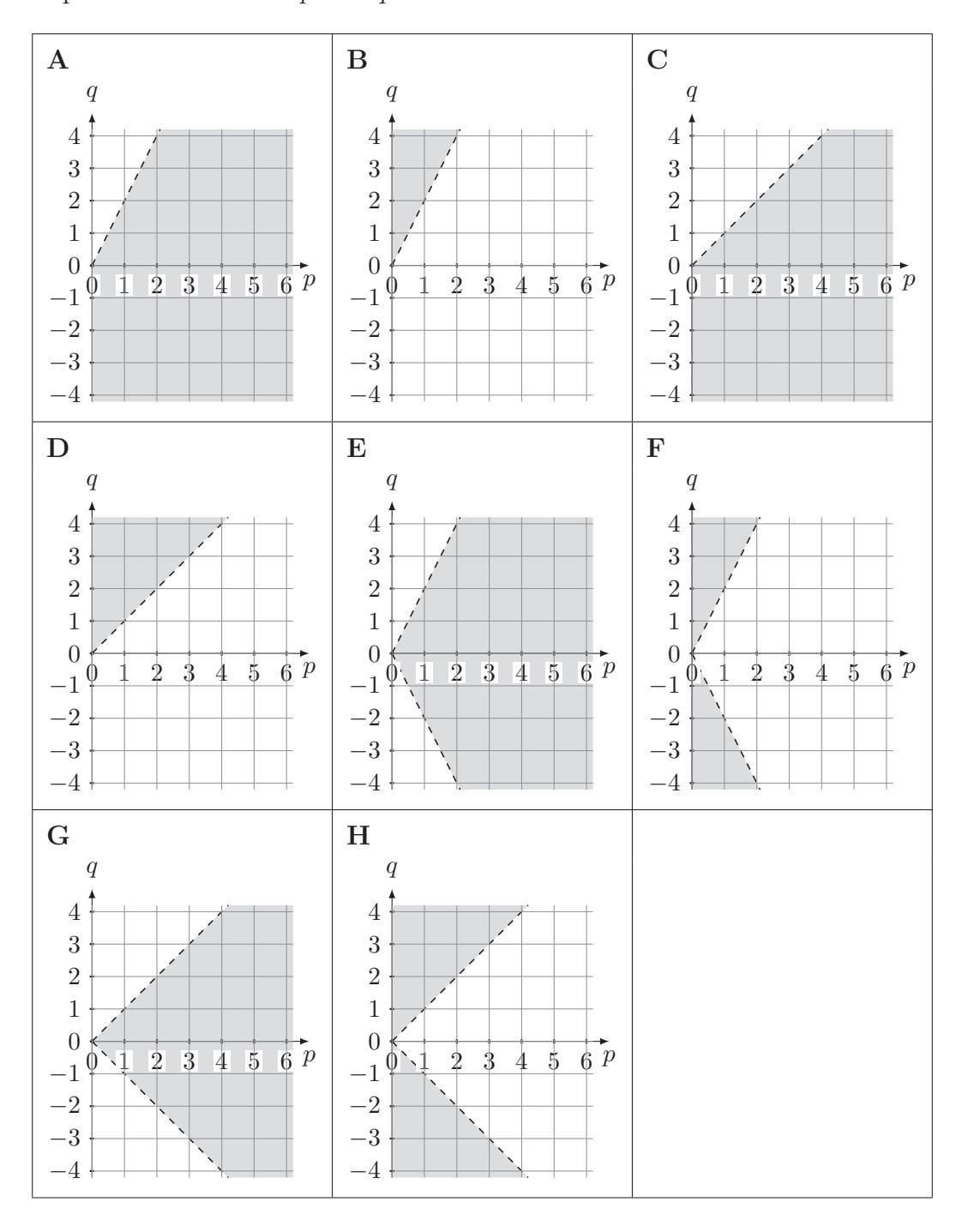
The graph of the quadratic \(y = p x^2 + q x + p\) where \(p > 0\), intersects the \(x\)-axis at two distinct points. In which one of the following graphs does the *shaded* region show the complete set of possible values that \(p\) and \(q\) could take?
question image
A
Graph A
B
Graph B
C
Graph C
D
Graph D
E
Graph E
F
Graph F
G
Graph G
H
Graph H
17 Basis of Logic · Level 3
A multiple-choice test question offered the following four options relating to a certain statement: A. The statement is true *if and only if* \(x > 1\) B. The statement is true *if* \(x > 1\) C. The statement is true *if and only if* \(x > 2\) D. The statement is true *if* \(x > 2\) Given that *exactly one* of these options was correct, which one was it?
A
The statement is true *if and only if* \(x > 1\)
B
The statement is true *if* \(x > 1\)
C
The statement is true *if and only if* \(x > 2\)
D
The statement is true *if* \(x > 2\)
18 Inequalities · Level 3
Consider the following inequality: \((*): \quad a |x| + 1 \leq |x - 2|\) where \(a\) is a real constant. Which one of the following describes the complete set of values of \(a\) such that \((*)\) is *true for all real* \(x\)?
A
\(a \leq \dfrac{3}{2}\)
B
\(a \leq 1\)
C
\(a \leq \dfrac{1}{2}\)
D
\(a \leq 0\)
E
\(a \leq -\dfrac{1}{2}\)
F
\(a \leq -1\)
G
\(a \leq -\dfrac{3}{2}\)
H
There are no such values of \(a\).
19 Algebraic Manipulations · Level 3
Find the value of the expression \(\sqrt{8 - 4 \sqrt{2} + 1} + \sqrt{9 - 12 \sqrt{2} + 8}\)
A
\(26 - 16 \sqrt{2}\)
B
\(4 \sqrt{2} - 4\)
C
\(-2\)
D
\(4 - 4 \sqrt{2}\)
E
\(2\)
F
\(\sqrt{26 - 4 \sqrt{2}}\)
G
\(1\)
20 Functions and Their Graphs · Level 3
When the graph of the function \(y = f(x)\), defined on the real numbers, is reflected in the \(y\)-axis and then translated by 2 units in the negative \(x\)-direction, the result is the graph of the function \(y = g(x)\). When the graph of the same function \(y = f(x)\) is translated by 2 units in the negative \(x\)-direction and then reflected in the \(y\)-axis, the result is the graph of the function \(y = h(x)\). Which one of the following conditions on \(y = f(x)\) is *necessary and sufficient* for the functions \(g(x)\) and \(h(x)\) to be identical?
A
\(f(x) = f(x + 2)\) for all \(x\)
B
\(f(x) = f(x + 4)\) for all \(x\)
C
\(f(x) = f(x + 8)\) for all \(x\)
D
\(f(x) = f(-x)\) for all \(x\)
E
\(f(x) = f(2 - x)\) for all \(x\)
F
\(f(x) = f(4 - x)\) for all \(x\)
G
\(f(x) = f(8 - x)\) for all \(x\)

Answered: 0 / 20

0 / 20