TMUA 2020 Paper 1

20 questions

0 / 20
TMUA 2020 Paper 1 0/20
1 Differentiation · Level 3
Which of the following is an expression for the first derivative with respect to \(x\) of \(\dfrac{x^3 - 5x^2}{2x \sqrt{x}}\) ?
A
\(-\dfrac{\sqrt{x}}{2}\)
B
\(\dfrac{\sqrt{x}}{4}\)
C
\(\dfrac{3x - 5}{4 \sqrt{x}}\)
D
\(\dfrac{3 \sqrt{x} - 5}{4 \sqrt{x}}\)
E
\(\dfrac{3 \sqrt{x} - 10}{3 \sqrt{x}}\)
F
\(\dfrac{3x^2 - 10x}{3 \sqrt{x}}\)
2 Polynomials · Level 3
\((2x + 1)\) and \((x - 2)\) are factors of \(2x^3 + p x^2 + q\). What is the value of \(2p + q\) ?
A
\(-10\)
B
\(-\dfrac{38}{5}\)
C
\(-\dfrac{22}{3}\)
D
\(\dfrac{22}{3}\)
E
\(\dfrac{38}{5}\)
F
\(10\)
3 Inequalities · Level 3
Find the complete set of values of \(x\) for which \((x + 4)(x + 3)(1 - x) > 0\) and \((x + 2)(x - 2) < 0\)
A
\(1 < x < 2\)
B
\(-2 < x < 1\)
C
\(-2 < x < 2\)
D
\(x < -2\) or \(x > 1\)
E
\(x < -4\) or \(x > 2\)
F
\(x < -4\) or \(-3 < x < 1\)
G
\(-4 < x < -2\) or \(x > 1\)
4 Sequences and Series · Level 3
The 1st, 2nd and 3rd terms of a geometric progression are also the 1st, 4th and 6th terms, respectively, of an arithmetic progression. The sum to infinity of the geometric progression is \(12\). Find the 1st term of the geometric progression.
A
\(1\)
B
\(2\)
C
\(3\)
D
\(4\)
E
\(5\)
F
\(6\)
5 Equations · Level 3
The curve \(S\) has equation \(y = p x^2 + 6x - q\) where \(p\) and \(q\) are constants. \(S\) has a line of symmetry at \(x = -\dfrac{1}{4}\) and touches the \(x\)-axis at exactly one point. What is the value of \(p + 8q\) ?
A
\(6\)
B
\(18\)
C
\(21\)
D
\(25\)
E
\(38\)
6 Exponentials and Logarithms · Level 3
Find the maximum value of the function \(f(x) = \dfrac{1}{5^{2x} - 4(5^x) + 7}\)
A
\(\dfrac{1}{7}\)
B
\(\dfrac{1}{4}\)
C
\(\dfrac{1}{3}\)
D
\(3\)
E
\(4\)
F
\(7\)
7 Exponentials and Logarithms · Level 3
Given that \(2^{3x} = 8^{y + 3}\) and \(4^{x + 1} = \dfrac{16^{y + 1}}{8^{y + 3}}\), what is the value of \(x + y\) ?
A
\(-23\)
B
\(-22\)
C
\(-15\)
D
\(-14\)
E
\(-11\)
F
\(-10\)
8 Inequalities · Level 3
The function \(f\) is defined for all real \(x\) as \(f(x) = (p - x)(x + 2)\). Find the complete set of values of \(p\) for which the maximum value of \(f(x)\) is less than \(4\).
A
\(-2 - 4 \sqrt{2}\)
B
\(-2 - 2 \sqrt{2}\)
C
\(-2 \sqrt{5}\)
D
\(-6\)
E
\(-4\)
F
\(-2\)
9 Polynomials · Level 3
The quadratic expression \(x^2 - 14x + 9\) factorises as \((x - \alpha)(x - \beta)\), where \(\alpha\) and \(\beta\) are positive real numbers. Which quadratic expression can be factorised as \((x - \sqrt{\alpha})(x - \sqrt{\beta})\) ?
A
\(x^2 - \sqrt{10} x + 3\)
B
\(x^2 - \sqrt{14} x + 3\)
C
\(x^2 - \sqrt{20} x + 3\)
D
\(x^2 - 178 x + 81\)
E
\(x^2 - 176 x + 81\)
F
\(x^2 + 196 x + 81\)
10 Functions and Their Graphs · Level 3
The following sequence of transformations is applied to the curve \(y = 4x^2\) 1. Translation by \(\vec{-3, -5}\) 2. Reflection in the \(x\)-axis 3. Stretch parallel to the \(x\)-axis with scale factor \(2\) What is the equation of the resulting curve?
A
\(y = -x^2 + 12x - 31\)
B
\(y = -x^2 + 12x - 41\)
C
\(y = x^2 + 12x + 31\)
D
\(y = x^2 + 12x + 41\)
E
\(y = -16x^2 + 48x - 31\)
F
\(y = -16x^2 + 48x - 41\)
G
\(y = 16x^2 - 48x + 31\)
H
\(y = 16x^2 - 48x + 41\)
11 Integration · Level 3
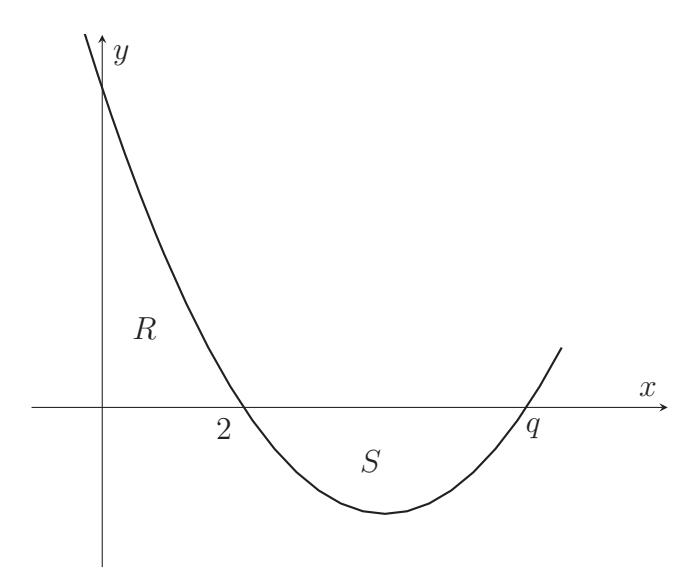
The quadratic function shown passes through \((2, 0)\) and \((q, 0)\), where \(q > 2\). What is the value of \(q\) such that the area of region \(R\) equals the area of region \(S\) ?
question image
A
\(\sqrt{6}\)
B
\(3\)
C
\(\sqrt[3]{18}\)
D
\(4\)
E
\(6\)
F
\(\sqrt[3]{33}\)
12 Curve Sketching · Level 3
How many real solutions are there to the equation \(3 \cos x = \sqrt{x}\) where \(x\) is in radians?
A
\(0\)
B
\(1\)
C
\(2\)
D
\(3\)
E
\(4\)
F
\(5\)
G
infinitely many
13 Algebraic Manipulations · Level 3
Find the coefficient of \(x^2 y^4\) in the expansion of \((1 + x + y^2)^7\)
A
\(6\)
B
\(10\)
C
\(21\)
D
\(35\)
E
\(105\)
F
\(210\)
14 Integration · Level 3
The area enclosed between the line \(y = m x\) and the curve \(y = x^3\) is \(6\). What is the value of \(m\) ?
A
\(2\)
B
\(4\)
C
\(\sqrt{3}\)
D
\(\sqrt{6}\)
E
\(2 \sqrt{3}\)
F
\(2 \sqrt{6}\)
15 Exponentials and Logarithms · Level 3
Find the positive difference between the two real values of \(x\) for which \((\log_2 x)^4 + 12 (\log_2 \left(\dfrac{1}{x}\right))^2 - 2^6 = 0\)
A
\(4\)
B
\(16\)
C
\(\dfrac{15}{4}\)
D
\(\dfrac{17}{4}\)
E
\(\dfrac{255}{16}\)
F
\(\dfrac{257}{16}\)
16 Coordinate Geometry · Level 3
The circle \(C_1\) has equation \((x + 2)^2 + (y - 1)^2 = 3\). The circle \(C_2\) has equation \((x - 4)^2 + (y - 1)^2 = 3\). The straight line \(l\) is a tangent to both \(C_1\) and \(C_2\) and has positive gradient. The acute angle between \(l\) and the \(x\)-axis is \(\theta\). Find the value of \(\tan \theta\)
A
\(\dfrac{1}{2}\)
B
\(2\)
C
\(\dfrac{\sqrt{2}}{2}\)
D
\(\sqrt{2}\)
E
\(\dfrac{\sqrt{6}}{2}\)
F
\(\sqrt{6}\)
G
\(\dfrac{\sqrt{3}}{3}\)
H
\(\sqrt{3}\)
17 Equations · Level 3
Find the complete set of values of \(m\) in terms of \(c\) such that the graphs of \(y = m x + c\) and \(y = \sqrt{x}\) have two points of intersection.
A
\(0 < m < \dfrac{1}{4c}\)
B
\(0 < m < 4c^2\)
C
\(m > \dfrac{1}{4c}\)
D
\(m < \dfrac{1}{4c}\)
E
\(m > 4c^2\)
F
\(m < 4c^2\)
18 Trigonometric Equations · Level 3
Find the number of solutions and the sum of the solutions of the equation \(1 - 2 \cos^2 x = |\cos x|\) where \(0 \leq x \leq 180^{\circ}\)
A
Number of solutions = 2, Sum of solutions = \(180^{\circ}\)
B
Number of solutions = 2, Sum of solutions = \(240^{\circ}\)
C
Number of solutions = 3, Sum of solutions = \(180^{\circ}\)
D
Number of solutions = 3, Sum of solutions = \(360^{\circ}\)
E
Number of solutions = 4, Sum of solutions = \(240^{\circ}\)
F
Number of solutions = 4, Sum of solutions = \(360^{\circ}\)
19 Inequalities · Level 3
Find the lowest positive integer for which \(x^2 - 52x - 52\) is positive.
A
\(26\)
B
\(27\)
C
\(51\)
D
\(52\)
E
\(53\)
F
\(54\)
20 Equations · Level 3
For how many values of \(a\) is the equation \((x - a)(x^2 - x + a) = 0\) satisfied by exactly two distinct values of \(x\)?
A
\(0\)
B
\(1\)
C
\(2\)
D
\(3\)
E
\(4\)
F
more than 4

Answered: 0 / 20

0 / 20