Stewart 9th Section 3.3: What Derivatives Tell Us about the Shape of a Graph

88 questions

0 / 88
Stewart 9th Section 3.3: What Derivatives Tell Us about the Shape of a Graph 0/88
1 Analytical Applications of Differentiation · Level 2
Use the given graph of \(f\) to find the following.
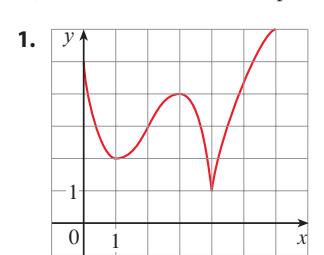
question image
(a) The open intervals on which \(f\) is increasing.
(b) The open intervals on which \(f\) is decreasing.
(c) The open intervals on which \(f\) is concave upward.
(d) The open intervals on which \(f\) is concave downward.
(e) The coordinates of the points of inflection.

Enter your answer directly below each part above.

2 Analytical Applications of Differentiation · Level 2
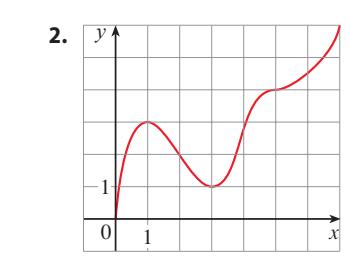
Use the given graph of \(f\) to find the following.
question image
(a) The open intervals on which \(f\) is increasing.
(b) The open intervals on which \(f\) is decreasing.
(c) The open intervals on which \(f\) is concave upward.
(d) The open intervals on which \(f\) is concave downward.
(e) The coordinates of the points of inflection.

Enter your answer directly below each part above.

3 Limits and Continuity · Level 1
Suppose you are given a formula for a function \(f\).
(a) How do you determine where \(f\) is increasing or decreasing?
(b) How do you determine where the graph of \(f\) is concave upward or concave downward?
(c) How do you locate inflection points?

Enter your answer directly below each part above.

4 Analytical Applications of Differentiation · Level 1
(a) State the First Derivative Test.
(b) State the Second Derivative Test. Under what circumstances is it inconclusive? What do you do if it fails?

Enter your answer directly below each part above.

5 Analytical Applications of Differentiation · Level 2
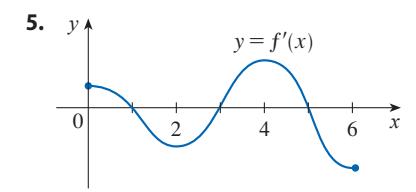
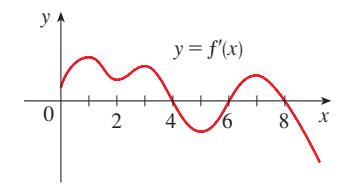
The graph of the derivative \(f'\) of a function \(f\) is shown.
question image
(a) On what intervals is \(f\) increasing? Decreasing?
(b) At what values of \(x\) does \(f\) have a local maximum? Local minimum?

Enter your answer directly below each part above.

6 Analytical Applications of Differentiation · Level 2
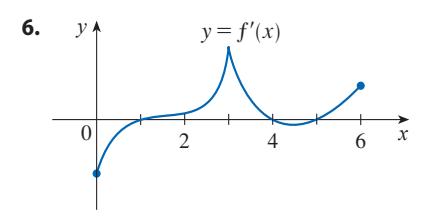
The graph of the derivative \(f'\) of a function \(f\) is shown.
question image
(a) On what intervals is \(f\) increasing? Decreasing?
(b) At what values of \(x\) does \(f\) have a local maximum? Local minimum?

Enter your answer directly below each part above.

7 Analytical Applications of Differentiation · Level 2
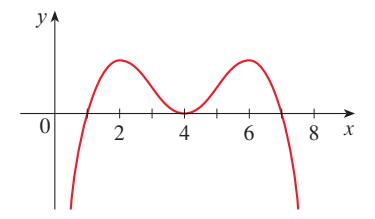
In each part use the given graph to state the \(x\)-coordinates of the inflection points of \(f\). Give reasons for your answers.
question image
(a) The curve is the graph of \(f\).
(b) The curve is the graph of \(f'\).
(c) The curve is the graph of \(f''\).

Enter your answer directly below each part above.

8 Analytical Applications of Differentiation · Level 2
The graph of the first derivative \(f'\) of a function \(f\) is shown.
question image
(a) On what intervals is \(f\) increasing? Explain.
(b) At what values of \(x\) does \(f\) have a local maximum or minimum? Explain.
(c) On what intervals is \(f\) concave upward or concave downward? Explain.
(d) What are the \(x\)-coordinates of the inflection points of \(f\)? Why?

Enter your answer directly below each part above.

9 Analytical Applications of Differentiation · Level 2
Find the intervals on which \(f\) is increasing or decreasing, and find the local maximum and minimum values of \(f\). \(f(x) = 2x^3 - 15 x^2 + 24 x - 5\)
10 Analytical Applications of Differentiation · Level 2
Find the intervals on which \(f\) is increasing or decreasing, and find the local maximum and minimum values of \(f\). \(f(x) = x^3 - 6 x^2 - 135 x\)
11 Analytical Applications of Differentiation · Level 2
Find the intervals on which \(f\) is increasing or decreasing, and find the local maximum and minimum values of \(f\). \(f(x) = 6 x^4 - 16 x^3 + 1\)
12 Analytical Applications of Differentiation · Level 3
Find the intervals on which \(f\) is increasing or decreasing, and find the local maximum and minimum values of \(f\). \(f(x) = x^{\dfrac{2}{3}} (x - 3)\)
13 Analytical Applications of Differentiation · Level 3
Find the intervals on which \(f\) is increasing or decreasing, and find the local maximum and minimum values of \(f\). \(f(x) = \dfrac{x^2 - 24}{x - 5}\)
14 Analytical Applications of Differentiation · Level 2
Find the intervals on which \(f\) is increasing or decreasing, and find the local maximum and minimum values of \(f\). \(f(x) = x + \dfrac{4}{x^2}\)
15 Analytical Applications of Differentiation · Level 2
Find the intervals on which \(f\) is concave upward or concave downward, and find the inflection points of \(f\). \(f(x) = x^3 - 3 x^2 - 9 x + 4\)
16 Analytical Applications of Differentiation · Level 2
Find the intervals on which \(f\) is concave upward or concave downward, and find the inflection points of \(f\). \(f(x) = 2 x^3 - 9 x^2 + 12 x - 3\)
17 Analytical Applications of Differentiation · Level 3
Find the intervals on which \(f\) is concave upward or concave downward, and find the inflection points of \(f\). \(f(x) = \sin^2 x - \cos 2 x\), \(0 \leq x \leq \pi\)
18 Analytical Applications of Differentiation · Level 3
Find the intervals on which \(f\) is concave upward or concave downward, and find the inflection points of \(f\). \(f(x) = x \sqrt[3]{x - 4}\)
19 Analytical Applications of Differentiation · Level 2
(a) Find the intervals on which \(f\) is increasing or decreasing.
(b) Find the local maximum and minimum values of \(f\).
(c) Find the intervals of concavity and the inflection points. \(f(x) = x^4 - 2 x^2 + 3\)

Enter your answer directly below each part above.

20 Analytical Applications of Differentiation · Level 3
(a) Find the intervals on which \(f\) is increasing or decreasing.
(b) Find the local maximum and minimum values of \(f\).
(c) Find the intervals of concavity and the inflection points. \(f(x) = \dfrac{x}{x^2 + 1}\)

Enter your answer directly below each part above.

21 Analytical Applications of Differentiation · Level 3
(a) Find the intervals on which \(f\) is increasing or decreasing.
(b) Find the local maximum and minimum values of \(f\).
(c) Find the intervals of concavity and the inflection points. \(f(x) = \sin x + \cos x\), \(0 \leq x \leq 2 \pi\)

Enter your answer directly below each part above.

22 Analytical Applications of Differentiation · Level 3
(a) Find the intervals on which \(f\) is increasing or decreasing.
(b) Find the local maximum and minimum values of \(f\).
(c) Find the intervals of concavity and the inflection points. \(f(x) = \cos^2 x - 2 \sin x\), \(0 \leq x \leq 2 \pi\)

Enter your answer directly below each part above.

23 Analytical Applications of Differentiation · Level 2
Find the local maximum and minimum values of \(f\) using both the First and Second Derivative Tests. Which method do you prefer? \(f(x) = 1 + 3 x^2 - 2 x^3\)
24 Analytical Applications of Differentiation · Level 3
Find the local maximum and minimum values of \(f\) using both the First and Second Derivative Tests. Which method do you prefer? \(f(x) = \dfrac{x^2}{x - 1}\)
25 Analytical Applications of Differentiation · Level 2
Suppose the derivative of a function \(f\) is \(f'(x) = (x - 4)^2 (x + 3)^7 (x - 5)^8\). On what interval(s) is \(f\) increasing?
26 Analytical Applications of Differentiation · Level 3
(a) Find the critical numbers of \(f(x) = x^4 (x - 1)^3\).
(b) What does the Second Derivative Test tell you about the behavior of \(f\) at these critical numbers?
(c) What does the First Derivative Test tell you?

Enter your answer directly below each part above.

27 Analytical Applications of Differentiation · Level 2
Suppose \(f''\) is continuous on \((-\infty, \infty)\).
(a) If \(f'(2) = 0\) and \(f''(2) = -5\), what can you say about \(f\)?
(b) If \(f'(6) = 0\) and \(f''(6) = 0\), what can you say about \(f\)?

Enter your answer directly below each part above.

28 Analytical Applications of Differentiation · Level 2
Sketch the graph of a function that satisfies all of the given conditions.
(a) \(f'(x) < 0\) and \(f''(x) < 0\) for all \(x\).
(b) \(f'(x) > 0\) and \(f''(x) > 0\) for all \(x\).

Enter your answer directly below each part above.

29 Analytical Applications of Differentiation · Level 2
Sketch the graph of a function that satisfies all of the given conditions.
(a) \(f'(x) > 0\) and \(f''(x) < 0\) for all \(x\).
(b) \(f'(x) < 0\) and \(f''(x) > 0\) for all \(x\).

Enter your answer directly below each part above.

30 Analytical Applications of Differentiation · Level 3
Sketch the graph of a function that satisfies all of the given conditions. Vertical asymptote \(x = 0\), \(f'(x) > 0\) if \(x < -2\), \(f'(x) < 0\) if \(x > -2\) \((x \neq 0)\), \(f''(x) < 0\) if \(x < 0\), \(f''(x) > 0\) if \(x > 0\).
31 Analytical Applications of Differentiation · Level 3
Sketch the graph of a function that satisfies all of the given conditions. \(f'(0) = f'(2) = f'(4) = 0\), \(f'(x) > 0\) if \(x < 0\) or \(2 < x < 4\), \(f'(x) < 0\) if \(0 < x < 2\) or \(x > 4\), \(f''(x) > 0\) if \(1 < x < 3\), \(f''(x) < 0\) if \(x < 1\) or \(x > 3\).
32 Analytical Applications of Differentiation · Level 3
Sketch the graph of a function that satisfies all of the given conditions. \(f'(x) > 0\) for all \(x \neq 1\), vertical asymptote \(x = 1\), \(f''(x) > 0\) if \(x < 1\) or \(x > 3\), \(f''(x) < 0\) if \(1 < x < 3\).
33 Analytical Applications of Differentiation · Level 3
Sketch the graph of a function that satisfies all of the given conditions. \(f'(5) = 0\), \(f'(x) < 0\) when \(x < 5\), \(f'(x) > 0\) when \(x > 5\), \(f''(2) = 0\), \(f''(8) = 0\), \(f''(x) < 0\) when \(x < 2\) or \(x > 8\), \(f''(x) > 0\) for \(2 < x < 8\).
34 Analytical Applications of Differentiation · Level 4
Sketch the graph of a function that satisfies all of the given conditions. \(f'(0) = f'(4) = 0\), \(f'(x) = 1\) if \(x < -1\), \(f'(x) > 0\) if \(0 < x < 2\), \(f'(x) < 0\) if \(-1 < x < 0\) or \(2 < x < 4\) or \(x > 4\), \(\operatorname*{lim}\limits_{x \rightarrow 2^-} f'(x) = \infty\), \(\operatorname*{lim}\limits_{x \rightarrow 2^+} f'(x) = -\infty\), \(f''(x) > 0\) if \(-1 < x < 2\) or \(2 < x < 4\), \(f''(x) < 0\) if \(x > 4\).
35 Analytical Applications of Differentiation · Level 4
Sketch the graph of a function that satisfies all of the given conditions. \(f(0) = f'(0) = f'(2) = f'(4) = f'(6) = 0\), \(f'(x) > 0\) if \(0 < x < 2\) or \(4 < x < 6\), \(f'(x) < 0\) if \(2 < x < 4\) or \(x > 6\), \(f''(x) > 0\) if \(0 < x < 1\) or \(3 < x < 5\), \(f''(x) < 0\) if \(1 < x < 3\) or \(x > 5\), \(f(-x) = f(x)\).
36 Differentiation: Definition and Fundamental Properties · Level 2
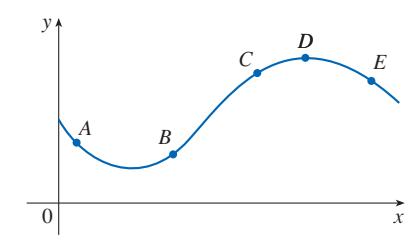
The graph of a function \(y = f(x)\) is shown. At which point(s) are the following true?
question image
(a) \(\dfrac{d y}{d x}\) and \(\dfrac{d^2 y}{d x^2}\) are both positive.
(b) \(\dfrac{d y}{d x}\) and \(\dfrac{d^2 y}{d x^2}\) are both negative.
(c) \(\dfrac{d y}{d x}\) is negative but \(\dfrac{d^2 y}{d x^2}\) is positive.

Enter your answer directly below each part above.

37 Analytical Applications of Differentiation · Level 3
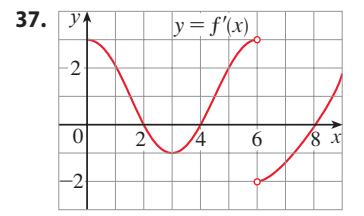
The graph of the derivative \(f'\) of a continuous function \(f\) is shown.
question image
(a) On what intervals is \(f\) increasing? Decreasing?
(b) At what values of \(x\) does \(f\) have a local maximum? Local minimum?
(c) On what intervals is \(f\) concave upward? Concave downward?
(d) State the \(x\)-coordinate(s) of the point(s) of inflection.
(e) Assuming that \(f(0) = 0\), sketch a graph of \(f\).

Enter your answer directly below each part above.

38 Analytical Applications of Differentiation · Level 3
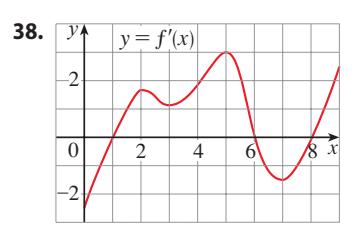
The graph of the derivative \(f'\) of a continuous function \(f\) is shown.
question image
(a) On what intervals is \(f\) increasing? Decreasing?
(b) At what values of \(x\) does \(f\) have a local maximum? Local minimum?
(c) On what intervals is \(f\) concave upward? Concave downward?
(d) State the \(x\)-coordinate(s) of the point(s) of inflection.
(e) Assuming that \(f(0) = 0\), sketch a graph of \(f\).

Enter your answer directly below each part above.

39 Analytical Applications of Differentiation · Level 3
(b) Find the local maximum and minimum values.
(c) Find the intervals of concavity and the inflection points.
(d) Use the information from parts (a)-(c) to sketch the graph. \( f(x) = x^3 - 3 x^2 + 4 \)

Enter your answer directly below each part above.

40 Analytical Applications of Differentiation · Level 3
(b) Find the local maximum and minimum values.
(c) Find the intervals of concavity and the inflection points.
(d) Use the information from parts (a)-(c) to sketch the graph. \( f(x) = 36 x + 3 x^2 - 2 x^3 \)

Enter your answer directly below each part above.

41 Analytical Applications of Differentiation · Level 3
(b) Find the local maximum and minimum values.
(c) Find the intervals of concavity and the inflection points.
(d) Use the information from parts (a)-(c) to sketch the graph. \( f(x) = \dfrac{1}{2} x^4 - 4 x^2 + 3 \)

Enter your answer directly below each part above.

42 Analytical Applications of Differentiation · Level 3
(b) Find the local maximum and minimum values.
(c) Find the intervals of concavity and the inflection points.
(d) Use the information from parts (a)-(c) to sketch the graph. \( g(x) = 200 + 8 x^3 + x^4 \)

Enter your answer directly below each part above.

43 Analytical Applications of Differentiation · Level 3
(b) Find the local maximum and minimum values.
(c) Find the intervals of concavity and the inflection points.
(d) Use the information from parts (a)-(c) to sketch the graph. \( a(t) = 3 t^4 - 8 t^3 + 12 \)

Enter your answer directly below each part above.

44 Analytical Applications of Differentiation · Level 3
(b) Find the local maximum and minimum values.
(c) Find the intervals of concavity and the inflection points.
(d) Use the information from parts (a)-(c) to sketch the graph. \( h(x) = 5 x^3 - 3 x^5 \)

Enter your answer directly below each part above.

45 Analytical Applications of Differentiation · Level 3
(b) Find the local maximum and minimum values.
(c) Find the intervals of concavity and the inflection points.
(d) Use the information from parts (a)-(c) to sketch the graph. \( f(z) = z^7 - 112 z^2 \)

Enter your answer directly below each part above.

46 Analytical Applications of Differentiation · Level 3
(b) Find the local maximum and minimum values.
(c) Find the intervals of concavity and the inflection points.
(d) Use the information from parts (a)-(c) to sketch the graph. \( f(x) = (x^2 - 4)^3 \)

Enter your answer directly below each part above.

47 Analytical Applications of Differentiation · Level 3
(b) Find the local maximum and minimum values.
(c) Find the intervals of concavity and the inflection points.
(d) Use the information from parts (a)-(c) to sketch the graph. \( F(x) = x \sqrt{6 - x} \)

Enter your answer directly below each part above.

48 Analytical Applications of Differentiation · Level 3
(b) Find the local maximum and minimum values.
(c) Find the intervals of concavity and the inflection points.
(d) Use the information from parts (a)-(c) to sketch the graph. \( G(x) = 5 x^{\dfrac{2}{3}} - 2 x^{\dfrac{5}{3}} \)

Enter your answer directly below each part above.

49 Analytical Applications of Differentiation · Level 3
(b) Find the local maximum and minimum values.
(c) Find the intervals of concavity and the inflection points.
(d) Use the information from parts (a)-(c) to sketch the graph. \( C(x) = x^{\dfrac{1}{3}} (x + 4) \)

Enter your answer directly below each part above.

50 Analytical Applications of Differentiation · Level 3
(b) Find the local maximum and minimum values.
(c) Find the intervals of concavity and the inflection points.
(d) Use the information from parts (a)-(c) to sketch the graph. \( f(x) = 2 \sqrt{x} - 4 x^2 \)

Enter your answer directly below each part above.

51 Analytical Applications of Differentiation · Level 3
(b) Find the local maximum and minimum values.
(c) Find the intervals of concavity and the inflection points.
(d) Use the information from parts (a)-(c) to sketch the graph. \(f(\theta) = 2 \cos \theta + \cos^2 \theta\), \(0 \leq \theta \leq 2 \pi\)

Enter your answer directly below each part above.

52 Analytical Applications of Differentiation · Level 3
(b) Find the local maximum and minimum values.
(c) Find the intervals of concavity and the inflection points.
(d) Use the information from parts (a)-(c) to sketch the graph. \(S(x) = x - \sin x\), \(0 \leq x \leq 4 \pi\)

Enter your answer directly below each part above.

53 Differential Equations · Level 3
Use the methods of this section to sketch several members of the given family of curves. What do the members have in common? How do they differ from each other? \(f(x) = x^4 - c x\), \(c > 0\)
54 Differential Equations · Level 3
Use the methods of this section to sketch several members of the given family of curves. What do the members have in common? How do they differ from each other? \(f(x) = x^3 - 3 c^2 x + 2 c^3\), \(c > 0\)
55 Analytical Applications of Differentiation · Level 3
(a) Use a graph of \(f\) to estimate the maximum and minimum values. Then find the exact values.
(b) Estimate the value of \(x\) at which \(f\) increases most rapidly. Then find the exact value. \(f(x) = \dfrac{x + 1}{\sqrt{x^2 + 1}}\)

Enter your answer directly below each part above.

56 Analytical Applications of Differentiation · Level 3
(a) Use a graph of \(f\) to estimate the maximum and minimum values. Then find the exact values.
(b) Estimate the value of \(x\) at which \(f\) increases most rapidly. Then find the exact value. \(f(x) = x + 2 \cos x\), \(0 \leq x \leq 2 \pi\)

Enter your answer directly below each part above.

57 Analytical Applications of Differentiation · Level 3
(a) Use a graph of \(f\) to give a rough estimate of the intervals of concavity and the coordinates of the points of inflection.
(b) Use a graph of \(f''\) to give better estimates. \(f(x) = \sin 2 x + \sin 4 x\), \(0 \leq x \leq \pi\)

Enter your answer directly below each part above.

58 Analytical Applications of Differentiation · Level 3
(a) Use a graph of \(f\) to give a rough estimate of the intervals of concavity and the coordinates of the points of inflection.
(b) Use a graph of \(f''\) to give better estimates. \(f(x) = (x - 1)^2 (x + 1)^3\)

Enter your answer directly below each part above.

59 Analytical Applications of Differentiation · Level 4
Estimate the intervals of concavity to one decimal place by using a computer algebra system to compute and graph \(f''\). \(f(x) = \dfrac{x^4 + x^3 + 1}{\sqrt{x^2 + x + 1}}\)
60 Analytical Applications of Differentiation · Level 4
Estimate the intervals of concavity to one decimal place by using a computer algebra system to compute and graph \(f''\). \(f(x) = \dfrac{(x + 1)^3 (x^2 + 5)}{(x^3 + 1)(x^2 + 4)}\)
61 Differential Equations · Level 2
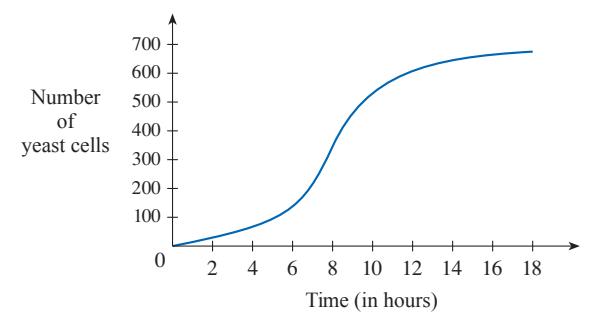
A graph of a population of yeast cells in a new laboratory culture as a function of time is shown.
question image
(a) Describe how the rate of population increase varies.
(b) When is this rate highest?
(c) On what intervals is the population function concave upward or downward?
(d) Estimate the coordinates of the inflection point.

Enter your answer directly below each part above.

62 Integration and Accumulation of Change · Level 2
In an episode of The Simpsons television show, Homer reads from a newspaper and announces "Here's good news! According to this eye-catching article, SAT scores are declining at a slower rate." Interpret Homer's statement in terms of a function and its first and second derivatives.
63 Integration and Accumulation of Change · Level 2
The president announces that the national deficit is increasing, but at a decreasing rate. Interpret this statement in terms of a function and its first and second derivatives.
64 Integration and Accumulation of Change · Level 2
Let \(f(t)\) be the temperature at time \(t\) where you live and suppose that at time \(t = 3\) you feel uncomfortably hot. How do you feel about the given data in each case?
(a) \(f'(3) = 2\), \(f''(3) = 4\)
(b) \(f'(3) = 2\), \(f''(3) = -4\)
(c) \(f'(3) = -2\), \(f''(3) = 4\)
(d) \(f'(3) = -2\), \(f''(3) = -4\)

Enter your answer directly below each part above.

65 Integration and Accumulation of Change · Level 2
Let \(K(t)\) be a measure of the knowledge you gain by studying for a test for \(t\) hours. Which do you think is larger, \(K(8) - K(7)\) or \(K(3) - K(2)\)? Is the graph of \(K\) concave upward or concave downward? Why?
66 Contextual Applications of Differentiation · Level 2
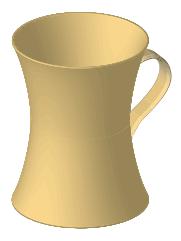
Coffee is being poured into the mug shown in the figure at a constant rate (measured in volume per unit time). Sketch a rough graph of the depth of the coffee in the mug as a function of time. Account for the shape of the graph in terms of concavity. What is the significance of the inflection point?
question image
67 Analytical Applications of Differentiation · Level 3
Find a cubic function \(f(x) = a x^3 + b x^2 + c x + d\) that has a local maximum value of \(3\) at \(x = -2\) and a local minimum value of \(0\) at \(x = 1\).
68 Analytical Applications of Differentiation · Level 4
Show that the curve \(y = \dfrac{1 + x}{1 + x^2}\) has three points of inflection and they all lie on one straight line.
69 Analytical Applications of Differentiation · Level 4
Show that the inflection points of the curve \(y = x \sin x\) lie on the curve \(y^2 (x^2 + 4) = 4 x^2\).
70 Analytical Applications of Differentiation · Level 3
Assume that all of the functions are twice differentiable and the second derivatives are never \(0\).
(a) If \(f\) and \(g\) are concave upward on an interval \(I\), show that \(f + g\) is concave upward on \(I\).
(b) If \(f\) is positive and concave upward on \(I\), show that the function \(g(x) = [f(x)]^2\) is concave upward on \(I\).

Enter your answer directly below each part above.

71 Analytical Applications of Differentiation · Level 4
Assume that all of the functions are twice differentiable and the second derivatives are never \(0\).
(a) If \(f\) and \(g\) are positive, increasing, concave upward functions on an interval \(I\), show that the product function \(f g\) is concave upward on \(I\).
(b) Show that part (a) remains true if \(f\) and \(g\) are both decreasing.
(c) Suppose \(f\) is increasing and \(g\) is decreasing. Show, by giving three examples, that \(f g\) may be concave upward, concave downward, or linear. Why doesn't the argument in parts (a) and (b) work in this case?

Enter your answer directly below each part above.

72 Analytical Applications of Differentiation · Level 4
Suppose \(f\) and \(g\) are both concave upward on \((-\infty, \infty)\). Under what condition on \(f\) will the composite function \(h(x) = f(g(x))\) be concave upward?
73 Analytical Applications of Differentiation · Level 4
Show that a cubic function (a third-degree polynomial) always has exactly one point of inflection. If its graph has three \(x\)-intercepts \(x_1\), \(x_2\), and \(x_3\), show that the \(x\)-coordinate of the inflection point is \((x_1 + x_2 + x_3)/3\).
74 Analytical Applications of Differentiation · Level 4
For what values of \(c\) does the polynomial \(P(x) = x^4 + c x^3 + x^2\) have two inflection points? One inflection point? None? Illustrate by graphing \(P\) for several values of \(c\). How does the graph change as \(c\) decreases?
75 Analytical Applications of Differentiation · Level 4
Prove that if \((c, f(c))\) is a point of inflection of the graph of \(f\) and \(f''\) exists in an open interval that contains \(c\), then \(f''(c) = 0\). [Hint: Apply the First Derivative Test and Fermat's Theorem to the function \(g = f'\).]
76 Analytical Applications of Differentiation · Level 3
Show that if \(f(x) = x^4\), then \(f''(0) = 0\), but \((0, 0)\) is not an inflection point of the graph of \(f\).
77 Analytical Applications of Differentiation · Level 3
Show that the function \(g(x) = x |x|\) has an inflection point at \((0, 0)\) but \(g''(0)\) does not exist.
78 Differentiation: Definition and Fundamental Properties · Level 4
Suppose that \(f'''\) is continuous and \(f'(c) = f''(c) = 0\), but \(f'''(c) > 0\). Does \(f\) have a local maximum or minimum at \(c\)? Does \(f\) have a point of inflection at \(c\)?
79 Analytical Applications of Differentiation · Level 4
Suppose \(f\) is differentiable on an interval \(I\) and \(f'(x) > 0\) for all numbers \(x\) in \(I\) except for a single number \(c\). Prove that \(f\) is increasing on the entire interval \(I\).
80 Analytical Applications of Differentiation · Level 3
For what values of \(c\) is the function \(f(x) = c x + \dfrac{1}{x^2 + 3}\) increasing on \((-\infty, \infty)\)?
81 Analytical Applications of Differentiation · Level 5
The three cases in the First Derivative Test cover the situations commonly encountered but do not exhaust all possibilities. Consider the functions \(f\), \(g\), and \(h\) whose values at \(0\) are all \(0\) and, for \(x \neq 0\), \(f(x) = x^4 \sin \dfrac{1}{x}\), \(g(x) = x^4 \left(2 + \sin \dfrac{1}{x}\right)\), \(h(x) = x^4 \left(-2 + \sin \dfrac{1}{x}\right)\)
(a) Show that \(0\) is a critical number of all three functions but their derivatives change sign infinitely often on both sides of \(0\).
(b) Show that \(f\) has neither a local maximum nor a local minimum at \(0\), \(g\) has a local minimum, and \(h\) has a local maximum.

Enter your answer directly below each part above.

82 Analytical Applications of Differentiation · Level 3
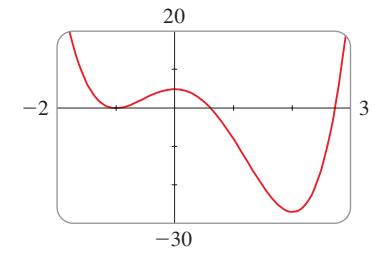
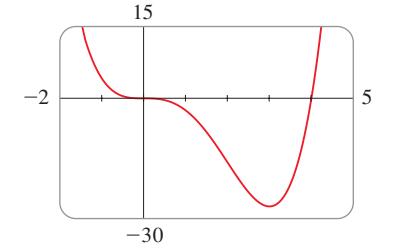
Find where the function \(f(x) = 3 x^4 - 4 x^3 - 12 x^2 + 5\) is increasing and where it is decreasing.
question image
83 Analytical Applications of Differentiation · Level 2
Find the local maximum and minimum values of \(f(x) = 3 x^4 - 4 x^3 - 12 x^2 + 5\).
84 Analytical Applications of Differentiation · Level 3
Find the local maximum and minimum values of \(g(x) = x + 2 \sin x\) on \([0, 2 \pi]\).
question image
85 Analytical Applications of Differentiation · Level 2
A population graph for honeybees raised in an apiary shows initial slow growth, accelerating until reaching a maximum rate at about \(t = 12\) weeks, then leveling off near 75,000 bees. (a) How does the rate of population growth change over time? (b) When is this rate highest? (c) Over what intervals is \(P\) concave upward or downward?
question image
86 Analytical Applications of Differentiation · Level 3
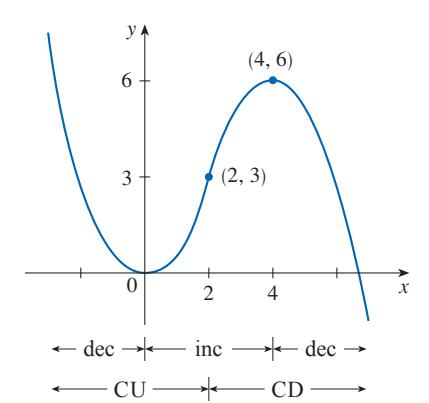
Sketch a possible graph of a function \(f\) that satisfies: (i) \(f(0) = 0\), \(f(2) = 3\), \(f(4) = 6\), \(f'(0) = f'(4) = 0\); (ii) \(f'(x) > 0\) for \(0 < x < 4\), \(f'(x) < 0\) for \(x < 0\) and for \(x > 4\); (iii) \(f''(x) > 0\) for \(x < 2\), \(f''(x) < 0\) for \(x > 2\).
question image
87 Analytical Applications of Differentiation · Level 3
Discuss the curve \(y = x^4 - 4 x^3\) with respect to concavity, points of inflection, and local maxima and minima.
question image
88 Analytical Applications of Differentiation · Level 4
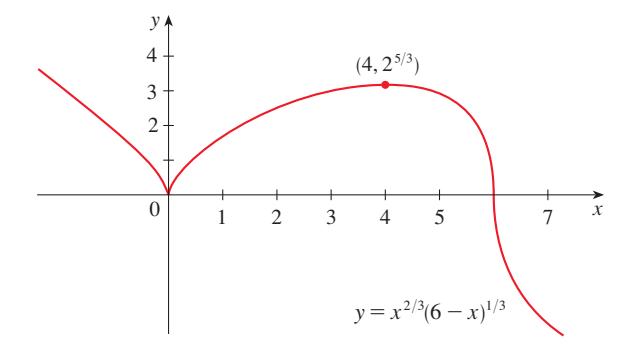
Sketch the graph of the function \(f(x) = x^{\dfrac{2}{3}} (6 - x)^{\dfrac{1}{3}}\).
question image

Answered: 0 / 88