TMUA Specimen Paper 2

20 questions

--:--
0 / 20
TMUA Specimen Paper 2 0/20
1 Coordinate Geometry · Level 3
The radius of the circle \(2x^2 + 2y^2 - 8x + 12y + 15 = 0\) is
A
\(\sqrt{\dfrac{5}{2}}\)
B
\(\sqrt{\dfrac{11}{2}}\)
C
\(\sqrt{\dfrac{41}{2}}\)
D
\(\sqrt{37}\)
E
\(\sqrt{67}\)
2 Differentiation · Level 3
The gradient of the curve \(y = \dfrac{(3x-2)^2}{x \sqrt{x}}\) at the point where \(x = 2\) is
A
\(frac(3,2) \sqrt{2}\)
B
\(3 \sqrt{2}\)
C
\(4 \sqrt{2}\)
D
\(frac(9,2) \sqrt{2}\)
E
\(6 \sqrt{2}\)
3 Logic of Arguments · Level 3
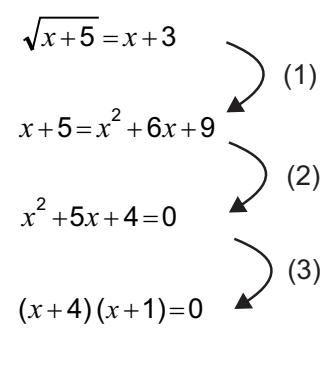
Consider the following attempt to solve an equation. The steps have been numbered for reference. \(\sqrt{x+5} = x+3\) (1) \(x+5 = x^2 + 6x + 9\) (2) \(x^2 + 5x + 4 = 0\) (3) \((x+4)(x+1) = 0\) \(x = -4\) or \(x = -1\) Which one of the following statements is true?
question image
A
Both \(-4\) and \(-1\) are solutions of the equation.
B
Neither \(-4\) nor \(-1\) are solutions of the equation.
C
One solution is correct and the incorrect solution arises as a result of step (1).
D
One solution is correct and the incorrect solution arises as a result of step (2).
E
One solution is correct and the incorrect solution arises as a result of step (3).
4 Basis of Logic · Level 3
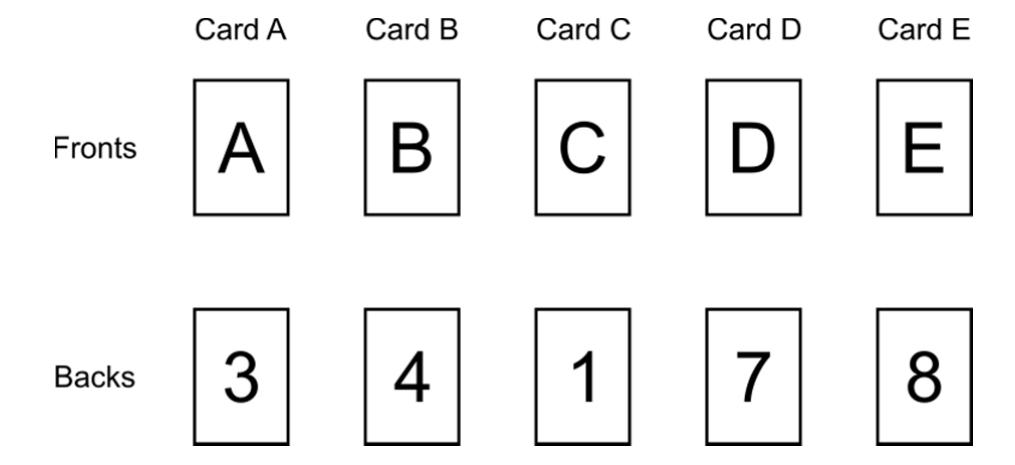
A set of five cards each have a letter printed on their front and a number printed on their back, as follows: Card A: front \(A\), back \(3\); Card B: front \(B\), back \(4\); Card C: front \(C\), back \(1\); Card D: front \(D\), back \(7\); Card E: front \(E\), back \(8\). Which one of the five cards (A, B, C, D or E) provides a counterexample to the following statement? _Every card that has a vowel on its front has an even number on its back._
question image
A
Card A (front \(A\), back \(3\))
B
Card B (front \(B\), back \(4\))
C
Card C (front \(C\), back \(1\))
D
Card D (front \(D\), back \(7\))
E
Card E (front \(E\), back \(8\))
5 Exponentials and Logarithms · Level 3
Using the observation that \(2^5 \approx 3^3\), it is possible to deduce that \(\log_3 2\) is approximately
A
\(frac(3,5)\)
B
\(frac(2,3)\)
C
\(frac(3,2)\)
D
\(frac(5,3)\)
E
\(frac(1,2)\)
F
\(2\)
6 Inequalities · Level 3
The area of a rectangle is measured to be \(5600 \text{cm}^2\) correct to 2 significant figures. The width of the rectangle is measured to be \(80 \text{cm}\) correct to the nearest centimetre. Which one of the following expressions gives the greatest possible height of the rectangle?
A
\(70.5 \text{cm}\)
B
\(75 \text{cm}\)
C
\(\dfrac{5650}{85} \text{cm}\)
D
\(\dfrac{5650}{8.5} \text{cm}\)
E
\(\dfrac{5650}{75} \text{cm}\)
F
\(\dfrac{5650}{79.5} \text{cm}\)
7 Curve Sketching · Level 3
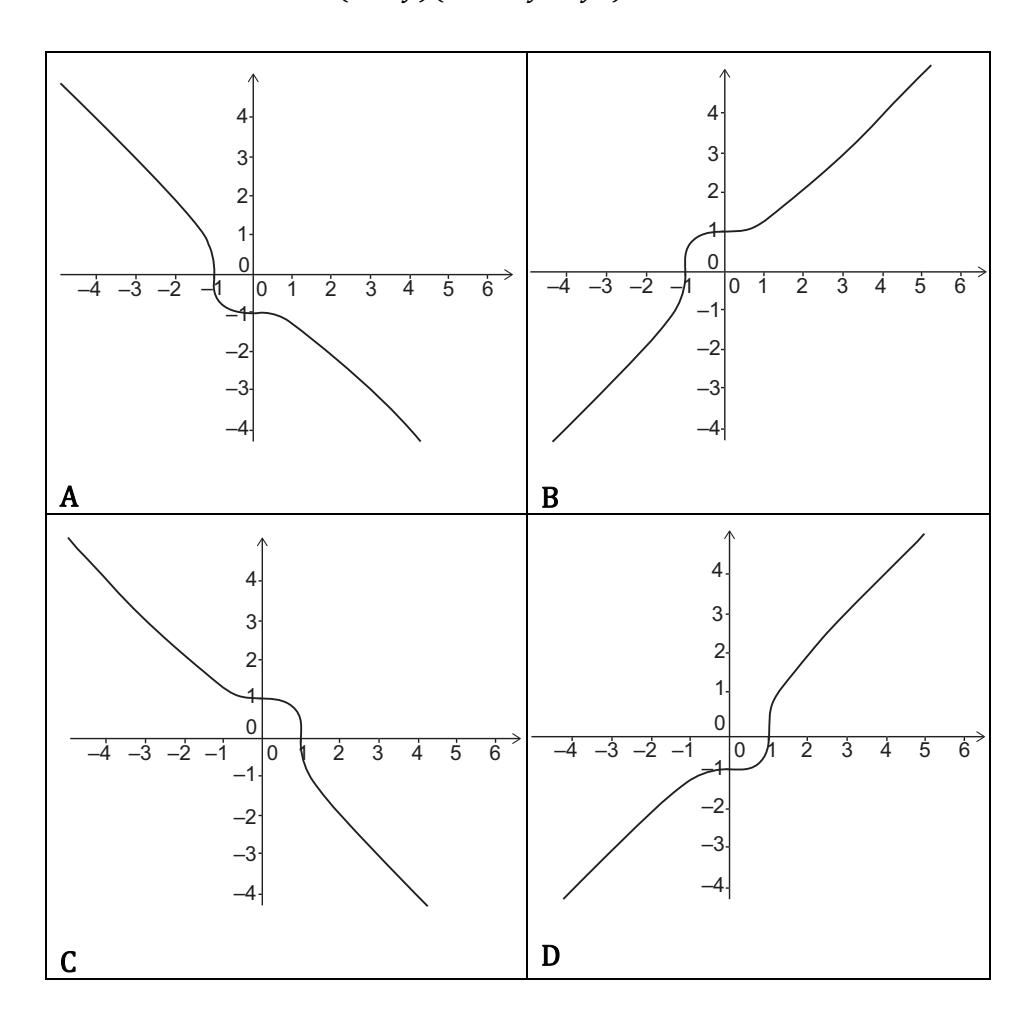
Which one of the following is a sketch of the graph \((x + y)(x^2 - x y + y^2) = 1\)?
question image
A
Graph A (see figure)
B
Graph B (see figure)
C
Graph C (see figure)
D
Graph D (see figure)
E
Graph E (see figure)
8 Mathematical Proofs · Level 3
Consider the following statement about the positive integer \(n\): Statement (*): _The sum of the four consecutive integers, the smallest of which is_ \(n\)_, is a multiple of 6._ Which one of the following is true?
A
Statement (*) is true for all values of \(n\).
B
Statement (*) is true for all values of \(n\) which are odd, but not for any other values of \(n\).
C
Statement (*) is true for all values of \(n\) which are multiples of 3, but not for any other values of \(n\).
D
Statement (*) is true for all values of \(n\) which are multiples of 6, but not for any other values of \(n\).
E
Statement (*) is not true for any value of \(n\).
9 Basis of Logic · Level 3
Consider the statement about Fred: (*) _Every day next week, Fred will do at least one maths problem._ If statement (*) is not true, which of the following is certainly true?
A
Every day next week, Fred will do more than one maths problem.
B
Some day next week, Fred will do more than one maths problem.
C
On no day next week will Fred do more than one maths problem.
D
Every day next week, Fred will do no maths problems.
E
Some day next week, Fred will do no maths problems.
F
On no day next week will Fred do no maths problems.
10 Curve Sketching · Level 3
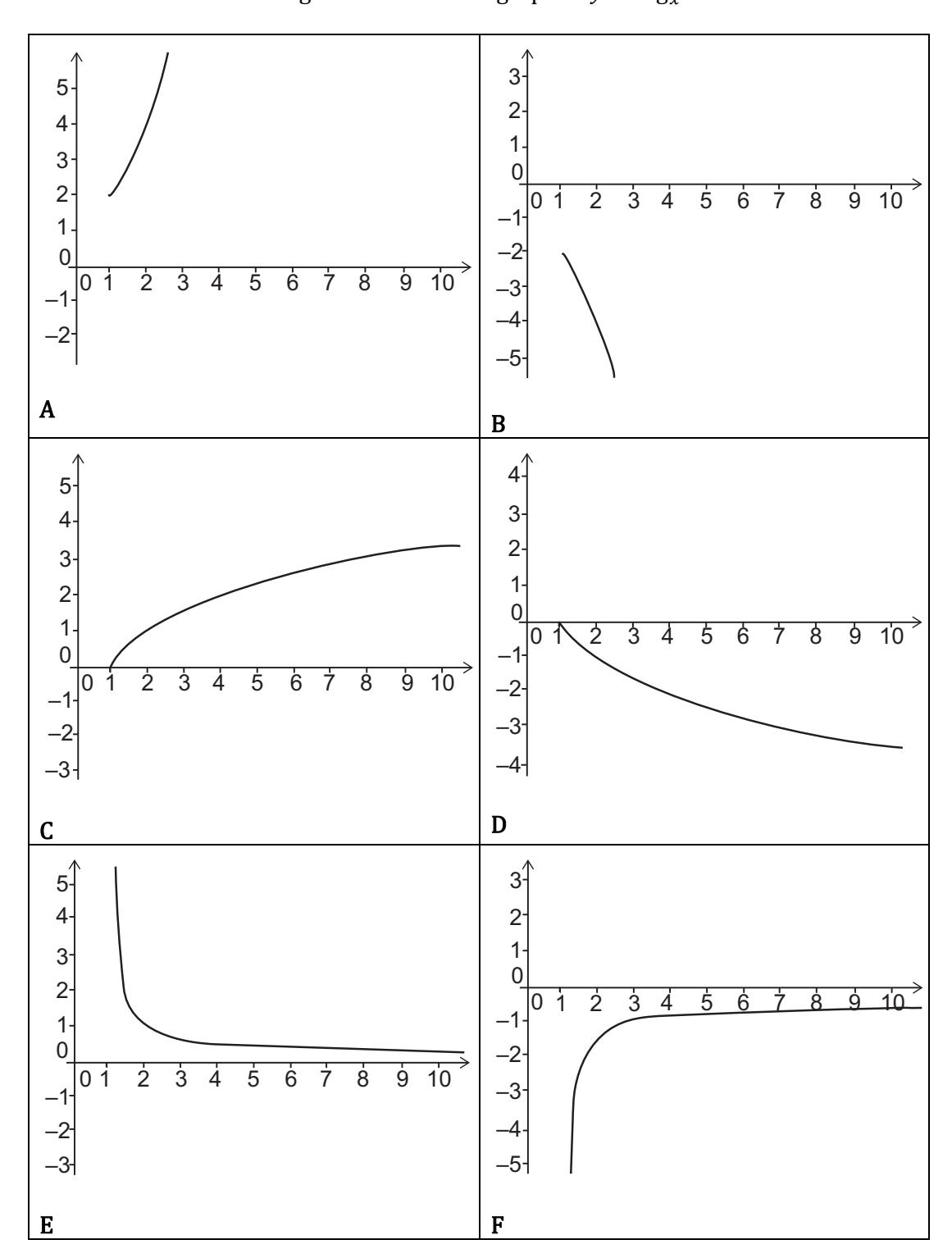
Which one of the following is a sketch of the graph of \(y = \log_x 2\) for \(x < 1\)?
question image
A
Graph A (see figure)
B
Graph B (see figure)
C
Graph C (see figure)
D
Graph D (see figure)
E
Graph E (see figure)
11 Exponentials and Logarithms · Level 3
Which one of the following numbers is largest in value? (All angles are given in radians.)
A
\(\tan\left(\dfrac{3 \pi}{4}\right)\)
B
\(\log_10 100\)
C
\(\sin^{-1}\left(\dfrac{\pi}{2}\right)\)
D
\(\log_2 10\)
E
\((\sqrt{2} - 1)^{10}\)
12 Polynomials · Level 3
A polynomial \(P(x)\) has the property that \(P(1) = 2\). Which one of the following can be deduced from this?
A
\(P(x) = (x-1) q(x) + 2\) for some polynomial \(q(x)\).
B
\(P(x) = (x+1) q(x) + 2\) for some polynomial \(q(x)\).
C
\(P(x) = (x-1) q(x) - 2\) for some polynomial \(q(x)\).
D
\(P(x) = (x+1) q(x) - 2\) for some polynomial \(q(x)\).
E
\(P(x) = (x-2) q(x) + 1\) for some polynomial \(q(x)\).
F
\(P(x) = (x+2) q(x) + 1\) for some polynomial \(q(x)\).
G
\(P(x) = (x-2) q(x) - 1\) for some polynomial \(q(x)\).
H
\(P(x) = (x+2) q(x) - 1\) for some polynomial \(q(x)\).
13 Counting and Probabilities · Level 3
Five runners competed in a race: Fred, George, Hermione, Lavender, and Ron. Fred beat George. Hermione beat Lavender. Lavender beat George. Ron beat George. Assuming there were no ties, how many possible finishing orders could there have been, given only this information?
A
\(1\)
B
\(6\)
C
\(12\)
D
\(18\)
E
\(24\)
F
\(120\)
14 Curve Sketching · Level 3
The graph of the polynomial function \(y = a x^5 + b x^4 + c x^3 + d x^2 + e x + f\), is sketched, where \(a, b, c, d, e\), and \(f\) are real constants with \(a \neq 0\). Which one of the following is not possible?
A
The graph has two local minima and two local maxima.
B
The graph has one local minimum and two local maxima.
C
The graph has one local minimum and one local maximum.
D
The graph has no local minima or local maxima.
15 Inequalities · Level 3
For any real numbers \(a, b\), and \(c\) where \(a \geq b\), consider these three statements: 1. \(-b \geq -a\) 2. \(a^2 + b^2 \geq 2 a b\) 3. \(a c \geq b c\) Which of the statements 1, 2, and 3 must be true?
A
none
B
1 only
C
2 only
D
3 only
E
1 and 2 only
F
1 and 3 only
G
2 and 3 only
H
1, 2 and 3
16 Sequences and Series · Level 3
The sequence \(a_n\) is given by the rule: \(a_1 = 2\) \(a_{n+1} = a_n + (-1)^n\) for \(n \geq 1\) What is \(\displaystyle\sum_{n=1}^{100} a_n\)
A
\(150\)
B
\(250\)
C
\(-4750\)
D
\(5150\)
E
\(4(1 - (frac(1,2))^{10})\)
F
\(4((frac(3,2))^{10} - 1)\)
17 Basis of Logic · Level 3
Let \(S\) be a set of positive integers, for example \(S\) could consist of 3, 4, and 8. A positive integer \(n\) is called an \(S\)-number if and only if for every factor \(m\) of \(n\) with \(m > 1\), the number \(m\) is a multiple of some number in \(S\). So in the above example, 9 is an \(S\)-number; this is because the factors of 9 greater than 1 are 3 and 9, and each of these is a multiple of 3. Positive integer \(n\) is therefore not an \(S\)-number if and only if
A
for every (positive) factor \(m\) of \(n\) with \(m > 1\), there is a number in \(S\) which is not a factor of \(m\).
B
for every (positive) factor \(m\) of \(n\) with \(m > 1\), there is no number in \(S\) which is a factor of \(m\).
C
for every (positive) factor \(m\) of \(n\) with \(m > 1\), every number in \(S\) is a factor of \(m\).
D
for some (positive) factor \(m\) of \(n\) with \(m > 1\), there is a number in \(S\) which is not a factor of \(m\).
E
for some (positive) factor \(m\) of \(n\) with \(m > 1\), there is no number in \(S\) which is a factor of \(m\).
F
for some (positive) factor \(m\) of \(n\) with \(m > 1\), every number in \(S\) is a factor of \(m\).
18 Statistics · Level 3
A group of five numbers are such that: - their mean is 0 - their range is 20 What is the largest possible median of the five numbers?
A
\(0\)
B
\(4\)
C
\(4 frac(1,2)\)
D
\(6 frac(1,2)\)
E
\(8\)
F
\(20\)
19 Polynomials · Level 3
The positive real numbers \(a, b\), and \(c\) are such that the equation \(x^3 + a x^2 = b x + c\) has three real roots, one positive and two negative. Which one of the following correctly describes the real roots of the equation \(x^3 + c = a x^2 + b x\)?
A
It has three real roots, one positive and two negative.
B
It has three real roots, two positive and one negative.
C
It has three real roots, but their signs differ depending on \(a, b\), and \(c\).
D
It has exactly one real root, which is positive.
E
It has exactly one real root, which is negative.
F
It has exactly one real root, whose sign differs depending on \(a, b\), and \(c\).
G
The number of real roots can be one or three, but the number of roots differs depending on \(a, b\), and \(c\).
20 Logic of Arguments · Level 3
Five logicians each make a statement, as follows: - Mr P: Of these five statements, an odd number are true. - Ms Q: Both statements made by women are true. - Mr R: My first name is Robert and Mr P's statement is true. - Ms S: Exactly one statement made by a man is true. - Mr T: Neither statement made by a woman is true. How many of the five statements can be simultaneously true?
A
none
B
1 only
C
2 only
D
3 only
E
4 only
F
none or 1 only
G
1 or 2 only
H
2 or 3 only

Answered: 0 / 20

0 / 20