Stewart Section 12.2: Vectors

52 questions

0 / 52
Stewart Section 12.2: Vectors 0/52
1 Parametric Equations, Polar Coordinates, and Vector-Valued Functions · Level 1
Are the following quantities vectors or scalars? Explain.
(a) The cost of a theater ticket
(b) The current in a river
(c) The initial flight path from Houston to Dallas
(d) The population of the world

Enter your answer directly below each part above.

2 Parametric Equations, Polar Coordinates, and Vector-Valued Functions · Level 2
What is the relationship between the point \((4, 7)\) and the vector \(\langle 4, 7 \rangle\)? Illustrate with a sketch.
3 Parametric Equations, Polar Coordinates, and Vector-Valued Functions · Level 2
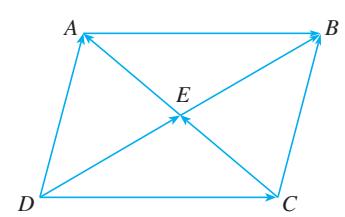
Name all the equal vectors in the parallelogram shown.
question image
4 Parametric Equations, Polar Coordinates, and Vector-Valued Functions · Level 2
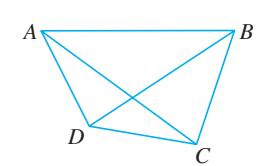
Write each combination of vectors as a single vector.
question image
(a) \(\overrightarrow{A B} + \overrightarrow{B C}\)
(b) \(\overrightarrow{C D} + \overrightarrow{D B}\)
(c) \(\overrightarrow{D B} - \overrightarrow{A B}\)
(d) \(\overrightarrow{D C} + \overrightarrow{C A} + \overrightarrow{A B}\)

Enter your answer directly below each part above.

5 Parametric Equations, Polar Coordinates, and Vector-Valued Functions · Level 2
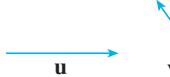
Copy the vectors in the figure and use them to draw the following vectors.
question image
(a) \(\mathbf{u} + \mathbf{v}\)
(b) \(\mathbf{u} + \mathbf{w}\)
(c) \(\mathbf{v} + \mathbf{w}\)
(d) \(\mathbf{u} - \mathbf{v}\)
(e) \(\mathbf{v} + \mathbf{u} + \mathbf{w}\)
(f) \(\mathbf{u} - \mathbf{w} - \mathbf{v}\)

Enter your answer directly below each part above.

6 Parametric Equations, Polar Coordinates, and Vector-Valued Functions · Level 2
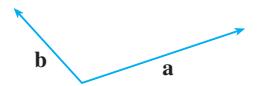
Copy the vectors in the figure and use them to draw the following vectors.
question image
(a) \(\mathbf{a} + \mathbf{b}\)
(b) \(\mathbf{a} - \mathbf{b}\)
(c) \(\dfrac{1}{2} \mathbf{a}\)
(d) \(-3 \mathbf{b}\)
(e) \(\mathbf{a} + 2 \mathbf{b}\)
(f) \(2 \mathbf{b} - \mathbf{a}\)

Enter your answer directly below each part above.

7 Parametric Equations, Polar Coordinates, and Vector-Valued Functions · Level 3
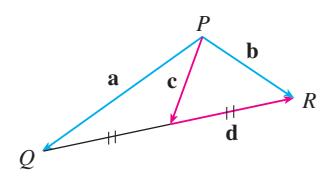
In the figure, the tip of \(\mathbf{c}\) and the tail of \(\mathbf{d}\) are both the midpoint of \(Q R\). Express \(\mathbf{c}\) and \(\mathbf{d}\) in terms of \(\mathbf{a}\) and \(\mathbf{b}\).
question image
8 Parametric Equations, Polar Coordinates, and Vector-Valued Functions · Level 3
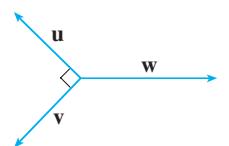
If the vectors in the figure satisfy \(|\mathbf{u}| = |\mathbf{v}| = 1\) and \(\mathbf{u} + \mathbf{v} + \mathbf{w} = \mathbf{0}\), what is \(|\mathbf{w}|\)?
question image
9 Parametric Equations, Polar Coordinates, and Vector-Valued Functions · Level 2
Find a vector \(\mathbf{a}\) with representation given by the directed line segment \(\overrightarrow{A B}\). Draw \(\overrightarrow{A B}\) and the equivalent representation starting at the origin. \(A(-2, 1)\), \(B(1, 2)\)
10 Parametric Equations, Polar Coordinates, and Vector-Valued Functions · Level 2
Find a vector \(\mathbf{a}\) with representation given by the directed line segment \(\overrightarrow{A B}\). Draw \(\overrightarrow{A B}\) and the equivalent representation starting at the origin. \(A(-5, -1)\), \(B(-3, 3)\)
11 Parametric Equations, Polar Coordinates, and Vector-Valued Functions · Level 2
Find a vector \(\mathbf{a}\) with representation given by the directed line segment \(\overrightarrow{A B}\). Draw \(\overrightarrow{A B}\) and the equivalent representation starting at the origin. \(A(3, -1)\), \(B(2, 3)\)
12 Parametric Equations, Polar Coordinates, and Vector-Valued Functions · Level 2
Find a vector \(\mathbf{a}\) with representation given by the directed line segment \(\overrightarrow{A B}\). Draw \(\overrightarrow{A B}\) and the equivalent representation starting at the origin. \(A(3, 2)\), \(B(1, 0)\)
13 Parametric Equations, Polar Coordinates, and Vector-Valued Functions · Level 2
Find a vector \(\mathbf{a}\) with representation given by the directed line segment \(\overrightarrow{A B}\). Draw \(\overrightarrow{A B}\) and the equivalent representation starting at the origin. \(A(0, 3, 1)\), \(B(2, 3, -1)\)
14 Parametric Equations, Polar Coordinates, and Vector-Valued Functions · Level 2
Find a vector \(\mathbf{a}\) with representation given by the directed line segment \(\overrightarrow{A B}\). Draw \(\overrightarrow{A B}\) and the equivalent representation starting at the origin. \(A(0, 6, -1)\), \(B(3, 4, 4)\)
15 Parametric Equations, Polar Coordinates, and Vector-Valued Functions · Level 2
Find the sum of the given vectors and illustrate geometrically. \(\langle -1, 4 \rangle\), \(\langle 6, -2 \rangle\)
16 Parametric Equations, Polar Coordinates, and Vector-Valued Functions · Level 2
Find the sum of the given vectors and illustrate geometrically. \(\langle 3, -1 \rangle\), \(\langle -1, 5 \rangle\)
17 Parametric Equations, Polar Coordinates, and Vector-Valued Functions · Level 2
Find the sum of the given vectors and illustrate geometrically. \(\langle 3, 0, 1 \rangle\), \(\langle 0, 8, 0 \rangle\)
18 Parametric Equations, Polar Coordinates, and Vector-Valued Functions · Level 2
Find the sum of the given vectors and illustrate geometrically. \(\langle 1, 3, -2 \rangle\), \(\langle 0, 0, 6 \rangle\)
19 Parametric Equations, Polar Coordinates, and Vector-Valued Functions · Level 3
Find \(\mathbf{a} + \mathbf{b}\), \(4 \mathbf{a} + 2 \mathbf{b}\), \(|\mathbf{a}|\), and \(|\mathbf{a} - \mathbf{b}|\). \(\mathbf{a} = \langle -3, 4 \rangle\), \(\mathbf{b} = \langle 9, -1 \rangle\)
20 Parametric Equations, Polar Coordinates, and Vector-Valued Functions · Level 3
Find \(\mathbf{a} + \mathbf{b}\), \(4 \mathbf{a} + 2 \mathbf{b}\), \(|\mathbf{a}|\), and \(|\mathbf{a} - \mathbf{b}|\). \(\mathbf{a} = 5 \mathbf{i} + 3 \mathbf{j}\), \(\mathbf{b} = -\mathbf{i} - 2 \mathbf{j}\)
21 Parametric Equations, Polar Coordinates, and Vector-Valued Functions · Level 3
Find \(\mathbf{a} + \mathbf{b}\), \(4 \mathbf{a} + 2 \mathbf{b}\), \(|\mathbf{a}|\), and \(|\mathbf{a} - \mathbf{b}|\). \(\mathbf{a} = 4 \mathbf{i} - 3 \mathbf{j} + 2 \mathbf{k}\), \(\mathbf{b} = 2 \mathbf{i} - 4 \mathbf{k}\)
22 Parametric Equations, Polar Coordinates, and Vector-Valued Functions · Level 3
Find \(\mathbf{a} + \mathbf{b}\), \(4 \mathbf{a} + 2 \mathbf{b}\), \(|\mathbf{a}|\), and \(|\mathbf{a} - \mathbf{b}|\). \(\mathbf{a} = \langle 8, 1, -4 \rangle\), \(\mathbf{b} = \langle 5, -2, 1 \rangle\)
23 Parametric Equations, Polar Coordinates, and Vector-Valued Functions · Level 2
Find a unit vector that has the same direction as the given vector. \(\langle 6, -2 \rangle\)
24 Parametric Equations, Polar Coordinates, and Vector-Valued Functions · Level 2
Find a unit vector that has the same direction as the given vector. \(-5 \mathbf{i} + 3 \mathbf{j} - \mathbf{k}\)
25 Parametric Equations, Polar Coordinates, and Vector-Valued Functions · Level 2
Find a unit vector that has the same direction as the given vector. \(8 \mathbf{i} - \mathbf{j} + 4 \mathbf{k}\)
26 Parametric Equations, Polar Coordinates, and Vector-Valued Functions · Level 3
Find the vector that has the same direction as \(\langle 6, 2, -3 \rangle\) but has length 4.
27 Parametric Equations, Polar Coordinates, and Vector-Valued Functions · Level 3
What is the angle between the given vector and the positive direction of the \(x\)-axis? \(\mathbf{i} + \sqrt{3} \mathbf{j}\)
28 Parametric Equations, Polar Coordinates, and Vector-Valued Functions · Level 3
What is the angle between the given vector and the positive direction of the \(x\)-axis? \(8 \mathbf{i} + 6 \mathbf{j}\)
29 Parametric Equations, Polar Coordinates, and Vector-Valued Functions · Level 3
If \(\mathbf{v}\) lies in the first quadrant and makes an angle \(\dfrac{\pi}{3}\) with the positive \(x\)-axis and \(|\mathbf{v}| = 4\), find \(\mathbf{v}\) in component form.
30 Parametric Equations, Polar Coordinates, and Vector-Valued Functions · Level 3
If a child pulls a sled through the snow on a level path with a force of 50 N exerted at an angle of \(38^{\circ}\) above the horizontal, find the horizontal and vertical components of the force.
31 Parametric Equations, Polar Coordinates, and Vector-Valued Functions · Level 3
A quarterback throws a football with angle of elevation \(40^{\circ}\) and speed 60 ft/s. Find the horizontal and vertical components of the velocity vector.
32 Parametric Equations, Polar Coordinates, and Vector-Valued Functions · Level 3
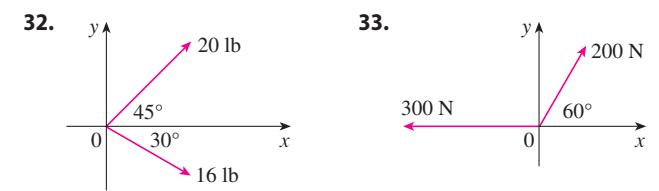
Find the magnitude of the resultant force and the angle it makes with the positive \(x\)-axis.
question image
33 Parametric Equations, Polar Coordinates, and Vector-Valued Functions · Level 3
Find the magnitude of the resultant force and the angle it makes with the positive \(x\)-axis.
question image
34 Parametric Equations, Polar Coordinates, and Vector-Valued Functions · Level 4
The magnitude of a velocity vector is called speed. Suppose that a wind is blowing from the direction N\(45^{\circ}\)W at a speed of 50 km/h. (This means that the direction from which the wind blows is \(45^{\circ}\) west of the northerly direction.) A pilot is steering a plane in the direction N\(60^{\circ}\)E at an airspeed (speed in still air) of 250 km/h. The true course, or track, of the plane is the direction of the resultant of the velocity vectors of the plane and the wind. The ground speed of the plane is the magnitude of the resultant. Find the true course and the ground speed of the plane.
35 Parametric Equations, Polar Coordinates, and Vector-Valued Functions · Level 3
A woman walks due west on the deck of a ship at 3 mi/h. The ship is moving north at a speed of 22 mi/h. Find the speed and direction of the woman relative to the surface of the water.
36 Parametric Equations, Polar Coordinates, and Vector-Valued Functions · Level 4
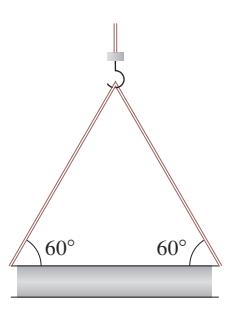
A crane suspends a 500-lb steel beam horizontally by support cables (with negligible weight) attached from a hook to each end of the beam. The support cables each make an angle of \(60^{\circ}\) with the beam. Find the tension vector in each support cable and the magnitude of each tension.
question image
37 Parametric Equations, Polar Coordinates, and Vector-Valued Functions · Level 4
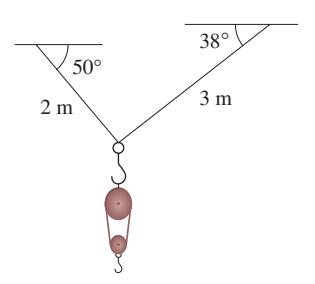
A block-and-tackle pulley hoist is suspended in a warehouse by ropes of lengths 2 m and 3 m. The hoist weighs 350 N. The ropes, fastened at different heights, make angles of \(50^{\circ}\) and \(38^{\circ}\) with the horizontal. Find the tension in each rope and the magnitude of each tension.
question image
38 Parametric Equations, Polar Coordinates, and Vector-Valued Functions · Level 3
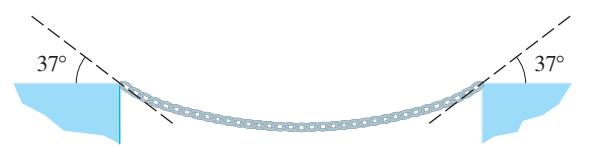
The tension \(\mathbf{T}\) at each end of a chain has magnitude 25 N (see the figure). What is the weight of the chain?
question image
39 Parametric Equations, Polar Coordinates, and Vector-Valued Functions · Level 4
A boatman wants to cross a canal that is 3 km wide and wants to land at a point 2 km upstream from his starting point. The current in the canal flows at 3.5 km/h and the speed of his boat is 13 km/h.
(a) In what direction should he steer?
(b) How long will the trip take?

Enter your answer directly below each part above.

40 Parametric Equations, Polar Coordinates, and Vector-Valued Functions · Level 4
Three forces act on an object. Two of the forces are at an angle of \(100^{\circ}\) to each other and have magnitudes 25 N and 12 N. The third is perpendicular to the plane of these two forces and has magnitude 4 N. Calculate the magnitude of the force that would exactly counterbalance these three forces.
41 Parametric Equations, Polar Coordinates, and Vector-Valued Functions · Level 4
Find the unit vectors that are parallel to the tangent line to the parabola \(y = x^2\) at the point \((2, 4)\).
42 Parametric Equations, Polar Coordinates, and Vector-Valued Functions · Level 4
(a) Find the unit vectors that are parallel to the tangent line to the curve \(y = 2 \sin x\) at the point \(\left(\dfrac{\pi}{6}, 1\right)\).
(b) Find the unit vectors that are perpendicular to the tangent line.
(c) Sketch the curve \(y = 2 \sin x\) and the vectors in parts (a) and (b), all starting at \(\left(\dfrac{\pi}{6}, 1\right)\).

Enter your answer directly below each part above.

43 Parametric Equations, Polar Coordinates, and Vector-Valued Functions · Level 3
If \(A\), \(B\), and \(C\) are the vertices of a triangle, find \(\overrightarrow{A B} + \overrightarrow{B C} + \overrightarrow{C A}\)
44 Parametric Equations, Polar Coordinates, and Vector-Valued Functions · Level 4
Let \(C\) be the point on the line segment \(A B\) that is twice as far from \(B\) as it is from \(A\). If \(\mathbf{a} = \overrightarrow{O A}\), \(\mathbf{b} = \overrightarrow{O B}\), and \(\mathbf{c} = \overrightarrow{O C}\), show that \(\mathbf{c} = \dfrac{2}{3} \mathbf{a} + \dfrac{1}{3} \mathbf{b}\).
45 Parametric Equations, Polar Coordinates, and Vector-Valued Functions · Level 3
(a) Draw the vectors \(\mathbf{a} = \langle 3, 2 \rangle\), \(\mathbf{b} = \langle 2, -1 \rangle\), and \(\mathbf{c} = \langle 7, 1 \rangle\).
(b) Show, by means of a sketch, that there are scalars \(s\) and \(t\) such that \(\mathbf{c} = s \mathbf{a} + t \mathbf{b}\).
(c) Use the sketch to estimate the values of \(s\) and \(t\).
(d) Find the exact values of \(s\) and \(t\).

Enter your answer directly below each part above.

46 Parametric Equations, Polar Coordinates, and Vector-Valued Functions · Level 4
Suppose that \(\mathbf{a}\) and \(\mathbf{b}\) are nonzero vectors that are not parallel and \(\mathbf{c}\) is any vector in the plane determined by \(\mathbf{a}\) and \(\mathbf{b}\). Give a geometric argument to show that \(\mathbf{c}\) can be written as \(\mathbf{c} = s \mathbf{a} + t \mathbf{b}\) for suitable scalars \(s\) and \(t\). Then give an argument using components.
47 Parametric Equations, Polar Coordinates, and Vector-Valued Functions · Level 3
If \(\mathbf{r} = \langle x, y, z \rangle\) and \(\mathbf{r}_0 = \langle x_0, y_0, z_0 \rangle\), describe the set of all points \((x, y, z)\) such that \(|\mathbf{r} - \mathbf{r}_0| = 1\).
48 Parametric Equations, Polar Coordinates, and Vector-Valued Functions · Level 4
If \(\mathbf{r} = \langle x, y \rangle\), \(\mathbf{r}_1 = \langle x_1, y_1 \rangle\), and \(\mathbf{r}_2 = \langle x_2, y_2 \rangle\), describe the set of all points \((x, y)\) such that \(|\mathbf{r} - \mathbf{r}_1| + |\mathbf{r} - \mathbf{r}_2| = k\), where \(k > |\mathbf{r}_1 - \mathbf{r}_2|\).
49 Parametric Equations, Polar Coordinates, and Vector-Valued Functions · Level 3
Figure 16 gives a geometric demonstration of Property 2 of vectors. Use components to give an algebraic proof of this fact for the case \(n = 2\).
50 Parametric Equations, Polar Coordinates, and Vector-Valued Functions · Level 4
Prove Property 5 of vectors algebraically for the case \(n = 3\). Then use similar triangles to give a geometric proof.
51 Parametric Equations, Polar Coordinates, and Vector-Valued Functions · Level 4
Use vectors to prove that the line joining the midpoints of two sides of a triangle is parallel to the third side and half its length.
52 Parametric Equations, Polar Coordinates, and Vector-Valued Functions · Level 5
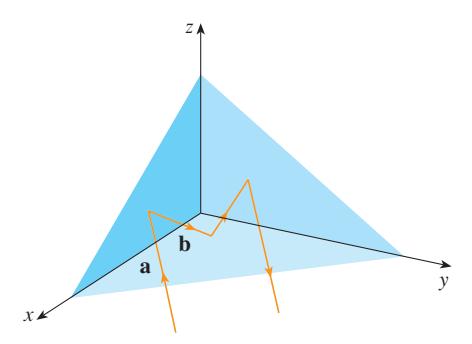
Suppose the three coordinate planes are all mirrored and a light ray given by the vector \(\mathbf{a} = \langle a_1, a_2, a_3 \rangle\) first strikes the \(x z\)-plane, as shown in the figure. Use the fact that the angle of incidence equals the angle of reflection to show that the direction of the reflected ray is given by \(\mathbf{b} = \langle a_1, -a_2, a_3 \rangle\). Deduce that, after being reflected by all three mutually perpendicular mirrors, the resulting ray is parallel to the initial ray. (American space scientists used this principle, together with laser beams and an array of corner mirrors on the moon, to calculate very precisely the distance from the earth to the moon.)
question image

Answered: 0 / 52