TMUA 2017 Paper 2

20 questions

0 / 20
TMUA 2017 Paper 2 0/20
1 Differentiation · Level 3
Given that \(y = \dfrac{(1 - 3x)^2}{2 x^{\dfrac{3}{2}}}\), which one of the following is a correct expression for \(\dfrac{d y}{d x}\)?
A
\(\dfrac{9}{4} x^{-\dfrac{1}{2}} + \dfrac{3}{2} x^{-\dfrac{3}{2}} - \dfrac{3}{4} x^{-\dfrac{5}{2}}\)
B
\(\dfrac{9}{4} x^{-\dfrac{1}{2}} - \dfrac{3}{2} x^{-\dfrac{3}{2}} + \dfrac{3}{4} x^{-\dfrac{5}{2}}\)
C
\(\dfrac{9}{4} x^{-\dfrac{1}{2}} - \dfrac{3}{2} x^{-\dfrac{3}{2}} - \dfrac{3}{4} x^{-\dfrac{5}{2}}\)
D
\(-\dfrac{9}{4} x^{-\dfrac{1}{2}} + \dfrac{3}{2} x^{-\dfrac{3}{2}} + \dfrac{3}{4} x^{-\dfrac{5}{2}}\)
E
\(-\dfrac{9}{4} x^{-\dfrac{1}{2}} + \dfrac{3}{2} x^{-\dfrac{3}{2}} - \dfrac{3}{4} x^{-\dfrac{5}{2}}\)
F
\(-\dfrac{9}{4} x^{-\dfrac{1}{2}} - \dfrac{3}{2} x^{-\dfrac{3}{2}} - \dfrac{3}{4} x^{-\dfrac{5}{2}}\)
2 Coordinate Geometry · Level 3
\(P Q R S\) is a rectangle. The coordinates of \(P\) and \(Q\) are \((0, 6)\) and \((1, 8)\) respectively. The perpendicular to \(P Q\) at \(Q\) meets the \(x\)-axis at \(R\). What is the area of \(P Q R S\)?
A
\(\dfrac{5}{2}\)
B
\(4 \sqrt{10}\)
C
\(20\)
D
\(8 \sqrt{10}\)
E
\(40\)
3 Sequences and Series · Level 3
The first term of a geometric progression is \(2 - \sqrt{3}\) and the fourth term is \(\dfrac{9}{4}\). What is the sum to infinity of this geometric progression?
A
\(-2(2 - \sqrt{3})\)
B
\(4(2 \sqrt{3} - 3)\)
C
\(\dfrac{16(8 \sqrt{3} + 9)}{37}\)
D
\(\dfrac{4(2 \sqrt{3} - 3)}{7}\)
E
\(\dfrac{4(2 \sqrt{3} + 3)}{7}\)
F
\(2(2 + \sqrt{3})\)
G
\(4(2 \sqrt{3} + 3)\)
4 Logic of Arguments · Level 3
The following question appeared in an examination: Given that \(\tan x = \sqrt{3}\), find the possible values of \(\sin 2x\). A student gave the following answer: \(\tan x = \sqrt{3}\) so \(x = 60^{\circ}\) and \(2x = 120^{\circ}\), therefore \(\sin 2x = \dfrac{\sqrt{3}}{2}\). Which one of the following statements is correct?
A
\(\dfrac{\sqrt{3}}{2}\) is the only possible value, and this is fully supported by the reasoning given in the student's answer.
B
\(\dfrac{\sqrt{3}}{2}\) is the only possible value, but the reasoning given should consider other possible values of \(x\) for which \(\tan x = \sqrt{3}\).
C
\(\dfrac{\sqrt{3}}{2}\) is the only possible value, but the reasoning given should consider other possible values of \(x\) for which \(\sin 2x = \dfrac{\sqrt{3}}{2}\).
D
\(\dfrac{\sqrt{3}}{2}\) is *not* the only possible value because the reasoning given should have considered other possible values of \(x\) for which \(\tan x = \sqrt{3}\).
E
\(\dfrac{\sqrt{3}}{2}\) is *not* the only possible value because the reasoning given should have considered other possible values of \(x\) for which \(\sin 2x = \dfrac{\sqrt{3}}{2}\).
5 Basis of Logic · Level 3
Consider the following three statements: 1. \(10 p^2 + 1\) and \(10 p^2 - 1\) are both prime when \(p\) is an odd prime. 2. Every prime greater than 5 is of the form \(6n + 1\) for some integer \(n\). 3. No multiple of 7 greater than 7 is prime. The result \(91 = 7 \times 13\) can be used to provide a counterexample to which of the above statements?
A
none of them
B
1 only
C
2 only
D
3 only
E
1 and 2 only
F
1 and 3 only
G
2 and 3 only
H
1, 2 and 3
6 Sequences and Series · Level 3
A sequence \(u_0, u_1, u_2, ...\) is defined as follows: \(u_0 = 1\) \(u_n = \displaystyle\int_{0}^{1} 4 x u_{n-1} d x\) for \(n \geq 1\) What is the value of \(u_1000\)?
A
\(2^{1000}\)
B
\(4^{1000}\)
C
\(\dfrac{4}{1000!}\)
D
\(\dfrac{4}{1001!}\)
E
\(\dfrac{2^{1000}}{1000!}\)
F
\(\dfrac{4^{1000}}{1000!}\)
G
\(\dfrac{2^{1000}}{1001!}\)
H
\(\dfrac{4^{1000}}{1001!}\)
7 Exponentials and Logarithms · Level 3
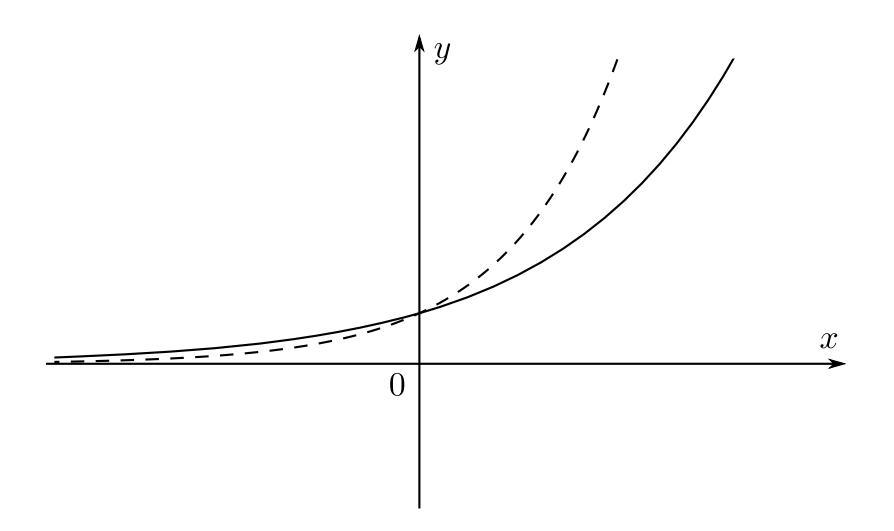
The graphs of two functions are shown here: - \(y = a^x\) is shown with a solid line, where \(a\) is a positive real number - \(y = f(x)\) is shown with a dashed line Which of the following statements (1, 2, 3,
4) could be true? 1. \(f(x) = b^x\) for some \(b > a\) 2. \(f(x) = b^x\) for some \(b < a\) 3. \(f(x) = a^{k x}\) for some \(k > 1\) 4. \(f(x) = a^{k x}\) for some \(k < 1\)
question image
A
1 only
B
2 only
C
3 only
D
4 only
E
1 and 3 only
F
1 and 4 only
G
2 and 3 only
H
2 and 4 only
8 Exponentials and Logarithms · Level 3
Which one of the following numbers is smallest in value?
A
\(\log_2 7\)
B
\((2^{-3} + 2^{-2})^{-1}\)
C
\(2^{\dfrac{\pi}{3}}\)
D
\(\dfrac{1}{4(\sqrt{2} - 1)^3}\)
E
\(4 \sin^2 \left(\dfrac{\pi}{4}\right)\)
9 Mathematical Proofs · Level 3
Consider the following attempt to prove this true theorem: Theorem: \(a^3 + b^3 = c^3\) has no solutions with \(a\), \(b\) and \(c\) positive integers. Attempted proof: Suppose that there are positive integers \(a\), \(b\) and \(c\) such that \(a^3 + b^3 = c^3\).
I. We have \(a^3 = c^3 - b^3\).
II. Hence \(a^3 = (c - b)(c^2 + c b + b^2)\).
III. It follows that \(a = c - b\) and \(a^2 = c^2 + c b + b^2\), since \(a | a^2\) and \(c - b | c^2 + c b + b^2\).
IV. Eliminating \(a\), we have \((c - b)^2 = c^2 + c b + b^2\).
V. Multiplying out, we have \(c^2 - 2 c b + b^2 = c^2 + c b + b^2\).
VI. Hence \(3 c b = 0\) so one of \(b\) and \(c\) is zero. But this is a contradiction to the original assumption that all of \(a\), \(b\) and \(c\) are positive. It follows that the equation has no solutions. Comment on this proof by choosing one of the following options:
A
The proof is correct
B
The proof is incorrect and the first mistake occurs on line I.
C
The proof is incorrect and the first mistake occurs on line II.
D
The proof is incorrect and the first mistake occurs on line III.
E
The proof is incorrect and the first mistake occurs on line IV.
F
The proof is incorrect and the first mistake occurs on line V.
G
The proof is incorrect and the first mistake occurs on line VI.
10 Integration · Level 3
\(f(x)\) is a function defined for all real values of \(x\). Which one of the following is a *sufficient* condition for \(\displaystyle\int_{1}^{3} f(x) d x = 0\)?
A
\(f(2) = 0\)
B
\(f(1) = f(3) = 0\)
C
\(f(-x) = -f(x)\) for all \(x\)
D
\(f(x + 2) = -f(2 - x)\) for all \(x\)
E
\(f(x - 2) = -f(2 - x)\) for all \(x\)
11 Integration · Level 3
The function \(f(x)\) is increasing and \(f(0) = 0\). The positive constants \(a\) and \(b\) are such that \(a < b\). The area of the region enclosed by the curve \(y = f(x)\), the \(x\)-axis and the lines \(x = a\) and \(x = b\) is denoted by \(R\). The function \(g(x)\) is defined by \(g(x) = f(x) + 2 f(b)\). Which of the following is an expression for the area enclosed by the curve \(y = g(x)\), the \(x\)-axis and the lines \(x = a\) and \(x = b\)?
A
\(R + (b - a) f(b)\)
B
\(R + 2(b - a) f(b)\)
C
\(R + 2 f(b) - f(a)\)
D
\(R + 2 f(b)\)
E
\(R + (f(b))^2\)
F
\(R + (f(b))^2 - (f(a))^2\)
G
\(R + 2(f(b) - f(a)) f(b)\)
12 Trigonometric Functions · Level 3
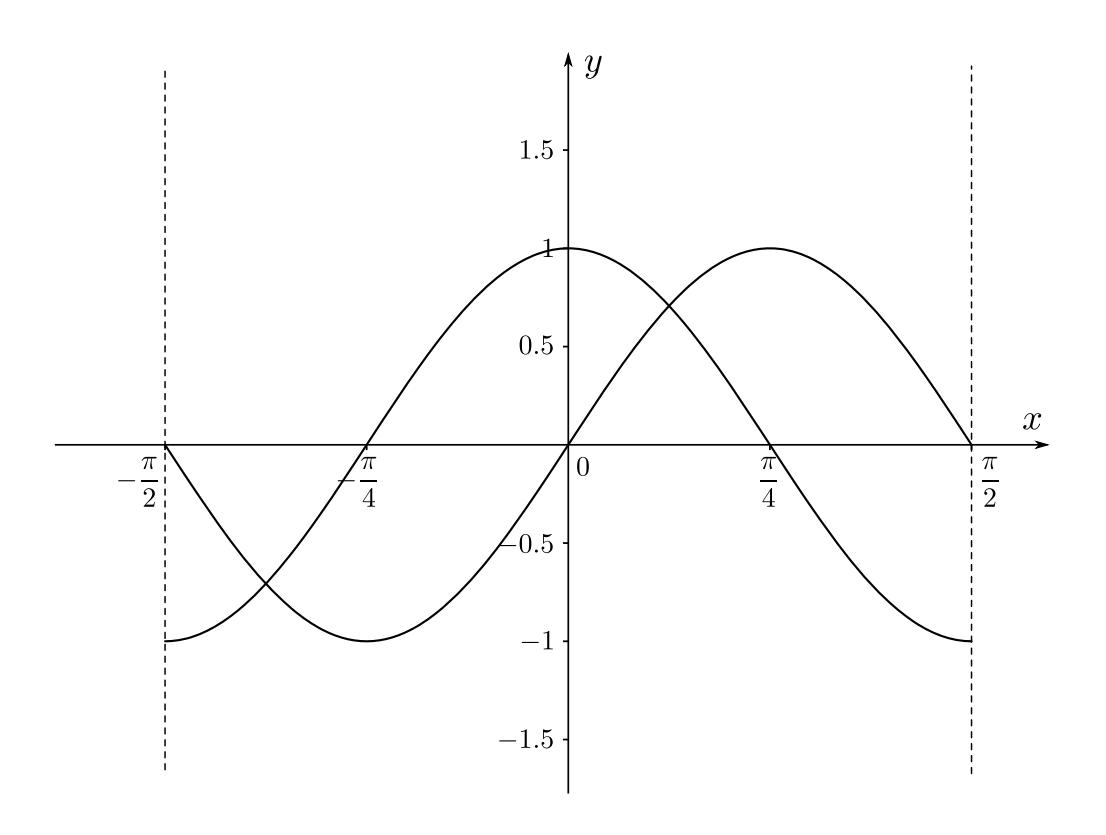
The diagram shows the graphs of \(y = \sin 2x\) and \(y = \cos 2x\) for \(-\dfrac{\pi}{2} < x < \dfrac{\pi}{2}\). Which one of the following is *not* true?
question image
A
\(\cos 2x < \sin 2x < \tan x\) for some real number \(x\) with \(-\dfrac{\pi}{2} < x < \dfrac{\pi}{2}\)
B
\(\cos 2x < \tan x < \sin 2x\) for some real number \(x\) with \(-\dfrac{\pi}{2} < x < \dfrac{\pi}{2}\)
C
\(\sin 2x < \cos 2x < \tan x\) for some real number \(x\) with \(-\dfrac{\pi}{2} < x < \dfrac{\pi}{2}\)
D
\(\sin 2x < \tan x < \cos 2x\) for some real number \(x\) with \(-\dfrac{\pi}{2} < x < \dfrac{\pi}{2}\)
E
\(\tan x < \sin 2x < \cos 2x\) for some real number \(x\) with \(-\dfrac{\pi}{2} < x < \dfrac{\pi}{2}\)
F
\(\tan x < \cos 2x < \sin 2x\) for some real number \(x\) with \(-\dfrac{\pi}{2} < x < \dfrac{\pi}{2}\)
13 Algebraic Manipulations · Level 3
The positive real numbers \(a \times 10^{-3}\), \(b \times 10^{-2}\) and \(c \times 10^{-1}\) are each in standard form, and \((a \times 10^{-3}) + (b \times 10^{-2}) = (c \times 10^{-1})\). Which of the following statements (I, II, III,
IV) must be true?
I. \(a > 9\)
II. \(b > 9\)
III. \(a < c\)
IV. \(b < c\)
A
I only
B
II only
C
I and II only
D
I and III only
E
I and IV only
F
II and III only
G
II and IV only
H
I, II, III and IV
14 Functions and Their Graphs · Level 3
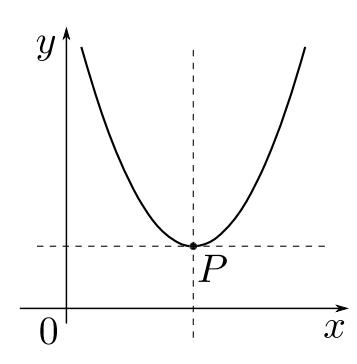
The diagram below shows the graph of \(y = x^2 - 2 b x + c\). The vertex of this graph is at the point \(P\). Which one of the following could be the graph of \(y = x^2 - 2 B x + c\), where \(B > b\)?
question image
A
A
B
B
C
C
D
D
E
E
F
F
15 Sequences and Series · Level 3
The function \(f\) is defined on the positive integers as follows: \(f(1) = 5\), and for \(n \geq 1\): \(f(n+1) = 3 f(n) + 1\) if \(f(n)\) is odd, \(f(n+1) = \dfrac{1}{2} f(n)\) if \(f(n)\) is even The function \(g\) is defined on the positive integers as follows: \(g(1) = 3\), and for \(n \geq 1\): \(g(n+1) = g(n) + 5\) if \(g(n)\) is odd, \(g(n+1) = \dfrac{1}{2} g(n)\) if \(g(n)\) is even What is the value of \(f(1000) - g(1000)\)?
A
\(-6\)
B
\(-5\)
C
\(1\)
D
\(2\)
E
\(4\)
F
\(8\)
16 Differentiation · Level 3
Consider the following statement: (\(*\)) *If* \(f(x)\) is an integer for every integer \(x\), *then* \(f'(x)\) is an integer for every integer \(x\). Which one of the following is a *counterexample* to (\(*\))?
A
\(f(x) = \dfrac{x^3 + x + 1}{4}\)
B
\(f(x) = \dfrac{x^4 + x^2 + x}{2}\)
C
\(f(x) = \dfrac{x^4 + x^3 + x^2 + x}{2}\)
D
\(f(x) = \dfrac{x^4 + 2 x^3 + x^2}{4}\)
17 Basis of Logic · Level 3
A set \(S\) of whole numbers is called stapled *if and only if* for every whole number \(a\) which is in \(S\) there exists a prime factor of \(a\) which divides at least one other number in \(S\). Let \(T\) be a set of whole numbers. Which of the following is true *if and only if* \(T\) is *not* stapled?
A
For every number \(a\) which is in \(T\), there is no prime factor of \(a\) which divides every other number in \(T\).
B
For every number \(a\) which is in \(T\), there is no prime factor of \(a\) which divides at least one other number in \(T\).
C
For every number \(a\) which is in \(T\), there is a prime factor of \(a\) which does not divide any other number in \(T\).
D
For every number \(a\) which is in \(T\), there is a prime factor of \(a\) which does not divide at least one other number in \(T\).
E
There exists a number \(a\) which is in \(T\) such that there is no prime factor of \(a\) which divides every other number in \(T\).
F
There exists a number \(a\) which is in \(T\) such that there is no prime factor of \(a\) which divides at least one other number in \(T\).
G
There exists a number \(a\) which is in \(T\) such that there is a prime factor of \(a\) which does not divide any other number in \(T\).
H
There exists a number \(a\) which is in \(T\) such that there is a prime factor of \(a\) which does not divide at least one other number in \(T\).
18 Logic of Arguments · Level 3
Consider the following problem: Solve the inequality \(\left(\dfrac{1}{4}\right)^n < \left(\dfrac{1}{32}\right)^{10}\), where \(n\) is a positive integer. A student produces the following argument:
I. \(\left(\dfrac{1}{4}\right)^n < \left(\dfrac{1}{32}\right)^{10}\)
II. \(\log_{\dfrac{1}{2}} \left(\dfrac{1}{4}\right)^n < \log_{\dfrac{1}{2}} \left(\dfrac{1}{32}\right)^{10}\)
III. \(n \log_{\dfrac{1}{2}} \left(\dfrac{1}{4}\right) < 10 \log_{\dfrac{1}{2}} \left(\dfrac{1}{32}\right)\)
IV. \(n < \dfrac{10 \log_{\dfrac{1}{2}} \left(\dfrac{1}{32}\right)}{\log_{\dfrac{1}{2}} \left(\dfrac{1}{4}\right)}\)
V. \(n < \dfrac{10 \times 5}{2} = 25\) Which step (if any) in the argument is invalid?
A
There are no invalid steps; the argument is correct
B
Only step (I) is invalid; the rest are correct
C
Only step (II) is invalid; the rest are correct
D
Only step (III) is invalid; the rest are correct
E
Only step (IV) is invalid; the rest are correct
F
Only step (V) is invalid; the rest are correct
19 Curve Sketching · Level 3
Which one of the following is a *sufficient* condition for the equation \(x^3 - 3 x^2 + a = 0\), where \(a\) is a constant, to have exactly one real root?
A
\(a > 0\)
B
\(a \leq 0\)
C
\(a \geq 4\)
D
\(a < 4\)
E
\(|a| > 4\)
F
\(|a| \leq 4\)
G
\(a = \dfrac{9}{4}\)
H
\(|a| = \dfrac{3}{2}\)
20 Counting and Probabilities · Level 3
I have forgotten my 5-character computer password, but I know that it consists of the letters \(a, b, c, d, e\) in some order. When I enter a potential password into the computer, it tells me exactly how many of the letters are in the correct position. When I enter abcde, it tells me that none of the letters are in the correct position. The same happens when I enter cdbea and eadbc. Using the best strategy, how many *further* attempts must I make in order to *guarantee* that I can *deduce* the correct password?
A
None: I can deduce it immediately
B
One
C
Two
D
Three
E
More than three

Answered: 0 / 20

0 / 20