Stewart Section 2.3: Calculating Limits

66 questions

0 / 66
Stewart Section 2.3: Calculating Limits 0/66
1 Limits and Continuity · Level 3
Given that \(\operatorname*{lim}\limits_{x \rightarrow 2} f(x) = 4\), \(\operatorname*{lim}\limits_{x \rightarrow 2} g(x) = -2\), \(\operatorname*{lim}\limits_{x \rightarrow 2} h(x) = 0\), find the limits that exist. If the limit does not exist, explain why.
(a) \(\operatorname*{lim}\limits_{x \rightarrow 2} [f(x) + 5g(x)]\)
(b) \(\operatorname*{lim}\limits_{x \rightarrow 2} [g(x)]^3\)
(c) \(\operatorname*{lim}\limits_{x \rightarrow 2} \sqrt{f(x)}\)
(d) \(\operatorname*{lim}\limits_{x \rightarrow 2} \dfrac{3f(x)}{g(x)}\)
(e) \(\operatorname*{lim}\limits_{x \rightarrow 2} \dfrac{g(x)}{h(x)}\)
(f) \(\operatorname*{lim}\limits_{x \rightarrow 2} \dfrac{g(x) h(x)}{f(x)}\)

Enter your answer directly below each part above.

2 Limits and Continuity · Level 3
The graphs of \(f\) and \(g\) are given. Use them to evaluate each limit, if it exists. If the limit does not exist, explain why.
(a) \(\operatorname*{lim}\limits_{x \rightarrow 2} [f(x) + g(x)]\)
(b) \(\operatorname*{lim}\limits_{x \rightarrow 0} [f(x) - g(x)]\)
(c) \(\operatorname*{lim}\limits_{x \rightarrow -1} [f(x) g(x)]\)
(d) \(\operatorname*{lim}\limits_{x \rightarrow 3} \dfrac{f(x)}{g(x)}\)
(e) \(\operatorname*{lim}\limits_{x \rightarrow 2} [x^2 f(x)]\)
(f) \(f(-1) + \operatorname*{lim}\limits_{x \rightarrow -1} g(x)\)

Enter your answer directly below each part above.

3 Limits and Continuity · Level 3
\(\operatorname*{lim}\limits_{x \rightarrow 0} (5x^3 - 3x^2 + x - 6)\)
4 Limits and Continuity · Level 3
\(\operatorname*{lim}\limits_{x \rightarrow -1} (x^4 - 3x)(x^2 + 5x + 3)\)
5 Limits and Continuity · Level 3
\(\operatorname*{lim}\limits_{t \rightarrow -2} \dfrac{t^4 - 2}{2t^2 - 3t + 2}\)
6 Limits and Continuity · Level 3
\(\operatorname*{lim}\limits_{u \rightarrow -2} \sqrt{u^4 + 3u + 6}\)
7 Limits and Continuity · Level 3
\(\operatorname*{lim}\limits_{x \rightarrow 8} (1 + \sqrt[3]{x})(2 - 6x^2 + x^3)\)
8 Limits and Continuity · Level 3
\(\operatorname*{lim}\limits_{t \rightarrow 2} \left(\dfrac{t^2 - 2}{t^3 - 3t + 5}\right)^2\)
9 Limits and Continuity · Level 3
\(\operatorname*{lim}\limits_{x \rightarrow -2} \sqrt{\dfrac{2x^2 + 1}{3x - 2}}\)
10 Limits and Continuity · Level 3
(a) What is wrong with the following equation? \(\dfrac{x^2 + x - 6}{x - 2} = x + 3\)
(b) In view of part (a), explain why the equation \(\operatorname*{lim}\limits_{x \rightarrow 2} \dfrac{x^2 + x - 6}{x - 2} = \operatorname*{lim}\limits_{x \rightarrow 2} (x + 3)\) is correct.

Enter your answer directly below each part above.

11 Limits and Continuity · Level 3
\(\operatorname*{lim}\limits_{x \rightarrow 5} \dfrac{x^2 - 6x + 5}{x - 5}\)
12 Limits and Continuity · Level 3
\(\operatorname*{lim}\limits_{x \rightarrow -3} \dfrac{x^2 + 3x}{x^2 - x - 12}\)
13 Limits and Continuity · Level 3
\(\operatorname*{lim}\limits_{x \rightarrow 5} \dfrac{x^2 - 5x + 6}{x - 5}\)
14 Limits and Continuity · Level 3
\(\operatorname*{lim}\limits_{x \rightarrow 4} \dfrac{x^2 + 3x}{x^2 - x - 12}\)
15 Limits and Continuity · Level 3
\(\operatorname*{lim}\limits_{x \rightarrow -1} \dfrac{x^2 - 4x}{x^2 - 3x - 4}\)
16 Limits and Continuity · Level 3
\(\operatorname*{lim}\limits_{x \rightarrow -1} \dfrac{2x^2 + 3x + 1}{x^2 - 2x - 3}\)
17 Limits and Continuity · Level 3
\(\operatorname*{lim}\limits_{x \rightarrow 0} \dfrac{(5 + h)^2 - 25}{h}\)
18 Limits and Continuity · Level 3
\(\operatorname*{lim}\limits_{h \rightarrow 0} \dfrac{(2 + h)^3 - 8}{h}\)
19 Limits and Continuity · Level 3
\(\operatorname*{lim}\limits_{x \rightarrow 1} \dfrac{x + 2}{x^2 + 8}\)
20 Limits and Continuity · Level 3
\(\operatorname*{lim}\limits_{t \rightarrow 1} \dfrac{t^4 - 1}{t^3 - 1}\)
21 Limits and Continuity · Level 3
\(\operatorname*{lim}\limits_{x \rightarrow -4} \dfrac{\sqrt{x + 8} - 2}{x + 4}\)
22 Limits and Continuity · Level 3
\(\operatorname*{lim}\limits_{x \rightarrow 2} \dfrac{\sqrt{4x + 1} - 3}{x - 2}\)
23 Limits and Continuity · Level 3
\(\operatorname*{lim}\limits_{h \rightarrow 0} \dfrac{(3 + h)^{-1} - 3^{-1}}{h}\)
24 Limits and Continuity · Level 3
\(\operatorname*{lim}\limits_{h \rightarrow 0} \dfrac{1/(h+3) - \dfrac{1}{3}}{h}\)
25 Limits and Continuity · Level 3
\(\operatorname*{lim}\limits_{x \rightarrow -1} \dfrac{x + 1}{\sqrt{x + 5} - 2}\)
26 Limits and Continuity · Level 3
\(\operatorname*{lim}\limits_{x \rightarrow 1} \dfrac{\sqrt{x} - x^2}{1 - \sqrt{x}}\)
27 Limits and Continuity · Level 3
\(\operatorname*{lim}\limits_{x \rightarrow 16} \dfrac{4 - \sqrt{x}}{16x - x^2}\)
28 Limits and Continuity · Level 3
\(\operatorname*{lim}\limits_{x \rightarrow 0} \dfrac{x^2 - 4x + 4}{x^3 - 3x^2 + 2x}\)
29 Limits and Continuity · Level 3
\(\operatorname*{lim}\limits_{t \rightarrow 0} \left(\dfrac{1}{t \sqrt{1 + t}} - \dfrac{1}{t}\right)\)
30 Limits and Continuity · Level 3
\(\operatorname*{lim}\limits_{x \rightarrow 0} \dfrac{x}{\sqrt{1 + 3x} - 1}\)
31 Limits and Continuity · Level 3
\(\operatorname*{lim}\limits_{h \rightarrow 0} \dfrac{(x + h)^2 - x^2}{h}\)
32 Limits and Continuity · Level 3
\(\operatorname*{lim}\limits_{h \rightarrow 0} \dfrac{1/(x + h)^2 - 1/x^2}{h}\)
33 Limits and Continuity · Level 3
(a) Estimate the value of \(\operatorname*{lim}\limits_{x \rightarrow 0} \dfrac{x}{\sqrt{1 + 3x} - 1}\) by graphing.
(b) Make a table of values for \(x\) close to 0.
(c) Use the Limit Laws to prove your guess is correct.

Enter your answer directly below each part above.

34 Limits and Continuity · Level 3
(a) Use a graph of \(f(x) = \dfrac{\sqrt{3 + x} - \sqrt{3}}{x}\) to estimate \(\operatorname*{lim}\limits_{x \rightarrow 0} f(x)\).
(b) Use a table of values to estimate to four decimal places.
(c) Use the Limit Laws to find the exact value.

Enter your answer directly below each part above.

35 Limits and Continuity · Level 3
Use the Squeeze Theorem to show that \(\operatorname*{lim}\limits_{x \rightarrow 0} x^2 \cos 20 \pi x = 0\).
36 Limits and Continuity · Level 3
Use the Squeeze Theorem to show that \(\operatorname*{lim}\limits_{x \rightarrow 0} \sqrt{x^3 + x^2} \sin\left(\dfrac{\pi}{x}\right) = 0\).
37 Limits and Continuity · Level 3
If \(4x - 9 \leq f(x) \leq x^2 - 4x + 7\) for \(x \geq 0\), find \(\operatorname*{lim}\limits_{x \rightarrow 4} f(x)\).
38 Limits and Continuity · Level 3
If \(2x \leq g(x) \leq x^4 - x^2 + 2\) for all \(x\), evaluate \(\operatorname*{lim}\limits_{x \rightarrow 1} g(x)\).
39 Limits and Continuity · Level 3
Prove that \(\operatorname*{lim}\limits_{x \rightarrow 0} x^4 \cos\left(\dfrac{2}{x}\right) = 0\).
40 Limits and Continuity · Level 3
Prove that \(\operatorname*{lim}\limits_{x \rightarrow 0} \sqrt{x} e^{\sin\left(\dfrac{\pi}{x}\right)} = 0\).
41 Limits and Continuity · Level 3
\(\operatorname*{lim}\limits_{x \rightarrow -4} (2x + |x - 4|)\)
42 Limits and Continuity · Level 3
\(\operatorname*{lim}\limits_{x \rightarrow 0^-} \dfrac{2x + 12}{|x + 6|}\)
43 Limits and Continuity · Level 3
\(\operatorname*{lim}\limits_{x \rightarrow 0^-} \dfrac{2x - 1}{|2x^3 - x^2|}\)
44 Limits and Continuity · Level 3
\(\operatorname*{lim}\limits_{x \rightarrow 0} \dfrac{2 - |x|}{2 + |x|}\)
45 Limits and Continuity · Level 3
\(\operatorname*{lim}\limits_{x \rightarrow 0^+} \left(\dfrac{1}{x} - 1/|x|\right)\)
46 Limits and Continuity · Level 3
\(\operatorname*{lim}\limits_{x \rightarrow 0} \left(\dfrac{1}{x} - 1/|x|\right)\)
47 Limits and Continuity · Level 3
The signum function is defined by \(\text{sgn} x = \begin{cases} -1 & \quad \text{if} x < 0 \\ 0 & \quad \text{if} x = 0 \\ 1 & \quad \text{if} x > 0 \end{cases}\)
(a) Sketch the graph.
(b) Find: (i) \(\operatorname*{lim}\limits_{x \rightarrow 0^+} \text{sgn} x\) (ii) \(\operatorname*{lim}\limits_{x \rightarrow 0^-} \text{sgn} x\) (iii) \(\operatorname*{lim}\limits_{x \rightarrow 0} \text{sgn} x\) (iv) \(\operatorname*{lim}\limits_{x \rightarrow 0} |\text{sgn} x|\)

Enter your answer directly below each part above.

48 Limits and Continuity · Level 3
Let \(g(x) = \text{sgn}(\sin x)\). Find limits at \(x = 0, \pi\) and determine where \(\operatorname*{lim}\limits_{x \rightarrow a} g(x)\) does not exist. Sketch a graph of \(g\).
49 Limits and Continuity · Level 3
Let \(g(x) = \dfrac{x^2 + x - 6}{|x - 2|}\). Find \(\operatorname*{lim}\limits_{x \rightarrow 2^+} g(x)\), \(\operatorname*{lim}\limits_{x \rightarrow 2^-} g(x)\). Does \(\operatorname*{lim}\limits_{x \rightarrow 2} g(x)\) exist? Sketch the graph.
50 Limits and Continuity · Level 3
Let \(f(x) = \begin{cases} x^2 + 1 & \quad \text{if} x < 1 \\ (x - 2)^2 & \quad \text{if} x \geq 1 \end{cases}\). Find \(\operatorname*{lim}\limits_{x \rightarrow 1^-} f(x)\) and \(\operatorname*{lim}\limits_{x \rightarrow 1^+} f(x)\). Does \(\operatorname*{lim}\limits_{x \rightarrow 1} f(x)\) exist? Sketch the graph.
51 Limits and Continuity · Level 3
Let \(B(t) = \begin{cases} 4 - \dfrac{1}{2} t & \quad \text{if} t < 2 \\ \sqrt{t + c} & \quad \text{if} t \geq 2 \end{cases}\). Find the value of \(c\) so that \(\operatorname*{lim}\limits_{t \rightarrow 2} B(t)\) exists.
52 Limits and Continuity · Level 3
Let \(g(x) = \begin{cases} x & \quad \text{if} x < 1 \\ 3 & \quad \text{if} x = 1 \\ 2 - x^2 & \quad \text{if} 1 < x \leq 2 \\ x - 3 & \quad \text{if} x > 2 \end{cases}\) Evaluate: (i)-(vi) limits at \(x = 1\) and \(x = 2\). Sketch the graph.
53 Limits and Continuity · Level 3
(a) If \(\lfloor x \rfloor\) denotes the greatest integer function, evaluate limits at \(x = -2\) and \(x = -2.4\).
(b) If \(n\) is integer, evaluate \(\operatorname*{lim}\limits_{x \rightarrow n^-} \lfloor x \rfloor\) and \(\operatorname*{lim}\limits_{x \rightarrow n^+} \lfloor x \rfloor\).
(c) For what values of \(a\) does \(\operatorname*{lim}\limits_{x \rightarrow a} \lfloor x \rfloor\) exist?

Enter your answer directly below each part above.

54 Limits and Continuity · Level 3
Let \(f(x) = \lfloor \cos x \rfloor\), \(-\pi \leq x \leq \pi\). Sketch the graph, evaluate limits, determine where \(\operatorname*{lim}\limits_{x \rightarrow a} f(x)\) exists.
55 Limits and Continuity · Level 3
If \(f(x) = \lfloor x \rfloor + \lfloor -x \rfloor\), show that \(\operatorname*{lim}\limits_{x \rightarrow 2} f(x)\) exists but is not equal to \(f(2)\).
56 Limits and Continuity · Level 3
In the theory of relativity, the Lorentz contraction formula \(L = L_0 \sqrt{1 - v^2/c^2}\) gives the length \(L\) as a function of velocity \(v\). Find \(\operatorname*{lim}\limits_{v \rightarrow c^-} L\) and interpret the result.
57 Limits and Continuity · Level 3
If \(p\) is a polynomial, show that \(\operatorname*{lim}\limits_{x \rightarrow a} p(x) = p(a)\).
58 Limits and Continuity · Level 3
If \(r\) is a rational function, use Exercise 57 to show that \(\operatorname*{lim}\limits_{x \rightarrow a} r(x) = r(a)\) for every \(a\) in the domain of \(r\).
59 Limits and Continuity · Level 3
If \(\operatorname*{lim}\limits_{x \rightarrow 1} \dfrac{f(x) - 8}{x - 1} = 10\), find \(\operatorname*{lim}\limits_{x \rightarrow 1} f(x)\).
60 Limits and Continuity · Level 3
If \(\operatorname*{lim}\limits_{x \rightarrow 0} \dfrac{f(x)}{x^2} = 5\), find (a) \(\operatorname*{lim}\limits_{x \rightarrow 0} f(x)\) and (b) \(\operatorname*{lim}\limits_{x \rightarrow 0} \dfrac{f(x)}{x}\).
61 Limits and Continuity · Level 3
If \(f(x) = \begin{cases} x^2 & \quad \text{if} x \text{is rational} \\ 0 & \quad \text{if} x \text{is irrational} \end{cases}\), prove that \(\operatorname*{lim}\limits_{x \rightarrow 0} f(x) = 0\).
62 Limits and Continuity · Level 3
Show by example that \(\operatorname*{lim}\limits_{x \rightarrow a} [f(x) + g(x)]\) may exist even though neither \(\operatorname*{lim}\limits_{x \rightarrow a} f(x)\) nor \(\operatorname*{lim}\limits_{x \rightarrow a} g(x)\) exists.
63 Limits and Continuity · Level 3
Show by example that \(\operatorname*{lim}\limits_{x \rightarrow a} [f(x) g(x)]\) may exist even though neither \(\operatorname*{lim}\limits_{x \rightarrow a} f(x)\) nor \(\operatorname*{lim}\limits_{x \rightarrow a} g(x)\) exists.
64 Limits and Continuity · Level 3
Evaluate \(\operatorname*{lim}\limits_{x \rightarrow 2} \dfrac{6 - x}{\sqrt{\sqrt{3x + 1} - 1}}\).
65 Limits and Continuity · Level 3
Is there a number \(a\) such that \(\operatorname*{lim}\limits_{x \rightarrow -2} \dfrac{3x^2 + a x + a + 3}{x^2 + x - 2}\) exists? If so, find \(a\) and the limit.
66 Limits and Continuity · Level 3
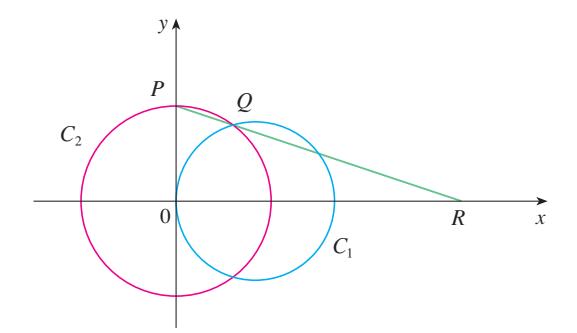
The figure shows a fixed circle \(C_1\) with equation \((x - 1)^2 + y^2 = 1\) and a shrinking circle \(C_2\) with radius \(r\) and center the origin. What happens to \(R\) as \(r \rightarrow 0^+\)?
question image

Answered: 0 / 66