Stewart 9e Section 10.3: Polar Coordinates

81 questions

0 / 81
Stewart 9e Section 10.3: Polar Coordinates 0/81
1 Parametric Equations, Polar Coordinates, and Vector-Valued Functions · Level 1
Plot the point whose polar coordinates are given. Then find two other pairs of polar coordinates of this point, one with \(r > 0\) and one with \(r < 0\).
(a) \(\left(1, \dfrac{\pi}{4}\right)\)
(b) \(\left(-2, 3 \dfrac{\pi}{2}\right)\)
(c) \(\left(3, -\dfrac{\pi}{3}\right)\)

Enter your answer directly below each part above.

2 Parametric Equations, Polar Coordinates, and Vector-Valued Functions · Level 1
Plot the point whose polar coordinates are given. Then find two other pairs of polar coordinates of this point, one with \(r > 0\) and one with \(r < 0\).
(a) \(\left(2, 5 \dfrac{\pi}{6}\right)\)
(b) \(\left(1, -2 \dfrac{\pi}{3}\right)\)
(c) \(\left(-1, 5 \dfrac{\pi}{4}\right)\)

Enter your answer directly below each part above.

3 Parametric Equations, Polar Coordinates, and Vector-Valued Functions · Level 1
Plot the point whose polar coordinates are given. Then find the Cartesian coordinates of the point.
(a) \(\left(2, 3 \dfrac{\pi}{2}\right)\)
(b) \(\left(\sqrt{2}, \dfrac{\pi}{4}\right)\)
(c) \(\left(-1, -\dfrac{\pi}{6}\right)\)

Enter your answer directly below each part above.

4 Parametric Equations, Polar Coordinates, and Vector-Valued Functions · Level 1
Plot the point whose polar coordinates are given. Then find the Cartesian coordinates of the point.
(a) \(\left(4, 4 \dfrac{\pi}{3}\right)\)
(b) \(\left(-2, 3 \dfrac{\pi}{4}\right)\)
(c) \(\left(-3, -\dfrac{\pi}{3}\right)\)

Enter your answer directly below each part above.

5 Parametric Equations, Polar Coordinates, and Vector-Valued Functions · Level 2
The Cartesian coordinates of a point are given. (i) Find polar coordinates \((r, \theta)\) of the point, where \(r > 0\) and \(0 \leq \theta < 2 \pi\). (ii) Find polar coordinates \((r, \theta)\) of the point, where \(r < 0\) and \(0 \leq \theta < 2 \pi\).
(a) \((-4, 4)\)
(b) \((3, 3 \sqrt{3})\)

Enter your answer directly below each part above.

6 Parametric Equations, Polar Coordinates, and Vector-Valued Functions · Level 2
The Cartesian coordinates of a point are given. (i) Find polar coordinates \((r, \theta)\) of the point, where \(r > 0\) and \(0 \leq \theta < 2 \pi\). (ii) Find polar coordinates \((r, \theta)\) of the point, where \(r < 0\) and \(0 \leq \theta < 2 \pi\).
(a) \((\sqrt{3}, -1)\)
(b) \((-6, 0)\)

Enter your answer directly below each part above.

7 Parametric Equations, Polar Coordinates, and Vector-Valued Functions · Level 1
Sketch the region in the plane consisting of points whose polar coordinates satisfy the given conditions. \(r \geq 1\)
8 Parametric Equations, Polar Coordinates, and Vector-Valued Functions · Level 1
Sketch the region in the plane consisting of points whose polar coordinates satisfy the given conditions. \(0 \leq r < 2\), \(\pi \leq \theta \leq 3 \dfrac{\pi}{2}\)
9 Parametric Equations, Polar Coordinates, and Vector-Valued Functions · Level 1
Sketch the region in the plane consisting of points whose polar coordinates satisfy the given conditions. \(r \geq 0\), \(\dfrac{\pi}{4} \leq \theta \leq 3 \dfrac{\pi}{4}\)
10 Parametric Equations, Polar Coordinates, and Vector-Valued Functions · Level 1
Sketch the region in the plane consisting of points whose polar coordinates satisfy the given conditions. \(1 \leq r \leq 3\), \(\dfrac{\pi}{6} < \theta < 5 \dfrac{\pi}{6}\)
11 Parametric Equations, Polar Coordinates, and Vector-Valued Functions · Level 2
Sketch the region in the plane consisting of points whose polar coordinates satisfy the given conditions. \(2 < r < 3\), \(5 \dfrac{\pi}{3} \leq \theta \leq 7 \dfrac{\pi}{3}\)
12 Parametric Equations, Polar Coordinates, and Vector-Valued Functions · Level 1
Sketch the region in the plane consisting of points whose polar coordinates satisfy the given conditions. \(r \geq 1\), \(\pi \leq \theta \leq 2 \pi\)
13 Parametric Equations, Polar Coordinates, and Vector-Valued Functions · Level 2
Find the distance between the points with polar coordinates \(\left(4, 4 \dfrac{\pi}{3}\right)\) and \(\left(6, 5 \dfrac{\pi}{3}\right)\).
14 Parametric Equations, Polar Coordinates, and Vector-Valued Functions · Level 2
Find a formula for the distance between the points with polar coordinates \((r_1, \theta_1)\) and \((r_2, \theta_2)\).
15 Parametric Equations, Polar Coordinates, and Vector-Valued Functions · Level 1
Identify the curve by finding a Cartesian equation for the curve. \(r^2 = 5\)
16 Parametric Equations, Polar Coordinates, and Vector-Valued Functions · Level 1
Identify the curve by finding a Cartesian equation for the curve. \(r = 4 \sec \theta\)
17 Parametric Equations, Polar Coordinates, and Vector-Valued Functions · Level 2
Identify the curve by finding a Cartesian equation for the curve. \(r = 5 \cos \theta\)
18 Parametric Equations, Polar Coordinates, and Vector-Valued Functions · Level 1
Identify the curve by finding a Cartesian equation for the curve. \(\theta = \dfrac{\pi}{3}\)
19 Parametric Equations, Polar Coordinates, and Vector-Valued Functions · Level 2
Identify the curve by finding a Cartesian equation for the curve. \(r^2 \cos 2 \theta = 1\)
20 Parametric Equations, Polar Coordinates, and Vector-Valued Functions · Level 2
Identify the curve by finding a Cartesian equation for the curve. \(r^2 \sin 2 \theta = 1\)
21 Parametric Equations, Polar Coordinates, and Vector-Valued Functions · Level 1
Find a polar equation for the curve represented by the given Cartesian equation. \(y = 2\)
22 Parametric Equations, Polar Coordinates, and Vector-Valued Functions · Level 1
Find a polar equation for the curve represented by the given Cartesian equation. \(y = x\)
23 Parametric Equations, Polar Coordinates, and Vector-Valued Functions · Level 2
Find a polar equation for the curve represented by the given Cartesian equation. \(y = 1 + 3 x\)
24 Parametric Equations, Polar Coordinates, and Vector-Valued Functions · Level 2
Find a polar equation for the curve represented by the given Cartesian equation. \(4 y^2 = x\)
25 Parametric Equations, Polar Coordinates, and Vector-Valued Functions · Level 2
Find a polar equation for the curve represented by the given Cartesian equation. \(x^2 + y^2 = 2 c x\)
26 Parametric Equations, Polar Coordinates, and Vector-Valued Functions · Level 2
Find a polar equation for the curve represented by the given Cartesian equation. \(x^2 - y^2 = 4\)
27 Parametric Equations, Polar Coordinates, and Vector-Valued Functions · Level 1
For each of the described curves, decide if the curve would be more easily given by a polar equation or a Cartesian equation. Then write an equation for the curve.
(a) A line through the origin that makes an angle of \(\dfrac{\pi}{6}\) with the positive \(x\)-axis.
(b) A vertical line through the point \((3, 3)\).

Enter your answer directly below each part above.

28 Parametric Equations, Polar Coordinates, and Vector-Valued Functions · Level 1
For each of the described curves, decide if the curve would be more easily given by a polar equation or a Cartesian equation. Then write an equation for the curve.
(a) A circle with radius 5 and center \((2, 3)\).
(b) A circle centered at the origin with radius 4.

Enter your answer directly below each part above.

29 Parametric Equations, Polar Coordinates, and Vector-Valued Functions · Level 1
Sketch the curve with the given polar equation by first sketching the graph of \(r\) as a function of \(\theta\) in Cartesian coordinates. \(r = -2 \sin \theta\)
30 Parametric Equations, Polar Coordinates, and Vector-Valued Functions · Level 1
Sketch the curve with the given polar equation by first sketching the graph of \(r\) as a function of \(\theta\) in Cartesian coordinates. \(r = 1 - \cos \theta\)
31 Parametric Equations, Polar Coordinates, and Vector-Valued Functions · Level 1
Sketch the curve with the given polar equation by first sketching the graph of \(r\) as a function of \(\theta\) in Cartesian coordinates. \(r = 2 (1 + \cos \theta)\)
32 Parametric Equations, Polar Coordinates, and Vector-Valued Functions · Level 2
Sketch the curve with the given polar equation by first sketching the graph of \(r\) as a function of \(\theta\) in Cartesian coordinates. \(r = 1 + 2 \cos \theta\)
33 Parametric Equations, Polar Coordinates, and Vector-Valued Functions · Level 1
Sketch the curve with the given polar equation by first sketching the graph of \(r\) as a function of \(\theta\) in Cartesian coordinates. \(r = \theta\), \(\theta \geq 0\)
34 Parametric Equations, Polar Coordinates, and Vector-Valued Functions · Level 2
Sketch the curve with the given polar equation by first sketching the graph of \(r\) as a function of \(\theta\) in Cartesian coordinates. \(r = \theta^2\), \(-2 \pi \leq \theta \leq 2 \pi\)
35 Parametric Equations, Polar Coordinates, and Vector-Valued Functions · Level 2
Sketch the curve with the given polar equation by first sketching the graph of \(r\) as a function of \(\theta\) in Cartesian coordinates. \(r = 3 \cos 3 \theta\)
36 Parametric Equations, Polar Coordinates, and Vector-Valued Functions · Level 2
Sketch the curve with the given polar equation by first sketching the graph of \(r\) as a function of \(\theta\) in Cartesian coordinates. \(r = -\sin 5 \theta\)
37 Parametric Equations, Polar Coordinates, and Vector-Valued Functions · Level 2
Sketch the curve with the given polar equation by first sketching the graph of \(r\) as a function of \(\theta\) in Cartesian coordinates. \(r = 2 \cos 4 \theta\)
38 Parametric Equations, Polar Coordinates, and Vector-Valued Functions · Level 2
Sketch the curve with the given polar equation by first sketching the graph of \(r\) as a function of \(\theta\) in Cartesian coordinates. \(r = 2 \sin 6 \theta\)
39 Parametric Equations, Polar Coordinates, and Vector-Valued Functions · Level 2
Sketch the curve with the given polar equation by first sketching the graph of \(r\) as a function of \(\theta\) in Cartesian coordinates. \(r = 1 + 3 \cos \theta\)
40 Parametric Equations, Polar Coordinates, and Vector-Valued Functions · Level 2
Sketch the curve with the given polar equation by first sketching the graph of \(r\) as a function of \(\theta\) in Cartesian coordinates. \(r = 1 + 5 \sin \theta\)
41 Parametric Equations, Polar Coordinates, and Vector-Valued Functions · Level 3
Sketch the curve with the given polar equation by first sketching the graph of \(r\) as a function of \(\theta\) in Cartesian coordinates. \(r^2 = 9 \sin 2 \theta\)
42 Parametric Equations, Polar Coordinates, and Vector-Valued Functions · Level 3
Sketch the curve with the given polar equation by first sketching the graph of \(r\) as a function of \(\theta\) in Cartesian coordinates. \(r^2 = \cos 4 \theta\)
43 Parametric Equations, Polar Coordinates, and Vector-Valued Functions · Level 2
Sketch the curve with the given polar equation by first sketching the graph of \(r\) as a function of \(\theta\) in Cartesian coordinates. \(r = 2 + \sin 3 \theta\)
44 Parametric Equations, Polar Coordinates, and Vector-Valued Functions · Level 3
Sketch the curve with the given polar equation by first sketching the graph of \(r\) as a function of \(\theta\) in Cartesian coordinates. \(r^2 \theta = 1\)
45 Parametric Equations, Polar Coordinates, and Vector-Valued Functions · Level 2
Sketch the curve with the given polar equation by first sketching the graph of \(r\) as a function of \(\theta\) in Cartesian coordinates. \(r = \sin\left(\dfrac{\theta}{2}\right)\)
46 Parametric Equations, Polar Coordinates, and Vector-Valued Functions · Level 2
Sketch the curve with the given polar equation by first sketching the graph of \(r\) as a function of \(\theta\) in Cartesian coordinates. \(r = \cos\left(\dfrac{\theta}{3}\right)\)
47 Parametric Equations, Polar Coordinates, and Vector-Valued Functions · Level 2
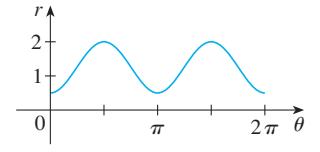
The figure shows a graph of \(r\) as a function of \(\theta\) in Cartesian coordinates. Use it to sketch the corresponding polar curve.
question image
48 Parametric Equations, Polar Coordinates, and Vector-Valued Functions · Level 2
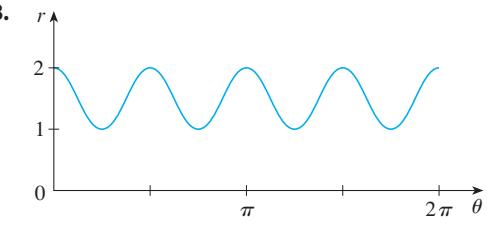
The figure shows a graph of \(r\) as a function of \(\theta\) in Cartesian coordinates. Use it to sketch the corresponding polar curve.
question image
49 Parametric Equations, Polar Coordinates, and Vector-Valued Functions · Level 3
Show that the polar curve \(r = 4 + 2 \sec \theta\) (called a conchoid) has the line \(x = 2\) as a vertical asymptote by showing that \(\operatorname*{lim}\limits_{r \rightarrow \pm \infty} x = 2\). Use this fact to help sketch the conchoid.
50 Parametric Equations, Polar Coordinates, and Vector-Valued Functions · Level 3
Show that the curve \(r = 2 - \csc \theta\) (also a conchoid) has the line \(y = -1\) as a horizontal asymptote by showing that \(\operatorname*{lim}\limits_{r \rightarrow \pm \infty} y = -1\). Use this fact to help sketch the conchoid.
51 Parametric Equations, Polar Coordinates, and Vector-Valued Functions · Level 3
Show that the curve \(r = \sin \theta \tan \theta\) (called a cissoid of Diocles) has the line \(x = 1\) as a vertical asymptote. Show also that the curve lies entirely within the vertical strip \(0 \leq x < 1\). Use these facts to help sketch the cissoid.
52 Parametric Equations, Polar Coordinates, and Vector-Valued Functions · Level 3
Sketch the curve \((x^2 + y^2)^3 = 4 x^2 y^2\).
53 Parametric Equations, Polar Coordinates, and Vector-Valued Functions · Level 3
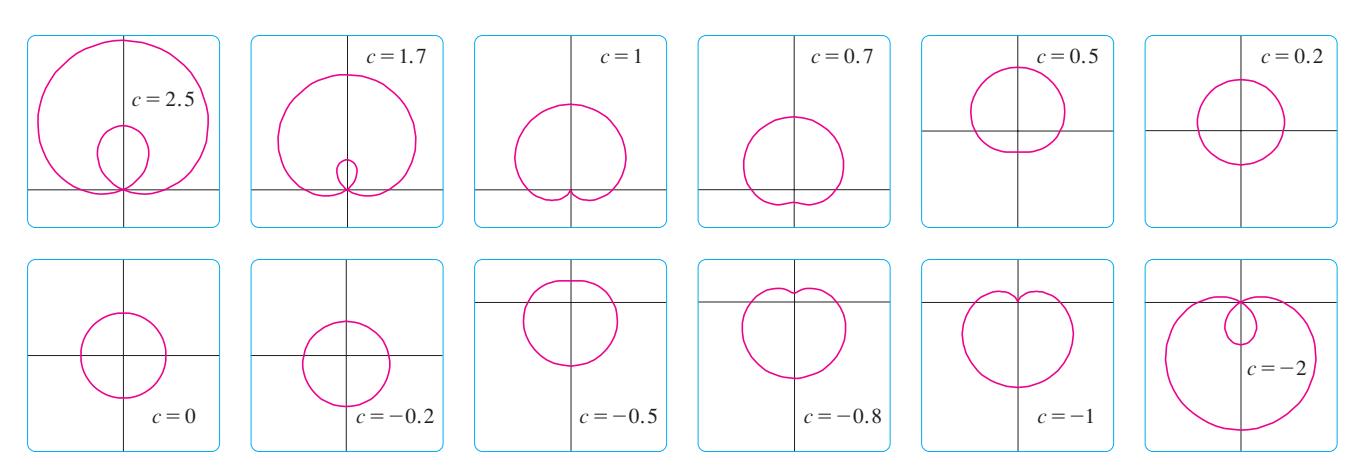
(a) In Example 11 the graphs suggest that the limacon \(r = 1 + c \sin \theta\) has an inner loop when \(|c| > 1\). Prove that this is true, and find the values of \(\theta\) that correspond to the inner loop.
(b) From Figure 19 it appears that the limacon loses its dimple when \(c = \dfrac{1}{2}\). Prove this.

Enter your answer directly below each part above.

54 Parametric Equations, Polar Coordinates, and Vector-Valued Functions · Level 2
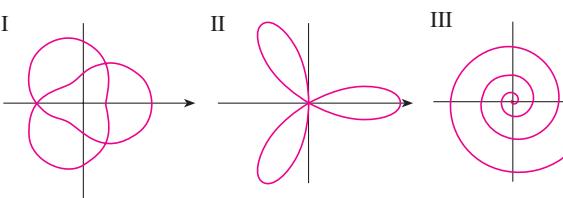
Match the polar equations with the graphs labeled I-VI. Give reasons for your choices. (Don't use a graphing device.)
question image
(a) \(r = \ln \theta\), \(1 \leq \theta \leq 6 \pi\)
(b) \(r = \theta^2\), \(0 \leq \theta \leq 8 \pi\)
(c) \(r = \cos 3 \theta\)
(d) \(r = 2 + \cos 3 \theta\)
(e) \(r = \cos\left(\dfrac{\theta}{2}\right)\)
(f) \(r = 2 + \cos\left(3 \dfrac{\theta}{2}\right)\)

Enter your answer directly below each part above.

55 Parametric Equations, Polar Coordinates, and Vector-Valued Functions · Level 2
Find the slope of the tangent line to the given polar curve at the point specified by the value of \(\theta\). \(r = 2 \cos \theta\), \(\theta = \dfrac{\pi}{3}\)
56 Parametric Equations, Polar Coordinates, and Vector-Valued Functions · Level 3
Find the slope of the tangent line to the given polar curve at the point specified by the value of \(\theta\). \(r = 2 + \sin 3 \theta\), \(\theta = \dfrac{\pi}{4}\)
57 Parametric Equations, Polar Coordinates, and Vector-Valued Functions · Level 2
Find the slope of the tangent line to the given polar curve at the point specified by the value of \(\theta\). \(r = \dfrac{1}{\theta}\), \(\theta = \pi\)
58 Parametric Equations, Polar Coordinates, and Vector-Valued Functions · Level 2
Find the slope of the tangent line to the given polar curve at the point specified by the value of \(\theta\). \(r = \cos\left(\dfrac{\theta}{3}\right)\), \(\theta = \pi\)
59 Parametric Equations, Polar Coordinates, and Vector-Valued Functions · Level 2
Find the slope of the tangent line to the given polar curve at the point specified by the value of \(\theta\). \(r = \cos 2 \theta\), \(\theta = \dfrac{\pi}{4}\)
60 Parametric Equations, Polar Coordinates, and Vector-Valued Functions · Level 2
Find the slope of the tangent line to the given polar curve at the point specified by the value of \(\theta\). \(r = 1 + 2 \cos \theta\), \(\theta = \dfrac{\pi}{3}\)
61 Differentiation: Composite, Implicit, and Inverse Functions · Level 2
Find the points on the given curve where the tangent line is horizontal or vertical. \(r = 3 \cos \theta\)
62 Differentiation: Composite, Implicit, and Inverse Functions · Level 3
Find the points on the given curve where the tangent line is horizontal or vertical. \(r = 1 - \sin \theta\)
63 Differentiation: Composite, Implicit, and Inverse Functions · Level 3
Find the points on the given curve where the tangent line is horizontal or vertical. \(r = 1 + \cos \theta\)
64 Differentiation: Composite, Implicit, and Inverse Functions · Level 3
Find the points on the given curve where the tangent line is horizontal or vertical. \(r = e^\theta\)
65 Parametric Equations, Polar Coordinates, and Vector-Valued Functions · Level 2
Show that the polar equation \(r = a \sin \theta + b \cos \theta\), where \(a b \neq 0\), represents a circle, and find its center and radius.
66 Parametric Equations, Polar Coordinates, and Vector-Valued Functions · Level 3
Show that the curves \(r = a \sin \theta\) and \(r = a \cos \theta\) intersect at right angles.
67 Parametric Equations, Polar Coordinates, and Vector-Valued Functions · Level 2
Use a graphing device to graph the polar curve. Choose the parameter interval to make sure that you produce the entire curve. \(r = 1 + 2 \sin\left(\dfrac{\theta}{2}\right)\) (nephroid of Freeth)
68 Parametric Equations, Polar Coordinates, and Vector-Valued Functions · Level 2
Use a graphing device to graph the polar curve. Choose the parameter interval to make sure that you produce the entire curve. \(r = \sqrt{1 - 0.8 \sin^2 \theta}\) (hippopede)
69 Parametric Equations, Polar Coordinates, and Vector-Valued Functions · Level 2
Use a graphing device to graph the polar curve. Choose the parameter interval to make sure that you produce the entire curve. \(r = e^{\sin \theta} - 2 \cos(4 \theta)\) (butterfly curve)
70 Parametric Equations, Polar Coordinates, and Vector-Valued Functions · Level 2
Use a graphing device to graph the polar curve. Choose the parameter interval to make sure that you produce the entire curve. \(r = |\tan \theta|^|\cot \theta|\) (valentine curve)
71 Parametric Equations, Polar Coordinates, and Vector-Valued Functions · Level 2
Use a graphing device to graph the polar curve. Choose the parameter interval to make sure that you produce the entire curve. \(r = 1 + \cos^{999} \theta\) (Pac-Man curve)
72 Parametric Equations, Polar Coordinates, and Vector-Valued Functions · Level 2
Use a graphing device to graph the polar curve. Choose the parameter interval to make sure that you produce the entire curve. \(r = 2 + \cos\left(9 \dfrac{\theta}{4}\right)\)
73 Parametric Equations, Polar Coordinates, and Vector-Valued Functions · Level 2
How are the graphs of \(r = 1 + \sin\left(\theta - \dfrac{\pi}{6}\right)\) and \(r = 1 + \sin\left(\theta - \dfrac{\pi}{3}\right)\) related to the graph of \(r = 1 + \sin \theta\)? In general, how is the graph of \(r = f(\theta - \alpha)\) related to the graph of \(r = f(\theta)\)?
74 Parametric Equations, Polar Coordinates, and Vector-Valued Functions · Level 3
Use a graph to estimate the \(y\)-coordinate of the highest points on the curve \(r = \sin 2 \theta\). Then use calculus to find the exact value.
75 Parametric Equations, Polar Coordinates, and Vector-Valued Functions · Level 2
Investigate the family of curves with polar equations \(r = 1 + c \cos \theta\), where \(c\) is a real number. How does the shape change as \(c\) changes?
76 Parametric Equations, Polar Coordinates, and Vector-Valued Functions · Level 3
Investigate the family of polar curves \(r = 1 + \cos^n \theta\) where \(n\) is a positive integer. How does the shape change as \(n\) increases? What happens as \(n\) becomes large? Explain the shape for large \(n\) by considering the graph of \(r\) as a function of \(\theta\) in Cartesian coordinates.
77 Parametric Equations, Polar Coordinates, and Vector-Valued Functions · Level 3
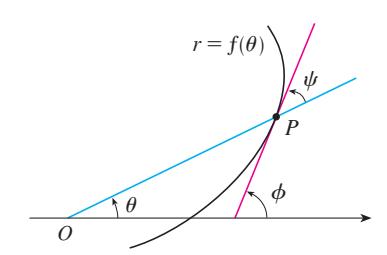
Let \(P\) be any point (except the origin) on the curve \(r = f(\theta)\). If \(\psi\) is the angle between the tangent line at \(P\) and the radial line \(O P\), show that \(\tan \psi = r / \left(d \dfrac{r}{d} \theta\right)\) [Hint: Observe that \(\psi = \phi - \theta\) in the figure.]
question image
78 Parametric Equations, Polar Coordinates, and Vector-Valued Functions · Level 3
(a) Use Exercise 77 to show that the angle between the tangent line and the radial line is \(\psi = \dfrac{\pi}{4}\) at every point on the curve \(r = e^\theta\).
(b) Illustrate part (a) by graphing the curve and the tangent lines at the points where \(\theta = 0\) and \(\dfrac{\pi}{2}\).
(c) Prove that any polar curve \(r = f(\theta)\) with the property that the angle \(\psi\) between the radial line and the tangent line is a constant must be of the form \(r = C e^{k \theta}\), where \(C\) and \(k\) are constants.

Enter your answer directly below each part above.

79 Parametric Equations, Polar Coordinates, and Vector-Valued Functions · Level 3
(a) For the cardioid \(r = 1 + \sin \theta\), find the slope of the tangent line when \(\theta = \dfrac{\pi}{3}\).
(b) Find the points on the cardioid where the tangent line is horizontal or vertical.

Enter your answer directly below each part above.

80 Parametric Equations, Polar Coordinates, and Vector-Valued Functions · Level 2
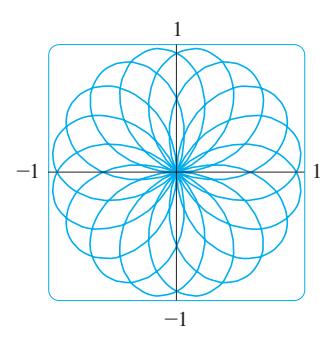
Graph the curve \(r = \sin\left(8 \dfrac{\theta}{5}\right)\).
question image
81 Parametric Equations, Polar Coordinates, and Vector-Valued Functions · Level 2
Investigate the family of polar curves given by \(r = 1 + c \sin \theta\). How does the shape change as \(c\) changes? (These curves are called limacons.)
question image

Answered: 0 / 81