TMUA 2021 Paper 1

20 questions

--:--
0 / 20
TMUA 2021 Paper 1 0/20
1 Coordinate Geometry · Level 3
Two circles have the same radius. The centre of one circle is \((-2, 1)\). The centre of the other circle is \((3, -2)\). The circles intersect at two distinct points. What is the equation of the straight line through the two points at which the circles intersect?
A
\(3x - 5y = 4\)
B
\(3x + 5y = -1\)
C
\(5x - 3y = -4\)
D
\(5x - 3y = -1\)
E
\(5x - 3y = 1\)
F
\(5x - 3y = 4\)
G
\(5x + 3y = 1\)
2 Integration · Level 3
The curve \(y = x^3 - 6x + 3\) has turning points at \(x = \alpha\) and \(x = \beta\), where \(\beta > \alpha\). Find \( \displaystyle\int_{\alpha}^{\beta} x^3 - 6x + 3 \, d x \)
A
\(-8 \sqrt{2}\)
B
\(-10\)
C
\(-10 + 6 \sqrt{2}\)
D
\(0\)
E
\(12 - 8 \sqrt{2}\)
F
\(6 \sqrt{2}\)
G
\(12\)
3 Sequences and Series · Level 3
An arithmetic progression and a convergent geometric progression each have first term \(\dfrac{1}{2}\). The sum of the second terms of the two progressions is \(\dfrac{1}{2}\). The sum of the third terms of the two progressions is \(\dfrac{1}{8}\). What is the sum to infinity of the geometric progression?
A
\(-2\)
B
\(-1\)
C
\(-\dfrac{1}{2}\)
D
\(-\dfrac{1}{3}\)
E
\(\dfrac{1}{3}\)
F
\(\dfrac{1}{2}\)
G
\(1\)
H
\(2\)
4 Exponentials and Logarithms · Level 3
Find the minimum value of the function \( 2^{2x} - 2^{x+3} + 4 \)
A
\(-16\)
B
\(-12\)
C
\(-8\)
D
\(0\)
E
\(4\)
F
\(20\)
5 Functions and Their Graphs · Level 3
The function \(f\) is such that \( f(m n) = \begin{cases} f(m) f(n) & \quad \text{if } m n \text{is a multiple of 3} \\ m n & \quad \text{if } m n \text{is not a multiple of 3} \end{cases} \) for all positive integers \(m\) and \(n\). Given that \(f(9) + f(16) - f(24) = 0\), what is the value of \(f(3)\)?
A
\(\dfrac{8}{3}\)
B
\(2 \sqrt{2}\)
C
\(3\)
D
\(\dfrac{16}{5}\)
E
\(3 \sqrt{2}\)
F
\(4\)
6 Trigonometric Functions · Level 3
The function \(f\) is given by \( f(x) = \dfrac{\cos x + 3}{7 + 5 \cos x - \sin^2 x} \) Find the positive difference between the maximum and the minimum values of \(f(x)\).
A
\(0\)
B
\(\dfrac{1}{3}\)
C
\(\dfrac{1}{2}\)
D
\(\dfrac{2}{3}\)
E
\(1\)
F
\(2\)
7 Integration · Level 3
The function \(f\) is such that \(f(0) = 0\), and \(x f(x) > 0\) for all non-zero values of \(x\). It is given that \( \displaystyle\int_{-2}^{2} f(x) \, d x = 4 \) and \( \displaystyle\int_{-2}^{2} |f(x)| \, d x = 8 \) Evaluate \( \displaystyle\int_{-2}^{0} f(|x|) \, d x \)
A
\(-8\)
B
\(-6\)
C
\(-4\)
D
\(-2\)
E
\(2\)
F
\(4\)
G
\(6\)
H
\(8\)
8 Equations · Level 3
The line \(y = 2x + 3\) meets the curve \(y = x^2 + b x + c\) at exactly one point. The line \(y = 4x - 2\) also meets the curve \(y = x^2 + b x + c\) at exactly one point. What is the value of \(b - c\)?
A
\(-9\)
B
\(-5.5\)
C
\(-1\)
D
\(5\)
E
\(6\)
F
\(14\)
9 Curve Sketching · Level 3
Find the area enclosed by the graph of \( |x| + |y| = 1 \)
A
\(\dfrac{1}{2}\)
B
\(1\)
C
\(2\)
D
\(4\)
E
\(\dfrac{1}{2} \sqrt{2}\)
F
\(\sqrt{2}\)
G
\(2 \sqrt{2}\)
10 Integration · Level 3
Use the trapezium rule with 3 strips to estimate \( \displaystyle\int_{\dfrac{1}{2}}^{2} 2 \log_10 x \, d x \)
A
\(\log_10 \dfrac{6}{\sqrt{2}}\)
B
\(\log_10 \dfrac{3}{2}\)
C
\(\log_10 \dfrac{9}{4}\)
D
\(\log_10 3\)
E
\(\log_10 \dfrac{81}{16}\)
F
\(\log_10 \dfrac{2}{3 \sqrt{2}}\)
11 Differentiation · Level 3
The function \(f\) is given by \( f(x) = x^{\dfrac{1}{7}} (x^2 - x + 1) \) Find the fraction of the interval \(0 < x < 1\) for which \(f(x)\) is decreasing.
A
\(\dfrac{2}{15}\)
B
\(\dfrac{1}{5}\)
C
\(\dfrac{1}{3}\)
D
\(\dfrac{1}{2}\)
E
\(\dfrac{2}{3}\)
F
\(\dfrac{4}{5}\)
G
\(\dfrac{13}{15}\)
12 Polynomials · Level 3
The minimum value of the function \(x^4 - p^2 x^2\) is \(-9\). \(p\) is a real number. Find the minimum value of the function \(x^2 - p x + 6\).
A
\(-3\)
B
\(6 - \dfrac{3 \sqrt{2}}{2}\)
C
\(\dfrac{3}{2}\)
D
\(3\)
E
\(\dfrac{9}{2}\)
F
\(6 + \dfrac{3 \sqrt{2}}{2}\)
13 Integration · Level 3
The function \(f\) is such that, for every integer \(n\), \( \displaystyle\int_{n}^{n+1} f(x) \, d x = n + 1 \) Evaluate \( \displaystyle\sum_{r=1}^{8} ( \displaystyle\int_{0}^{r} f(x) \, d x ) \)
A
\(36\)
B
\(84\)
C
\(120\)
D
\(165\)
E
\(204\)
F
\(288\)
14 Trigonometric Equations · Level 3
This question uses radians. Find the number of distinct values of \(x\) that satisfy the equation \( (x+1)(3-x) = 2(1 - \cos(\pi x)) \)
A
\(2\)
B
\(3\)
C
\(4\)
D
\(5\)
E
\(6\)
F
\(7\)
15 Integration · Level 3
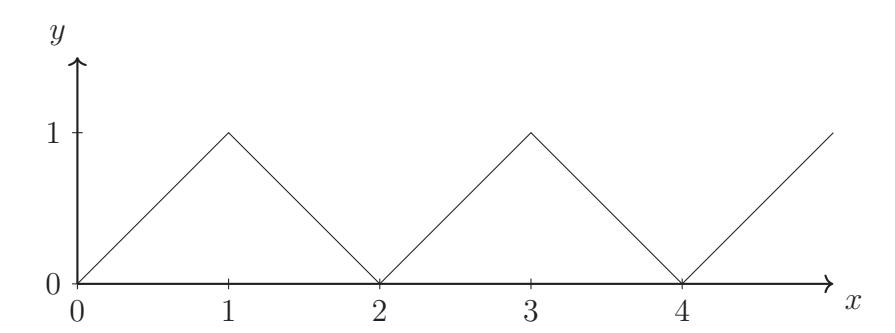
The diagram shows the graph of \(y = f(x)\). The graph consists of alternating straight-line segments of gradient \(1\) and \(-1\) and continues in this way for all values of \(x\). The function \(g\) is defined as \( g(x) = \displaystyle\sum_{r=1}^{10} f(2^{r-1} x) \) Find the value of \( \displaystyle\int_{0}^{1} g(x) \, d x \)
question image
A
\(\dfrac{1023}{1024}\)
B
\(\dfrac{1023}{512}\)
C
\(5\)
D
\(10\)
E
\(\dfrac{55}{2}\)
F
\(55\)
16 Polynomials · Level 3
Consider the expansion of \( (a + b x)^n \) The third term, in *ascending* powers of \(x\), is \(105 x^2\). The fourth term, in *ascending* powers of \(x\), is \(210 x^3\). The fourth term, in *descending* powers of \(x\), is \(210 x^3\). Find the value of \(\left(\dfrac{a}{b}\right)^2\).
A
\(\dfrac{1}{4}\)
B
\(\dfrac{4}{9}\)
C
\(\dfrac{25}{36}\)
D
\(\dfrac{5}{6}\)
E
\(1\)
17 Curve Sketching · Level 3
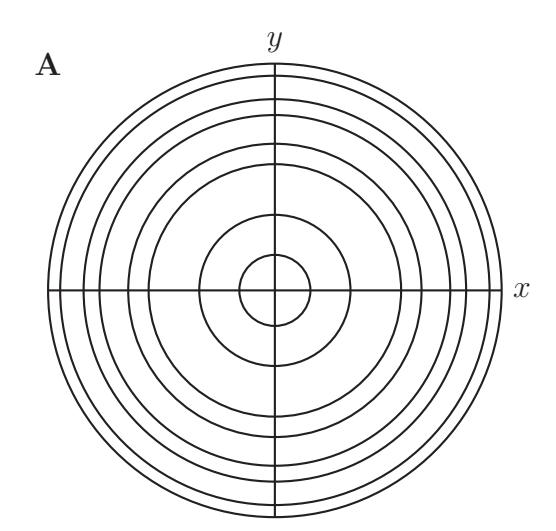
Which of the following sketches shows the graph of \( \sin(x^2 + y^2) = \dfrac{1}{2} \) where \(x^2 + y^2 \leq 8 \pi\) ?
question image
A
B
C
D
E
18 Coordinate Geometry · Level 3
The curve with equation \( x = y^2 - 6y + 11 \) is rotated \(90^{\circ}\) clockwise about the point \(P\) to give the curve \(C\). \(P\) has \(x\)-coordinate \(-2\) and \(y\)-coordinate \(3\). What is the equation of \(C\)?
A
\(y = -x^2 - 4x - 3\)
B
\(y = -x^2 - 4x - 5\)
C
\(y = -x^2 - 6x - 7\)
D
\(y = -x^2 - 6x - 11\)
E
\(y = x^2 - 4x + 5\)
F
\(y = x^2 + 4x + 3\)
G
\(y = x^2 - 6x + 11\)
H
\(y = x^2 + 6x + 7\)
19 Trigonometric Equations · Level 3
The equation \( \sin^2 (4^{\cos \theta} \times 60^{\circ}) = \dfrac{3}{4} \) has exactly three solutions in the range \(0^{\circ} \leq \theta \leq x^{\circ}\). What is the range of all possible values of \(x\)?
A
\(90 \leq x < 120\)
B
\(90 \leq x < 270\)
C
\(120 \leq x < 240\)
D
\(270 \leq x < 300\)
E
\(300 \leq x < 360\)
F
\(450 \leq x < 630\)
20 Exponentials and Logarithms · Level 3
Find the length of the curve with equation \( 2 \log_10 (x - y) = \log_10 (2 - 2x) + \log_10 (y + 5) \)
A
\(5\)
B
\(10\)
C
\(15\)
D
\(3 \pi\)
E
\(9 \pi\)
F
\(12 \pi\)

Answered: 0 / 20

0 / 20