Stewart 9e Section 3.1: Maximum and Minimum Values

84 questions

0 / 84
Stewart 9e Section 3.1: Maximum and Minimum Values 0/84
1 Limits and Continuity · Level 1
Explain the difference between an absolute minimum and a local minimum.
2 Limits and Continuity · Level 1
Suppose \(f\) is a continuous function defined on a closed interval \([a, b]\).
(a) What theorem guarantees the existence of an absolute maximum value and an absolute minimum value for \(f\)?
(b) What steps would you take to find those maximum and minimum values?

Enter your answer directly below each part above.

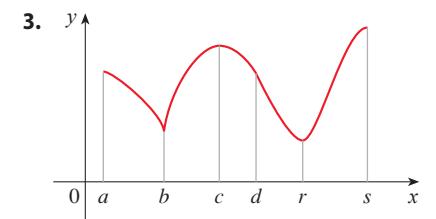
3 Analytical Applications of Differentiation · Level 1
For each of the numbers \(a\), \(b\), \(c\), \(d\), \(r\), and \(s\), state whether the function whose graph is shown has an absolute maximum or minimum, a local maximum or minimum, or neither a maximum nor a minimum at that number.
question image
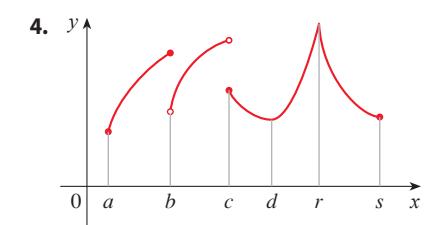
4 Analytical Applications of Differentiation · Level 1
For each of the numbers \(a\), \(b\), \(c\), \(d\), \(r\), and \(s\), state whether the function whose graph is shown has an absolute maximum or minimum, a local maximum or minimum, or neither a maximum nor a minimum at that number.
question image
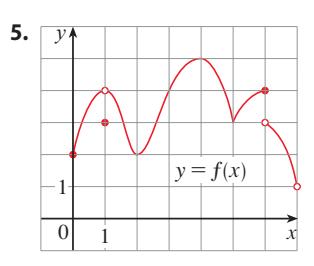
5 Analytical Applications of Differentiation · Level 1
Use the graph to state the absolute and local maximum and minimum values of the function.
question image
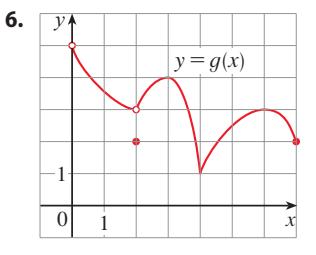
6 Analytical Applications of Differentiation · Level 1
Use the graph to state the absolute and local maximum and minimum values of the function.
question image
7 Analytical Applications of Differentiation · Level 2
Sketch the graph of a function \(f\) that is continuous on \([1, 5]\) and has the given properties: absolute maximum at \(5\), absolute minimum at \(2\), local maximum at \(3\), local minima at \(2\) and \(4\).
8 Analytical Applications of Differentiation · Level 2
Sketch the graph of a function \(f\) that is continuous on \([1, 5]\) and has the given properties: absolute maximum at \(4\), absolute minimum at \(5\), local maximum at \(2\), local minimum at \(3\).
9 Analytical Applications of Differentiation · Level 2
Sketch the graph of a function \(f\) that is continuous on \([1, 5]\) and has the given properties: absolute minimum at \(3\), absolute maximum at \(4\), local maximum at \(2\).
10 Analytical Applications of Differentiation · Level 2
Sketch the graph of a function \(f\) that is continuous on \([1, 5]\) and has the given properties: absolute maximum at \(2\), absolute minimum at \(5\), and \(4\) is a critical number but there is no local maximum or minimum there.
11 Analytical Applications of Differentiation · Level 2
(a) Sketch the graph of a function that has a local maximum at \(2\) and is differentiable at \(2\).
(b) Sketch the graph of a function that has a local maximum at \(2\) and is continuous but not differentiable at \(2\).
(c) Sketch the graph of a function that has a local maximum at \(2\) and is not continuous at \(2\).

Enter your answer directly below each part above.

12 Analytical Applications of Differentiation · Level 2
(a) Sketch the graph of a function on \([-1, 2]\) that has an absolute maximum but no local maximum.
(b) Sketch the graph of a function on \([-1, 2]\) that has a local maximum but no absolute maximum.

Enter your answer directly below each part above.

13 Analytical Applications of Differentiation · Level 2
(a) Sketch the graph of a function on \([-1, 2]\) that has an absolute maximum but no absolute minimum.
(b) Sketch the graph of a function on \([-1, 2]\) that is discontinuous but has both an absolute maximum and an absolute minimum.

Enter your answer directly below each part above.

14 Analytical Applications of Differentiation · Level 2
(a) Sketch the graph of a function that has two local maxima, one local minimum, and no absolute minimum.
(b) Sketch the graph of a function that has three local minima, two local maxima, and seven critical numbers.

Enter your answer directly below each part above.

15 Analytical Applications of Differentiation · Level 1
Sketch the graph of \(f(x) = 3 - 2 x\), \(x \geq -1\), by hand and find the absolute and local maximum and minimum values of \(f\).
16 Analytical Applications of Differentiation · Level 1
Sketch the graph of \(f(x) = x^2\), \(-1 \leq x < 2\), by hand and find the absolute and local maximum and minimum values of \(f\).
17 Analytical Applications of Differentiation · Level 1
Sketch the graph of \(f(x) = \dfrac{1}{x}\), \(x \geq 1\), by hand and find the absolute and local maximum and minimum values of \(f\).
18 Analytical Applications of Differentiation · Level 1
Sketch the graph of \(f(x) = \dfrac{1}{x}\), \(1 < x < 3\), by hand and find the absolute and local maximum and minimum values of \(f\).
19 Analytical Applications of Differentiation · Level 1
Sketch the graph of \(f(x) = \sin x\), \(0 \leq x < \dfrac{\pi}{2}\), by hand and find the absolute and local maximum and minimum values of \(f\).
20 Analytical Applications of Differentiation · Level 1
Sketch the graph of \(f(x) = \sin x\), \(0 < x \leq \dfrac{\pi}{2}\), by hand and find the absolute and local maximum and minimum values of \(f\).
21 Analytical Applications of Differentiation · Level 1
Sketch the graph of \(f(x) = \sin x\), \(-\dfrac{\pi}{2} \leq x \leq \dfrac{\pi}{2}\), by hand and find the absolute and local maximum and minimum values of \(f\).
22 Analytical Applications of Differentiation · Level 1
Sketch the graph of \(f(t) = \cos t\), \(-3 \dfrac{\pi}{2} \leq t \leq 3 \dfrac{\pi}{2}\), by hand and find the absolute and local maximum and minimum values of \(f\).
23 Analytical Applications of Differentiation · Level 1
Sketch the graph of \(f(x) = 1 + (x + 1)^2\), \(-2 \leq x < 5\), by hand and find the absolute and local maximum and minimum values of \(f\).
24 Analytical Applications of Differentiation · Level 1
Sketch the graph of \(f(x) = |x|\) by hand and find the absolute and local maximum and minimum values of \(f\).
25 Analytical Applications of Differentiation · Level 1
Sketch the graph of \(f(x) = 1 - \sqrt{x}\) by hand and find the absolute and local maximum and minimum values of \(f\).
26 Analytical Applications of Differentiation · Level 1
Sketch the graph of \(f(x) = 1 - x^3\) by hand and find the absolute and local maximum and minimum values of \(f\).
27 Analytical Applications of Differentiation · Level 2
Sketch the graph of \(f(x) = \begin{cases} x^2 & \quad \text{if } -1 \leq x \leq 0 \\ 2 - 3 x & \quad \text{if } 0 < x \leq 1 \end{cases}\) by hand and find the absolute and local maximum and minimum values of \(f\).
28 Analytical Applications of Differentiation · Level 2
Sketch the graph of \(f(x) = \begin{cases} 2 x + 1 & \quad \text{if } 0 \leq x < 1 \\ 4 - 2 x & \quad \text{if } 1 \leq x \leq 3 \end{cases}\) by hand and find the absolute and local maximum and minimum values of \(f\).
29 Analytical Applications of Differentiation · Level 1
Find the critical numbers of the function \(f(x) = 3 x^2 + x - 2\).
30 Analytical Applications of Differentiation · Level 1
Find the critical numbers of the function \(g(v) = v^3 - 12 v + 4\).
31 Analytical Applications of Differentiation · Level 2
Find the critical numbers of the function \(f(x) = 3 x^4 + 8 x^3 - 48 x^2\).
32 Analytical Applications of Differentiation · Level 2
Find the critical numbers of the function \(f(x) = 2 x^3 + x^2 + 8 x\).
33 Analytical Applications of Differentiation · Level 2
Find the critical numbers of the function \(g(t) = t^5 + 5 t^3 + 50 t\).
34 Analytical Applications of Differentiation · Level 1
Find the critical numbers of the function \(A(x) = |3 - 2 x|\).
35 Analytical Applications of Differentiation · Level 2
Find the critical numbers of the function \(g(y) = \dfrac{y - 1}{y^2 - y + 1}\).
36 Analytical Applications of Differentiation · Level 2
Find the critical numbers of the function \(h(p) = \dfrac{p - 1}{p^2 + 4}\).
37 Analytical Applications of Differentiation · Level 2
Find the critical numbers of the function \(p(x) = \dfrac{x^2 + 2}{2 x - 1}\).
38 Analytical Applications of Differentiation · Level 2
Find the critical numbers of the function \(q(t) = \dfrac{t^2 + 9}{t^2 + 9}\).
39 Analytical Applications of Differentiation · Level 2
Find the critical numbers of the function \(h(t) = t^{\dfrac{3}{4}} - 2 t^{\dfrac{1}{4}}\).
40 Analytical Applications of Differentiation · Level 2
Find the critical numbers of the function \(g(x) = \sqrt[3]{4 - x^2}\).
41 Analytical Applications of Differentiation · Level 3
Find the critical numbers of the function \(F(x) = x^{\dfrac{4}{5}} (x - 4)^2\).
42 Analytical Applications of Differentiation · Level 2
Find the critical numbers of the function \(h(x) = x^{-\dfrac{1}{3}}(x - 2)\).
43 Analytical Applications of Differentiation · Level 3
Find the critical numbers of the function \(f(x) = x^{\dfrac{1}{3}}(4 - x)^{\dfrac{2}{3}}\).
44 Analytical Applications of Differentiation · Level 2
Find the critical numbers of the function \(f(\theta) = \theta + \sqrt{2} \cos \theta\).
45 Analytical Applications of Differentiation · Level 2
Find the critical numbers of the function \(f(\theta) = 2 \cos \theta + \sin^2 \theta\).
46 Analytical Applications of Differentiation · Level 1
Find the critical numbers of the function \(g(x) = \sqrt{1 - x^2}\).
47 Analytical Applications of Differentiation · Level 3
A formula for the derivative of a function \(f\) is given. How many critical numbers does \(f\) have? \( f'(x) = 1 + \dfrac{210 \sin x}{x^2 - 6 x + 10} \)
48 Analytical Applications of Differentiation · Level 3
A formula for the derivative of a function \(f\) is given. How many critical numbers does \(f\) have? \( f'(x) = \dfrac{100 \cos^2 x}{10 + x^2} - 1 \)
49 Analytical Applications of Differentiation · Level 1
Find the absolute maximum and absolute minimum values of \(f(x) = 12 + 4 x - x^2\) on \([0, 5]\).
50 Analytical Applications of Differentiation · Level 2
Find the absolute maximum and absolute minimum values of \(f(x) = 5 + 54 x - 2 x^3\) on \([0, 4]\).
51 Analytical Applications of Differentiation · Level 2
Find the absolute maximum and absolute minimum values of \(f(x) = 2 x^3 - 3 x^2 - 12 x + 1\) on \([-2, 3]\).
52 Analytical Applications of Differentiation · Level 2
Find the absolute maximum and absolute minimum values of \(f(x) = x^3 - 6 x^2 + 5\) on \([-3, 5]\).
53 Analytical Applications of Differentiation · Level 2
Find the absolute maximum and absolute minimum values of \(f(x) = 3 x^4 - 4 x^3 - 12 x^2 + 1\) on \([-2, 3]\).
54 Analytical Applications of Differentiation · Level 2
Find the absolute maximum and absolute minimum values of \(f(t) = (t^2 - 4)^3\) on \([-2, 3]\).
55 Analytical Applications of Differentiation · Level 2
Find the absolute maximum and absolute minimum values of \(f(x) = x + \dfrac{1}{x}\) on \([0.2, 4]\).
56 Analytical Applications of Differentiation · Level 2
Find the absolute maximum and absolute minimum values of \(f(x) = \dfrac{x}{x^2 - x + 1}\) on \([0, 3]\).
57 Analytical Applications of Differentiation · Level 3
Find the absolute maximum and absolute minimum values of \(f(t) = t - \sqrt[3]{t}\) on \([-1, 4]\).
58 Analytical Applications of Differentiation · Level 2
Find the absolute maximum and absolute minimum values of \(f(t) = \dfrac{\sqrt{t}}{1 + t^2}\) on \([0, 2]\).
59 Analytical Applications of Differentiation · Level 2
Find the absolute maximum and absolute minimum values of \(f(t) = 2 \cos t + \sin 2 t\) on \([0, \dfrac{\pi}{2}]\).
60 Analytical Applications of Differentiation · Level 2
Find the absolute maximum and absolute minimum values of \(f(\theta) = 1 + \cos^2 \theta\) on \([\dfrac{\pi}{4}, \pi]\).
61 Analytical Applications of Differentiation · Level 3
If \(a\) and \(b\) are positive numbers, find the maximum value of \(f(x) = x^a (1 - x)^b\), \(0 \leq x \leq 1\).
62 Integration and Accumulation of Change · Level 2
Use a graph to estimate the critical numbers of \(f(x) = |1 + 5 x - x^3|\) correct to one decimal place.
63 Analytical Applications of Differentiation · Level 2
(a) Use a graph to estimate the absolute maximum and minimum values of \(f(x) = x^5 - x^3 + 2\) on \([-1, 1]\) to two decimal places.
(b) Use calculus to find the exact maximum and minimum values.

Enter your answer directly below each part above.

64 Analytical Applications of Differentiation · Level 3
(a) Use a graph to estimate the absolute maximum and minimum values of \(f(x) = x^4 - 3 x^3 + 3 x^2 - x\) on \([0, 2]\) to two decimal places.
(b) Use calculus to find the exact maximum and minimum values.

Enter your answer directly below each part above.

65 Analytical Applications of Differentiation · Level 3
(a) Use a graph to estimate the absolute maximum and minimum values of \(f(x) = x \sqrt{x - x^2}\) to two decimal places.
(b) Use calculus to find the exact maximum and minimum values.

Enter your answer directly below each part above.

66 Analytical Applications of Differentiation · Level 2
(a) Use a graph to estimate the absolute maximum and minimum values of \(f(x) = x - 2 \cos x\) on \([-2, 0]\) to two decimal places.
(b) Use calculus to find the exact maximum and minimum values.

Enter your answer directly below each part above.

67 Applications of Integration · Level 2
Between \(0^{\circ} C\) and \(30^{\circ} C\), the volume \(V\) (in cubic centimeters) of \(1\) kg of water at a temperature \(T\) is given approximately by the formula \( V = 999.87 - 0.06426 T + 0.0085043 T^2 - 0.0000679 T^3 \) Find the temperature at which water has its maximum density.
68 Analytical Applications of Differentiation · Level 3
An object with weight \(W\) is dragged along a horizontal plane by a force acting along a rope attached to the object. If the rope makes an angle \(\theta\) with the plane, then the magnitude of the force is \( F = \dfrac{\mu W}{\mu \sin \theta + \cos \theta} \) where \(\mu\) is a positive constant called the coefficient of friction and \(0 \leq \theta \leq \dfrac{\pi}{2}\). Show that \(F\) is minimized when \(\tan \theta = \mu\).
69 Analytical Applications of Differentiation · Level 2
The water level, measured in feet above mean sea level, of Lake Lanier in Georgia, USA, during 2012 can be modeled by the function \( L(t) = 0.01441 t^3 - 0.4177 t^2 + 2.703 t + 1060.1 \) where \(t\) is measured in months since January 1, 2012. Estimate when the water level was highest during 2012.
70 Integration and Accumulation of Change · Level 3
In 1992 the space shuttle Endeavour was launched on mission STS-49 to install a new perigee kick motor in an Intelsat communications satellite. The table gives velocity data between liftoff and the jettisoning of the solid rocket boosters:
Event Time (s) Velocity (ft/s)
Launch 0 0
Begin roll maneuver 10 185
End roll maneuver 15 319
Throttle to 89% 20 447
Throttle to 67% 32 742
Throttle to 104% 59 1325
Maximum dynamic pressure 62 1445
Solid rocket booster separation 125 4151
(a) Use a graphing calculator or computer to find the cubic polynomial that best models the velocity of the shuttle for the time interval \(t \in [0, 125]\). Then graph this polynomial.
(b) Find a model for the acceleration of the shuttle and use it to estimate the maximum and minimum values of the acceleration during the first \(125\) seconds.

Enter your answer directly below each part above.

71 Application - Coughing · Level 3
When a foreign object lodged in the trachea forces a person to cough, the velocity \(v\) of the airstream is related to the radius \(r\) of the trachea by \( v(r) = k(r_0 - r) r^2, \quad \left(\dfrac{1}{2}\right) r_0 \leq r \leq r_0 \) where \(k\) is a constant and \(r_0\) is the normal radius of the trachea.
(a) Determine the value of \(r\) in \([\dfrac{r_0}{2}, r_0]\) at which \(v\) has an absolute maximum.
(b) What is the absolute maximum value of \(v\) on the interval?
(c) Sketch the graph of \(v\) on the interval \([0, r_0]\).

Enter your answer directly below each part above.

72 Limits and Continuity · Level 2
Prove that the function \(f(x) = x^{101} + x^{51} + x + 1\) has neither a local maximum nor a local minimum.
73 Limits and Continuity · Level 2
(a) If \(f\) has a local minimum value at \(c\), show that the function \(g(x) = -f(x)\) has a local maximum value at \(c\).
(b) Use part (a) to prove Fermat's Theorem for the case in which \(f\) has a local minimum at \(c\).

Enter your answer directly below each part above.

74 Analytical Applications of Differentiation · Level 2
A cubic function is a polynomial of degree \(3\); that is, it has the form \(f(x) = a x^3 + b x^2 + c x + d\), where \(a \neq 0\).
(a) Show that a cubic function can have two, one, or no critical number(s). Give examples and sketches to illustrate the three possibilities.
(b) How many local extreme values can a cubic function have?

Enter your answer directly below each part above.

75 Analytical Applications of Differentiation · Level 2
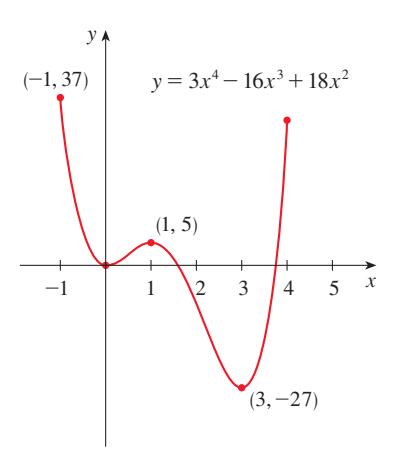
The graph of the function \(f(x) = 3 x^4 - 16 x^3 + 18 x^2\), \(-1 \leq x \leq 4\), is shown. Identify the absolute maximum, absolute minimum, and local extreme values of \(f\).
question image
76 Analytical Applications of Differentiation · Level 2
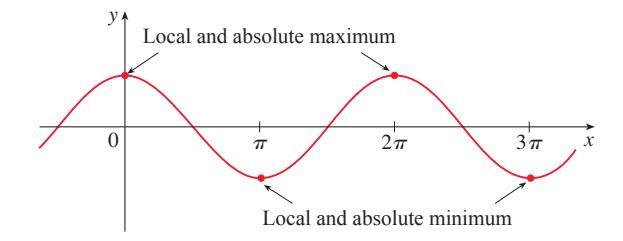
Find the maximum and minimum values of \(f(x) = \cos x\).
question image
77 Analytical Applications of Differentiation · Level 1
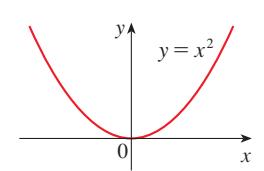
Find the extreme values of \(f(x) = x^2\).
question image
78 Analytical Applications of Differentiation · Level 1
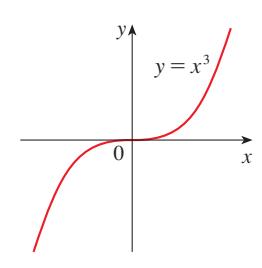
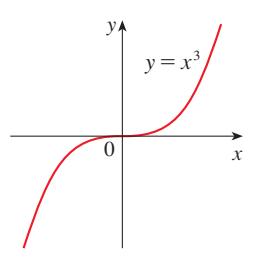
Discuss the extreme values of \(f(x) = x^3\).
question image
79 Analytical Applications of Differentiation · Level 2
If \(f(x) = x^3\), show that \(f'(0) = 0\) but \(f\) has neither a maximum nor a minimum at \(0\).
question image
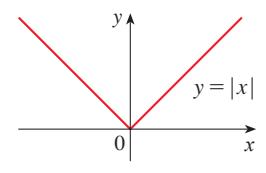
80 Analytical Applications of Differentiation · Level 2
Show that \(f(x) = |x|\) has an absolute minimum at \(0\) even though \(f'(0)\) does not exist.
question image
81 Analytical Applications of Differentiation · Level 2
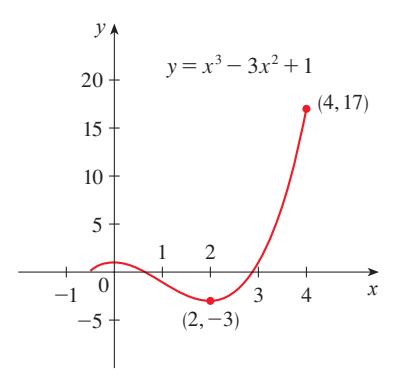
Find the critical numbers of (a) \(f(x) = x^3 - 3 x^2 + 1\) and (b) \(f(x) = x^{\dfrac{3}{5}}(4 - x)\).
question image
82 Analytical Applications of Differentiation · Level 2
Find the absolute maximum and minimum values of \(f(x) = x^3 - 3 x^2 + 1\) on \(-\dfrac{1}{2} \leq x \leq 4\).
question image
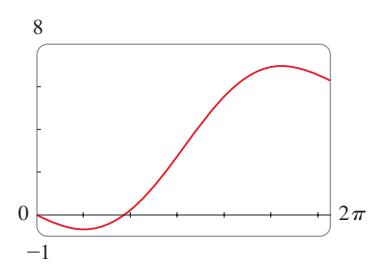
83 Analytical Applications of Differentiation · Level 3
question image
(a) Use a calculator or computer to estimate the absolute minimum and maximum values of \(f(x) = x - 2 \sin x\) on \(0 \leq x \leq 2 \pi\).
(b) Use calculus to find the exact minimum and maximum values.

Enter your answer directly below each part above.

84 Analytical Applications of Differentiation · Level 3
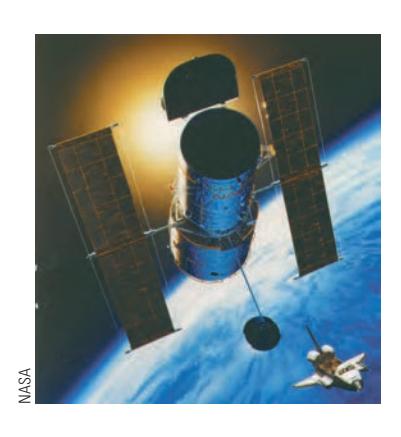
The Hubble Space Telescope was deployed on April 24, 1990, by the space shuttle Discovery. A model for the velocity of the shuttle from liftoff at \(t = 0\) until the solid rocket boosters were jettisoned at \(t = 126\) seconds is \( v(t) = 0.001302 t^3 - 0.09029 t^2 + 23.61 t - 3.083 \) (in ft/s). Using this model, estimate the absolute maximum and minimum values of the acceleration of the shuttle between liftoff and the jettisoning of the boosters.

Answered: 0 / 84