Stewart Section 9.5: Linear Equations

38 questions

0 / 38
Stewart Section 9.5: Linear Equations 0/38
1 Differential Equations · Level 2
Determine whether the differential equation is linear. \(y' + x \sqrt{y} = x^2\)
2 Differential Equations · Level 2
Determine whether the differential equation is linear. \(y' - x = y \tan x\)
3 Differential Equations · Level 2
Determine whether the differential equation is linear. \(u e^t = t + \sqrt{t} \dfrac{d u}{d t}\)
4 Differential Equations · Level 2
Determine whether the differential equation is linear. \( \dfrac{d R}{d t} + t \cos R = e^{-t} \)
5 Differential Equations · Level 2
\( y' + y = 1 \)
6 Differential Equations · Level 2
\( y' - y = e^x \)
7 Differential Equations · Level 2
\( y' = x - y \)
8 Differential Equations · Level 3
\( 4x^3 y + x^4 y' = \sin^3 x \)
9 Differential Equations · Level 3
\( x y' + y = \sqrt{x} \)
10 Differential Equations · Level 3
\( 2x y' + y = 2 \sqrt{x} \)
11 Differential Equations · Level 3
\(x y' - 2y = x^2\), \(\quad x > 0\)
12 Differential Equations · Level 3
\( y' + 2x y = 1 \)
13 Differential Equations · Level 3
\(t^2 \dfrac{d y}{d t} + 3t y = \sqrt{1 + t^2}\), \(\quad t > 0\)
14 Differential Equations · Level 3
\( t \ln t \dfrac{d r}{d t} + r = t e^t \)
15 Differential Equations · Level 3
Solve the initial-value problem. \(x^2 y' + 2x y = \ln x\), \(\quad y(1) = 2\)
16 Differential Equations · Level 3
Solve the initial-value problem. \(t^3 \dfrac{d y}{d t} + 3t^2 y = \cos t\), \(\quad y(\pi) = 0\)
17 Differential Equations · Level 3
Solve the initial-value problem. \(t \dfrac{d u}{d t} = t^2 + 3u\), \(\quad t > 0\), \(\quad u(2) = 4\)
18 Differential Equations · Level 3
Solve the initial-value problem. \(x y' + y = x \ln x\), \(\quad y(1) = 0\)
19 Differential Equations · Level 3
Solve the initial-value problem. \(x y' = y + x^2 \sin x\), \(\quad y(\pi) = 0\)
20 Differential Equations · Level 3
Solve the initial-value problem. \((x^2 + 1) \dfrac{d y}{d x} + 3x(y - 1) = 0\), \(\quad y(0) = 2\)
21 Differential Equations · Level 3
Solve the differential equation and use a calculator to graph several members of the family of solutions. How does the solution curve change as \(C\) varies? \(x y' + 2y = e^x\)
22 Differential Equations · Level 3
Solve the differential equation and use a calculator to graph several members of the family of solutions. How does the solution curve change as \(C\) varies? \(x y' = x^2 + 2y\)
23 Differential Equations · Level 4
A Bernoulli differential equation (named after James Bernoulli) is of the form \( \dfrac{d y}{d x} + P(x) y = Q(x) y^n \) Observe that, if \(n = 0\) or 1, the Bernoulli equation is linear. For other values of \(n\), show that the substitution \(u = y^{1 - n}\) transforms the Bernoulli equation into the linear equation \( \dfrac{d u}{d x} + (1 - n) P(x) u = (1 - n) Q(x) \)
24 Differential Equations · Level 4
Use the method of Exercise 23 to solve the differential equation. \(x y' + y = -x y^2\)
25 Differential Equations · Level 4
Use the method of Exercise 23 to solve the differential equation. \(y' + \dfrac{2}{x} y = \dfrac{y^3}{x^2}\)
26 Differential Equations · Level 4
Solve the second-order equation \(x y'' + 2y' = 12x^2\) by making the substitution \(u = y'\).
27 Differential Equations · Level 3
In the circuit shown in Figure 4, a battery supplies a constant voltage of 40 V, the inductance is 2 H, the resistance is 10 \(\Omega\), and \(I(0) = 0\).
(a) Find \(I(t)\).
(b) Find the current after 0.1 seconds.

Enter your answer directly below each part above.

28 Differential Equations · Level 3
In the circuit shown in Figure 4, a generator supplies a voltage of \(E(t) = 40 \sin 60t\) volts, the inductance is 1 H, the resistance is 20 \(\Omega\), and \(I(0) = 1\) A.
(a) Find \(I(t)\).
(b) Find the current after 0.1 seconds.
(c) Use a graphing device to draw the graph of the current function.

Enter your answer directly below each part above.

29 Differential Equations · Level 3
The figure shows a circuit containing an electromotive force, a capacitor with a capacitance of \(C\) farads (F), and a resistor with a resistance of \(R\) ohms (\(\Omega\)). The voltage drop across the capacitor is \(\dfrac{Q}{C}\), where \(Q\) is the charge (in coulombs), so in this case Kirchhoff's Law gives \(R I + \dfrac{Q}{C} = E(t)\) But \(I = d \dfrac{Q}{d} t\), so we have \(R \dfrac{d Q}{d t} + \dfrac{1}{C} Q = E(t)\) Suppose the resistance is 5 \(\Omega\), the capacitance is 0.05 F, a battery gives a constant voltage of 60 V, and the initial charge is \(Q(0) = 0\) C. Find the charge and the current at time \(t\).
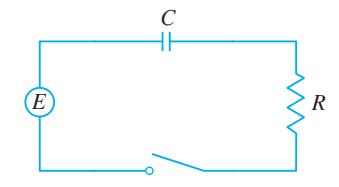
question image
30 Differential Equations · Level 3
In the circuit of Exercise 29, \(R = 2\) \(\Omega\), \(C = 0.01\) F, \(Q(0) = 0\), and \(E(t) = 10 \sin 60t\). Find the charge and the current at time \(t\).
31 Differential Equations · Level 3
Let \(P(t)\) be the performance level of someone learning a skill as a function of the training time \(t\). The graph of \(P\) is called a learning curve. In Exercise 9.1.15 we proposed the differential equation \( \dfrac{d P}{d t} = k [M - P(t)] \) as a reasonable model for learning, where \(k\) is a positive constant. Solve it as a linear differential equation and use your solution to graph the learning curve.
32 Differential Equations · Level 3
Two new workers were hired for an assembly line. Jim processed 25 units during the first hour and 45 units during the second hour. Mark processed 35 units during the first hour and 50 units the second hour. Using the model of Exercise 31 and assuming that \(P(0) = 0\), estimate the maximum number of units per hour that each worker is capable of processing.
33 Differential Equations · Level 4
In Section 9.3 we looked at mixing problems in which the volume of fluid remained constant and saw that such problems give rise to separable differential equations. If the rates of flow into and out of the system are different, then the volume is not constant and the resulting differential equation is linear but not separable. A tank contains 100 L of water. A solution with a salt concentration of 0.4 kg/L is added at a rate of 5 L/min. The solution is kept mixed and is drained from the tank at a rate of 3 L/min. If \(y(t)\) is the amount of salt (in kilograms) after \(t\) minutes, show that \(y\) satisfies the differential equation \( \dfrac{d y}{d t} = 2 - \dfrac{3y}{100 + 2t} \) Solve this equation and find the concentration after 20 minutes.
34 Differential Equations · Level 4
A tank with a capacity of 400 L is full of a mixture of water and chlorine with a concentration of 0.05 g of chlorine per liter. In order to reduce the concentration of chlorine, fresh water is pumped into the tank at a rate of 4 L/s. The mixture is kept stirred and is pumped out at a rate of 10 L/s. Find the amount of chlorine in the tank as a function of time.
35 Differential Equations · Level 4
An object with mass \(m\) is dropped from rest and we assume that the air resistance is proportional to the speed of the object. If \(s(t)\) is the distance dropped after \(t\) seconds, then the speed is \(v = s'(t)\) and the acceleration is \(a = v'(t)\). If \(g\) is the acceleration due to gravity, then the downward force on the object is \(m g - c v\), where \(c\) is a positive constant, and Newton's Second Law gives \(m \dfrac{d v}{d t} = m g - c v\)
(a) Solve this as a linear equation to show that \(v = \dfrac{m g}{c} \left(1 - e^{-c \dfrac{t}{m}}\right)\)
(b) What is the limiting velocity?
(c) Find the distance the object has fallen after \(t\) seconds.

Enter your answer directly below each part above.

36 Differential Equations · Level 4
If we ignore air resistance, we can conclude that heavier objects fall no faster than lighter objects. But if we take air resistance into account, our conclusion changes. Use the expression for the velocity of a falling object in Exercise 35(a) to find \(d \dfrac{v}{d} m\) and show that heavier objects do fall faster than lighter ones.
37 Differential Equations · Level 4
(a) Show that the substitution \(z = \dfrac{1}{P}\) transforms the logistic differential equation \(P' = k P\left(1 - \dfrac{P}{M}\right)\) into the linear differential equation \(z' + k z = \dfrac{k}{M}\)
(b) Solve the linear differential equation in part (a) and thus obtain an expression for \(P(t)\). Compare with Equation 9.4.7.

Enter your answer directly below each part above.

38 Differential Equations · Level 5
To account for seasonal variation in the logistic differential equation, we could allow \(k\) and \(M\) to be functions of \(t\): \( \dfrac{d P}{d t} = k(t) P (1 - \dfrac{P}{M(t)}) \)
(a) Verify that the substitution \(z = \dfrac{1}{P}\) transforms this equation into the linear equation \( \dfrac{d z}{d t} + k(t) z = \dfrac{k(t)}{M(t)} \)
(b) Write an expression for the solution of the linear equation in part (a) and use it to show that if the carrying capacity \(M\) is constant, then \(P(t) \rightarrow M\) as \(t \rightarrow \infty\).

Enter your answer directly below each part above.

Answered: 0 / 38