Stewart 9th Section 3.9: Antiderivatives

86 questions

0 / 86
Stewart 9th Section 3.9: Antiderivatives 0/86
1 Integration and Accumulation of Change · Level 1
Find an antiderivative of the function.
(a) \(f(x) = 6\)
(b) \(g(t) = 3 t^2\)

Enter your answer directly below each part above.

2 Integration and Accumulation of Change · Level 1
Find an antiderivative of the function.
(a) \(f(x) = 2 x\)
(b) \(g(x) = -1 / x^2\)

Enter your answer directly below each part above.

3 Integration and Accumulation of Change · Level 1
Find an antiderivative of the function.
(a) \(h(q) = \cos q\)
(b) \(f(x) = \sec x \tan x\)

Enter your answer directly below each part above.

4 Integration and Accumulation of Change · Level 1
Find an antiderivative of the function.
(a) \(g(t) = \sin t\)
(b) \(r(\theta) = \sec^2 \theta\)

Enter your answer directly below each part above.

5 Integration and Accumulation of Change · Level 1
Find the most general antiderivative of the function. (Check your answer by differentiation.) \(f(x) = 4 x + 7\)
6 Integration and Accumulation of Change · Level 1
\( f(x) = x^2 - 3 x + 2 \)
7 Integration and Accumulation of Change · Level 2
\( f(x) = 2 x^3 - \dfrac{2}{3} x^2 + 5 x \)
8 Integration and Accumulation of Change · Level 2
\( f(x) = 6 x^5 - 8 x^4 - 9 x^2 \)
9 Integration and Accumulation of Change · Level 2
\( f(x) = x (12 x + 8) \)
10 Integration and Accumulation of Change · Level 2
\( f(x) = (x - 5)^2 \)
11 Integration and Accumulation of Change · Level 2
\( g(x) = 4 x^{-\dfrac{2}{3}} - 2 x^{\dfrac{5}{3}} \)
12 Integration and Accumulation of Change · Level 2
\( h(z) = 3 z^{0.8} + z^{-2.5} \)
13 Integration and Accumulation of Change · Level 2
\( f(x) = 3 \sqrt{x} - 2 \sqrt[3]{x} \)
14 Integration and Accumulation of Change · Level 2
\( g(x) = \sqrt{x} (2 - x + 6 x^2) \)
15 Integration and Accumulation of Change · Level 2
\( f(t) = \dfrac{2 t - 4 + 3 \sqrt{t}}{\sqrt{t}} \)
16 Integration and Accumulation of Change · Level 2
\( f(x) = \sqrt[4]{5} + \sqrt[4]{x} \)
17 Integration and Accumulation of Change · Level 2
\( f(x) = \dfrac{10}{x^9} \)
18 Integration and Accumulation of Change · Level 2
\( g(x) = \dfrac{5 - 4 x^3 + 2 x^6}{x^6} \)
19 Integration and Accumulation of Change · Level 2
\( f(\theta) = 2 \sin \theta - 3 \sec \theta \tan \theta \)
20 Integration and Accumulation of Change · Level 2
\( f(t) = 3 \cos t - 4 \sin t \)
21 Integration and Accumulation of Change · Level 2
\( h(\theta) = 2 \sin \theta - \sec^2 \theta \)
22 Integration and Accumulation of Change · Level 2
\( h(x) = \sec^2 x + \pi \cos x \)
23 Integration and Accumulation of Change · Level 2
\( g(v) = \sqrt[3]{v^2} - 2 \sec^2 v \)
24 Integration and Accumulation of Change · Level 2
\( f(x) = 1 + 2 \sin x + \dfrac{3}{\sqrt{x}} \)
25 Integration and Accumulation of Change · Level 2
Find the antiderivative \(F\) of \(f\) that satisfies the given condition. Check your answer by comparing the graphs of \(f\) and \(F\). \(f(x) = 5 x^4 - 2 x^5\), \(F(0) = 4\)
26 Integration and Accumulation of Change · Level 2
Find the antiderivative \(F\) of \(f\) that satisfies the given condition. \(f(x) = x + 2 \sin x\), \(F(0) = -6\)
27 Integration and Accumulation of Change · Level 2
Find \(f\). \(f''(x) = 24 x\)
28 Integration and Accumulation of Change · Level 2
Find \(f\). \(f''(t) = t^2 - 4\)
29 Integration and Accumulation of Change · Level 2
Find \(f\). \(f''(x) = 4 x^3 + 24 x - 1\)
30 Integration and Accumulation of Change · Level 2
Find \(f\). \(f''(x) = 6 x - x^4 + 3 x^5\)
31 Integration and Accumulation of Change · Level 2
Find \(f\). \(f''(x) = 4 - \sqrt[3]{x}\)
32 Integration and Accumulation of Change · Level 2
Find \(f\). \(f''(x) = x^{\dfrac{2}{3}} + x^{-\dfrac{2}{3}}\)
33 Integration and Accumulation of Change · Level 2
Find \(f\). \(f'''(t) = 12 + \sin t\)
34 Integration and Accumulation of Change · Level 2
Find \(f\). \(f'''(t) = \sqrt{t} - 2 \cos t\)
35 Differential Equations · Level 2
Find \(f\). \(f'(x) = 5 x^4 - 3 x^2 + 4\), \(f(-1) = 2\)
36 Differential Equations · Level 2
Find \(f\). \(f'(x) = \sqrt{x} - 2\), \(f(9) = 4\)
37 Differential Equations · Level 2
Find \(f\). \(f'(x) = 5 x^{\dfrac{2}{3}}\), \(f(8) = 21\)
38 Differential Equations · Level 2
Find \(f\). \(f'(t) = t + 1/t^3\), \(t > 0\), \(f(1) = 6\)
39 Differential Equations · Level 3
Find \(f\). \(f'(t) = \sec t (\sec t + \tan t)\), \(-\dfrac{\pi}{2} < t < \dfrac{\pi}{2}\), \(f\left(\dfrac{\pi}{4}\right) = -1\)
40 Differential Equations · Level 2
Find \(f\). \(f'(x) = \dfrac{x + 1}{\sqrt{x}}\), \(f(1) = 5\)
41 Integration and Accumulation of Change · Level 3
Find \(f\). \(f''(x) = -2 + 12 x - 12 x^2\), \(f(0) = 4\), \(f'(0) = 12\)
42 Integration and Accumulation of Change · Level 3
Find \(f\). \(f''(x) = 8 x^3 + 5\), \(f(1) = 0\), \(f'(1) = 8\)
43 Integration and Accumulation of Change · Level 3
Find \(f\). \(f''(\theta) = \sin \theta + \cos \theta\), \(f(0) = 3\), \(f'(0) = 4\)
44 Integration and Accumulation of Change · Level 3
Find \(f\). \(f''(t) = 4 - 6/t^4\), \(f(1) = 6\), \(f'(2) = 9\), \(t > 0\)
45 Differential Equations · Level 3
Find \(f\). \(f''(x) = 4 + 6 x + 24 x^2\), \(f(0) = 3\), \(f(1) = 10\)
46 Differential Equations · Level 3
Find \(f\). \(f''(x) = 20 x^3 + 12 x^2 + 4\), \(f(0) = 8\), \(f(1) = 5\)
47 Differential Equations · Level 3
Find \(f\). \(f''(t) = \sqrt[3]{t} - \cos t\), \(f(0) = 2\), \(f(1) = 2\)
48 Integration and Accumulation of Change · Level 3
Find \(f\). \(f'''(x) = \cos x\), \(f(0) = 1\), \(f'(0) = 2\), \(f''(0) = 3\)
49 Contextual Applications of Differentiation · Level 2
Given that the graph of \(f\) passes through the point \((2, 5)\) and that the slope of its tangent line at \((x, f(x))\) is \(3 - 4 x\), find \(f(1)\).
50 Contextual Applications of Differentiation · Level 3
Find a function \(f\) such that \(f'(x) = x^3\) and the line \(x + y = 0\) is tangent to the graph of \(f\).
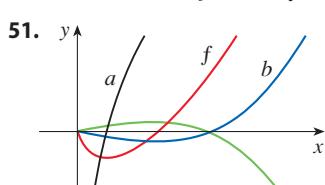
51 Integration and Accumulation of Change · Level 2
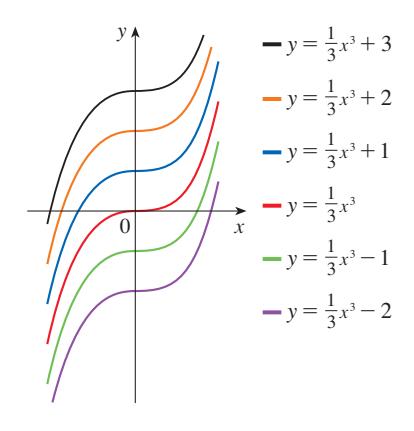
The graph of a function \(f\) is shown. Which graph is an antiderivative of \(f\) and why?
question image
52 Integration and Accumulation of Change · Level 2
The graph of a function \(f\) is shown. Which graph is an antiderivative of \(f\) and why?
question image
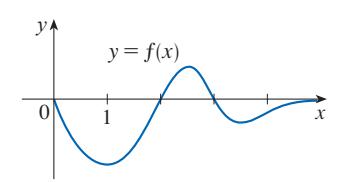
53 Integration and Accumulation of Change · Level 2
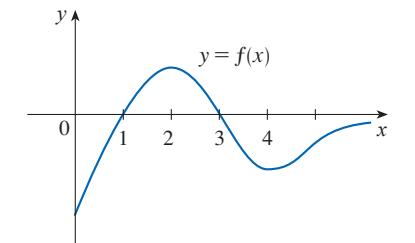
The graph of a function is shown in the figure. Make a rough sketch of an antiderivative \(F\), given that \(F(0) = 1\).
question image
54 Antiderivative - Position · Level 2
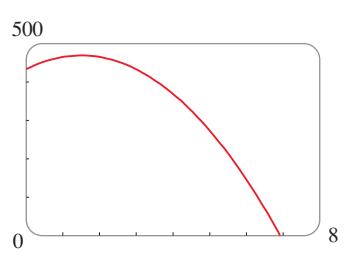
The graph of the velocity function of a particle is shown in the figure. Sketch the graph of a position function.
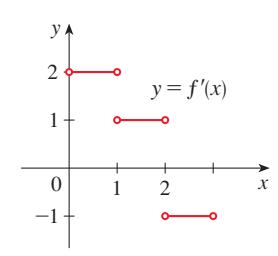
55 Integration and Accumulation of Change · Level 2
The graph of \(f'\) is shown in the figure. Sketch the graph of \(f\) if \(f\) is continuous on \([0, 3]\) and \(f(0) = -1\).
56 Analytical Applications of Differentiation · Level 3
(a) Graph \(f(x) = 2 x - 3 \sqrt{x}\).
(b) Starting with the graph in part (a), sketch a rough graph of the antiderivative \(F\) that satisfies \(F(0) = 1\).
(c) Use the rules of this section to find an expression for \(F(x)\).
(d) Graph \(F\) using the expression in part (c). Compare with your sketch in part (b).

Enter your answer directly below each part above.

57 Analytical Applications of Differentiation · Level 3
Draw a graph of \(f\) and use it to make a rough sketch of the antiderivative that passes through the origin. \(f(x) = \dfrac{\sin x}{1 + x^2}\), \(-2 \pi \leq x \leq 2 \pi\)
58 Analytical Applications of Differentiation · Level 3
Draw a graph of \(f\) and use it to make a rough sketch of the antiderivative that passes through the origin. \(f(x) = \sqrt{x^4 - 2 x^2 + 2} - 2\), \(-3 \leq x \leq 3\)
59 Contextual Applications of Differentiation · Level 2
A particle is moving with the given data. Find the position of the particle. \(v(t) = 2 \cos t + 4 \sin t\), \(s(0) = 3\)
60 Contextual Applications of Differentiation · Level 2
A particle is moving with the given data. Find the position of the particle. \(v(t) = t^2 - 3 \sqrt{t}\), \(s(4) = 8\)
61 Contextual Applications of Differentiation · Level 2
A particle is moving with the given data. Find the position of the particle. \(a(t) = 2 t + 1\), \(s(0) = 3\), \(v(0) = -2\)
62 Contextual Applications of Differentiation · Level 2
A particle is moving with the given data. Find the position of the particle. \(a(t) = 3 \cos t - 2 \sin t\), \(s(0) = 0\), \(v(0) = 4\)
63 Contextual Applications of Differentiation · Level 3
A particle is moving with the given data. Find the position of the particle. \(a(t) = \sin t - \cos t\), \(s(0) = 0\), \(s(\pi) = 6\)
64 Contextual Applications of Differentiation · Level 3
A particle is moving with the given data. Find the position of the particle. \(a(t) = t^2 - 4 t + 6\), \(s(0) = 0\), \(s(1) = 20\)
65 Contextual Applications of Differentiation · Level 3
A stone is dropped from the upper observation deck (the Space Deck) of the CN Tower, 450 m above the ground.
(a) Find the distance of the stone above ground level at time \(t\).
(b) How long does it take the stone to reach the ground?
(c) With what velocity does it strike the ground?
(d) If the stone is thrown downward with a speed of 5 m/s, how long does it take to reach the ground?

Enter your answer directly below each part above.

66 Contextual Applications of Differentiation · Level 3
Show that for motion in a straight line with constant acceleration \(a\), initial velocity \(v_0\), and initial displacement \(s_0\), the displacement after time \(t\) is \(s = \dfrac{1}{2} a t^2 + v_0 t + s_0\).
67 Contextual Applications of Differentiation · Level 3
An object is projected upward with initial velocity \(v_0\) meters per second from a point \(s_0\) meters above the ground. Show that \([v(t)]^2 = v_0^2 - 19.6 [s(t) - s_0]\)
68 Contextual Applications of Differentiation · Level 3
Two balls are thrown upward from the edge of the cliff in Example 7. The first is thrown with a speed of 48 ft/s and the other is thrown a second later with a speed of 24 ft/s. Do the balls ever pass each other?
69 Contextual Applications of Differentiation · Level 2
A stone was dropped off a cliff and hit the ground with a speed of 120 ft/s. What is the height of the cliff?
70 Analytical Applications of Differentiation · Level 3
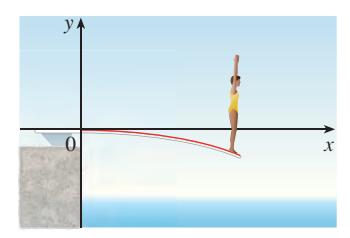
If a diver of mass \(m\) stands at the end of a diving board with length \(L\) and linear density \(\rho\), then the board takes on the shape of a curve \(y = f(x)\), where \(E I y'' = m g (L - x) + \dfrac{1}{2} \rho g (L - x)^2\) \(E\) and \(I\) are positive constants that depend on the material of the board and \(g (> 0)\) is the acceleration due to gravity.
question image
(a) Find an expression for the shape of the curve.
(b) Use \(f(L)\) to estimate the distance below the horizontal at the end of the board.

Enter your answer directly below each part above.

71 Contextual Applications of Differentiation · Level 3
A company estimates that the marginal cost (in dollars per item) of producing \(x\) items is \(1.92 - 0.002 x\). If the cost of producing one item is \$562, find the cost of producing 100 items.
72 Applications of Integration · Level 3
The linear density of a rod of length 1 m is given by \(\rho(x) = \dfrac{1}{\sqrt{x}}\), in grams per centimeter, where \(x\) is measured in centimeters from one end of the rod. Find the mass of the rod.
73 Differential Equations · Level 4
Since raindrops grow as they fall, their surface area increases and therefore the resistance to their falling increases. A raindrop has an initial downward velocity of 10 m/s and its downward acceleration is \(a = \begin{cases} 9 - 0.9 t & \quad \text{if } 0 \leq t \leq 10 \\ 0 & \quad \text{if } t > 10 \end{cases}\) If the raindrop forms 500 m above the ground, how long does it take to fall?
74 Contextual Applications of Differentiation · Level 3
A car is traveling at 50 mi/h when the brakes are fully applied, producing a constant deceleration of 22 ft/s\(^2\). What is the distance traveled before the car comes to a stop?
75 Contextual Applications of Differentiation · Level 2
What constant acceleration is required to increase the speed of a car from 30 mi/h to 50 mi/h in 5 seconds?
76 Applications of Integration · Level 3
A car braked with a constant deceleration of 16 ft/s\(^2\), producing skid marks measuring 200 ft before coming to a stop. How fast was the car traveling when the brakes were first applied?
77 Contextual Applications of Differentiation · Level 3
A car is traveling at 100 km/h when the driver sees an accident 80 m ahead and slams on the brakes. What constant deceleration is required to stop the car in time to avoid a multicar pileup?
78 Contextual Applications of Differentiation · Level 4
A model rocket is fired vertically upward from rest. Its acceleration for the first three seconds is \(a(t) = 60 t\), at which time the fuel is exhausted and it becomes a freely "falling" body. Fourteen seconds later, the rocket's parachute opens, and the (downward) velocity slows linearly to \(-18\) ft/s in 5 seconds. The rocket then "floats" to the ground at that rate.
(a) Determine the position function \(s\) and the velocity function \(v\) (for all times \(t\)). Sketch the graphs of \(s\) and \(v\).
(b) At what time does the rocket reach its maximum height, and what is that height?
(c) At what time does the rocket land?

Enter your answer directly below each part above.

79 Contextual Applications of Differentiation · Level 4
A particular bullet train accelerates and decelerates at the rate of 2.4 ft/s\(^2\). Its maximum cruising speed is 180 mi/h.
(a) What is the maximum distance the train can travel if it accelerates from rest until it reaches its cruising speed and then runs at that speed for 20 minutes?
(b) Suppose that the train starts from rest and must come to a complete stop in 20 minutes. What is the maximum distance it can travel under these conditions?
(c) Find the minimum time that the train takes to travel between two consecutive stations that are 60 miles apart.
(d) The trip from one station to the next takes 37.5 minutes. How far apart are the stations?

Enter your answer directly below each part above.

80 Integration and Accumulation of Change · Level 2
Find the most general antiderivative of each of the following functions.
question image
(a) \(f(x) = \sin x\)
(b) \(f(x) = x^n\), \(n \geq 0\)
(c) \(f(x) = x^{-3}\)

Enter your answer directly below each part above.

81 Integration and Accumulation of Change · Level 2
Find all functions \(g\) such that \(g'(x) = 4 \sin x + \dfrac{2 x^5 - \sqrt{x}}{x}\)
82 Differential Equations · Level 2
Find \(f\) if \(f'(x) = x \sqrt{x}\) and \(f(1) = 2\).
83 Differentiation: Definition and Fundamental Properties · Level 3
Find \(f\) if \(f''(x) = 12 x^2 + 6 x - 4\), \(f(0) = 4\), and \(f(1) = 1\).
84 Integration and Accumulation of Change · Level 3
The graph of a function \(f\) is given in Figure 2. Make a rough sketch of an antiderivative \(F\), given that \(F(0) = 2\).
question image
85 Contextual Applications of Differentiation · Level 3
A particle moves in a straight line and has acceleration given by \(a(t) = 6 t + 4\). Its initial velocity is \(v(0) = -6\) cm/s and its initial displacement is \(s(0) = 9\) cm. Find its position function \(s(t)\).
86 Contextual Applications of Differentiation · Level 3
A ball is thrown upward with a speed of 48 ft/s from the edge of a cliff, 432 ft above the ground. Find its height above the ground \(t\) seconds later. When does it reach its maximum height? When does it hit the ground?
question image

Answered: 0 / 86