Stewart Section 2.8: The Derivative as a Function

63 questions

0 / 63
Stewart Section 2.8: The Derivative as a Function 0/63
1 Analytical Applications of Differentiation · Level 2
Use the given graph to estimate the value of each derivative. Then sketch the graph of \(f'\).
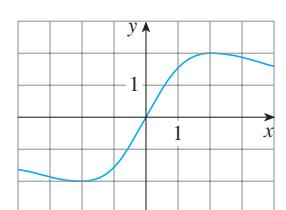
question image
(a) \(f'(-3)\)
(b) \(f'(-2)\)
(c) \(f'(-1)\)
(d) \(f'(0)\)
(e) \(f'(1)\)
(f) \(f'(2)\) (g) \(f'(3)\)

Enter your answer directly below each part above.

2 Analytical Applications of Differentiation · Level 2
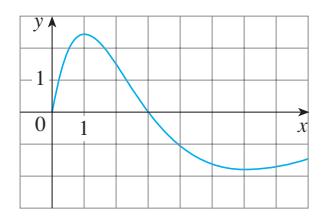
Use the given graph to estimate the value of each derivative. Then sketch the graph of \(f'\).
question image
(a) \(f'(0)\)
(b) \(f'(1)\)
(c) \(f'(2)\)
(d) \(f'(3)\)
(e) \(f'(4)\)
(f) \(f'(5)\) (g) \(f'(6)\) (h) \(f'(7)\)

Enter your answer directly below each part above.

3 Analytical Applications of Differentiation · Level 3
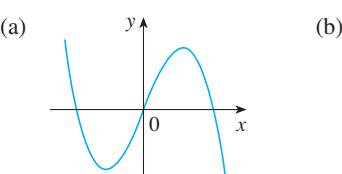
Match the graph of each function in (a)-(d) with the graph of its derivative in I-IV. Give reasons for your choices.
question image
4 Analytical Applications of Differentiation · Level 3
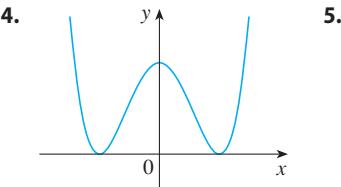
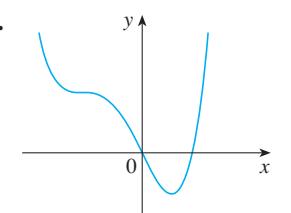
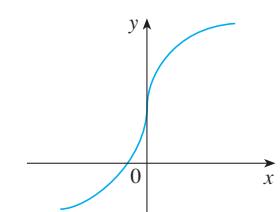
Trace or copy the graph of the given function \(f\). (Assume that the axes have equal scales.) Then use the method of Example 1 to sketch the graph of \(f'\) below it.
question image
5 Analytical Applications of Differentiation · Level 3
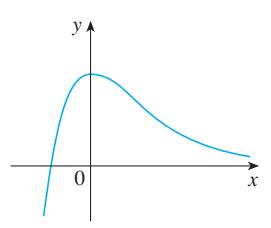
Trace or copy the graph of the given function \(f\). (Assume that the axes have equal scales.) Then use the method of Example 1 to sketch the graph of \(f'\) below it.
question image
6 Analytical Applications of Differentiation · Level 3
Trace or copy the graph of the given function \(f\). (Assume that the axes have equal scales.) Then use the method of Example 1 to sketch the graph of \(f'\) below it.
question image
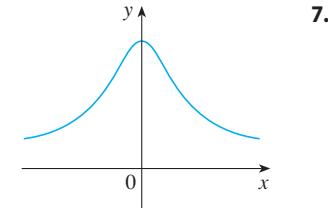
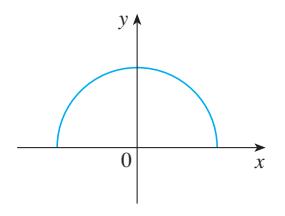
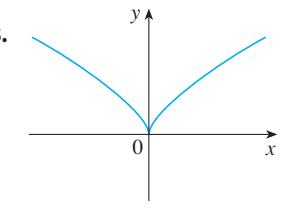
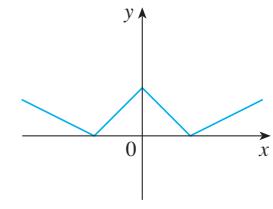
7 Analytical Applications of Differentiation · Level 3
Trace or copy the graph of the given function \(f\). (Assume that the axes have equal scales.) Then use the method of Example 1 to sketch the graph of \(f'\) below it.
question image
8 Analytical Applications of Differentiation · Level 3
Trace or copy the graph of the given function \(f\). (Assume that the axes have equal scales.) Then use the method of Example 1 to sketch the graph of \(f'\) below it.
question image
9 Analytical Applications of Differentiation · Level 3
Trace or copy the graph of the given function \(f\). (Assume that the axes have equal scales.) Then use the method of Example 1 to sketch the graph of \(f'\) below it.
question image
10 Analytical Applications of Differentiation · Level 3
Trace or copy the graph of the given function \(f\). (Assume that the axes have equal scales.) Then use the method of Example 1 to sketch the graph of \(f'\) below it.
question image
11 Analytical Applications of Differentiation · Level 3
Trace or copy the graph of the given function \(f\). (Assume that the axes have equal scales.) Then use the method of Example 1 to sketch the graph of \(f'\) below it.
question image
12 Analytical Applications of Differentiation · Level 3
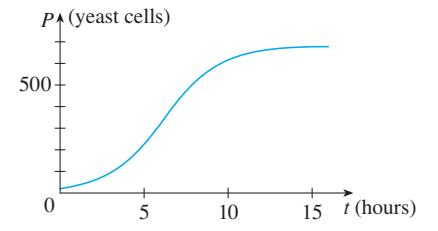
Shown is the graph of the population function \(P(t)\) for yeast cells in a laboratory culture. Use the method of Example 1 to graph the derivative \(P'(t)\). What does the graph of \(P'\) tell us about the yeast population?
question image
13 Contextual Applications of Differentiation · Level 3
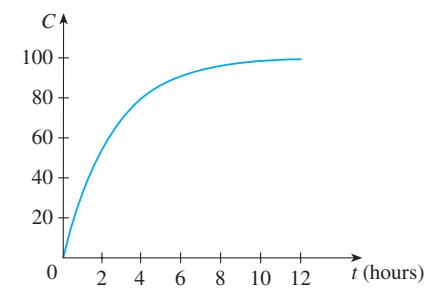
A rechargeable battery is plugged into a charger. The graph shows \(C(t)\), the percentage of full capacity that the battery reaches as a function of time \(t\) elapsed (in hours).
question image
(a) What is the meaning of the derivative \(C'(t)\)?
(b) Sketch the graph of \(C'(t)\). What does the graph tell you?

Enter your answer directly below each part above.

14 Contextual Applications of Differentiation · Level 3
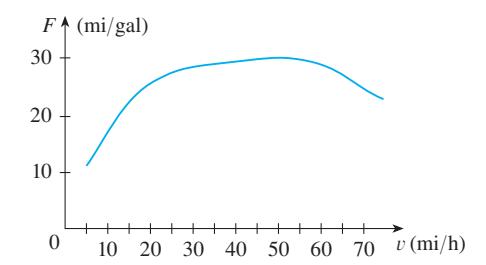
The graph (from the US Department of Energy) shows how driving speed affects gas mileage. Fuel economy \(F\) is measured in miles per gallon and speed \(v\) is measured in miles per hour.
question image
(a) What is the meaning of the derivative \(F'(v)\)?
(b) Sketch the graph of \(F'(v)\).
(c) At what speed should you drive if you want to save on gas?

Enter your answer directly below each part above.

15 Contextual Applications of Differentiation · Level 3
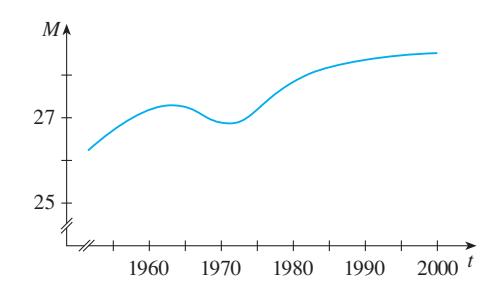
The graph shows how the average age of first marriage of Japanese men varied in the last half of the 20th century. Sketch the graph of the derivative function \(M'(t)\). During which years was the derivative negative?
question image
16 Analytical Applications of Differentiation · Level 3
Make a careful sketch of the graph of \(f\) and below it sketch the graph of \(f'\) in the same manner as in Exercises 4-11. Can you guess a formula for \(f'(x)\) from its graph? \(f(x) = \sin x\)
17 Analytical Applications of Differentiation · Level 3
Make a careful sketch of the graph of \(f\) and below it sketch the graph of \(f'\) in the same manner as in Exercises 4-11. Can you guess a formula for \(f'(x)\) from its graph? \(f(x) = e^x\)
18 Analytical Applications of Differentiation · Level 3
Make a careful sketch of the graph of \(f\) and below it sketch the graph of \(f'\) in the same manner as in Exercises 4-11. Can you guess a formula for \(f'(x)\) from its graph? \(f(x) = \ln x\)
19 Differentiation: Definition and Fundamental Properties · Level 3
Let \(f(x) = x^2\).
(a) Estimate the values of \(f'(0)\), \(f'\left(\dfrac{1}{2}\right)\), \(f'(1)\), and \(f'(2)\) by using a graphing device to zoom in on the graph of \(f\).
(b) Use symmetry to deduce the values of \(f'\left(-\dfrac{1}{2}\right)\), \(f'(-1)\), and \(f'(-2)\).
(c) Use the results from parts (a) and (b) to guess a formula for \(f'(x)\).
(d) Use the definition of derivative to prove that your guess in part (c) is correct.

Enter your answer directly below each part above.

20 Differentiation: Definition and Fundamental Properties · Level 3
Let \(f(x) = x^3\).
(a) Estimate the values of \(f'(0)\), \(f'\left(\dfrac{1}{2}\right)\), \(f'(1)\), \(f'(2)\), and \(f'(3)\) by using a graphing device to zoom in on the graph of \(f\).
(b) Use symmetry to deduce the values of \(f'\left(-\dfrac{1}{2}\right)\), \(f'(-1)\), \(f'(-2)\), and \(f'(-3)\).
(c) Use the values from parts (a) and (b) to graph \(f'\).
(d) Guess a formula for \(f'(x)\).
(e) Use the definition of derivative to prove that your guess in part (d) is correct.

Enter your answer directly below each part above.

21 Differentiation: Definition and Fundamental Properties · Level 3
\( f(x) = 3x - 8 \)
22 Differentiation: Definition and Fundamental Properties · Level 3
\( f(x) = m x + b \)
23 Differentiation: Definition and Fundamental Properties · Level 3
\( f(t) = 2.5t^2 + 6t \)
24 Differentiation: Definition and Fundamental Properties · Level 3
\( f(x) = 4 + 8x - 5x^2 \)
25 Differentiation: Definition and Fundamental Properties · Level 3
\( f(x) = x^2 - 2x^3 \)
26 Differentiation: Definition and Fundamental Properties · Level 3
\( g(t) = \dfrac{1}{\sqrt{t}} \)
27 Differentiation: Definition and Fundamental Properties · Level 3
\( g(x) = \sqrt{9 - x} \)
28 Differentiation: Definition and Fundamental Properties · Level 4
\( f(x) = \dfrac{x^2 - 1}{2x - 3} \)
29 Differentiation: Definition and Fundamental Properties · Level 4
\( G(t) = \dfrac{1 - 2t}{3 + t} \)
30 Differentiation: Definition and Fundamental Properties · Level 4
\( f(x) = x^{\dfrac{3}{2}} \)
31 Differentiation: Definition and Fundamental Properties · Level 3
\( f(x) = x^4 \)
32 Differentiation: Definition and Fundamental Properties · Level 3
(a) Sketch the graph of \(f(x) = \sqrt{6 - x}\) by starting with the graph of \(y = \sqrt{x}\) and using the transformations of Section 1.3.
(b) Use the graph from part (a) to sketch the graph of \(f'\).
(c) Use the definition of a derivative to find \(f'(x)\). What are the domains of \(f\) and \(f'\)?
(d) Use a graphing device to graph \(f'\) and compare with your sketch in part (b).

Enter your answer directly below each part above.

33 Differentiation: Definition and Fundamental Properties · Level 3
(a) If \(f(x) = x^4 + 2x\), find \(f'(x)\).
(b) Check to see that your answer to part (a) is reasonable by comparing the graphs of \(f\) and \(f'\).

Enter your answer directly below each part above.

34 Differentiation: Definition and Fundamental Properties · Level 3
(a) If \(f(x) = x + \dfrac{1}{x}\), find \(f'(x)\).
(b) Check to see that your answer to part (a) is reasonable by comparing the graphs of \(f\) and \(f'\).

Enter your answer directly below each part above.

35 Contextual Applications of Differentiation · Level 3
The unemployment rate \(U(t)\) varies with time. The table gives the percentage of unemployed in the US labor force from 2003 to 2012.
(a) What is the meaning of \(U'(t)\)? What are its units?
(b) Construct a table of estimated values for \(U'(t)\).
\(t\) \(U(t)\) \(t\) \(U(t)\)
2003 6.0 2008 5.8
2004 5.5 2009 9.3
2005 5.1 2010 9.6
2006 4.6 2011 8.9
2007 4.6 2012 8.1

Enter your answer directly below each part above.

36 Contextual Applications of Differentiation · Level 3
The table gives the number \(N(t)\), measured in thousands, of minimally invasive cosmetic surgery procedures performed in the United States for various years \(t\).
(a) What is the meaning of \(N'(t)\)? What are its units?
(b) Construct a table of estimated values for \(N'(t)\).
(c) Graph \(N\) and \(N'\).
(d) How would it be possible to get more accurate values for \(N'(t)\)?
\(t\) \(N(t)\) (thousands)
2000 5,500
2002 4,897
2004 7,470
2006 9,138
2008 10,897
2010 11,561
2012 13,035

Enter your answer directly below each part above.

37 Contextual Applications of Differentiation · Level 3
The table gives the height as time passes of a typical pine tree grown for lumber at a managed site.
Tree age (years) 14 21 28 35 42 49
Height (feet) 41 54 64 72 78 83
If \(H(t)\) is the height of the tree after \(t\) years, construct a table of estimated values for \(H'\) and sketch its graph.
38 Contextual Applications of Differentiation · Level 3
Water temperature affects the growth rate of brook trout. The table shows the amount of weight gained by brook trout after 24 days in various water temperatures.
Temperature (degrees C) 15.5 17.7 20.0 22.4 24.4
Weight gained (g) 37.2 31.0 19.8 9.7 29.8
If \(W(x)\) is the weight gain at temperature \(x\), construct a table of estimated values for \(W'\) and sketch its graph. What are the units for \(W'(x)\)?
39 Contextual Applications of Differentiation · Level 3
Let \(P\) represent the percentage of a city's electrical power that is produced by solar panels \(t\) years after January 1, 2000.
(a) What does \(\dfrac{d P}{d t}\) represent in this context?
(b) Interpret the statement \(\dfrac{d P}{d t}|_{t = 2} = 3.5\)

Enter your answer directly below each part above.

40 Contextual Applications of Differentiation · Level 3
Suppose \(N\) is the number of people in the United States who travel by car to another state for a vacation this year when the average price of gasoline is \(p\) dollars per gallon. Do you expect \(\dfrac{d N}{d p}\) to be positive or negative? Explain.
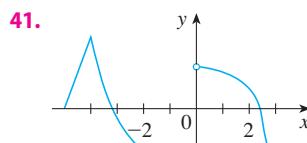
41 Differentiation: Definition and Fundamental Properties · Level 3
The graph of \(f\) is given. State, with reasons, the numbers at which \(f\) is not differentiable.
question image
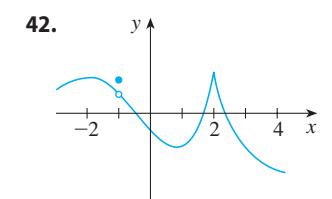
42 Differentiation: Definition and Fundamental Properties · Level 3
The graph of \(f\) is given. State, with reasons, the numbers at which \(f\) is not differentiable.
question image
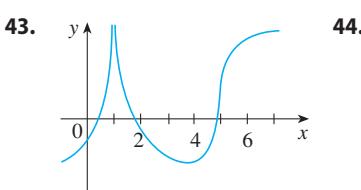
43 Differentiation: Definition and Fundamental Properties · Level 3
The graph of \(f\) is given. State, with reasons, the numbers at which \(f\) is not differentiable.
question image
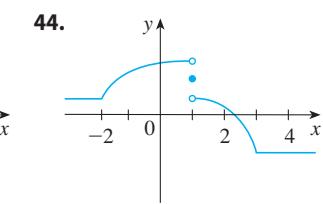
44 Differentiation: Definition and Fundamental Properties · Level 3
The graph of \(f\) is given. State, with reasons, the numbers at which \(f\) is not differentiable.
question image
45 Differentiation: Definition and Fundamental Properties · Level 3
Graph the function \(f(x) = x + |x|\). Zoom in repeatedly, first toward the point \((-1, 0)\) and then toward the origin. What is different about the behavior of \(f\) in the vicinity of these two points? What do you conclude about the differentiability of \(f\)?
46 Differentiation: Definition and Fundamental Properties · Level 3
Zoom in toward the points \((1, 0)\), \((0, 1)\), and \((-1, 0)\) on the graph of the function \(g(x) = (x^2 - 1)^{\dfrac{2}{3}}\). What do you notice? Account for what you see in terms of the differentiability of \(g\).
47 Differentiation: Definition and Fundamental Properties · Level 3
The graphs of a function \(f\) and its derivative \(f'\) are shown. Which is bigger, \(f'(-1)\) or \(f''(1)\)?
question image
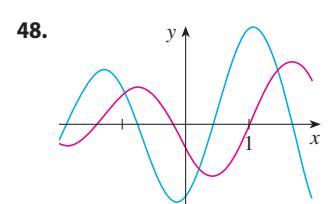
48 Differentiation: Definition and Fundamental Properties · Level 3
The graphs of a function \(f\) and its derivative \(f'\) are shown. Which is bigger, \(f'(-1)\) or \(f''(1)\)?
question image
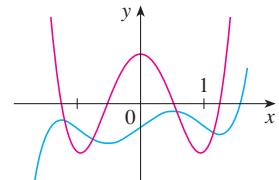
49 Differentiation: Definition and Fundamental Properties · Level 3
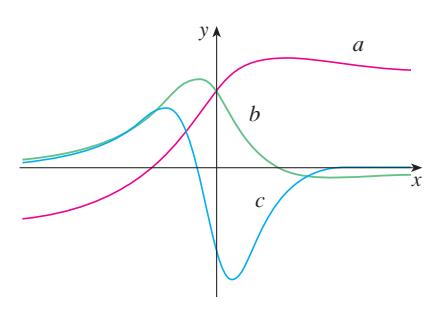
The figure shows the graphs of \(f\), \(f'\), and \(f''\). Identify each curve, and explain your choices.
question image
50 Differentiation: Definition and Fundamental Properties · Level 3
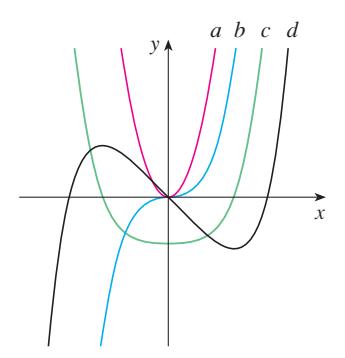
The figure shows graphs of \(f\), \(f'\), \(f''\), and \(f'''\). Identify each curve, and explain your choices.
question image
51 Contextual Applications of Differentiation · Level 3
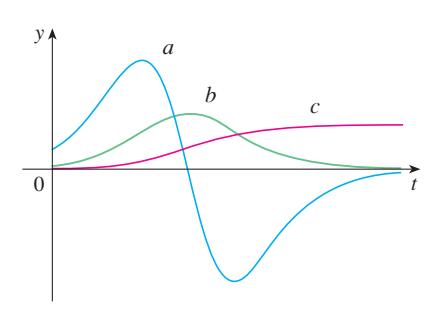
The figure shows the graphs of three functions. One is the position function of a car, one is the velocity of the car, and one is its acceleration. Identify each curve, and explain your choices.
question image
52 Contextual Applications of Differentiation · Level 3
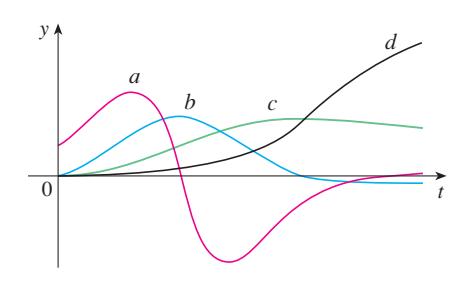
The figure shows the graphs of four functions. One is the position function of a car, one is the velocity of the car, one is its acceleration, and one is its jerk. Identify each curve, and explain your choices.
question image
53 Differentiation: Definition and Fundamental Properties · Level 3
Use the definition of a derivative to find \(f'(x)\) and \(f''(x)\). Then graph \(f\), \(f'\), and \(f''\) on a common screen and check to see if your answers are reasonable. \(f(x) = 3x^2 + 2x + 1\)
54 Differentiation: Definition and Fundamental Properties · Level 3
Use the definition of a derivative to find \(f'(x)\) and \(f''(x)\). Then graph \(f\), \(f'\), and \(f''\) on a common screen and check to see if your answers are reasonable. \(f(x) = x^3 - 3x\)
55 Differentiation: Definition and Fundamental Properties · Level 4
If \(f(x) = 2x^2 - x^3\), find \(f'(x)\), \(f''(x)\), \(f'''(x)\), and \(f^{(4)}(x)\). Graph \(f\), \(f'\), \(f''\), and \(f'''\) on a common screen. Are the graphs consistent with the geometric interpretations of these derivatives?
56 Contextual Applications of Differentiation · Level 4
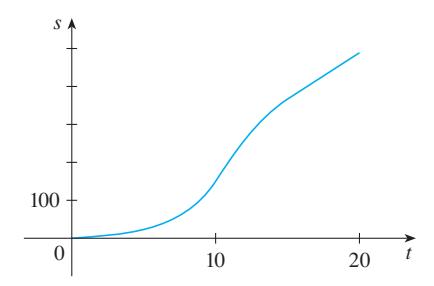
question image
(a) The graph of a position function of a car is shown, where \(s\) is measured in feet and \(t\) in seconds. Use it to graph the velocity and acceleration of the car. What is the acceleration at \(t = 10\) seconds?
(b) Use the acceleration curve from part (a) to estimate the jerk at \(t = 10\) seconds. What are the units for jerk?

Enter your answer directly below each part above.

57 Differentiation: Definition and Fundamental Properties · Level 4
Let \(f(x) = \sqrt[3]{x}\).
(a) If \(a \neq 0\), use Equation 2.7.5 to find \(f'(a)\).
(b) Show that \(f'(0)\) does not exist.
(c) Show that \(y = \sqrt[3]{x}\) has a vertical tangent line at \((0, 0)\). (Recall the shape of the graph of \(f\). See Figure 1.2.13.)

Enter your answer directly below each part above.

58 Differentiation: Definition and Fundamental Properties · Level 4
(a) If \(g(x) = x^{\dfrac{2}{3}}\), show that \(g'(0)\) does not exist.
(b) If \(a \neq 0\), find \(g'(a)\).
(c) Show that \(y = x^{\dfrac{2}{3}}\) has a vertical tangent line at \((0, 0)\).

Enter your answer directly below each part above.

59 Differentiation: Definition and Fundamental Properties · Level 4
Show that the function \(f(x) = |x - 6|\) is not differentiable at 6. Find a formula for \(f'\) and sketch its graph.
60 Differentiation: Definition and Fundamental Properties · Level 4
Where is the greatest integer function \(f(x) = \lfloor x \rfloor\) not differentiable? Find a formula for \(f'\) and sketch its graph.
61 Differentiation: Definition and Fundamental Properties · Level 4
(a) Sketch the graph of the function \(f(x) = x |x|\).
(b) For what values of \(x\) is \(f\) differentiable?
(c) Find a formula for \(f'\).

Enter your answer directly below each part above.

62 Differentiation: Definition and Fundamental Properties · Level 4
(a) Sketch the graph of the function \(g(x) = x + |x|\).
(b) For what values of \(x\) is \(g\) differentiable?
(c) Find a formula for \(g'\).

Enter your answer directly below each part above.

63 Differentiation: Definition and Fundamental Properties · Level 5
Recall that a function \(f\) is called even if \(f(-x) = f(x)\) for all \(x\) in its domain and odd if \(f(-x) = -f(x)\) for all such \(x\). Prove each of the following.
(a) The derivative of an even function is an odd function.
(b) The derivative of an odd function is an even function.

Enter your answer directly below each part above.

Answered: 0 / 63