Stewart Section 10.5: Conic Sections

66 questions

0 / 66
Stewart Section 10.5: Conic Sections 0/66
1 Parametric Equations, Polar Coordinates, and Vector-Valued Functions · Level 2
Find the vertex, focus, and directrix of the parabola and sketch its graph. \(x^2 = 6y\)
2 Parametric Equations, Polar Coordinates, and Vector-Valued Functions · Level 2
Find the vertex, focus, and directrix of the parabola and sketch its graph. \(2y^2 = 5x\)
3 Parametric Equations, Polar Coordinates, and Vector-Valued Functions · Level 2
Find the vertex, focus, and directrix of the parabola and sketch its graph. \(2x = -y^2\)
4 Parametric Equations, Polar Coordinates, and Vector-Valued Functions · Level 2
Find the vertex, focus, and directrix of the parabola and sketch its graph. \(3x^2 + 8y = 0\)
5 Parametric Equations, Polar Coordinates, and Vector-Valued Functions · Level 3
Find the vertex, focus, and directrix of the parabola and sketch its graph. \((x + 2)^2 = 8(y - 3)\)
6 Parametric Equations, Polar Coordinates, and Vector-Valued Functions · Level 3
Find the vertex, focus, and directrix of the parabola and sketch its graph. \((y - 2)^2 = 2x + 1\)
7 Parametric Equations, Polar Coordinates, and Vector-Valued Functions · Level 3
Find the vertex, focus, and directrix of the parabola and sketch its graph. \(y^2 + 6y + 2x + 1 = 0\)
8 Parametric Equations, Polar Coordinates, and Vector-Valued Functions · Level 3
Find the vertex, focus, and directrix of the parabola and sketch its graph. \(2x^2 - 16x - 3y + 38 = 0\)
9 Parametric Equations, Polar Coordinates, and Vector-Valued Functions · Level 3
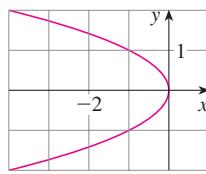
Find an equation of the parabola. Then find the focus and directrix.
question image
10 Parametric Equations, Polar Coordinates, and Vector-Valued Functions · Level 3
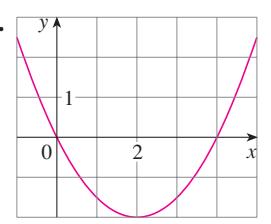
Find an equation of the parabola. Then find the focus and directrix.
question image
11 Parametric Equations, Polar Coordinates, and Vector-Valued Functions · Level 2
Find the vertices and foci of the ellipse and sketch its graph. \(\dfrac{x^2}{2} + \dfrac{y^2}{4} = 1\)
12 Parametric Equations, Polar Coordinates, and Vector-Valued Functions · Level 2
Find the vertices and foci of the ellipse and sketch its graph. \(\dfrac{x^2}{36} + \dfrac{y^2}{8} = 1\)
13 Parametric Equations, Polar Coordinates, and Vector-Valued Functions · Level 2
Find the vertices and foci of the ellipse and sketch its graph. \(x^2 + 9y^2 = 9\)
14 Parametric Equations, Polar Coordinates, and Vector-Valued Functions · Level 2
Find the vertices and foci of the ellipse and sketch its graph. \(100 x^2 + 36 y^2 = 225\)
15 Parametric Equations, Polar Coordinates, and Vector-Valued Functions · Level 3
Find the vertices and foci of the ellipse and sketch its graph. \(9x^2 - 18x + 4y^2 = 27\)
16 Parametric Equations, Polar Coordinates, and Vector-Valued Functions · Level 3
Find the vertices and foci of the ellipse and sketch its graph. \(x^2 + 3y^2 + 2x - 12y + 10 = 0\)
17 Parametric Equations, Polar Coordinates, and Vector-Valued Functions · Level 3
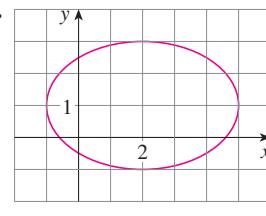
Find an equation of the ellipse. Then find its foci.
question image
18 Parametric Equations, Polar Coordinates, and Vector-Valued Functions · Level 3
Find an equation of the ellipse. Then find its foci.
question image
19 Parametric Equations, Polar Coordinates, and Vector-Valued Functions · Level 2
Find the vertices, foci, and asymptotes of the hyperbola and sketch its graph. \(\dfrac{y^2}{25} - \dfrac{x^2}{9} = 1\)
20 Parametric Equations, Polar Coordinates, and Vector-Valued Functions · Level 2
Find the vertices, foci, and asymptotes of the hyperbola and sketch its graph. \(\dfrac{x^2}{36} - \dfrac{y^2}{64} = 1\)
21 Parametric Equations, Polar Coordinates, and Vector-Valued Functions · Level 2
Find the vertices, foci, and asymptotes of the hyperbola and sketch its graph. \(x^2 - y^2 = 100\)
22 Parametric Equations, Polar Coordinates, and Vector-Valued Functions · Level 2
Find the vertices, foci, and asymptotes of the hyperbola and sketch its graph. \(y^2 - 16x^2 = 16\)
23 Parametric Equations, Polar Coordinates, and Vector-Valued Functions · Level 3
Find the vertices, foci, and asymptotes of the hyperbola and sketch its graph. \(x^2 - y^2 + 2y = 2\)
24 Parametric Equations, Polar Coordinates, and Vector-Valued Functions · Level 3
Find the vertices, foci, and asymptotes of the hyperbola and sketch its graph. \(9y^2 - 4x^2 - 36y - 8x = 4\)
25 Parametric Equations, Polar Coordinates, and Vector-Valued Functions · Level 3
Identify the type of conic section whose equation is given and find the vertices and foci. \(4x^2 = y^2 + 4\)
26 Parametric Equations, Polar Coordinates, and Vector-Valued Functions · Level 3
Identify the type of conic section whose equation is given and find the vertices and foci. \(4x^2 = y + 4\)
27 Parametric Equations, Polar Coordinates, and Vector-Valued Functions · Level 3
Identify the type of conic section whose equation is given and find the vertices and foci. \(x^2 = 4y - 2y^2\)
28 Parametric Equations, Polar Coordinates, and Vector-Valued Functions · Level 3
Identify the type of conic section whose equation is given and find the vertices and foci. \(y^2 - 2 = x^2 - 2x\)
29 Parametric Equations, Polar Coordinates, and Vector-Valued Functions · Level 3
Identify the type of conic section whose equation is given and find the vertices and foci. \(3x^2 - 6x - 2y = 1\)
30 Parametric Equations, Polar Coordinates, and Vector-Valued Functions · Level 3
Identify the type of conic section whose equation is given and find the vertices and foci. \(x^2 - 2x + 2y^2 - 8y + 7 = 0\)
31 Parametric Equations, Polar Coordinates, and Vector-Valued Functions · Level 2
Parabola, vertex \((0, 0)\), focus \((1, 0)\)
32 Parametric Equations, Polar Coordinates, and Vector-Valued Functions · Level 2
Parabola, focus \((0, 0)\), directrix \(y = 6\)
33 Parametric Equations, Polar Coordinates, and Vector-Valued Functions · Level 2
Parabola, focus \((-4, 0)\), directrix \(x = 2\)
34 Parametric Equations, Polar Coordinates, and Vector-Valued Functions · Level 3
Parabola, focus \((2, -1)\), vertex \((2, 3)\)
35 Parametric Equations, Polar Coordinates, and Vector-Valued Functions · Level 3
Parabola, vertex \((3, -1)\), horizontal axis, passing through \((-15, 2)\)
36 Parametric Equations, Polar Coordinates, and Vector-Valued Functions · Level 3
Parabola, vertical axis, passing through \((0, 4)\), \((1, 3)\), and \((-2, -6)\)
37 Parametric Equations, Polar Coordinates, and Vector-Valued Functions · Level 2
Ellipse, foci \((\pm 2, 0)\), vertices \((\pm 5, 0)\)
38 Parametric Equations, Polar Coordinates, and Vector-Valued Functions · Level 2
Ellipse, foci \((0, \pm \sqrt{2})\), vertices \((0, \pm 2)\)
39 Parametric Equations, Polar Coordinates, and Vector-Valued Functions · Level 3
Ellipse, foci \((0, 2)\), \((0, 6)\), vertices \((0, 0)\), \((0, 8)\)
40 Parametric Equations, Polar Coordinates, and Vector-Valued Functions · Level 3
Ellipse, foci \((0, -1)\), \((8, -1)\), vertex \((9, -1)\)
41 Parametric Equations, Polar Coordinates, and Vector-Valued Functions · Level 3
Ellipse, center \((-1, 4)\), vertex \((-1, 0)\), focus \((-1, 6)\)
42 Parametric Equations, Polar Coordinates, and Vector-Valued Functions · Level 3
Ellipse, foci \((\pm 4, 0)\), passing through \((-4, 1.8)\)
43 Parametric Equations, Polar Coordinates, and Vector-Valued Functions · Level 2
Hyperbola, vertices \((\pm 3, 0)\), foci \((\pm 5, 0)\)
44 Parametric Equations, Polar Coordinates, and Vector-Valued Functions · Level 2
Hyperbola, vertices \((0, \pm 2)\), foci \((0, \pm 5)\)
45 Parametric Equations, Polar Coordinates, and Vector-Valued Functions · Level 3
Hyperbola, vertices \((-3, -4)\), \((-3, 6)\), foci \((-3, -7)\), \((-3, 9)\)
46 Parametric Equations, Polar Coordinates, and Vector-Valued Functions · Level 3
Hyperbola, vertices \((-1, 2)\), \((7, 2)\), foci \((-2, 2)\), \((8, 2)\)
47 Parametric Equations, Polar Coordinates, and Vector-Valued Functions · Level 3
Hyperbola, vertices \((\pm 3, 0)\), asymptotes \(y = \pm 2x\)
48 Parametric Equations, Polar Coordinates, and Vector-Valued Functions · Level 4
Hyperbola, foci \((2, 0)\), \((2, 8)\), asymptotes \(y = 3 + \dfrac{1}{2} x\) and \(y = 5 - \dfrac{1}{2} x\)
49 Parametric Equations, Polar Coordinates, and Vector-Valued Functions · Level 3
The point in a lunar orbit nearest the surface of the moon is called perilune and the point farthest from the surface is called apolune. The Apollo 11 spacecraft was placed in an elliptical lunar orbit with perilune altitude 110 km and apolune altitude 314 km (above the moon). Find an equation of this ellipse if the radius of the moon is 1728 km and the center of the moon is at one focus.
50 Parametric Equations, Polar Coordinates, and Vector-Valued Functions · Level 3
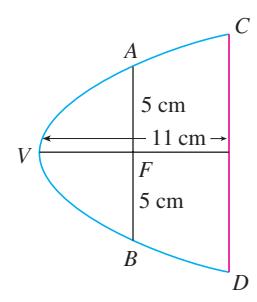
A cross-section of a parabolic reflector is shown in the figure. The bulb is located at the focus and the opening at the focus is 10 cm.
question image
(a) Find an equation of the parabola.
(b) Find the diameter of the opening \(|C D|\), 11 cm from the vertex.

Enter your answer directly below each part above.

51 Parametric Equations, Polar Coordinates, and Vector-Valued Functions · Level 4
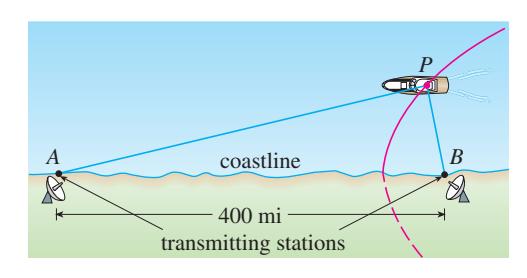
The LORAN (LOng RAnge Navigation) radio navigation system was widely used until the 1990s when it was superseded by the GPS system. In the LORAN system, two radio stations located at \(A\) and \(B\) transmit simultaneous signals to a ship or an aircraft located at \(P\). The onboard computer converts the time difference in receiving these signals into a distance difference \(|P A| - |P B|\), and this, according to the definition of a hyperbola, locates the ship or aircraft on one branch of a hyperbola. Suppose that station \(B\) is located 400 mi due east of station \(A\) on a coastline. A ship received the signal from \(B\) 1200 microseconds before it received the signal from \(A\).
question image
(a) Assuming that radio signals travel at a speed of 980 ft/microsecond, find an equation of the hyperbola on which the ship lies.
(b) If the ship is due north of \(B\), how far off the coastline is the ship?

Enter your answer directly below each part above.

52 Parametric Equations, Polar Coordinates, and Vector-Valued Functions · Level 4
Use the definition of a hyperbola to derive Equation 6 for a hyperbola with foci \((\pm c, 0)\) and vertices \((\pm a, 0)\).
53 Parametric Equations, Polar Coordinates, and Vector-Valued Functions · Level 4
Show that the function defined by the upper branch of the hyperbola \(y^2/a^2 - x^2/b^2 = 1\) is concave upward.
54 Parametric Equations, Polar Coordinates, and Vector-Valued Functions · Level 4
Find an equation for the ellipse with foci \((1, 1)\) and \((-1, -1)\) and major axis of length 4.
55 Parametric Equations, Polar Coordinates, and Vector-Valued Functions · Level 3
Determine the type of curve represented by the equation \(\dfrac{x^2}{k} + \dfrac{y^2}{k - 16} = 1\) in each of the following cases:
(a) \(k > 16\)
(b) \(0 < k < 16\)
(c) \(k < 0\)
(d) Show that all the curves in parts (a) and (b) have the same foci, no matter what the value of \(k\) is.

Enter your answer directly below each part above.

56 Parametric Equations, Polar Coordinates, and Vector-Valued Functions · Level 4
(a) Show that the equation of the tangent line to the parabola \(y^2 = 4p x\) at the point \((x_0, y_0)\) can be written as \(y_0 y = 2p(x + x_0)\)
(b) What is the \(x\)-intercept of this tangent line? Use this fact to draw the tangent line.

Enter your answer directly below each part above.

57 Parametric Equations, Polar Coordinates, and Vector-Valued Functions · Level 4
Show that the tangent lines to the parabola \(x^2 = 4p y\) drawn from any point on the directrix are perpendicular.
58 Parametric Equations, Polar Coordinates, and Vector-Valued Functions · Level 5
Show that if an ellipse and a hyperbola have the same foci, then their tangent lines at each point of intersection are perpendicular.
59 Parametric Equations, Polar Coordinates, and Vector-Valued Functions · Level 3
Use parametric equations and Simpson's Rule with \(n = 8\) to estimate the circumference of the ellipse \(9x^2 + 4y^2 = 36\).
60 Parametric Equations, Polar Coordinates, and Vector-Valued Functions · Level 3
The dwarf planet Pluto travels in an elliptical orbit around the sun (at one focus). The length of the major axis is \(1.18 \times 10^{10}\) km and the length of the minor axis is \(1.14 \times 10^{10}\) km. Use Simpson's Rule with \(n = 10\) to estimate the distance traveled by the planet during one complete orbit around the sun.
61 Parametric Equations, Polar Coordinates, and Vector-Valued Functions · Level 3
Find the area of the region enclosed by the hyperbola \(x^2/a^2 - y^2/b^2 = 1\) and the vertical line through a focus.
62 Parametric Equations, Polar Coordinates, and Vector-Valued Functions · Level 3
(a) If an ellipse is rotated about its major axis, find the volume of the resulting solid.
(b) If it is rotated about its minor axis, find the resulting volume.

Enter your answer directly below each part above.

63 Parametric Equations, Polar Coordinates, and Vector-Valued Functions · Level 3
Find the centroid of the region enclosed by the \(x\)-axis and the top half of the ellipse \(9x^2 + 4y^2 = 36\).
64 Parametric Equations, Polar Coordinates, and Vector-Valued Functions · Level 4
(a) Calculate the surface area of the ellipsoid that is generated by rotating an ellipse about its major axis.
(b) What is the surface area if the ellipse is rotated about its minor axis?

Enter your answer directly below each part above.

65 Parametric Equations, Polar Coordinates, and Vector-Valued Functions · Level 5
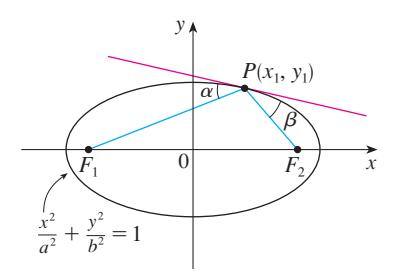
Let \(P(x_1, y_1)\) be a point on the ellipse \(x^2/a^2 + y^2/b^2 = 1\) with foci \(F_1\) and \(F_2\) and let \(\alpha\) and \(\beta\) be the angles between the lines \(P F_1\), \(P F_2\) and the ellipse as shown in the figure. Prove that \(\alpha = \beta\). This explains how whispering galleries and lithotripsy work. [Hint: Use the formula in Problem 21 on page 273 to show that \(\tan \alpha = \tan \beta\).]
question image
66 Parametric Equations, Polar Coordinates, and Vector-Valued Functions · Level 5
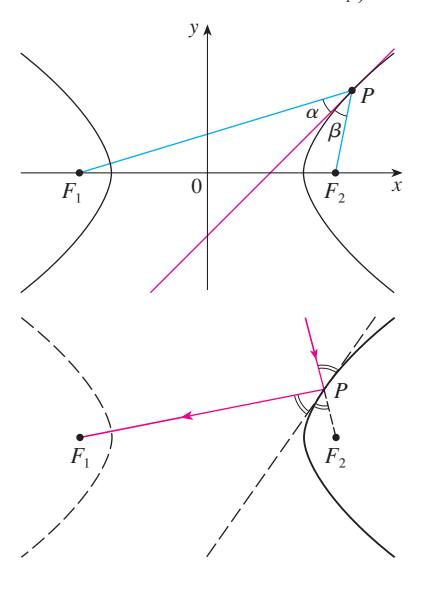
Let \(P(x_1, y_1)\) be a point on the hyperbola \(x^2/a^2 - y^2/b^2 = 1\) with foci \(F_1\) and \(F_2\) and let \(\alpha\) and \(\beta\) be the angles between the lines \(P F_1\), \(P F_2\) and the hyperbola as shown in the figure. Prove that \(\alpha = \beta\). (This is the reflection property of the hyperbola. It shows that light aimed at a focus \(F_2\) of a hyperbolic mirror is reflected toward the other focus \(F_1\).)
question image

Answered: 0 / 66