Stewart 9th Section 2.3: Differentiation Formulas

110 questions

0 / 110
Stewart 9th Section 2.3: Differentiation Formulas 0/110
1 Differentiation: Definition and Fundamental Properties · Level 1
\( g(x) = 4x + 7 \)
2 Differentiation: Definition and Fundamental Properties · Level 1
\( g(t) = 5t + 4t^2 \)
3 Differentiation: Definition and Fundamental Properties · Level 1
\( f(x) = x^{75} - x + 3 \)
4 Differentiation: Definition and Fundamental Properties · Level 1
\( g(x) = \dfrac{7}{4} x^2 - 3x + 12 \)
5 Differentiation: Definition and Fundamental Properties · Level 1
\( W(v) = 1.8 v^{-3} \)
6 Differentiation: Definition and Fundamental Properties · Level 2
\( r(z) = z^{-5} - z^{\dfrac{1}{2}} \)
7 Differentiation: Definition and Fundamental Properties · Level 2
\( f(x) = x^{\dfrac{3}{2}} + x^{-3} \)
8 Differentiation: Definition and Fundamental Properties · Level 2
\( V(t) = t^{\dfrac{-3}{5}} + t^4 \)
9 Differentiation: Definition and Fundamental Properties · Level 2
\( s(t) = \dfrac{1}{t} + \dfrac{1}{t^2} \)
10 Differentiation: Definition and Fundamental Properties · Level 2
\( r(t) = \dfrac{a}{t^2} + \dfrac{b}{t^4} \)
11 Differentiation: Definition and Fundamental Properties · Level 1
\( y = 2x + \sqrt{x} \)
12 Differentiation: Definition and Fundamental Properties · Level 1
\( h(w) = \sqrt{2} w - \sqrt{2} \)
13 Differentiation: Definition and Fundamental Properties · Level 2
\( g(x) = \dfrac{1}{\sqrt{x}} + \sqrt[5]{x} \)
14 Differentiation: Definition and Fundamental Properties · Level 1
\( S(R) = 4 \pi R^2 \)
15 Differentiation: Definition and Fundamental Properties · Level 2
\( f(x) = x^3 (x + 3) \)
16 Differentiation: Definition and Fundamental Properties · Level 2
\( F(t) = (2t - 3)^2 \)
17 Differentiation: Definition and Fundamental Properties · Level 2
\( f(x) = \dfrac{3x^2 + x^3}{x} \)
18 Differentiation: Definition and Fundamental Properties · Level 2
\( y = \dfrac{\sqrt{x} + x}{x^2} \)
19 Differentiation: Definition and Fundamental Properties · Level 2
\( G(q) = (1 + q^{-1})^2 \)
20 Differentiation: Definition and Fundamental Properties · Level 2
\( G(t) = \sqrt{5t} + \dfrac{\sqrt{7}}{t} \)
21 Differentiation: Definition and Fundamental Properties · Level 2
\( G(r) = \dfrac{3r^{\dfrac{3}{2}} + r^{\dfrac{5}{2}}}{r} \)
22 Differentiation: Definition and Fundamental Properties · Level 2
\( F(z) = \dfrac{A + B z + C z^2}{z^2} \)
23 Differentiation: Definition and Fundamental Properties · Level 3
\( P(w) = \dfrac{2w^2 - w + 4}{\sqrt{w}} \)
24 Differentiation: Definition and Fundamental Properties · Level 3
\( D(t) = \dfrac{1 + 16t^2}{(4t)^3} \)
25 Differentiation: Definition and Fundamental Properties · Level 2
Find \(\dfrac{d y}{d x}\) and \(\dfrac{d y}{d t}\). \(y = t x^2 + t^3 x\)
26 Differentiation: Definition and Fundamental Properties · Level 3
Find \(\dfrac{d y}{d x}\) and \(\dfrac{d y}{d t}\). \(y = \dfrac{t}{x^2} + \dfrac{x}{t}\)
27 Differentiation: Definition and Fundamental Properties · Level 2
Find the derivative of \(f(x) = (1 + 2x^2)(x - x^2)\) in two ways: by using the Product Rule and by performing the multiplication first. Do your answers agree?
28 Differentiation: Definition and Fundamental Properties · Level 2
Find the derivative of \(F(x) = \dfrac{x^4 - 5x^3 + \sqrt{x}}{x^2}\) in two ways: by using the Quotient Rule and by simplifying first. Do your answers agree?
29 Differentiation: Definition and Fundamental Properties · Level 2
Use the Product Rule to find the derivative of the function. \(f(x) = (3x^2 - 5x) x^2\)
30 Differentiation: Definition and Fundamental Properties · Level 2
Use the Product Rule to find the derivative of the function. \(y = (10x^2 + 7x - 2)(2 - x^2)\)
31 Differentiation: Definition and Fundamental Properties · Level 2
Use the Product Rule to find the derivative of the function. \(y = (4x^2 + 3)(2x + 5)\)
32 Differentiation: Definition and Fundamental Properties · Level 2
Use the Product Rule to find the derivative of the function. \(g(x) = \sqrt{x}(x + 2 \sqrt{x})\)
33 Differentiation: Definition and Fundamental Properties · Level 2
Use the Quotient Rule to find the derivative of the function. \(y = \dfrac{5x}{1 + x}\)
34 Differentiation: Definition and Fundamental Properties · Level 2
Use the Quotient Rule to find the derivative of the function. \(y = \dfrac{x^2}{1 - x}\)
35 Differentiation: Definition and Fundamental Properties · Level 2
Use the Quotient Rule to find the derivative of the function. \(g(t) = \dfrac{3 - 2t}{5t + 1}\)
36 Differentiation: Definition and Fundamental Properties · Level 2
Use the Quotient Rule to find the derivative of the function. \(G(u) = \dfrac{6u^4 - 5u}{u + 1}\)
37 Differentiation: Definition and Fundamental Properties · Level 3
Differentiate. \(f(t) = \dfrac{5t}{t^3 - t - 1}\)
38 Differentiation: Definition and Fundamental Properties · Level 3
Differentiate. \(F(x) = \dfrac{1}{2x^3 - 6x^2 + 5}\)
39 Differentiation: Definition and Fundamental Properties · Level 3
Differentiate. \(y = \dfrac{s - \sqrt{s}}{s^2}\)
40 Differentiation: Definition and Fundamental Properties · Level 3
Differentiate. \(y = \dfrac{\sqrt{x}}{\sqrt{x} + 1}\)
41 Differentiation: Definition and Fundamental Properties · Level 2
Differentiate. \(F(x) = \dfrac{2x^5 + x^4 - 6x}{x^3}\)
42 Differentiation: Definition and Fundamental Properties · Level 3
Differentiate. \(y = \dfrac{(u + 2)^2}{1 - u}\)
43 Differentiation: Definition and Fundamental Properties · Level 2
Differentiate. \(H(u) = (u - \sqrt{u})(u + \sqrt{u})\)
44 Differentiation: Definition and Fundamental Properties · Level 3
Differentiate. \(A(v) = v^{\dfrac{2}{3}}(2v^2 + 1 - v^{-2})\)
45 Differentiation: Definition and Fundamental Properties · Level 3
Differentiate. \(J(u) = \left(\dfrac{1}{u} + \dfrac{1}{u^2}\right)\left(u + \dfrac{1}{u}\right)\)
46 Differentiation: Definition and Fundamental Properties · Level 3
Differentiate. \(h(w) = (w^2 + 3w)(w^{-1} - w^{-4})\)
47 Differentiation: Definition and Fundamental Properties · Level 3
Differentiate. \(f(t) = \dfrac{\sqrt[3]{t}}{t - 3}\)
48 Differentiation: Definition and Fundamental Properties · Level 3
Differentiate. \(y = \dfrac{c x}{1 + c x}\)
49 Differentiation: Definition and Fundamental Properties · Level 3
Differentiate. \(G(y) = \dfrac{B}{A y^3 + B}\)
50 Differentiation: Definition and Fundamental Properties · Level 3
Differentiate. \(F(t) = \dfrac{A t}{B t^2 + C t^3}\)
51 Differentiation: Definition and Fundamental Properties · Level 4
Differentiate. \(f(x) = \dfrac{x}{x + \dfrac{c}{x}}\)
52 Differentiation: Definition and Fundamental Properties · Level 3
Differentiate. \(f(x) = \dfrac{a x + b}{c x + d}\)
53 Differentiation: Definition and Fundamental Properties · Level 3
The general polynomial of degree \(n\) has the form \(P(x) = a_n x^n + a_{n-1} x^{n-1} + \cdots + a_2 x^2 + a_1 x + a_0\), where \(a_n \neq 0\). Find \(P'(x)\).
54 Analytical Applications of Differentiation · Level 2
Find \(f'(x)\). Compare the graphs of \(f\) and \(f'\) and use them to explain why your answer is reasonable. \(f(x) = x^4 - 2x^3 + x^2\)
55 Analytical Applications of Differentiation · Level 2
Find \(f'(x)\). Compare the graphs of \(f\) and \(f'\) and use them to explain why your answer is reasonable. \(f(x) = 3x^{15} - 5x^3 + 3\)
56 Analytical Applications of Differentiation · Level 2
Find \(f'(x)\). Compare the graphs of \(f\) and \(f'\) and use them to explain why your answer is reasonable. \(f(x) = x + \dfrac{1}{x}\)
57 Analytical Applications of Differentiation · Level 3
(a) Graph \(f(x) = x^4 - 3x^3 - 6x^2 + 7x + 30\) in the viewing rectangle \([-3, 5]\) by \([-10, 50]\).
(b) On a separate graph, sketch \(f'\) by hand, using the graph in part (a) to estimate the slope of the tangent line at selected points.
(c) Calculate \(f'(x)\) and use this expression to graph \(f'\). Compare with your sketch in part (b).

Enter your answer directly below each part above.

58 Analytical Applications of Differentiation · Level 3
(a) Graph \(g(x) = \dfrac{x^2}{x^2 + 1}\) in the viewing rectangle \([-4, 4]\) by \([-1, 1.5]\).
(b) On a separate graph, sketch \(g'\) by hand, using the graph in part (a) to estimate the slope of the tangent line at selected points.
(c) Calculate \(g'(x)\) and use this expression to graph \(g'\). Compare with your sketch in part (b).

Enter your answer directly below each part above.

59 Differentiation: Definition and Fundamental Properties · Level 2
Find an equation of the tangent line to the curve at the given point. \(y = \dfrac{2x}{x + 1}\), \((1, 1)\)
60 Differentiation: Definition and Fundamental Properties · Level 2
Find an equation of the tangent line to the curve at the given point. \(y = 2x^3 - x^2 + 2\), \((1, 3)\)
61 Differentiation: Definition and Fundamental Properties · Level 3
Find equations of the tangent line and normal line to the curve at the given point. \(y = x + \sqrt{x}\), \((1, 2)\)
62 Differentiation: Definition and Fundamental Properties · Level 3
Find equations of the tangent line and normal line to the curve at the given point. \(y = x^{\dfrac{3}{2}}\), \((1, 1)\)
63 Differentiation: Definition and Fundamental Properties · Level 3
Find equations of the tangent line and normal line to the curve at the given point. \(y = \dfrac{3x}{1 + 5x^2}\), \(\left(1, \dfrac{1}{2}\right)\)
64 Differentiation: Definition and Fundamental Properties · Level 3
Find equations of the tangent line and normal line to the curve at the given point. \(y = \dfrac{\sqrt{x}}{x + 1}\), \((4, 0.4)\)
65 Differentiation: Definition and Fundamental Properties · Level 3
(a) The curve \(y = \dfrac{1}{1 + x^2}\) is called a witch of Maria Agnesi. Find an equation of the tangent line to this curve at the point \(\left(-1, \dfrac{1}{2}\right)\).
(b) Illustrate part (a) by graphing the curve and tangent line on the same screen.

Enter your answer directly below each part above.

66 Differentiation: Definition and Fundamental Properties · Level 3
(a) The curve \(y = \dfrac{x}{1 + x^2}\) is called a serpentine. Find an equation of the tangent line to this curve at the point \((3, 0.3)\).
(b) Illustrate part (a) by graphing the curve and tangent line on the same screen.

Enter your answer directly below each part above.

67 Differentiation: Definition and Fundamental Properties · Level 2
Find the first and second derivatives of the function. \(f(x) = 0.001x^5 - 0.02x^3\)
68 Differentiation: Definition and Fundamental Properties · Level 3
Find the first and second derivatives of the function. \(G(r) = \sqrt{r} + \sqrt[3]{r}\)
69 Differentiation: Definition and Fundamental Properties · Level 3
Find the first and second derivatives of the function. \(f(x) = \dfrac{x^2}{1 + 2x}\)
70 Differentiation: Definition and Fundamental Properties · Level 3
Find the first and second derivatives of the function. \(f(x) = \dfrac{1}{3 - x}\)
71 Differentiation: Definition and Fundamental Properties · Level 3
Find the first and second derivatives of the function. Check to see that your answers are reasonable by comparing the graphs of \(f\), \(f'\), and \(f''\). \(f(x) = 2x - 5x^{\dfrac{3}{4}}\)
72 Differentiation: Definition and Fundamental Properties · Level 3
Find the first and second derivatives of the function. Check to see that your answers are reasonable by comparing the graphs of \(f\), \(f'\), and \(f''\). \(f(x) = \dfrac{x^2 - 1}{x^2 + 1}\)
73 Contextual Applications of Differentiation · Level 3
The equation of motion of a particle is \(s = t^3 - 3t\), where \(s\) is measured in meters and \(t\) in seconds. Find
(a) the velocity and acceleration as functions of \(t\),
(b) the acceleration after 2 s, and
(c) the acceleration when the velocity is 0.

Enter your answer directly below each part above.

74 Contextual Applications of Differentiation · Level 3
The equation of motion of a particle is \(s = t^4 - 2t^3 + t^2 - t\), where \(s\) is in meters and \(t\) is in seconds.
(a) Find the velocity and acceleration as functions of \(t\).
(b) Find the acceleration after 1 s.

Enter your answer directly below each part above.

75 Contextual Applications of Differentiation · Level 3
Biologists have proposed a cubic polynomial to model the length \(L\) of Alaskan rockfish at age \(A\): \(L = 0.0155 A^3 - 0.372 A^2 + 3.95 A + 1.21\) where \(L\) is measured in inches and \(A\) in years. Calculate \(\dfrac{d L}{d A} bar.v_{A = 12}\) and interpret the result.
76 Contextual Applications of Differentiation · Level 3
The number of tree species \(S\) in a given area \(A\) in the Pasoh Forest Reserve in Malaysia has been modeled by the power function \(S(A) = 0.882 A^{0.842}\). Find \(S'(100)\) and interpret your answer.
77 Contextual Applications of Differentiation · Level 3
According to Boyle's Law, when a sample of gas is compressed at a constant temperature, the pressure \(P\) of the gas is inversely proportional to the volume \(V\) of the gas.
(a) Suppose that the pressure of a sample of air that occupies \(0.106\) m^3 at \(25^{\circ}\)C is 50 kPa. Write \(V\) as a function of \(P\).
(b) Calculate \(\dfrac{d V}{d P}\) when \(P = 50\) kPa. What is the meaning of the derivative? What are its units?

Enter your answer directly below each part above.

78 Contextual Applications of Differentiation · Level 3
The table shows data from an experiment in which the weights on a tire were varied and the tire life was measured.
(a) Find a quadratic model for the data.
(b) Use the model to estimate \(\dfrac{d L}{d P}\) when \(P = 30\) and when \(P = 40\). Interpret the results.

Enter your answer directly below each part above.

79 Differentiation: Definition and Fundamental Properties · Level 2
If \(f(5) = 1\), \(f'(5) = 6\), \(g(5) = -3\), \(g'(5) = 2\), find the following numbers.
(a) \((f g)'(5)\)
(b) \(\left(\dfrac{f}{g}\right)'(5)\)
(c) \(\left(\dfrac{g}{f}\right)'(5)\)

Enter your answer directly below each part above.

80 Differentiation: Definition and Fundamental Properties · Level 3
If \(f(4) = 2\), \(g(4) = 5\), \(f'(4) = 6\), \(g'(4) = -3\), find \(h'(4)\) for each of the following.
(a) \(h(x) = 3f(x) + 8g(x)\)
(b) \(h(x) = f(x) g(x)\)
(c) \(h(x) = \dfrac{f(x)}{g(x)}\)
(d) \(h(x) = \dfrac{g(x)}{f(x) + g(x)}\)

Enter your answer directly below each part above.

81 Differentiation: Definition and Fundamental Properties · Level 3
If \(f(x) = \sqrt{x} \cdot g(x)\), where \(g(4) = 8\) and \(g'(4) = 7\), find \(f'(4)\).
82 Differentiation: Definition and Fundamental Properties · Level 3
If \(h(2) = 4\) and \(h'(2) = -3\), find \(\dfrac{d}{d x}(\dfrac{h(x)}{x}) bar.v_{x = 2}\).
83 Differentiation: Definition and Fundamental Properties · Level 3
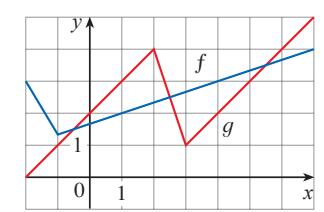
If \(f\) and \(g\) are the functions whose graphs are shown, let \(u(x) = f(x) g(x)\) and \(v(x) = \dfrac{f(x)}{g(x)}\).
question image
(a) Find \(u'(1)\).
(b) Find \(v'(4)\).

Enter your answer directly below each part above.

84 Differentiation: Definition and Fundamental Properties · Level 3
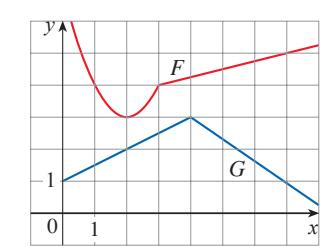
Let \(P(x) = F(x) G(x)\) and \(Q(x) = \dfrac{F(x)}{G(x)}\), where \(F\) and \(G\) are the functions whose graphs are shown.
question image
(a) Find \(P'(2)\).
(b) Find \(Q'(7)\).

Enter your answer directly below each part above.

85 Differentiation: Definition and Fundamental Properties · Level 3
If \(g\) is a differentiable function, find an expression for the derivative of each of the following.
(a) \(y = x g(x)\)
(b) \(y = \dfrac{x}{g(x)}\)
(c) \(y = \dfrac{g(x)}{x}\)

Enter your answer directly below each part above.

86 Differentiation: Definition and Fundamental Properties · Level 3
If \(f\) is a differentiable function, find an expression for the derivative of each of the following.
(a) \(y = x^2 f(x)\)
(b) \(y = \dfrac{f(x)}{x^2}\)
(c) \(y = \dfrac{x^2}{f(x)}\)
(d) \(y = \dfrac{1 + x f(x)}{\sqrt{x}}\)

Enter your answer directly below each part above.

87 Analytical Applications of Differentiation · Level 3
Find the points on the curve \(y = x^3 + 3x^2 - 9x + 10\) where the tangent is horizontal.
88 Analytical Applications of Differentiation · Level 3
For what values of \(x\) does the graph of \(f(x) = x^3 + 3x^2 + x + 3\) have a horizontal tangent?
89 Analytical Applications of Differentiation · Level 3
Show that the curve \(y = 6x^3 + 5x - 3\) has no tangent line with slope 4.
90 Analytical Applications of Differentiation · Level 3
Find an equation of the tangent line to the curve \(y = x^4 + 1\) that is parallel to the line \(32x - y = 15\).
91 Analytical Applications of Differentiation · Level 4
Find equations of both lines that are tangent to the curve \(y = x^3 - 3x^2 + 3x - 3\) and are parallel to the line \(3x - y = 15\).
92 Analytical Applications of Differentiation · Level 4
Find equations of the tangent lines to the curve \(y = \dfrac{x - 1}{x + 1}\) that are parallel to the line \(x - 2y = 2\).
93 Analytical Applications of Differentiation · Level 4
Find an equation of the normal line to the parabola \(y = \sqrt{x}\) that is parallel to the line \(2x + y = 1\).
94 Analytical Applications of Differentiation · Level 4
Where does the normal line to the parabola \(y = x^2 - 1\) at the point \((-1, 0)\) intersect the parabola a second time? Illustrate with a sketch.
95 Analytical Applications of Differentiation · Level 4
Draw a diagram to show that there are two tangent lines to the parabola \(y = x^2\) that pass through the point \((0, -4)\). Find the coordinates of the points where these tangent lines touch the parabola.
96 Analytical Applications of Differentiation · Level 4
(a) Find equations of both lines through the point \((2, -3)\) that are tangent to the parabola \(y = x^2 + x\).
(b) Show that there is no line through the point \((2, 7)\) that is tangent to the parabola. Then draw a diagram to see why.

Enter your answer directly below each part above.

97 Analytical Applications of Differentiation · Level 3
For what values of \(a\) and \(b\) is the line \(2x + y = b\) tangent to the parabola \(y = a x^2\) when \(x = 2\)?
98 Differentiation: Definition and Fundamental Properties · Level 4
Find the \(n\)th derivative of each function by calculating the first few derivatives and observing the pattern that occurs.
(a) \(f(x) = x^n\)
(b) \(f(x) = \dfrac{1}{x}\)

Enter your answer directly below each part above.

99 Differentiation: Definition and Fundamental Properties · Level 3
Find a second-degree polynomial \(P\) such that \(P(2) = 5\), \(P'(2) = 3\), and \(P''(2) = 2\).
100 Analytical Applications of Differentiation · Level 4
The equation \(y'' + y' - 2y = x^2\) is called a differential equation because it involves an unknown function \(y\) and its derivatives \(y'\) and \(y''\). Find constants \(A\), \(B\), and \(C\) such that the function \(y = A x^2 + B x + C\) satisfies this equation. (Differential equations will be studied in detail in Chapter 7.)
101 Analytical Applications of Differentiation · Level 4
Find a cubic function \(y = a x^3 + b x^2 + c x + d\) whose graph has horizontal tangents at the points \((-2, 6)\) and \((2, 0)\).
102 Analytical Applications of Differentiation · Level 4
Find a parabola \(y = a x^2 + b x + c\) that has slope 4 at \(x = 1\), slope \(-8\) at \(x = -1\), and passes through the point \((2, 15)\).
103 Contextual Applications of Differentiation · Level 3
In 2018 the population of Boulder, Colorado, was 108,250 and was increasing at a rate of about 1300 people per year. The average annual income was \$62,370 per capita, and this average was increasing at about \$2500 per year. Use the Product Rule to estimate the rate at which total personal income was rising in Boulder in 2018. Explain the meaning of each term in the Product Rule.
104 Contextual Applications of Differentiation · Level 3
A manufacturer of fabric produces rolls of material and the total revenue is \(R(p) = p f(p)\) dollars, where \(p\) is the price per yard and \(f(p)\) is the number of yards sold.
(a) What does it mean to say that \(f(20) = 10000\) and \(f'(20) = -350\)?
(b) Find \(R'(20)\) and interpret your answer.

Enter your answer directly below each part above.

105 Contextual Applications of Differentiation · Level 3
The Michaelis-Menten equation for the enzyme chymotrypsin is \(v = \dfrac{0.14 [S]}{0.015 + [S]}\), where \(v\) is the rate of an enzymatic reaction and \([S]\) is the concentration of a substrate \(S\). Calculate \(\dfrac{d v}{d [S]}\) and interpret the result.
106 Contextual Applications of Differentiation · Level 3
The biomass of a guppy population in a small aquarium is modeled using the Product Rule. Let \(N(t)\) be the number of guppies and \(w(t)\) be the average weight of each guppy at time \(t\), and \(B(t) = N(t) w(t)\) is the total biomass. Use the Product Rule to find \(B'(t)\) and interpret each term.
107 Analytical Applications of Differentiation · Level 5
(a) If \(F(x) = f(x) g(x) h(x)\) and \(F'\), \(f'\), \(g'\), and \(h'\) all exist, show that \(F'(x) = f'(x) g(x) h(x) + f(x) g'(x) h(x) + f(x) g(x) h'(x)\).
(b) By taking \(f = g = h\) in part (a), show that \(\dfrac{d}{d x} [f(x)]^3 = 3 [f(x)]^2 f'(x)\).
(c) Use part (b) to differentiate \(y = (x^4 + 3x^3 + 17x + 82)^3\).

Enter your answer directly below each part above.

108 Analytical Applications of Differentiation · Level 5
(a) Use the Quotient Rule to prove the Reciprocal Rule: if \(g\) is differentiable, then \(\dfrac{d}{d x} [\dfrac{1}{g(x)}] = \dfrac{-g'(x)}{[g(x)]^2}\).
(b) Use the Reciprocal Rule to differentiate the function in Exercise 38.

Enter your answer directly below each part above.

109 Analytical Applications of Differentiation · Level 5
Use the Product Rule to prove the Quotient Rule. [Hint: Write \(f(x) = [\dfrac{f(x)}{g(x)}] \cdot g(x)\).]
110 Analytical Applications of Differentiation · Level 5
If \(F(x) = f(x) g(x)\), where \(f\) and \(g\) have derivatives of all orders, show that:
(a) \(F'' = f'' g + 2 f' g' + f g''\)
(b) \(F''' = f''' g + 3 f'' g' + 3 f' g'' + f g'''\)
(c) Find a similar formula for \(F^{(4)}\).
(d) Guess a formula for \(F^{(n)}\).

Enter your answer directly below each part above.

Answered: 0 / 110