Question 1 of 6
| FRQ
· Level 4
Fish enter a lake at a rate modeled by the function \(E\) given by \(E(t) = 20 + 15 \sin\left(\dfrac{\pi t}{6}\right)\). Fish leave the lake at a rate modeled by the function \(L\) given by \(L(t) = 4 + 2^{0.1 t^2}\). Both \(E(t)\) and \(L(t)\) are measured in fish per hour, and \(t\) is measured in hours since midnight \((t = 0)\).
(a) How many fish enter the lake over the 5-hour period from midnight \((t = 0)\) to 5 A.M. \((t = 5)\)? Give your answer to the nearest whole number.
(b) What is the average number of fish that leave the lake per hour over the 5-hour period from midnight \((t = 0)\) to 5 A.M. \((t = 5)\)?
(c) At what time \(t\), for \(0 \leq t \leq 8\), is the greatest number of fish in the lake? Justify your answer.
(d) Is the rate of change in the number of fish in the lake increasing or decreasing at 5 A.M. \((t = 5)\)? Explain your reasoning.
Question 2 of 6
| FRQ
· Level 4
Let \(S\) be the region bounded by the graph of the polar curve \(r(\theta) = 3 \sqrt{\theta} \sin(\theta^2)\) for \(0 \leq \theta \leq \sqrt{\pi}\), as shown in the figure above.
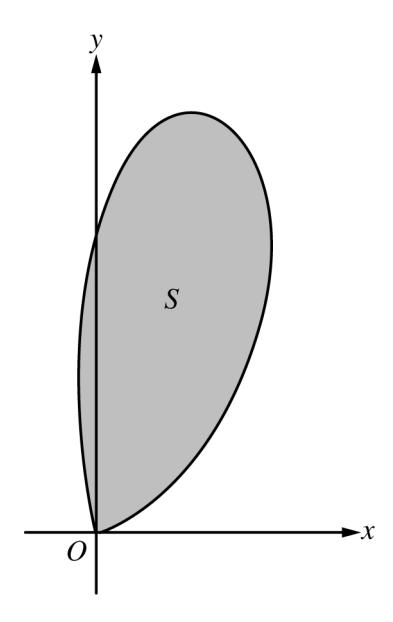
(a) Find the area of \(S\).
(b) What is the average distance from the origin to a point on the polar curve \(r(\theta) = 3 \sqrt{\theta} \sin(\theta^2)\) for \(0 \leq \theta \leq \sqrt{\pi}\)?
(c) There is a line through the origin with positive slope \(m\) that divides the region \(S\) into two regions with equal areas. Write, but do not solve, an equation involving one or more integrals whose solution gives the value of \(m\).
(d) For \(k > 0\), let \(A(k)\) be the area of the portion of region \(S\) that is also inside the circle \(r = k \cos \theta\). Find \(\operatorname*{lim}\limits_{k \rightarrow \infty} A(k)\).
Question 3 of 6
| FRQ
· Level 4
The continuous function \(f\) is defined on the closed interval \(-6 \leq x \leq 5\). The figure above shows a portion of the graph of \(f\), consisting of two line segments and a quarter of a circle centered at the point \((5, 3)\). It is known that the point \((3, 3 - \sqrt{5})\) is on the graph of \(f\).
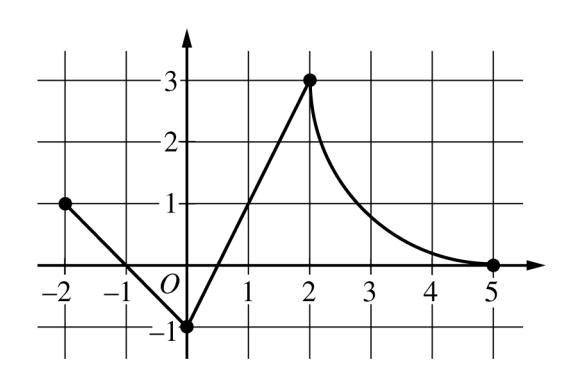
(a) If \(\displaystyle\int_{-6}^5 f(x) d x = 7\), find the value of \(\displaystyle\int_{-6}^{-2} f(x) d x\). Show the work that leads to your answer.
(b) Evaluate \(\displaystyle\int_{3}^{5} (2 f'(x) + 4) d x\).
(c) The function \(g\) is given by \(g(x) = \displaystyle\int_{-2}^x f(t) d t\). Find the absolute maximum value of \(g\) on the interval \(-2 \leq x \leq 5\). Justify your answer.
(d) Find \(\operatorname*{lim}\limits_{x \rightarrow 1} \dfrac{10^x - 3 f'(x)}{f(x) - \arctan x}\).
Question 4 of 6
| FRQ
· Level 4
A cylindrical barrel with a diameter of \(2\) feet contains collected rainwater, as shown in the figure above. The water drains out through a valve (not shown) at the bottom of the barrel. The rate of change of the height \(h\) of the water in the barrel with respect to time \(t\) is modeled by \(\dfrac{d h}{d t} = -\dfrac{1}{10} \sqrt{h}\), where \(h\) is measured in feet and \(t\) is measured in seconds. (The volume \(V\) of a cylinder with radius \(r\) and height \(h\) is \(V = \pi r^2 h\).)
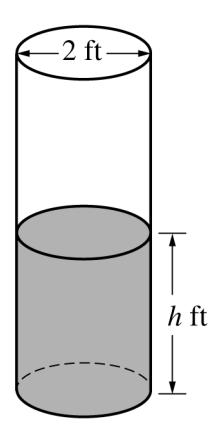
(a) Find the rate of change of the volume of water in the barrel with respect to time when the height of the water is \(4\) feet. Indicate units of measure.
(b) When the height of the water is \(3\) feet, is the rate of change of the height of the water with respect to time increasing or decreasing? Explain your reasoning.
(c) At time \(t = 0\) seconds, the height of the water is \(5\) feet. Use separation of variables to find an expression for \(h\) in terms of \(t\).
Question 5 of 6
| FRQ
· Level 4
Consider the family of functions \(f(x) = \dfrac{1}{x^2 - 2 x + k}\), where \(k\) is a constant.
(a) Find the value of \(k\), for \(k > 0\), such that the slope of the line tangent to the graph of \(f\) at \(x = 0\) equals \(6\).
(b) For \(k = -8\), find the value of \(\displaystyle\int_{0}^{1} f(x) d x\).
(c) For \(k = 1\), find the value of \(\displaystyle\int_{0}^{2} f(x) d x\) or show that it diverges.
Question 6 of 6
| FRQ
· Level 4
A function \(f\) has derivatives of all orders for all real numbers \(x\). A portion of the graph of \(f\) is shown above, along with the line tangent to the graph of \(f\) at \(x = 0\). Selected derivatives of \(f\) at \(x = 0\) are given in the table above.
| \(n\) | \(f^{(n)}(0)\) |
|---|---|
| 2 | 3 |
| 3 | \(-\dfrac{23}{2}\) |
| 4 | 54 |
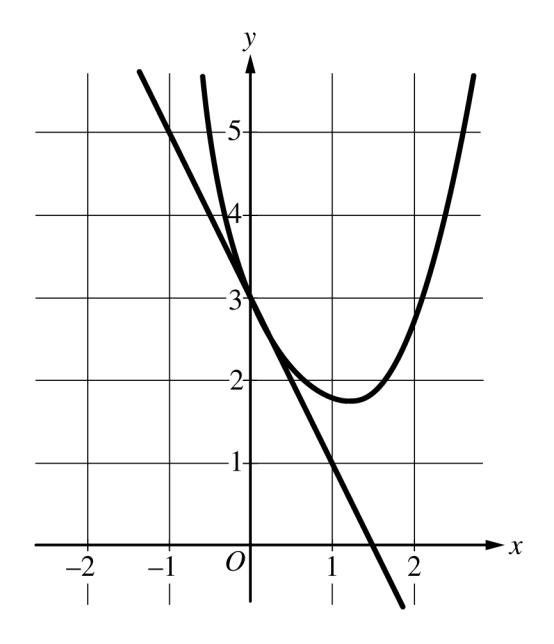
(a) Write the third-degree Taylor polynomial for \(f\) about \(x = 0\).
(b) Write the first three nonzero terms of the Maclaurin series for \(e^x\). Write the second-degree Taylor polynomial for \(e^x f(x)\) about \(x = 0\).
(c) Let \(h\) be the function defined by \(h(x) = \displaystyle\int_{0}^{x} f(t) d t\). Use the Taylor polynomial found in part (a) to find an approximation for \(h(1)\).
(d) It is known that the Maclaurin series for \(h\) converges to \(h(x)\) for all real numbers \(x\). It is also known that the individual terms of the series for \(h(1)\) alternate in sign and decrease in absolute value to \(0\). Use the alternating series error bound to show that the approximation found in part (c) differs from \(h(1)\) by at most \(0.45\).
Review Your Answers
Check your work before submitting. You can return to any question.
Answered: 0
Unanswered: 0
Flagged: 0