Question 1 of 6
| FRQ
· Level 4
An invasive species of plant appears in a fruit grove at time \(t = 0\) and begins to spread. The function \(C\) defined by \(C(t) = 7.6 \arctan(0.2 t)\) models the number of acres in the fruit grove affected by the species \(t\) weeks after the species appears. It can be shown that \(C'(t) = \dfrac{38}{25 + t^2}\).
(Note: Your calculator should be in radian mode.)
(a) Find the average number of acres affected by the invasive species from time \(t = 0\) to time \(t = 4\) weeks. Show the setup for your calculations.
(b) Find the time \(t\) when the instantaneous rate of change of \(C\) equals the average rate of change of \(C\) over the time interval \(0 \leq t \leq 4\). Show the setup for your calculations.
(c) Assume that the invasive species continues to spread according to the given model for all times \(t > 0\). Write a limit expression that describes the end behavior of the rate of change in the number of acres affected by the species. Evaluate this limit expression.
(d) At time \(t = 4\) weeks after the invasive species appears in the fruit grove, measures are taken to counter the spread of the species. The function \(A\), defined by \(A(t) = C(t) - \displaystyle\int_{4}^{t} 0.1 \cdot \ln(x) d x\), models the number of acres affected by the species over the time interval \(4 \leq t \leq 36\). At what time \(t\), for \(4 \leq t \leq 36\), does \(A\) attain its maximum value? Justify your answer.
Question 2 of 6
| FRQ
· Level 4
The shaded region \(R\) is bounded by the graphs of the functions \(f\) and \(g\), where \(f(x) = x^2 - 2 x\) and \(g(x) = x + \sin(\pi x)\), as shown in the figure.
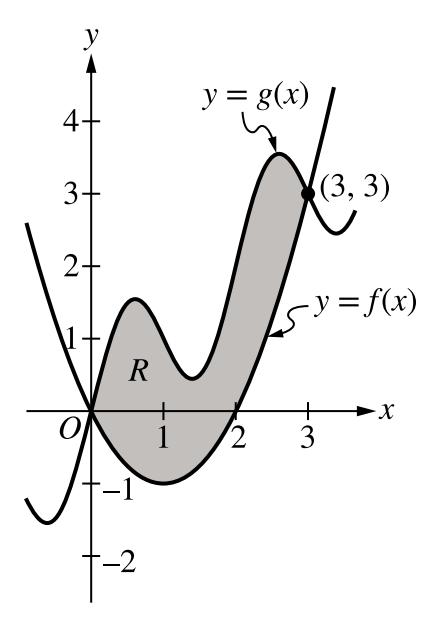
(a) Find the area of \(R\). Show the setup for your calculations.
(b) Region \(R\) is the base of a solid. For this solid, at each \(x\) the cross section perpendicular to the \(x\)-axis is a rectangle with height \(x\) and base in region \(R\). Find the volume of the solid. Show the setup for your calculations.
(c) Write, but do not evaluate, an integral expression for the volume of the solid generated when the region \(R\) is rotated about the horizontal line \(y = -2\).
(d) It can be shown that \(g'(x) = 1 + \pi \cos(\pi x)\). Find the value of \(x\), for \(0 < x < 1\), at which the line tangent to the graph of \(f\) is parallel to the line tangent to the graph of \(g\).
Question 3 of 6
| FRQ
· Level 4
A student starts reading a book at time \(t = 0\) minutes and continues reading for the next \(10\) minutes. The rate at which the student reads is modeled by the differentiable function \(R\), where \(R(t)\) is measured in words per minute. Selected values of \(R(t)\) are given in the table shown.
| \(t\) (minutes) | 0 | 2 | 8 | 10 |
|---|---|---|---|---|
| \(R(t)\) (words per minute) | 90 | 100 | 150 | 162 |
(a) Approximate \(R'(1)\) using the average rate of change of \(R\) over the interval \(0 \leq t \leq 2\). Show the work that leads to your answer. Indicate units of measure.
(b) Must there be a value \(c\), for \(0 < c < 10\), such that \(R(c) = 155\)? Justify your answer.
(c) Use a trapezoidal sum with the three subintervals indicated by the data in the table to approximate the value of \(\displaystyle\int_{0}^{10} R(t) d t\). Show the work that leads to your answer.
(d) A teacher also starts reading at time \(t = 0\) minutes and continues reading for the next \(10\) minutes. The rate at which the teacher reads is modeled by the function \(W\) defined by \(W(t) = -\dfrac{3}{10} t^2 + 8 t + 100\), where \(W(t)\) is measured in words per minute. Based on the model, how many words has the teacher read by the end of the \(10\) minutes? Show the work that leads to your answer.
Question 4 of 6
| FRQ
· Level 4
The continuous function \(f\) is defined on the closed interval \(-6 \leq x \leq 12\). The graph of \(f\), consisting of two semicircles and one line segment, is shown in the figure.
Let \(g\) be the function defined by \(g(x) = \displaystyle\int_{0}^{x} f(t) d t\).
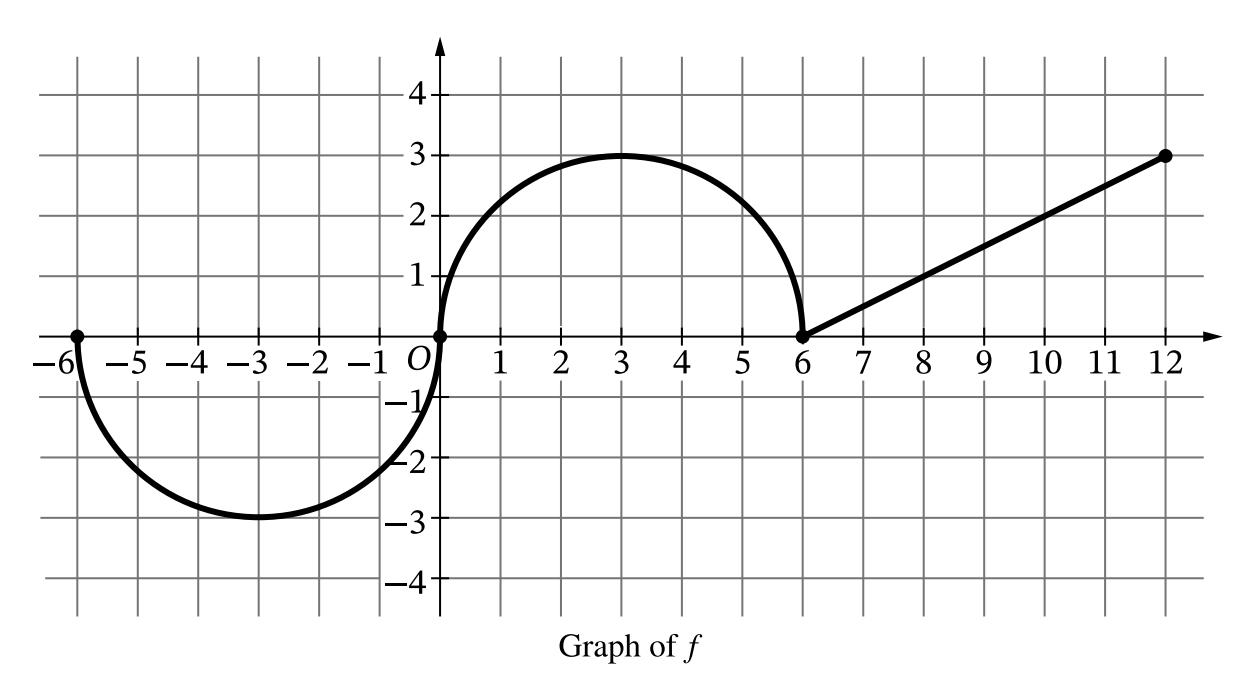
(a) Find \(g'(8)\). Give a reason for your answer.
(b) Find all values of \(x\) in the open interval \(-6 < x < 12\) at which the graph of \(g\) has a point of inflection. Give a reason for your answer.
(c) Find \(g(12)\) and \(g(0)\). Label your answers.
(d) Find the value of \(x\) at which \(g\) attains an absolute minimum on the closed interval \(-6 \leq x \leq 12\). Justify your answer.
Question 5 of 6
| FRQ
· Level 4
Two particles, \(H\) and \(J\), are moving along the \(x\)-axis. For \(0 \leq t \leq 5\), the position of particle \(H\) at time \(t\) is given by \(x_H (t) = e^{t^2 - 4 t}\) and the velocity of particle \(J\) at time \(t\) is given by \(v_J (t) = 2 t (t^2 - 1)^3\).
(a) Find the velocity of particle \(H\) at time \(t = 1\). Show the work that leads to your answer.
(b) During what open intervals of time \(t\), for \(0 < t < 5\), are particles \(H\) and \(J\) moving in opposite directions? Give a reason for your answer.
(c) It can be shown that \(v_J'(2) > 0\). Is the speed of particle \(J\) increasing, decreasing, or neither at time \(t = 2\)? Give a reason for your answer.
(d) Particle \(J\) is at position \(x = 7\) at time \(t = 0\). Find the position of particle \(J\) at time \(t = 2\). Show the work that leads to your answer.
Question 6 of 6
| FRQ
· Level 4
Consider the curve \(G\) defined by the equation \(y^3 - y^2 - y + \dfrac{1}{4} x^2 = 0\).
(a) Show that \(\dfrac{d y}{d x} = \dfrac{-x}{2(3 y^2 - 2 y - 1)}\).
(b) There is a point \(P\) on the curve \(G\) near \((2, -1)\) with \(x\)-coordinate \(1.6\). Use the line tangent to the curve at \((2, -1)\) to approximate the \(y\)-coordinate of point \(P\).
(c) For \(x > 0\) and \(y > 0\), there is a point \(S\) on the curve \(G\) at which the line tangent to the curve at that point is vertical. Find the \(y\)-coordinate of point \(S\). Show the work that leads to your answer.
(d) A particle moves along the curve \(H\) defined by the equation \(2 x y + \ln y = 8\). At the instant when the particle is at the point \((4, 1)\), \(\dfrac{d x}{d t} = 3\). Find \(\dfrac{d y}{d t}\) at that instant. Show the work that leads to your answer.
Review Your Answers
Check your work before submitting. You can return to any question.
Answered: 0
Unanswered: 0
Flagged: 0