⌛ 5 minutes remaining. The timer is now always visible.
Stewart 9th - 1.1, 1.6 (20Q)
20 Questions
Question 1 of 20
Stewart 9th - 1.1, 1.6 (20Q)
0/20
Question 1 of 20
| Functions - Applied
· Level 3
Find a formula for the described function and state its domain.
A rectangle has a perimeter of 20 m. Express the area of the rectangle as a function of the length of one of its sides.
Question 2 of 20
| Functions - Domain
· Level 3
Find the domain of the function.
\(h(x) = \dfrac{1}{\sqrt[4]{x^2 - 5 x}}\)
Determine whether the equation defines \(y\) as a function of \(x\).
\((y + 3)^3 + 1 = 2 x\)
Question 4 of 20
| Functions - Applied
· Level 3
Find a formula for the described function and state its domain.
An open rectangular box with volume 2 m\({}^3\) has a square base. Express the surface area of the box as a function of the length of a side of the base.
Evaluate \(f(-3)\), \(f(0)\), and \(f(2)\) for the piecewise defined function. Then sketch the graph of the function.
\( f(x) = \begin{cases} -1 & \text{if } x \leq 1 \\ 7 - 2 x & \text{if } x > 1 \end{cases} \)
Evaluate the difference quotient for the given function. Simplify your answer.
\(f(x) = 4 + 3 x - x^2\), \(\quad \dfrac{f(3 + h) - f(3)}{h}\)
Question 11 of 20
| Limit Laws - Absolute Value
· Level 3
Find the limit, if it exists. If the limit does not exist, explain why.
\(\operatorname*{lim}\limits_{x \rightarrow 0^-} \left(\dfrac{1}{x} - \dfrac{1}{|x|}\right)\)
Evaluate the limit, if it exists.
\(\operatorname*{lim}\limits_{x \rightarrow 4} \dfrac{x^2 + 3 x}{x^2 - x - 12}\)
Question 14 of 20
| Limit Laws - Direct Evaluation
· Level 2
Evaluate the limit and justify each step by indicating the appropriate Limit Law(s).
\(\operatorname*{lim}\limits_{t \rightarrow -1} \left(\dfrac{2 t^5 - t^3}{5 t^2 + 4}\right)^3\)
Show by means of an example that \(\operatorname*{lim}\limits_{x \rightarrow a} [f(x) g(x)]\) may exist even though neither \(\operatorname*{lim}\limits_{x \rightarrow a} f(x)\) nor \(\operatorname*{lim}\limits_{x \rightarrow a} g(x)\) exists.
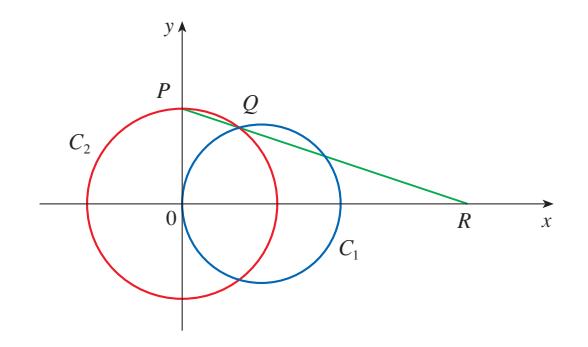
The figure shows a fixed circle \(C_1\) with equation \((x - 1)^2 + y^2 = 1\) and a shrinking circle \(C_2\) with radius \(r\) and center the origin. \(P\) is the point \((0, r)\), \(Q\) is the upper point of intersection of the two circles, and \(R\) is the point of intersection of the line \(P Q\) and the \(x\)-axis. What happens to \(R\) as \(C_2\) shrinks, that is, as \(r \rightarrow 0^+\)?
(a) If \(\lfloor x \rfloor\) denotes the greatest integer function, evaluate:
(i) \(\operatorname*{lim}\limits_{x \rightarrow -2^+} \lfloor x \rfloor\)
(ii) \(\operatorname*{lim}\limits_{x \rightarrow -2} \lfloor x \rfloor\)
(iii) \(\operatorname*{lim}\limits_{x \rightarrow -2.4} \lfloor x \rfloor\)
(b) If \(n\) is an integer, evaluate:
(i) \(\operatorname*{lim}\limits_{x \rightarrow n^-} \lfloor x \rfloor\)
(ii) \(\operatorname*{lim}\limits_{x \rightarrow n^+} \lfloor x \rfloor\)
(c) For what values of \(a\) does \(\operatorname*{lim}\limits_{x \rightarrow a} \lfloor x \rfloor\) exist?
(a) What is wrong with the following equation?
\(\dfrac{x^2 + x - 6}{x - 2} = x + 3\)
(b) In view of part (a), explain why the equation
\(\operatorname*{lim}\limits_{x \rightarrow 2} \dfrac{x^2 + x - 6}{x - 2} = \operatorname*{lim}\limits_{x \rightarrow 2} (x + 3)\)
is correct.
Question 20 of 20
| Limit Laws - Absolute Value
· Level 3
Find the limit, if it exists. If the limit does not exist, explain why.
\(\operatorname*{lim}\limits_{x \rightarrow -2} \dfrac{2 - |x|}{2 + x}\)
Review Your Answers
Check your work before submitting. You can return to any question.
Answered: 0Unanswered: 0Flagged: 0
Questions
AnsweredUnanswered⚑ Flagged
Graphing Calculator
Reference Sheet
Area & Circumference
Circle$A = \pi r^2$, $C = 2\pi r$
Rectangle$A = lw$
Triangle$A = \tfrac{1}{2}bh$
Trapezoid$A = \tfrac{1}{2}(b_1+b_2)h$
Volume
Box$V = lwh$
Cylinder$V = \pi r^2 h$
Sphere$V = \tfrac{4}{3}\pi r^3$
Cone$V = \tfrac{1}{3}\pi r^2 h$
Pyramid$V = \tfrac{1}{3}lwh$
Triangles
Pythagorean Thm$a^2 + b^2 = c^2$
30-60-90sides: $1,\, \sqrt{3},\, 2$
45-45-90sides: $1,\, 1,\, \sqrt{2}$
Triangle Anglessum $= 180°$
Other Facts
Circle Degrees$360° = 2\pi \text{ rad}$
Exterior Angle= sum of non-adjacent interior angles
The number of degrees of arc in a circle is 360. The number of radians of arc in a circle is $2\pi$.