Question 1 of 6
| FRQ
· Level 4
People enter a line for an escalator at a rate modeled by the function \(r\) given by
\(r(t) = \begin{cases} 44 \left(\dfrac{t}{100}\right)^3 \left(1 - \dfrac{t}{300}\right)^7 \text{for} 0 \leq t \leq 300 \\ 0 \text{for} t > 300 \end{cases}\)
where \(r(t)\) is measured in people per second and \(t\) is measured in seconds. As people get on the escalator, they exit the line at a constant rate of \(0.7\) person per second. There are \(20\) people in line at time \(t = 0\).
(a) How many people enter the line for the escalator during the time interval \(0 \leq t \leq 300\)?
(b) During the time interval \(0 \leq t \leq 300\), there are always people in line for the escalator. How many people are in line at time \(t = 300\)?
(c) For \(t > 300\), what is the first time \(t\) that there are no people in line for the escalator?
(d) For \(0 \leq t \leq 300\), at what time \(t\) is the number of people in line a minimum? To the nearest whole number, find the number of people in line at this time. Justify your answer.
Question 2 of 6
| FRQ
· Level 4
Researchers on a boat are investigating plankton cells in a sea. At a depth of \(h\) meters, the density of plankton cells, in millions of cells per cubic meter, is modeled by \(p(h) = 0.2 h^2 e^{-0.0025 h^2}\) for \(0 \leq h \leq 30\) and is modeled by \(f(h)\) for \(h \geq 30\). The continuous function \(f\) is not explicitly given.
(a) Find \(p'(25)\). Using correct units, interpret the meaning of \(p'(25)\) in the context of the problem.
(b) Consider a vertical column of water in this sea with horizontal cross sections of constant area \(3\) square meters. To the nearest million, how many plankton cells are in this column of water between \(h = 0\) and \(h = 30\) meters?
(c) There is a function \(u\) such that \(0 \leq f(h) \leq u(h)\) for all \(h \geq 30\) and \(\displaystyle\int_{30}^{\infty} u(h) d h = 105\). The column of water in part (b) is \(K\) meters deep, where \(K > 30\). Write an expression involving one or more integrals that gives the number of plankton cells, in millions, in the entire column. Explain why the number of plankton cells in the column is less than or equal to \(2000\) million.
(d) The boat is moving on the surface of the sea. At time \(t \geq 0\), the position of the boat is \((x(t), y(t))\), where \(x'(t) = 662 \sin(5 t)\) and \(y'(t) = 880 \cos(6 t)\). Time \(t\) is measured in hours, and \(x(t)\) and \(y(t)\) are measured in meters. Find the total distance traveled by the boat over the time interval \(0 \leq t \leq 1\).
Question 3 of 6
| FRQ
· Level 4
The graph of the continuous function \(g\), the derivative of the function \(f\), is shown above. The function \(g\) is piecewise linear for \(-5 \leq x < 3\), and \(g(x) = 2(x - 4)^2\) for \(3 \leq x \leq 6\).
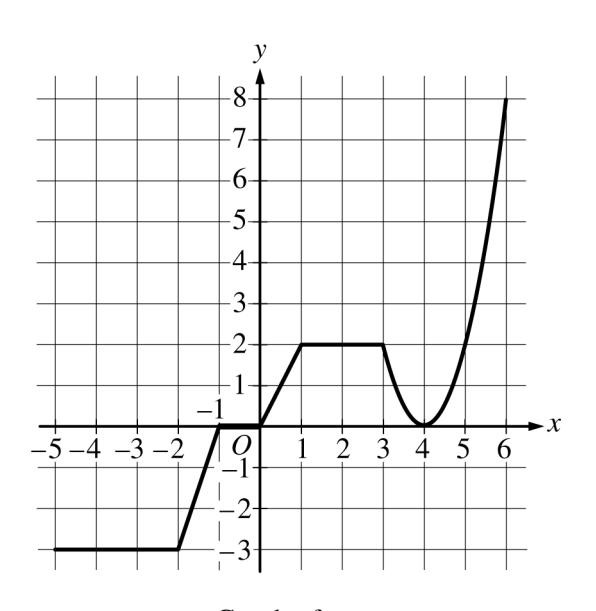
(a) If \(f(1) = 3\), what is the value of \(f(-5)\)?
(b) Evaluate \(\displaystyle\int_{1}^{6} g(x) d x\).
(c) For \(-5 < x < 6\), on what open intervals, if any, is the graph of \(f\) both increasing and concave up? Give a reason for your answer.
(d) Find the \(x\)-coordinate of each point of inflection of the graph of \(f\). Give a reason for your answer.
Question 4 of 6
| FRQ
· Level 4
The height of a tree at time \(t\) is given by a twice-differentiable function \(H\), where \(H(t)\) is measured in meters and \(t\) is measured in years. Selected values of \(H(t)\) are given in the table above.
| \(t\) (years) | 2 | 3 | 5 | 7 | 10 |
|---|---|---|---|---|---|
| \(H(t)\) (meters) | 1.5 | 2 | 6 | 11 | 15 |
(a) Use the data in the table to estimate \(H'(6)\). Using correct units, interpret the meaning of \(H'(6)\) in the context of the problem.
(b) Explain why there must be at least one time \(t\), for \(2 < t < 10\), such that \(H'(t) = 2\).
(c) Use a trapezoidal sum with the four subintervals indicated by the data in the table to approximate the average height of the tree over the time interval \(2 \leq t \leq 10\).
(d) The height of the tree, in meters, can also be modeled by the function \(G\), given by \(G(x) = \dfrac{100 x}{1 + x}\), where \(x\) is the diameter of the base of the tree, in meters. When the tree is \(50\) meters tall, the diameter of the base of the tree is increasing at a rate of \(0.03\) meter per year. According to this model, what is the rate of change of the height of the tree with respect to time, in meters per year, at the time when the tree is \(50\) meters tall?
Question 5 of 6
| FRQ
· Level 4
Let \(f\) be the function defined by \(f(x) = e^x \cos x\).
(a) Find the average rate of change of \(f\) on the interval \(0 \leq x \leq \pi\).
(b) What is the slope of the line tangent to the graph of \(f\) at \(x = \dfrac{3 \pi}{2}\)?
(c) Find the absolute minimum value of \(f\) on the interval \(0 \leq x \leq 2 \pi\). Justify your answer.
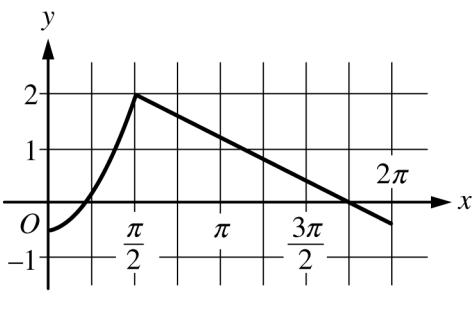
(d) Let \(g\) be a differentiable function such that \(g\left(\dfrac{\pi}{2}\right) = 0\). The graph of \(g'\), the derivative of \(g\), is shown below. Find the value of \(\operatorname*{lim}\limits_{x \rightarrow \pi slash 2} \dfrac{f(x)}{g(x)}\) or state that it does not exist. Justify your answer.
Question 6 of 6
| FRQ
· Level 4
Consider the differential equation \(\dfrac{d y}{d x} = \dfrac{1}{3} x (y^2 - 2)\).
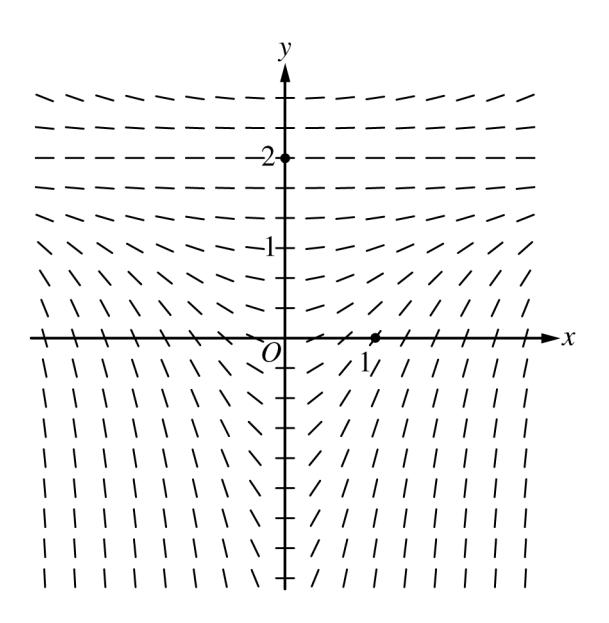
(a) A slope field for the given differential equation is shown below. Sketch the solution curve that passes through the point \((0, 2)\), and sketch the solution curve that passes through the point \((1, 0)\).
(b) Write an equation for the line tangent to the solution curve that passes through the point \((1, 0)\). Use the tangent line to approximate \(y(1.1)\), the value of the solution at \(x = 1.1\).
(c) Find \(\dfrac{d^2 y}{d x^2}\) in terms of \(x\) and \(y\). Determine the concavity of the solution curves that pass through the quadrant where \(x > 0\) and \(y > 0\).
(d) Find the particular solution \(y = f(x)\) to the differential equation with initial condition \(f(0) = \sqrt{2}\).
Review Your Answers
Check your work before submitting. You can return to any question.
Answered: 0
Unanswered: 0
Flagged: 0