Question 1 of 6
| FRQ
· Level 4
The density of a bacteria population in a circular petri dish at a distance \(r\) centimeters from the center of the dish is given by an increasing, differentiable function \(f\), where \(f(r)\) is measured in milligrams per square centimeter. Values of \(f(r)\) for selected values of \(r\) are given in the table above.
| \(r\) (centimeters) | 0 | 1 | 2 | 2.5 | 4 |
|---|---|---|---|---|---|
| \(f(r)\) (milligrams per square centimeter) | 1 | 2 | 6 | 10 | 18 |
(a) Use the data in the table to estimate \(f'(2.25)\). Using correct units, interpret the meaning of your answer in the context of this problem.
(b) The total mass, in milligrams, of bacteria in the petri dish is given by the integral expression \(2 \pi \displaystyle\int_{0}^{4} r f(r) d r\). Approximate the value of \(2 \pi \displaystyle\int_{0}^{4} r f(r) d r\) using a right Riemann sum with the four subintervals indicated by the data in the table.
(c) Is the approximation found in part (b) an overestimate or underestimate of the total mass of bacteria in the petri dish? Explain your reasoning.
(d) The density of bacteria in the petri dish, for \(1 \leq r \leq 4\), is modeled by the function \(g\) defined by \(g(r) = 2 - 16(\cos(1.57 \sqrt{r}))^3\). For what value of \(k\), \(1 < k < 4\), is \(g(k)\) equal to the average value of \(g(r)\) on the interval \(1 \leq r \leq 4\)?
Question 2 of 6
| FRQ
· Level 4
For time \(t \geq 0\), a particle moves in the \(x y\)-plane with position \((x(t), y(t))\) and velocity vector \(\langle (t - 1) e^{t^2}, \sin(t^1.25) \rangle\). At time \(t = 0\), the position of the particle is \((-2, 5)\).
(a) Find the speed of the particle at time \(t = 1.2\). Find the acceleration vector of the particle at time \(t = 1.2\).
(b) Find the total distance traveled by the particle over the time interval \(0 \leq t \leq 1.2\).
(c) Find the coordinates of the point at which the particle is farthest to the left for \(t \geq 0\). Explain why there is no point at which the particle is farthest to the right for \(t \geq 0\).
Question 3 of 6
| FRQ
· Level 4
A company designs spinning toys using the family of functions \(y = c x \sqrt{4 - x^2}\), where \(c\) is a positive constant. The figure above shows the region in the first quadrant bounded by the \(x\)-axis and the graph of \(y = c x \sqrt{4 - x^2}\), for some \(c\). Each spinning toy is in the shape of the solid generated when such a region is revolved about the \(x\)-axis. Both \(x\) and \(y\) are measured in inches.
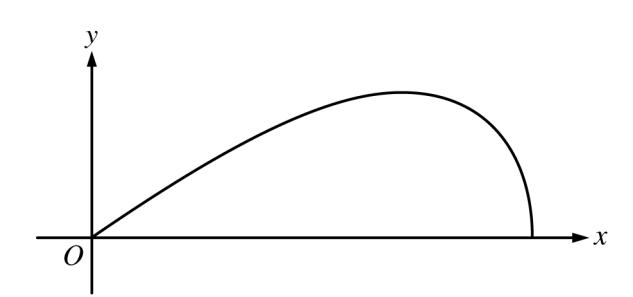
(a) Find the area of the region in the first quadrant bounded by the \(x\)-axis and the graph of \(y = c x \sqrt{4 - x^2}\) for \(c = 6\).
(b) It is known that, for \(y = c x \sqrt{4 - x^2}\), \(\dfrac{d y}{d x} = \dfrac{c(4 - 2 x^2)}{\sqrt{4 - x^2}}\). For a particular spinning toy, the radius of the largest cross-sectional circular slice is \(1.2\) inches. What is the value of \(c\) for this spinning toy?
(c) For another spinning toy, the volume is \(2 \pi\) cubic inches. What is the value of \(c\) for this spinning toy?
Question 4 of 6
| FRQ
· Level 4
Let \(f\) be a continuous function defined on the closed interval \(-4 \leq x \leq 6\). The graph of \(f\), consisting of four line segments, is shown above. Let \(G\) be the function defined by \(G(x) = \displaystyle\int_{0}^{x} f(t) d t\).
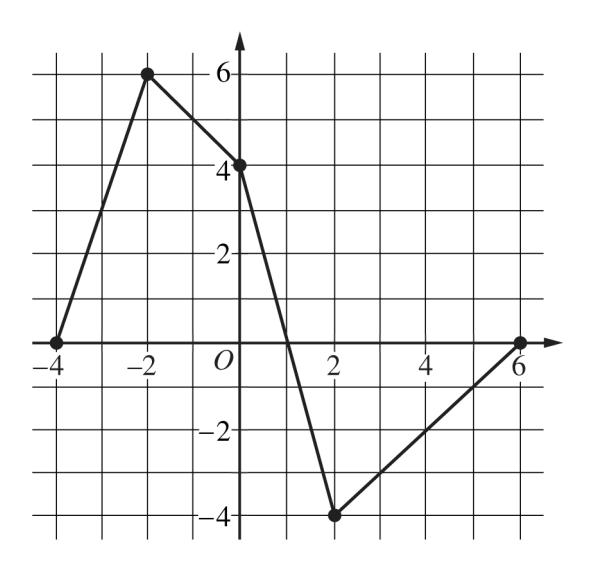
(a) On what open intervals is the graph of \(G\) concave up? Give a reason for your answer.
(b) Let \(P\) be the function defined by \(P(x) = G(x) \cdot f(x)\). Find \(P'(3)\).
(c) Find \(\operatorname*{lim}\limits_{x \rightarrow 2} \dfrac{G(x)}{x^2 - 2 x}\).
(d) Find the average rate of change of \(G\) on the interval \([-4, 2]\). Does the Mean Value Theorem guarantee a value \(c\), \(-4 < c < 2\), for which \(G'(c)\) is equal to this average rate of change? Justify your answer.
Question 5 of 6
| FRQ
· Level 4
Let \(y = f(x)\) be the particular solution to the differential equation \(\dfrac{d y}{d x} = y \cdot (x \ln x)\) with initial condition \(f(1) = 4\). It can be shown that \(f''(1) = 4\).
(a) Write the second-degree Taylor polynomial for \(f\) about \(x = 1\). Use the Taylor polynomial to approximate \(f(2)\).
(b) Use Euler's method, starting at \(x = 1\) with two steps of equal size, to approximate \(f(2)\). Show the work that leads to your answer.
(c) Find the particular solution \(y = f(x)\) to the differential equation \(\dfrac{d y}{d x} = y \cdot (x \ln x)\) with initial condition \(f(1) = 4\).
Question 6 of 6
| FRQ
· Level 4
The function \(g\) has derivatives of all orders for all real numbers. The Maclaurin series for \(g\) is given by \(g(x) = \displaystyle\sum_{n=0}^\infty \dfrac{(-1)^n x^n}{2 e^n + 3}\) on its interval of convergence.
(a) State the conditions necessary to use the integral test to determine convergence of the series \(\displaystyle\sum_{n=0}^\infty \dfrac{1}{e^n}\). Use the integral test to show that \(\displaystyle\sum_{n=0}^\infty \dfrac{1}{e^n}\) converges.
(b) Use the limit comparison test with the series \(\displaystyle\sum_{n=0}^\infty \dfrac{1}{e^n}\) to show that the series \(g(1) = \displaystyle\sum_{n=0}^\infty \dfrac{(-1)^n}{2 e^n + 3}\) converges absolutely.
(c) Determine the radius of convergence of the Maclaurin series for \(g\).
(d) The first two terms of the series \(g(1) = \displaystyle\sum_{n=0}^\infty \dfrac{(-1)^n}{2 e^n + 3}\) are used to approximate \(g(1)\). Use the alternating series error bound to determine an upper bound on the error of the approximation.
Review Your Answers
Check your work before submitting. You can return to any question.
Answered: 0
Unanswered: 0
Flagged: 0