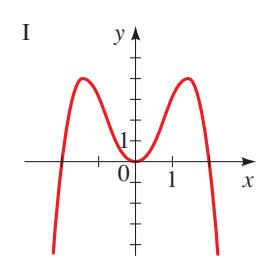
Stewart Precalc 6e Section 3.2: Polynomial Functions and Their Graphs

92 questions

0 / 92
Stewart Precalc 6e Section 3.2: Polynomial Functions and Their Graphs 0/92
1 Concepts - Polynomial graph identification · Level 1
Only one of the following graphs could be the graph of a polynomial function. Which one? Why are the others not graphs of polynomials?
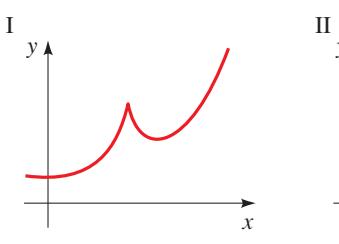
question image
2 Concepts - End behavior of polynomials · Level 1
Every polynomial has one of the following behaviors: (i) \(y \rightarrow \infty\) as \(x \rightarrow \infty\) and \(y \rightarrow \infty\) as \(x \rightarrow -\infty\) (ii) \(y \rightarrow \infty\) as \(x \rightarrow \infty\) and \(y \rightarrow -\infty\) as \(x \rightarrow -\infty\) (iii) \(y \rightarrow -\infty\) as \(x \rightarrow \infty\) and \(y \rightarrow \infty\) as \(x \rightarrow -\infty\) (iv) \(y \rightarrow -\infty\) as \(x \rightarrow \infty\) and \(y \rightarrow -\infty\) as \(x \rightarrow -\infty\) For each polynomial, choose the appropriate description of its end behavior from the list above.
(a) \(y = x^3 - 8x^2 + 2x - 15\): end behavior _____.
(b) \(y = -2x^4 + 12x + 100\): end behavior _____.

Enter your answer directly below each part above.

3 Concepts - Zeros and factors · Level 1
If \(c\) is a zero of the polynomial \(P\), which of the following statements must be true?
(a) \(P(c) = 0\).
(b) \(P(0) = c\).
(c) \(x - c\) is a factor of \(P(x)\).
(d) \(c\) is the \(y\)-intercept of the graph of \(P\).

Enter your answer directly below each part above.

4 Concepts - Possible local extrema · Level 2
Which of the following statements couldn't possibly be true about the polynomial function \(P\)?
(a) \(P\) has degree 3, two local maxima, and two local minima.
(b) \(P\) has degree 3 and no local maxima or minima.
(c) \(P\) has degree 4, one local maximum, and no local minima.

Enter your answer directly below each part above.

5 Skills - Graph by transformation · Level 2
Sketch the graph of each function by transforming the graph of an appropriate function of the form \(y = x^n\) from Figure 2. Indicate all \(x\)- and \(y\)-intercepts on each graph.
(a) \(P(x) = x^2 - 4\)
(b) \(Q(x) = (x - 4)^2\)
(c) \(R(x) = 2x^2 - 2\)
(d) \(S(x) = 2(x - 2)^2\)

Enter your answer directly below each part above.

6 Skills - Graph by transformation · Level 2
Sketch the graph by transforming \(y = x^n\). Indicate all \(x\)- and \(y\)-intercepts.
(a) \(P(x) = x^4 - 16\)
(b) \(Q(x) = (x + 2)^4\)
(c) \(R(x) = (x + 2)^4 - 16\)
(d) \(S(x) = -2(x + 2)^4\)

Enter your answer directly below each part above.

7 Skills - Graph by transformation · Level 2
Sketch the graph by transforming \(y = x^n\). Indicate all \(x\)- and \(y\)-intercepts.
(a) \(P(x) = x^3 - 8\)
(b) \(Q(x) = -x^3 + 27\)
(c) \(R(x) = -(x + 2)^3\)
(d) \(S(x) = \dfrac{1}{2}(x - 1)^3 + 4\)

Enter your answer directly below each part above.

8 Skills - Graph by transformation · Level 2
Sketch the graph by transforming \(y = x^n\). Indicate all \(x\)- and \(y\)-intercepts.
(a) \(P(x) = (x + 3)^5\)
(b) \(Q(x) = 2(x + 3)^5 - 64\)
(c) \(R(x) = -\dfrac{1}{2}(x - 2)^5\)
(d) \(S(x) = -\dfrac{1}{2}(x - 2)^5 + 16\)

Enter your answer directly below each part above.

9 Skills - Match polynomial with graph · Level 2
Match the polynomial function \(P(x) = x(x^2 - 4)\) with one of the graphs I-VI shown. Give reasons for your choice.
question image
10 Skills - Match polynomial with graph · Level 2
Match the polynomial function \(Q(x) = -x^2(x^2 - 4)\) with one of the graphs I-VI. Give reasons for your choice.
11 Skills - Match polynomial with graph · Level 2
Match the polynomial function \(R(x) = -x^5 + 5x^3 - 4x\) with one of the graphs I-VI. Give reasons.
12 Skills - Match polynomial with graph · Level 2
Match the polynomial function \(S(x) = \dfrac{1}{2}x^6 - 2x^4\) with one of the graphs I-VI. Give reasons.
13 Skills - Match polynomial with graph · Level 2
Match the polynomial function \(T(x) = x^4 + 2x^3\) with one of the graphs I-VI. Give reasons.
14 Skills - Match polynomial with graph · Level 2
Match the polynomial function \(U(x) = -x^3 + 2x^2\) with one of the graphs I-VI. Give reasons.
15 Skills - Sketch from factored form · Level 2
Sketch the graph of \(P(x) = (x - 1)(x + 2)\). Show all intercepts and proper end behavior.
16 Skills - Sketch from factored form · Level 2
Sketch the graph of \(P(x) = (x - 1)(x + 1)(x - 2)\). Show all intercepts and proper end behavior.
17 Skills - Sketch from factored form · Level 2
Sketch the graph of \(P(x) = x(x - 3)(x + 2)\). Show all intercepts and proper end behavior.
18 Skills - Sketch from factored form · Level 2
Sketch the graph of \(P(x) = (2x - 1)(x + 1)(x + 3)\). Show all intercepts and end behavior.
19 Skills - Sketch from factored form · Level 2
Sketch the graph of \(P(x) = (x - 3)(x + 2)(3x - 2)\). Show all intercepts and end behavior.
20 Skills - Sketch from factored form · Level 2
Sketch the graph of \(P(x) = \dfrac{1}{5}x(x - 5)^2\). Show all intercepts and end behavior.
21 Skills - Sketch from factored form · Level 2
Sketch the graph of \(P(x) = (x - 1)^2(x - 3)\). Show all intercepts and end behavior.
22 Skills - Sketch from factored form · Level 2
Sketch the graph of \(P(x) = \dfrac{1}{4}(x + 1)^3(x - 3)\). Show all intercepts and end behavior.
23 Skills - Sketch from factored form · Level 2
Sketch the graph of \(P(x) = \dfrac{1}{12}(x + 2)^2(x - 3)^2\). Show all intercepts and end behavior.
24 Skills - Sketch from factored form · Level 2
Sketch the graph of \(P(x) = (x - 1)^2(x + 2)^3\). Show all intercepts and end behavior.
25 Skills - Sketch from factored form · Level 2
Sketch the graph of \(P(x) = x^3(x + 2)(x - 3)^2\). Show all intercepts and end behavior.
26 Skills - Sketch from factored form · Level 2
Sketch the graph of \(P(x) = (x - 3)^2(x + 1)^2\). Show all intercepts and end behavior.
27 Skills - Factor and graph polynomial · Level 3
Factor the polynomial and use the factored form to find the zeros. Then sketch the graph. \(P(x) = x^3 - x^2 - 6x\)
28 Skills - Factor and graph polynomial · Level 3
\( P(x) = x^3 + 2x^2 - 8x \)
29 Skills - Factor and graph polynomial · Level 3
\( P(x) = -x^3 + x^2 + 12x \)
30 Skills - Factor and graph polynomial · Level 3
\( P(x) = -2x^3 - x^2 + x \)
31 Skills - Factor and graph polynomial · Level 3
\( P(x) = x^4 - 3x^3 + 2x^2 \)
32 Skills - Factor and graph polynomial · Level 3
\( P(x) = x^5 - 9x^3 \)
33 Skills - Factor and graph polynomial · Level 3
\( P(x) = x^3 + x^2 - x - 1 \)
34 Skills - Factor and graph polynomial · Level 3
\( P(x) = x^3 + 3x^2 - 4x - 12 \)
35 Skills - Factor and graph polynomial · Level 3
\( P(x) = 2x^3 - x^2 - 18x + 9 \)
36 Skills - Factor and graph polynomial · Level 3
\( P(x) = 2x^4 + 3x^3 - 16x - 24 \)
37 Skills - Factor and graph polynomial · Level 3
\( P(x) = x^4 - 2x^3 - 8x + 16 \)
38 Skills - Factor and graph polynomial · Level 3
\( P(x) = x^4 - 2x^3 + 8x - 16 \)
39 Skills - Factor and graph polynomial · Level 3
\( P(x) = x^4 - 3x^2 - 4 \)
40 Skills - Factor and graph polynomial · Level 3
\( P(x) = x^6 - 2x^3 + 1 \)
41 Skills - End behavior comparison · Level 2
Determine the end behavior of \(P\). Compare the graphs of \(P\) and \(Q\) in large and small viewing rectangles, as in Example 3(b). \(P(x) = 3x^3 - x^2 + 5x + 1\); \(Q(x) = 3x^3\)
42 Skills - End behavior comparison · Level 2
Determine the end behavior of \(P\). Compare graphs of \(P\) and \(Q\). \(P(x) = -\dfrac{1}{8}x^3 + \dfrac{1}{4}x^2 + 12x\); \(Q(x) = -\dfrac{1}{8}x^3\)
43 Skills - End behavior comparison · Level 2
Determine the end behavior of \(P\). Compare graphs of \(P\) and \(Q\). \(P(x) = x^4 - 7x^2 + 5x + 5\); \(Q(x) = x^4\)
44 Skills - End behavior comparison · Level 2
Determine the end behavior of \(P\). Compare graphs of \(P\) and \(Q\). \(P(x) = -x^5 + 2x^2 + x\); \(Q(x) = -x^5\)
45 Skills - End behavior comparison · Level 2
Determine the end behavior of \(P\). Compare graphs of \(P\) and \(Q\). \(P(x) = x^{11} - 9x^9\); \(Q(x) = x^{11}\)
46 Skills - End behavior comparison · Level 2
Determine the end behavior of \(P\). Compare graphs of \(P\) and \(Q\). \(P(x) = 2x^2 - x^{12}\); \(Q(x) = -x^{12}\)
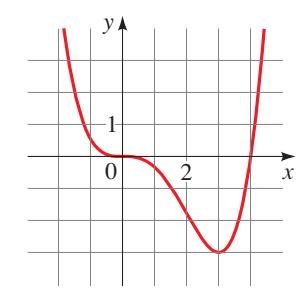
47 Skills - Read intercepts and extrema from graph · Level 2
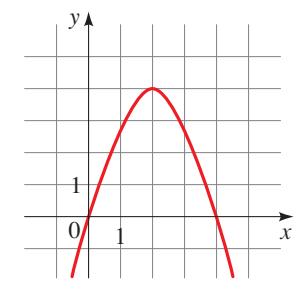
The graph of \(P(x) = -x^2 + 4x\) is given. From the graph, find (a) the \(x\)- and \(y\)-intercepts, and (b) the coordinates of all local extrema.
question image
48 Skills - Read intercepts and extrema from graph · Level 2
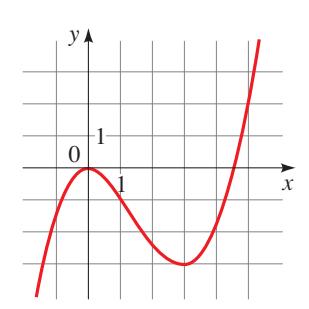
The graph of a polynomial function \(P\) is given. From the graph, find (a) the \(x\)- and \(y\)-intercepts, and (b) the coordinates of all local extrema.
question image
49 Skills - Read intercepts and extrema from graph · Level 2
The graph of \(P(x) = -\dfrac{1}{2}x^3 + \dfrac{3}{2}x - 1\) is given. From the graph, find (a) the \(x\)- and \(y\)-intercepts, and (b) the coordinates of all local extrema.
question image
50 Skills - Read intercepts and extrema from graph · Level 2
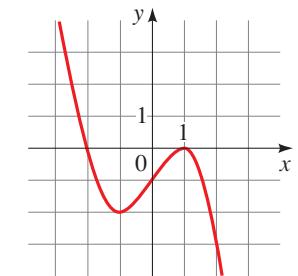
The graph of a polynomial function \(P\) is given. From the graph, find (a) the \(x\)- and \(y\)-intercepts, and (b) the coordinates of all local extrema.
question image
51 Skills - Graph with viewing rectangle · Level 2
Graph the polynomial in the given viewing rectangle. Find the coordinates of all local extrema. State each answer rounded to two decimal places. \(y = -x^2 + 8x\), \([-4, 12]\) by \([-50, 30]\)
52 Skills - Graph with viewing rectangle · Level 2
Graph the polynomial and find all local extrema (to two decimal places). \(y = x^3 - 3x^2\), \([-2, 5]\) by \([-10, 10]\)
53 Skills - Graph with viewing rectangle · Level 2
Graph and find all local extrema (to two decimal places). \(y = x^3 - 12x + 9\), \([-5, 5]\) by \([-30, 30]\)
54 Skills - Graph with viewing rectangle · Level 2
Graph and find all local extrema (to two decimal places). \(y = 2x^3 - 3x^2 - 12x - 32\), \([-5, 5]\) by \([-60, 30]\)
55 Skills - Graph with viewing rectangle · Level 2
Graph and find all local extrema (to two decimal places). \(y = x^4 + 4x^3\), \([-5, 5]\) by \([-30, 30]\)
56 Skills - Graph with viewing rectangle · Level 2
Graph and find all local extrema (to two decimal places). \(y = x^4 - 18x^2 + 32\), \([-5, 5]\) by \([-100, 100]\)
57 Skills - Graph with viewing rectangle · Level 2
Graph and find all local extrema (to two decimal places). \(y = 3x^5 - 5x^3 + 3\), \([-3, 3]\) by \([-5, 10]\)
58 Skills - Graph with viewing rectangle · Level 2
Graph and find all local extrema (to two decimal places). \(y = x^5 - 5x^2 + 6\), \([-3, 3]\) by \([-5, 10]\)
59 Skills - Count local extrema · Level 2
Graph the polynomial and determine how many local maxima and minima it has. \(y = -2x^2 + 3x + 5\)
60 Skills - Count local extrema · Level 2
Graph the polynomial and determine the number of local maxima and minima. \(y = x^3 + 12x\)
61 Skills - Count local extrema · Level 2
Graph the polynomial and determine the number of local maxima and minima. \(y = x^3 - x^2 - x\)
62 Skills - Count local extrema · Level 2
Graph the polynomial and determine the number of local maxima and minima. \(y = 6x^3 + 3x + 1\)
63 Skills - Count local extrema · Level 2
Graph the polynomial and determine the number of local maxima and minima. \(y = x^4 - 5x^2 + 4\)
64 Skills - Count local extrema · Level 3
Graph the polynomial and determine the number of local maxima and minima. \(y = 1.2x^5 + 3.75x^4 - 7x^3 - 15x^2 + 18x\)
65 Skills - Count local extrema · Level 2
Graph the polynomial and determine the number of local maxima and minima. \(y = (x - 2)^5 + 32\)
66 Skills - Count local extrema · Level 2
Graph the polynomial and determine the number of local maxima and minima. \(y = (x^2 - 2)^3\)
67 Skills - Count local extrema · Level 3
Graph the polynomial and determine the number of local maxima and minima. \(y = x^8 - 3x^4 + x\)
68 Skills - Count local extrema · Level 3
Graph the polynomial and determine the number of local maxima and minima. \(y = \dfrac{1}{3}x^7 - 17x^2 + 7\)
69 Skills - Family of polynomials · Level 2
Graph the family of polynomials in the same viewing rectangle, using the given values of \(c\). Explain how changing the value of \(c\) affects the graph. \(P(x) = cx^3\); \(c = 1, 2, 5, \dfrac{1}{2}\)
70 Skills - Family of polynomials · Level 2
Graph the family of polynomials and explain how changing \(c\) affects the graph. \(P(x) = (x - c)^4\); \(c = -1, 0, 1, 2\)
71 Skills - Family of polynomials · Level 2
Graph the family of polynomials and explain how changing \(c\) affects the graph. \(P(x) = x^4 + c\); \(c = -1, 0, 1, 2\)
72 Skills - Family of polynomials · Level 3
Graph the family of polynomials and explain how changing \(c\) affects the graph. \(P(x) = x^3 + cx\); \(c = 2, 0, -2, -4\)
73 Skills - Family of polynomials · Level 3
Graph the family of polynomials and explain how changing \(c\) affects the graph. \(P(x) = x^4 - cx\); \(c = 0, 1, 8, 27\)
74 Skills - Family of polynomials · Level 2
Graph the family of polynomials and explain how changing \(c\) affects the graph. \(P(x) = x^c\); \(c = 1, 3, 5, 7\)
75 Skills - Intersection of polynomial graphs · Level 3
(a) On the same coordinate axes, sketch graphs (as accurately as possible) of the functions \(y = x^3 - 2x^2 - x + 2\) and \(y = -x^2 + 5x + 2\).
(b) On the basis of your sketch in part (a), at how many points do the two graphs appear to intersect?
(c) Find the coordinates of all intersection points.

Enter your answer directly below each part above.

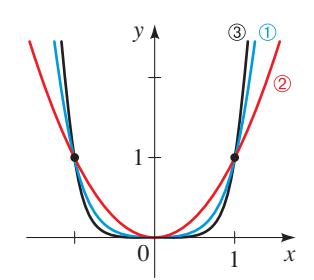
76 Skills - Identify power functions · Level 2
Portions of the graphs of \(y = x^2\), \(y = x^3\), \(y = x^4\), \(y = x^5\), and \(y = x^6\) are plotted in the figures. Determine which function belongs to each graph.
question image
77 Skills - Odd/even polynomial decomposition · Level 3
Recall that a function \(f\) is odd if \(f(-x) = -f(x)\) or even if \(f(-x) = f(x)\) for all real \(x\).
(a) Show that a polynomial \(P(x)\) that contains only odd powers of \(x\) is an odd function.
(b) Show that a polynomial \(P(x)\) that contains only even powers of \(x\) is an even function.
(c) Show that if a polynomial \(P(x)\) contains both odd and even powers of \(x\), then it is neither an odd nor an even function.
(d) Express the function \(P(x) = x^5 + 6x^3 - x^2 - 2x + 5\) as the sum of an odd function and an even function.

Enter your answer directly below each part above.

78 Skills - Vertical shift and extrema · Level 3
(a) Graph the function \(P(x) = (x - 1)(x - 3)(x - 4)\) and find all local extrema, correct to the nearest tenth.
(b) Graph the function \(Q(x) = (x - 1)(x - 3)(x - 4) + 5\) and use your answers to part (a) to find all local extrema, correct to the nearest tenth.

Enter your answer directly below each part above.

79 Skills - Local extrema of cubics with distinct zeros · Level 3
(a) Graph the function \(P(x) = (x - 2)(x - 4)(x - 5)\) and determine how many local extrema it has.
(b) If \(a < b < c\), explain why the function \(P(x) = (x - a)(x - b)(x - c)\) must have two local extrema.

Enter your answer directly below each part above.

80 Skills - Intercepts and extrema for parameter families · Level 3
(a) How many \(x\)-intercepts and how many local extrema does the polynomial \(P(x) = x^3 - 4x\) have?
(b) How many \(x\)-intercepts and how many local extrema does the polynomial \(Q(x) = x^3 + 4x\) have?
(c) If \(a > 0\), how many \(x\)-intercepts and how many local extrema does each of the polynomials \(P(x) = x^3 - a x\) and \(Q(x) = x^3 + a x\) have? Explain your answer.

Enter your answer directly below each part above.

81 Applications - Market research · Level 3
Market Research. A market analyst working for a small-appliance manufacturer finds that if the firm produces and sells \(x\) blenders annually, the total profit (in dollars) is \(P(x) = 8x + 0.3x^2 - 0.0013x^3 - 372\) Graph the function \(P\) in an appropriate viewing rectangle and use the graph to answer the following questions.
(a) When just a few blenders are manufactured, the firm loses money (profit is negative). For example, \(P(10) = -263.3\), so the firm loses \$263.30 if it produces and sells only 10 blenders. How many blenders must the firm produce to break even?
(b) Does profit increase indefinitely as more blenders are produced and sold? If not, what is the largest possible profit the firm could have?

Enter your answer directly below each part above.

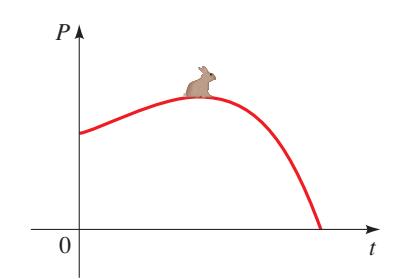
82 Applications - Population change · Level 3
Population Change. The rabbit population on a small island is observed to be given by the function \(P(t) = 120t - 0.4t^4 + 1000\) where \(t\) is the time (in months) since observations of the island began.
(a) When is the maximum population attained, and what is that maximum population?
(b) When does the rabbit population disappear from the island?

Enter your answer directly below each part above.

83 Applications - Volume of box (cut corners) · Level 3
Volume of a Box. An open box is to be constructed from a 20-inch by 40-inch piece of cardboard by cutting squares of side length \(x\) inches from each corner and folding up the sides.
question image
(a) Express the volume \(V\) of the box as a function of \(x\).
(b) What is the domain of \(V\)? (Use the fact that length and volume must be positive.)
(c) Draw a graph of the function \(V\), and use it to estimate the maximum volume for such a box.

Enter your answer directly below each part above.

84 Applications - Volume of box (square base) · Level 3
Volume of a Box. A cardboard box has a square base, with each edge of the base having length \(x\) inches. The total length of all 12 edges of the box is 144 in.
question image
(a) Show that the volume of the box is given by the function \(V(x) = 2x^2(18 - x)\).
(b) What is the domain of \(V\)? (Use the fact that length and volume must be positive.)
(c) Draw a graph of the function \(V\) and use it to estimate the maximum volume for such a box.

Enter your answer directly below each part above.

85 Discovery - Graphs of large powers · Level 2
Graphs of Large Powers. Graph the functions \(y = x^2\), \(y = x^3\), \(y = x^4\), and \(y = x^5\), for \(-1 \leq x \leq 1\), on the same coordinate axes. What do you think the graph of \(y = x^{100}\) would look like on this same interval? What about \(y = x^{101}\)? Make a table of values to confirm your answers.
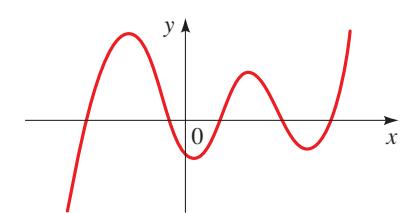
86 Discovery - Maximum number of local extrema · Level 3
Maximum Number of Local Extrema. What is the smallest possible degree that the polynomial whose graph is shown can have? Explain.
question image
87 Discovery - Possible number of local extrema · Level 3
Possible Number of Local Extrema. Is it possible for a third-degree polynomial to have exactly one local extremum? Can a fourth-degree polynomial have exactly two local extrema? How many local extrema can polynomials of third, fourth, fifth, and sixth degree have? (Think about the end behavior of such polynomials.) Now give an example of a polynomial that has six local extrema.
88 Discovery - Impossible polynomial situation · Level 3
Impossible Situation? Is it possible for a polynomial to have two local maxima and no local minimum? Explain.
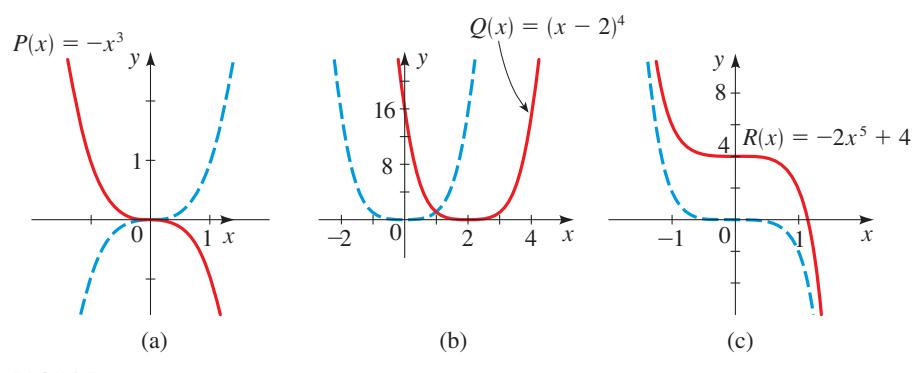
89 Example - Transformations of Monomials · Level 2
Sketch the graphs of the following functions.
question image
(a) \(P(x) = -x^3\)
(b) \(Q(x) = (x - 2)^4\)
(c) \(R(x) = -2 x^5 + 4\)

Enter your answer directly below each part above.

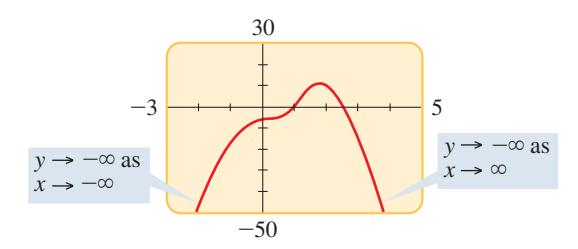
90 Example - End Behavior of a Polynomial · Level 2
Determine the end behavior of the polynomial \( P(x) = -2 x^4 + 5 x^3 + 4 x - 7 \)
question image
91 Example - End Behavior of a Polynomial · Level 3
question image
(a) Determine the end behavior of the polynomial \(P(x) = 3 x^5 - 5 x^3 + 2 x\).
(b) Confirm that \(P\) and its leading term \(Q(x) = 3 x^5\) have the same end behavior by graphing them together.

Enter your answer directly below each part above.

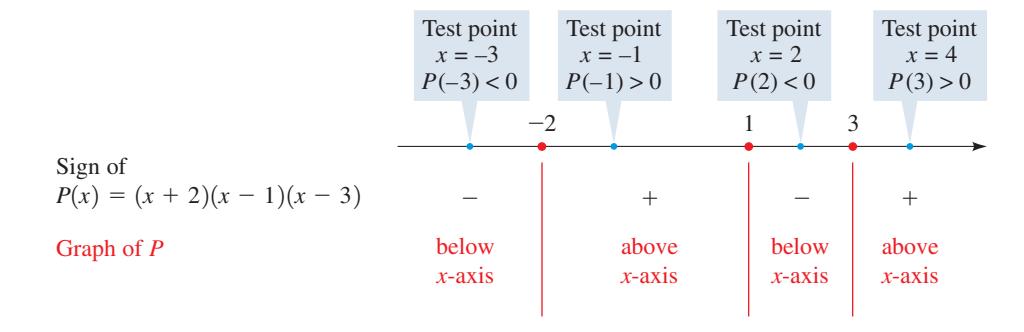
92 Example - Using Zeros to Graph a Polynomial Function · Level 3
Sketch the graph of the polynomial function \(P(x) = (x + 2)(x - 1)(x - 3)\).
question image

Answered: 0 / 92