Stewart Section 9.2: Direction Fields and Euler's Method

20 questions

--:--
0 / 20
Stewart Section 9.2: Direction Fields and Euler's Method 0/20
1 Direction Fields - Sketching Solutions · Level 2
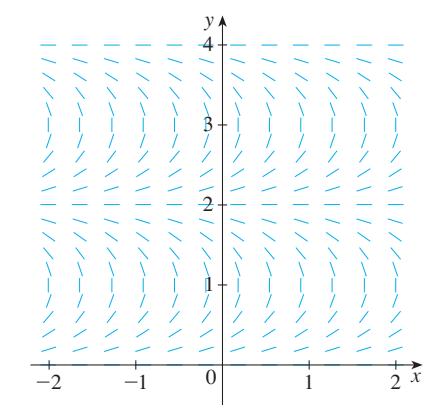
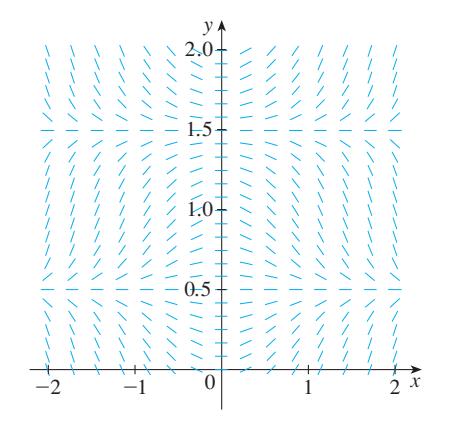
A direction field for the differential equation \(y' = x \cos \pi y\) is shown.
question image
(a) Sketch the graphs of the solutions that satisfy the given initial conditions. (i) \(y(0) = 0\) \(\quad\) (ii) \(y(0) = 0.5\) \(\quad\) (iii) \(y(0) = 1\) \(\quad\) (iv) \(y(0) = 1.6\)
(b) Find all the equilibrium solutions.

Enter your answer directly below each part above.

2 Direction Fields - Sketching Solutions · Level 2
A direction field for the differential equation \(y' = \tan\left(\dfrac{1}{2} \pi y\right)\) is shown.
question image
(a) Sketch the graphs of the solutions that satisfy the given initial conditions. (i) \(y(0) = 1\) \(\quad\) (ii) \(y(0) = 0.2\) \(\quad\) (iii) \(y(0) = 2\) \(\quad\) (iv) \(y(1) = 3\)
(b) Find all the equilibrium solutions.

Enter your answer directly below each part above.

3 Direction Fields - Matching · Level 2
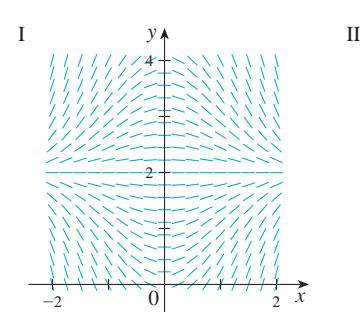
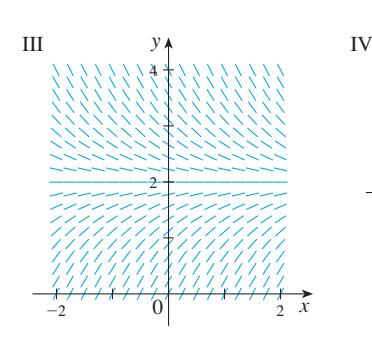
Match the differential equation with its direction field (labeled I-IV). Give reasons for your answer. \(y' = 2 - y\)
question image
4 Direction Fields - Matching · Level 2
Match the differential equation with its direction field (labeled I-IV). Give reasons for your answer. \(y' = x(2 - y)\)
question image
5 Direction Fields - Matching · Level 2
Match the differential equation with its direction field (labeled I-IV). Give reasons for your answer. \(y' = x + y - 1\)
question image
6 Direction Fields - Matching · Level 2
Match the differential equation with its direction field (labeled I-IV). Give reasons for your answer. \(y' = \sin x \sin y\)
question image
7 Direction Fields - Sketching Solutions · Level 2
Use the direction field labeled I (above) to sketch the graphs of the solutions that satisfy the given initial conditions. (a) \(y(0) = 1\) \(\quad\) (b) \(y(0) = 2.5\) \(\quad\) (c) \(y(0) = 3.5\)
question image
8 Direction Fields - Sketching Solutions · Level 2
Use the direction field labeled III (above) to sketch the graphs of the solutions that satisfy the given initial conditions. (a) \(y(0) = 1\) \(\quad\) (b) \(y(0) = 2.5\) \(\quad\) (c) \(y(0) = 3.5\)
question image
9 Direction Fields - Sketching · Level 3
Sketch a direction field for the differential equation. Then use it to sketch three solution curves. \(y' = \dfrac{1}{2} y\)
10 Direction Fields - Sketching · Level 3
Sketch a direction field for the differential equation. Then use it to sketch three solution curves. \(y' = x - y + 1\)
11 Direction Fields - Sketching · Level 3
Sketch the direction field of the differential equation. Then use it to sketch a solution curve that passes through the given point. \(y' = y - 2x\), \(\quad (1, 0)\)
12 Direction Fields - Sketching · Level 3
Sketch the direction field of the differential equation. Then use it to sketch a solution curve that passes through the given point. \(y' = x y - x^2\), \(\quad (0, 1)\)
13 Direction Fields - Sketching · Level 3
Sketch the direction field of the differential equation. Then use it to sketch a solution curve that passes through the given point. \(y' = y + x y\), \(\quad (0, 1)\)
14 Direction Fields - Sketching · Level 3
Sketch the direction field of the differential equation. Then use it to sketch a solution curve that passes through the given point. \(y' = x + y^2\), \(\quad (0, 0)\)
15 Direction Fields - CAS · Level 3
Use a computer algebra system to draw a direction field for the given differential equation. Get a printout and sketch on it the solution curve that passes through \((0, 1)\). Then use the CAS to draw the solution curve and compare it with your sketch. \(y' = x^2 y - \dfrac{1}{2} y^2\)
16 Direction Fields - CAS · Level 3
Use a computer algebra system to draw a direction field for the given differential equation. Get a printout and sketch on it the solution curve that passes through \((0, 1)\). Then use the CAS to draw the solution curve and compare it with your sketch. \(y' = \cos(x + y)\)
17 Direction Fields - CAS · Level 4
Use a computer algebra system to draw a direction field for the differential equation \(y' = y^3 - 4y\). Get a printout and sketch on it solutions that satisfy the initial condition \(y(0) = c\) for various values of \(c\). For what values of \(c\) does \(\operatorname*{lim}\limits_{t \rightarrow \infty} y(t)\) exist? What are the possible values for this limit?
18 Direction Fields - Analysis · Level 3
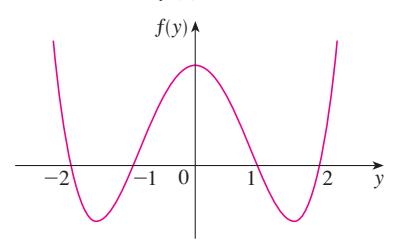
Make a rough sketch of a direction field for the autonomous differential equation \(y' = f(y)\), where the graph of \(f\) is as shown. How does the limiting behavior of solutions depend on the value of \(y(0)\)?
question image
19 Euler's Method · Level 3
(a) Use Euler's method with each of the following step sizes to estimate the value of \(y(0.4)\), where \(y\) is the solution of the initial-value problem \(y' = y\), \(y(0) = 1\). (i) \(h = 0.4\) \(\quad\) (ii) \(h = 0.2\) \(\quad\) (iii) \(h = 0.1\)
(b) We know that the exact solution of the initial-value problem in part (a) is \(y = e^x\). Draw, as accurately as you can, the graph of \(y = e^x\), \(0 < x < 0.4\), together with the Euler approximations using the step sizes in part (a). Use your sketches to decide whether your estimates in part (a) are underestimates or overestimates.
(c) The error in Euler's method is the difference between the exact value and the approximate value. Find the errors made in part (a) in using Euler's method to estimate the true value of \(y(0.4)\), namely, \(e^{0.4}\). What happens to the error each time the step size is halved?

Enter your answer directly below each part above.

20 Euler's Method · Level 3
A direction field for a differential equation is shown. Draw, with a ruler, the graphs of the Euler approximations to the solution curve that passes through the origin. Use step sizes \(h = 1\) and \(h = 0.5\). Will the Euler estimates be underestimates or overestimates? Explain.
question image

Answered: 0 / 20