Stewart Precalc 6e Section 8.4: Plane Curves and Parametric Equations

77 questions

--:--
0 / 77
Stewart Precalc 6e Section 8.4: Plane Curves and Parametric Equations 0/77
1 Concepts - Parameter and path · Level 1
(a) The parametric equations \(x = f(t)\) and \(y = g(t)\) give the coordinates of a point \((x, y) = (f(t), g(t))\) for appropriate values of \(t\). The variable \(t\) is called a _____.
(b) Suppose that the parametric equations \(x = t\), \(y = t^2\), \(t \geq 0\), model the position of a moving object at time \(t\). When \(t = 0\), the object is at \((_, _)\), and when \(t = 1\), the object is at \((_, _)\).
(c) If we eliminate the parameter in part (b), we get the equation \(y = _\). We see from this equation that the path of the moving object is a _____.

Enter your answer directly below each part above.

2 Concepts - Multiple parameterizations · Level 1
question image
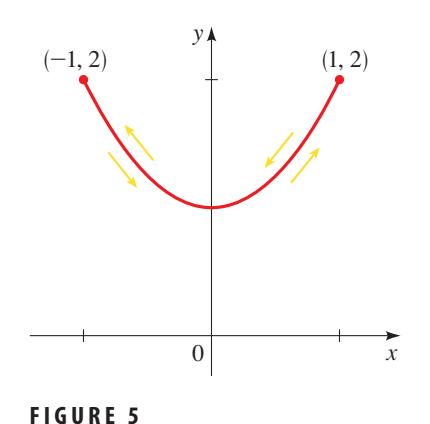
(a) True or false? The same curve can be described by parametric equations in many different ways.
(b) The parametric equations \(x = 2 t\), \(y = (2 t)^2\) model the position of a moving object at time \(t\). When \(t = 0\), the object is at \((_, _)\), and when \(t = 1\), the object is at \((_, _)\).
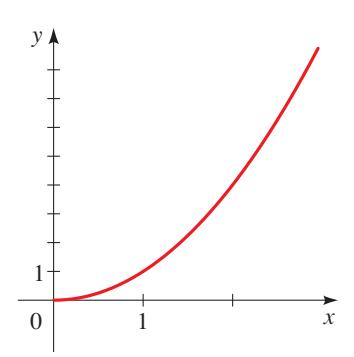
(c) If we eliminate the parameter, we get the equation \(y = _\), which is the same equation as in Exercise 1(b). So the objects in Exercises 1(b) and 2(b) move along the same _____ but traverse the path differently. Indicate the position of each object when \(t = 0\) and when \(t = 1\) on the following graph.

Enter your answer directly below each part above.

3 Skills - Sketch and eliminate parameter · Level 1
\(x = 2 t\), \(y = t + 6\) (a) Sketch the curve represented by the parametric equations. (b) Find a rectangular-coordinate equation for the curve by eliminating the parameter.
4 Skills - Sketch and eliminate parameter · Level 1
\(x = 6 t - 4\), \(y = 3 t\), \(t \geq 0\) (a) Sketch the curve. (b) Find a rectangular equation by eliminating the parameter.
5 Skills - Sketch and eliminate parameter · Level 2
\(x = t^2\), \(y = t - 2\), \(2 \leq t \leq 4\) (a) Sketch the curve. (b) Find a rectangular equation by eliminating the parameter.
6 Skills - Sketch and eliminate parameter · Level 2
\(x = 2 t + 1\), \(y = \left(t + \dfrac{1}{2}\right)^2\) (a) Sketch the curve. (b) Find a rectangular equation by eliminating the parameter.
7 Skills - Sketch and eliminate parameter · Level 2
\(x = \sqrt{t}\), \(y = 1 - t\) (a) Sketch the curve. (b) Find a rectangular equation by eliminating the parameter.
8 Skills - Sketch and eliminate parameter · Level 2
\(x = t^2\), \(y = t^4 + 1\) (a) Sketch the curve. (b) Find a rectangular equation by eliminating the parameter.
9 Skills - Sketch and eliminate parameter · Level 2
\(x = \dfrac{1}{t}\), \(y = t + 1\) (a) Sketch the curve. (b) Find a rectangular equation by eliminating the parameter.
10 Skills - Sketch and eliminate parameter · Level 2
\(x = t + 1\), \(y = \dfrac{t}{t + 1}\) (a) Sketch the curve. (b) Find a rectangular equation by eliminating the parameter.
11 Skills - Sketch and eliminate parameter · Level 3
\(x = 4 t^2\), \(y = 8 t^3\) (a) Sketch the curve. (b) Find a rectangular equation by eliminating the parameter.
12 Skills - Sketch and eliminate parameter · Level 2
\(x = |t|\), \(y = |1 - abs(t)|\) (a) Sketch the curve. (b) Find a rectangular equation by eliminating the parameter.
13 Skills - Sketch and eliminate parameter · Level 2
\(x = 2 \sin t\), \(y = 2 \cos t\), \(0 \leq t \leq \pi\) (a) Sketch the curve. (b) Find a rectangular equation by eliminating the parameter.
14 Skills - Sketch and eliminate parameter · Level 2
\(x = 2 \cos t\), \(y = 3 \sin t\), \(0 \leq t \leq 2 \pi\) (a) Sketch the curve. (b) Find a rectangular equation by eliminating the parameter.
15 Skills - Sketch and eliminate parameter · Level 2
\(x = \sin^2 t\), \(y = \sin^4 t\) (a) Sketch the curve. (b) Find a rectangular equation by eliminating the parameter.
16 Skills - Sketch and eliminate parameter · Level 2
\(x = \sin^2 t\), \(y = \cos t\) (a) Sketch the curve. (b) Find a rectangular equation by eliminating the parameter.
17 Skills - Sketch and eliminate parameter · Level 2
\(x = \cos t\), \(y = \cos 2 t\) (a) Sketch the curve. (b) Find a rectangular equation by eliminating the parameter.
18 Skills - Sketch and eliminate parameter · Level 1
\(x = \cos 2 t\), \(y = \sin 2 t\) (a) Sketch the curve. (b) Find a rectangular equation by eliminating the parameter.
19 Skills - Sketch and eliminate parameter · Level 3
\(x = \sec t\), \(y = \tan t\), \(0 \leq t < \dfrac{\pi}{2}\) (a) Sketch the curve. (b) Find a rectangular equation by eliminating the parameter.
20 Skills - Sketch and eliminate parameter · Level 3
\(x = \cot t\), \(y = \csc t\), \(0 < t < \pi\) (a) Sketch the curve. (b) Find a rectangular equation by eliminating the parameter.
21 Skills - Sketch and eliminate parameter · Level 2
\(x = \tan t\), \(y = \cot t\), \(0 < t < \dfrac{\pi}{2}\) (a) Sketch the curve. (b) Find a rectangular equation by eliminating the parameter.
22 Skills - Sketch and eliminate parameter · Level 3
\(x = \sec t\), \(y = \tan^2 t\), \(0 \leq t < \dfrac{\pi}{2}\) (a) Sketch the curve. (b) Find a rectangular equation by eliminating the parameter.
23 Skills - Sketch and eliminate parameter · Level 2
\(x = \cos^2 t\), \(y = \sin^2 t\) (a) Sketch the curve. (b) Find a rectangular equation by eliminating the parameter.
24 Skills - Sketch and eliminate parameter · Level 3
\(x = \cos^3 t\), \(y = \sin^3 t\), \(0 \leq t \leq 2 \pi\) (a) Sketch the curve. (b) Find a rectangular equation by eliminating the parameter.
25 Skills - Circular motion · Level 2
The position of an object in circular motion is modeled by the given parametric equations. Describe the path: radius of the circle, position at \(t = 0\), orientation (clockwise or counterclockwise), and the time \(t\) to complete one revolution. \(x = 3 \cos t\), \(y = 3 \sin t\)
26 Skills - Circular motion · Level 2
Describe the path of the object: radius, position at \(t = 0\), orientation, and period. \(x = 2 \sin t\), \(y = 2 \cos t\)
27 Skills - Circular motion · Level 2
Describe the path of the object: radius, position at \(t = 0\), orientation, and period. \(x = \sin 2 t\), \(y = \cos 2 t\)
28 Skills - Circular motion · Level 2
Describe the path of the object: radius, position at \(t = 0\), orientation, and period. \(x = 4 \cos 3 t\), \(y = 4 \sin 3 t\)
29 Skills - Parametric line · Level 2
Find parametric equations for the line with slope \(\dfrac{1}{2}\) passing through \((4, -1)\).
30 Skills - Parametric line · Level 2
Find parametric equations for the line with slope \(-2\) passing through \((-10, -20)\).
31 Skills - Parametric line · Level 2
Find parametric equations for the line passing through \((6, 7)\) and \((7, 8)\).
32 Skills - Parametric line · Level 2
Find parametric equations for the line passing through \((12, 7)\) and the origin.
33 Skills - Parametric equations for a circle · Level 2
Find parametric equations for the circle \(x^2 + y^2 = a^2\).
34 Skills - Parametric equations for an ellipse · Level 2
Find parametric equations for the ellipse \(\dfrac{x^2}{a^2} + \dfrac{y^2}{b^2} = 1\).
35 Skills - Hyperbola from parameter · Level 3
Show by eliminating the parameter \(\theta\) that the following parametric equations represent a hyperbola: \(x = a \tan \theta\), \(y = b \sec \theta\).
36 Skills - Part of hyperbola · Level 3
Show that the following parametric equations represent a part of the hyperbola of Exercise 35: \(x = a \sqrt{t}\), \(y = b \sqrt{t + 1}\).
37 Skills - Sketch parametric curve · Level 3
Sketch the curve given by the parametric equations. \(x = t \cos t\), \(y = t \sin t\), \(t \geq 0\)
38 Skills - Sketch parametric curve · Level 3
Sketch the curve given by the parametric equations. \(x = \sin t\), \(y = \sin 2 t\)
39 Skills - Sketch parametric curve · Level 4
Sketch the curve given by the parametric equations. \(x = \dfrac{3 t}{1 + t^3}\), \(y = \dfrac{3 t^2}{1 + t^3}\)
40 Skills - Sketch parametric curve · Level 4
Sketch the curve given by the parametric equations. \(x = \cot t\), \(y = 2 \sin^2 t\), \(0 < t < \pi\)
41 Skills - Projectile motion · Level 3
If a projectile is fired with an initial speed of \(v_0\) ft/s at an angle \(\alpha\) above the horizontal, then its position after \(t\) seconds is given by the parametric equations \(x = (v_0 \cos \alpha) t\), \(y = (v_0 \sin \alpha) t - 16 t^2\) (where \(x\) and \(y\) are measured in feet). Show that the path of the projectile is a parabola by eliminating the parameter \(t\).
42 Skills - Projectile application · Level 3
Referring to Exercise 41, suppose a gun fires a bullet into the air with an initial speed of 2048 ft/s at an angle of \(30^{\circ}\) to the horizontal.
(a) After how many seconds will the bullet hit the ground?
(b) How far from the gun will the bullet hit the ground?
(c) What is the maximum height attained by the bullet?

Enter your answer directly below each part above.

43 Skills - Graphing device · Level 2
Use a graphing device to draw the curve represented by the parametric equations. \(x = \sin t\), \(y = 2 \cos 3 t\)
44 Skills - Graphing device · Level 2
Use a graphing device to draw the curve represented by the parametric equations. \(x = 2 \sin t\), \(y = \cos 4 t\)
45 Skills - Graphing device · Level 2
Use a graphing device to draw the curve represented by the parametric equations. \(x = 3 \sin 5 t\), \(y = 5 \cos 3 t\)
46 Skills - Graphing device · Level 2
Use a graphing device to draw the curve represented by the parametric equations. \(x = \sin 4 t\), \(y = \cos 3 t\)
47 Skills - Graphing device · Level 3
Use a graphing device to draw the curve represented by the parametric equations. \(x = \sin(\cos t)\), \(y = \cos\left(t^{\dfrac{3}{2}}\right)\), \(0 \leq t \leq 2 \pi\)
48 Skills - Graphing device · Level 3
Use a graphing device to draw the curve represented by the parametric equations. \(x = 2 \cos t + \cos 2 t\), \(y = 2 \sin t - \sin 2 t\)
49 Skills - Polar to parametric · Level 2
A polar equation is given. (a) Express the polar equation in parametric form. (b) Use a graphing device to graph the parametric equations. \(r = 2^{\dfrac{\theta}{12}}\), \(0 \leq \theta \leq 4 \pi\)
50 Skills - Polar to parametric · Level 2
A polar equation is given. (a) Express the polar equation in parametric form. (b) Use a graphing device to graph the parametric equations. \(r = \sin \theta + 2 \cos \theta\)
51 Skills - Polar to parametric · Level 3
A polar equation is given. (a) Express the polar equation in parametric form. (b) Use a graphing device to graph the parametric equations. \(r = \dfrac{4}{2 - \cos \theta}\)
52 Skills - Polar to parametric · Level 3
A polar equation is given. (a) Express the polar equation in parametric form. (b) Use a graphing device to graph the parametric equations. \(r = 2^{\sin \theta}\)
53 Skills - Matching parametric curves · Level 3
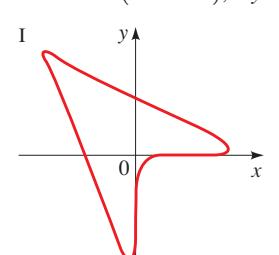
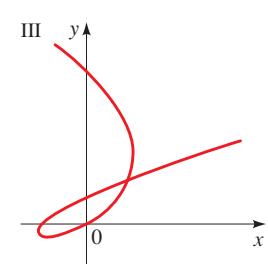
Match the parametric equations with one of the graphs labeled I-IV. Give reasons for your answer. \(x = t^3 - 2 t\), \(y = t^2 - t\)
question image
54 Skills - Matching parametric curves · Level 3
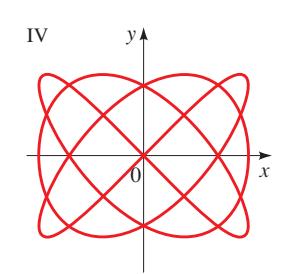
Match the parametric equations with one of the graphs labeled I-IV. Give reasons for your answer. \(x = \sin 3 t\), \(y = \sin 4 t\)
question image
55 Skills - Matching parametric curves · Level 3
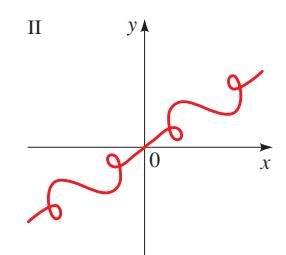
Match the parametric equations with one of the graphs labeled I-IV. Give reasons for your answer. \(x = t + \sin 2 t\), \(y = t + \sin 3 t\)
question image
56 Skills - Matching parametric curves · Level 3
Match the parametric equations with one of the graphs labeled I-IV. Give reasons for your answer. \(x = \sin(t + \sin t)\), \(y = \cos(t + \cos t)\)
question image
57 Skills - Curtate cycloid · Level 4
(a) In Example 6 suppose the point \(P\) that traces out the curve lies not on the edge of the circle, but rather at a fixed point inside the rim, at a distance \(b\) from the center (with \(b < a\)). The curve traced out by \(P\) is called a curtate cycloid (or trochoid). Show that parametric equations for the curtate cycloid are \(x = a \theta - b \sin \theta\), \(y = a - b \cos \theta\).
(b) Sketch the graph using \(a = 3\) and \(b = 2\).

Enter your answer directly below each part above.

58 Skills - Prolate cycloid · Level 4
(a) In Exercise 57 if the point \(P\) lies outside the circle at a distance \(b\) from the center (with \(b > a\)), then the curve traced out by \(P\) is called a prolate cycloid. Show that parametric equations for the prolate cycloid are the same as the equations for the curtate cycloid.
(b) Sketch the graph for the case in which \(a = 1\) and \(b = 2\).

Enter your answer directly below each part above.

59 Skills - Hypocycloid and astroid · Level 5
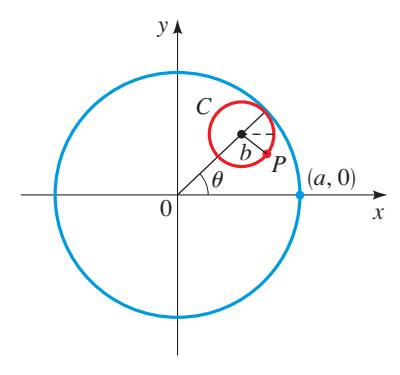
A circle \(C\) of radius \(b\) rolls on the inside of a larger circle of radius \(a\) centered at the origin. Let \(P\) be a fixed point on the smaller circle, with initial position at the point \((a, 0)\). The curve traced out by \(P\) is called a hypocycloid.
question image
(a) Show that parametric equations for the hypocycloid are \(x = (a - b) \cos \theta + b \cos\left(\dfrac{a - b}{b} \theta\right)\) \(y = (a - b) \sin \theta - b \sin\left(\dfrac{a - b}{b} \theta\right)\)
(b) If \(a = 4 b\), the hypocycloid is called an astroid. Show that in this case the parametric equations can be reduced to \(x = a \cos^3 \theta\), \(y = a \sin^3 \theta\) Sketch the curve. Eliminate the parameter to obtain an equation for the astroid in rectangular coordinates.

Enter your answer directly below each part above.

60 Skills - Epicycloid · Level 5
If the circle \(C\) of Exercise 59 rolls on the outside of the larger circle, the curve traced out by \(P\) is called an epicycloid. Find parametric equations for the epicycloid.
61 Skills - Longbow curve · Level 5
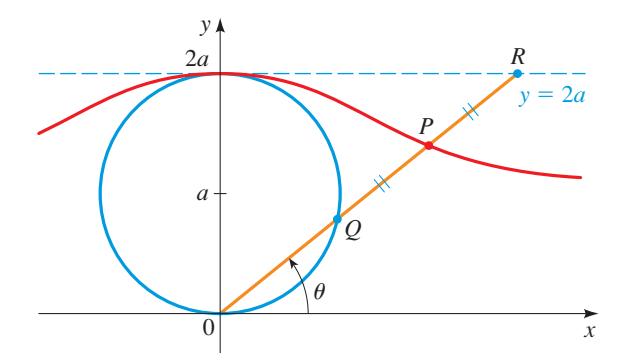
In the figure, the circle of radius \(a\) is stationary, and for every \(\theta\), the point \(P\) is the midpoint of the segment \(Q R\). The curve traced out by \(P\) for \(0 < \theta < \pi\) is called the longbow curve. Find parametric equations for this curve.
question image
62 Exercise - Ellipse from concentric circles · Level 3
Two circles of radius \(a\) and \(b\) are centered at the origin, as shown in the figure. As the angle \(\theta\) increases, the point \(P\) traces out a curve that lies between the circles. *(a)* Find parametric equations for the curve, using \(\theta\) as the parameter. *(b)* Graph the curve using a graphing device, with \(a = 3\) and \(b = 2\). *(c)* Eliminate the parameter, and identify the curve.
question image
63 Exercise - Curve traced via tangent segment · Level 4
Two circles of radius \(a\) and \(b\) are centered at the origin, as shown in the figure. *(a)* Find parametric equations for the curve traced out by the point \(P\), using the angle \(\theta\) as the parameter. (Note that the line segment \(\text{AB}\) is always tangent to the larger circle.) *(b)* Graph the curve using a graphing device, with \(a = 3\) and \(b = 2\).
64 Exercise - Witch of Agnesi · Level 4
A curve, called a *witch of Agnesi*, consists of all points \(P\) determined as shown in the figure. *(a)* Show that parametric equations for this curve can be written as \(x = 2 a \cot \theta, \quad y = 2 a \sin^2 \theta\) *(b)* Graph the curve using a graphing device, with \(a = 3\).
65 Exercise - Cycloid parameter elimination · Level 4
Eliminate the parameter \(\theta\) in the parametric equations for the cycloid (Example
6) to obtain a rectangular coordinate equation for the section of the curve given by \(0 \leq \theta \leq \pi\).
66 Exercise - Rotary Engine (Wankel) · Level 3
*The Rotary Engine* The Mazda RX-8 uses an unconventional engine (invented by Felix Wankel in 1954) in which the pistons are replaced by a triangular rotor that turns in a special housing as shown in the figure. The vertices of the rotor maintain contact with the housing at all times, while the center of the triangle traces out a circle of radius \(r\), turning the drive shaft. The shape of the housing is given by the parametric equations below (where \(R\) is the distance between the vertices and center of the rotor): \(x = r \cos 3 \theta + R \cos \theta, \quad y = r \sin 3 \theta + R \sin \theta\) *(a)* Suppose that the drive shaft has radius \(r = 1\). Graph the curve given by the parametric equations for the following values of \(R\): \(0.5, 1, 3, 5\). *(b)* Which of the four values of \(R\) given in part (a) seems to best model the engine housing illustrated in the figure?
67 Exercise - Involute of a circle (dog spiral) · Level 4
*Spiral Path of a Dog* A dog is tied to a circular tree trunk of radius \(1\) ft by a long leash. He has managed to wrap the entire leash around the tree while playing in the yard, and he finds himself at the point \((1, 0)\) in the figure. Seeing a squirrel, he runs around the tree counterclockwise, keeping the leash taut while chasing the intruder. *(a)* Show that parametric equations for the dog's path (called an *involute of a circle*) are \(x = \cos \theta + \theta \sin \theta, \quad y = \sin \theta - \theta \cos \theta\) [Hint: Note that the leash is always tangent to the tree, so \(\text{OT}\) is perpendicular to \(\text{TD}\).] *(b)* Graph the path of the dog for \(0 \leq \theta \leq 4 \pi\).
68 Exercise - Discussion: Information in parametric equations · Level 3
*More Information in Parametric Equations* In this section we stated that parametric equations contain more information than just the shape of a curve. Write a short paragraph explaining this statement. Use the following example and your answers to parts (a) and (b) below in your explanation. The position of a particle is given by the parametric equations \(x = \sin t, \quad y = \cos t\) where \(t\) represents time. We know that the shape of the path of the particle is a circle. *(a)* How long does it take the particle to go once around the circle? Find parametric equations if the particle moves twice as fast around the circle. *(b)* Does the particle travel clockwise or counterclockwise around the circle? Find parametric equations if the particle moves in the opposite direction around the circle.
69 Exercise - Discussion: Different parametrizations of y = x^2 · Level 3
*Different Ways of Tracing Out a Curve* The curves \(C\), \(D\), \(E\), and \(F\) are defined parametrically as follows, where the parameter \(t\) takes on all real values unless otherwise stated: \(C: \quad x = t, \quad y = t^2\) \(D: \quad x = \sqrt{t}, \quad y = t, \quad t \geq 0\) \(E: \quad x = \sin t, \quad y = \sin^2 t\) \(F: \quad x = 3^t, \quad y = 3^{2 t}\) *(a)* Show that the points on all four of these curves satisfy the same rectangular coordinate equation. *(b)* Draw the graph of each curve and explain how the curves differ from one another.
70 Example - Sketching a Plane Curve · Level 3
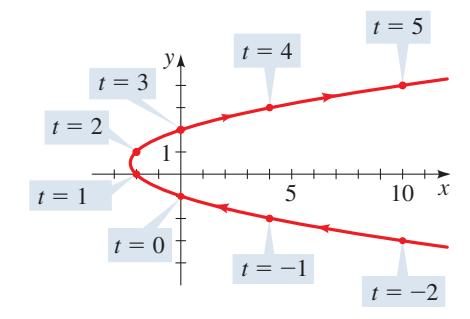
Sketch the curve defined by the parametric equations \(x = t^2 - 3 t\) and \(y = t - 1\).
question image
71 Example - Eliminating the Parameter · Level 3
Eliminate the parameter in the parametric equations \(x = t^2 - 3 t\) and \(y = t - 1\) from Example 1.
72 Example - Modeling Circular Motion · Level 3
The following parametric equations model the position of a moving object at time \(t\) (in seconds): \(x = \cos t\), \(y = \sin t\), \(t \geq 0\). Describe and graph the path of the object.
73 Example - Sketching a parametric curve · Level 3
Eliminate the parameter, and sketch the graph of the parametric equations \(x = \sin t\), \(y = 2 - \cos^2 t\).
74 Example - Finding parametric equations for a line · Level 2
Find parametric equations for the line of slope 3 that passes through the point \((2, 6)\).
question image
75 Example - Parametric equations for a cycloid · Level 4
As a circle rolls along a straight line, the curve traced out by a fixed point \(P\) on the circumference of the circle is called a cycloid. If the circle has radius \(a\) and rolls along the \(x\)-axis, with one position of the point \(P\) being at the origin, find parametric equations for the cycloid.
question image
76 Example - Graphing parametric curves (Lissajous) · Level 3
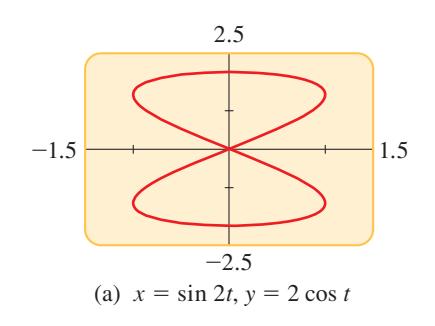
Use a graphing device to draw the following parametric curves. Discuss their similarities and differences.
question image
(a) \(x = \sin 2 t\), \(y = 2 \cos t\)
(b) \(x = \sin 3 t\), \(y = 2 \cos t\)

Enter your answer directly below each part above.

77 Example - Parametric form of a polar equation · Level 3
Consider the polar equation \(r = \theta\), \(1 \leq \theta \leq 10 \pi\).
question image
(a) Express the equation in parametric form.
(b) Draw a graph of the parametric equations from part (a).

Enter your answer directly below each part above.

Answered: 0 / 77