Stewart Precalc 6e Section 9.2: The Dot Product

61 questions

--:--
0 / 61
Stewart Precalc 6e Section 9.2: The Dot Product 0/61
1 Concepts - Dot Product Definition · Level 1
Let \(\mathbf{a} = \langle a_1, a_2 \rangle\) and \(\mathbf{b} = \langle b_1, b_2 \rangle\) be nonzero vectors in the plane, and let \(\theta\) be the angle between them. The dot product of \(\mathbf{a}\) and \(\mathbf{b}\) is defined by \(\mathbf{a} \cdot \mathbf{b} = \) ____. The dot product of two vectors is a ____, not a vector.
2 Concepts - Angle Between Vectors · Level 1
Let \(\mathbf{a} = \langle a_1, a_2 \rangle\) and \(\mathbf{b} = \langle b_1, b_2 \rangle\) be nonzero vectors in the plane, and let \(\theta\) be the angle between them. The angle \(\theta\) satisfies \(\cos \theta = \) ____. So if \(\mathbf{a} \cdot \mathbf{b} = 0\), the vectors are ____.
3 Concepts - Component and Projection · Level 2
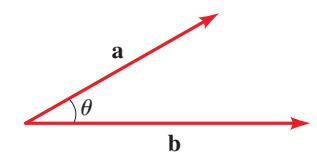
(a) The component of \(\mathbf{a}\) along \(\mathbf{b}\) is the scalar \(|\mathbf{a}| \cos \theta\) and can be expressed in terms of the dot product as ____. Sketch this component in the figure. (b) The projection of \(\mathbf{a}\) onto \(\mathbf{b}\) is the vector \(\text{proj}_{\mathbf{b}} \mathbf{a} = \) ____. Sketch this projection in the figure.
question image
4 Concepts - Work Formula · Level 1
The work done by a force \(\mathbf{F}\) in moving an object along a vector \(\mathbf{D}\) is \(W = \) ____.
5 Skills - Dot Product and Angle · Level 1
Find (a) \(\mathbf{u} \cdot \mathbf{v}\) and (b) the angle between \(\mathbf{u}\) and \(\mathbf{v}\) to the nearest degree, where \(\mathbf{u} = \langle 2, 0 \rangle\) and \(\mathbf{v} = \langle 1, 1 \rangle\).
6 Skills - Dot Product and Angle · Level 1
Find (a) \(\mathbf{u} \cdot \mathbf{v}\) and (b) the angle between \(\mathbf{u}\) and \(\mathbf{v}\) to the nearest degree, where \(\mathbf{u} = \mathbf{i} + \sqrt{3} \mathbf{j}\) and \(\mathbf{v} = -\sqrt{3} \mathbf{i} + \mathbf{j}\).
7 Skills - Dot Product and Angle · Level 2
Find (a) \(\mathbf{u} \cdot \mathbf{v}\) and (b) the angle between \(\mathbf{u}\) and \(\mathbf{v}\) to the nearest degree, where \(\mathbf{u} = \langle 2, 7 \rangle\) and \(\mathbf{v} = \langle 3, 1 \rangle\).
8 Skills - Dot Product and Angle · Level 2
Find (a) \(\mathbf{u} \cdot \mathbf{v}\) and (b) the angle between \(\mathbf{u}\) and \(\mathbf{v}\) to the nearest degree, where \(\mathbf{u} = \langle -6, 6 \rangle\) and \(\mathbf{v} = \langle 1, -1 \rangle\).
9 Skills - Dot Product and Angle · Level 2
Find (a) \(\mathbf{u} \cdot \mathbf{v}\) and (b) the angle between \(\mathbf{u}\) and \(\mathbf{v}\) to the nearest degree, where \(\mathbf{u} = \langle 3, -2 \rangle\) and \(\mathbf{v} = \langle 1, 2 \rangle\).
10 Skills - Dot Product and Angle · Level 2
Find (a) \(\mathbf{u} \cdot \mathbf{v}\) and (b) the angle between \(\mathbf{u}\) and \(\mathbf{v}\) to the nearest degree, where \(\mathbf{u} = 2 \mathbf{i} + \mathbf{j}\) and \(\mathbf{v} = 3 \mathbf{i} - 2 \mathbf{j}\).
11 Skills - Dot Product and Angle · Level 2
Find (a) \(\mathbf{u} \cdot \mathbf{v}\) and (b) the angle between \(\mathbf{u}\) and \(\mathbf{v}\) to the nearest degree, where \(\mathbf{u} = -5 \mathbf{i}\) and \(\mathbf{v} = -\mathbf{i} - \sqrt{3} \mathbf{j}\).
12 Skills - Dot Product and Angle · Level 1
Find (a) \(\mathbf{u} \cdot \mathbf{v}\) and (b) the angle between \(\mathbf{u}\) and \(\mathbf{v}\) to the nearest degree, where \(\mathbf{u} = \mathbf{i} + \mathbf{j}\) and \(\mathbf{v} = \mathbf{i} - \mathbf{j}\).
13 Skills - Dot Product and Angle · Level 2
Find (a) \(\mathbf{u} \cdot \mathbf{v}\) and (b) the angle between \(\mathbf{u}\) and \(\mathbf{v}\) to the nearest degree, where \(\mathbf{u} = \mathbf{i} + 3 \mathbf{j}\) and \(\mathbf{v} = 4 \mathbf{i} - \mathbf{j}\).
14 Skills - Dot Product and Angle · Level 2
Find (a) \(\mathbf{u} \cdot \mathbf{v}\) and (b) the angle between \(\mathbf{u}\) and \(\mathbf{v}\) to the nearest degree, where \(\mathbf{u} = 3 \mathbf{i} + 4 \mathbf{j}\) and \(\mathbf{v} = -2 \mathbf{i} - \mathbf{j}\).
15 Skills - Perpendicular Vectors · Level 1
Determine whether the given vectors are perpendicular: \(\mathbf{u} = \langle 6, 4 \rangle\) and \(\mathbf{v} = \langle -2, 3 \rangle\).
16 Skills - Perpendicular Vectors · Level 1
Determine whether the given vectors are perpendicular: \(\mathbf{u} = \langle 0, -5 \rangle\) and \(\mathbf{v} = \langle 4, 0 \rangle\).
17 Skills - Perpendicular Vectors · Level 1
Determine whether the given vectors are perpendicular: \(\mathbf{u} = \langle -2, 6 \rangle\) and \(\mathbf{v} = \langle 4, 2 \rangle\).
18 Skills - Perpendicular Vectors · Level 1
Determine whether the given vectors are perpendicular: \(\mathbf{u} = 2 \mathbf{i}\) and \(\mathbf{v} = -7 \mathbf{j}\).
19 Skills - Perpendicular Vectors · Level 2
Determine whether the given vectors are perpendicular: \(\mathbf{u} = 2 \mathbf{i} - 8 \mathbf{j}\) and \(\mathbf{v} = -12 \mathbf{i} - 3 \mathbf{j}\).
20 Skills - Perpendicular Vectors · Level 1
Determine whether the given vectors are perpendicular: \(\mathbf{u} = 4 \mathbf{i}\) and \(\mathbf{v} = -\mathbf{i} + 3 \mathbf{j}\).
21 Skills - Computing Dot Products · Level 2
Find the indicated quantity, assuming \(\mathbf{u} = 2 \mathbf{i} + \mathbf{j}\), \(\mathbf{v} = \mathbf{i} - 3 \mathbf{j}\), and \(\mathbf{w} = 3 \mathbf{i} + 4 \mathbf{j}\). Compute \(\mathbf{u} \cdot \mathbf{v} + \mathbf{u} \cdot \mathbf{w}\).
22 Skills - Computing Dot Products · Level 2
Find the indicated quantity, assuming \(\mathbf{u} = 2 \mathbf{i} + \mathbf{j}\), \(\mathbf{v} = \mathbf{i} - 3 \mathbf{j}\), and \(\mathbf{w} = 3 \mathbf{i} + 4 \mathbf{j}\). Compute \(\mathbf{u} \cdot (\mathbf{v} + \mathbf{w})\).
23 Skills - Computing Dot Products · Level 2
Find the indicated quantity, assuming \(\mathbf{u} = 2 \mathbf{i} + \mathbf{j}\), \(\mathbf{v} = \mathbf{i} - 3 \mathbf{j}\), and \(\mathbf{w} = 3 \mathbf{i} + 4 \mathbf{j}\). Compute \((\mathbf{u} + \mathbf{v}) \cdot (\mathbf{u} - \mathbf{v})\).
24 Skills - Computing Dot Products · Level 2
Find the indicated quantity, assuming \(\mathbf{u} = 2 \mathbf{i} + \mathbf{j}\), \(\mathbf{v} = \mathbf{i} - 3 \mathbf{j}\), and \(\mathbf{w} = 3 \mathbf{i} + 4 \mathbf{j}\). Compute \((\mathbf{u} \cdot \mathbf{v})(\mathbf{u} \cdot \mathbf{w})\).
25 Skills - Component of a Vector · Level 2
Find the component of \(\mathbf{u}\) along \(\mathbf{v}\), where \(\mathbf{u} = \langle 4, 6 \rangle\) and \(\mathbf{v} = \langle 3, -4 \rangle\).
26 Skills - Component of a Vector · Level 2
Find the component of \(\mathbf{u}\) along \(\mathbf{v}\), where \(\mathbf{u} = \langle -3, 5 \rangle\) and \(\mathbf{v} = \langle \dfrac{1}{\sqrt{2}}, \dfrac{1}{\sqrt{2}} \rangle\).
27 Skills - Component of a Vector · Level 1
Find the component of \(\mathbf{u}\) along \(\mathbf{v}\), where \(\mathbf{u} = 7 \mathbf{i} - 24 \mathbf{j}\) and \(\mathbf{v} = \mathbf{j}\).
28 Skills - Component of a Vector · Level 2
Find the component of \(\mathbf{u}\) along \(\mathbf{v}\), where \(\mathbf{u} = 7 \mathbf{i}\) and \(\mathbf{v} = 8 \mathbf{i} + 6 \mathbf{j}\).
29 Skills - Projection and Resolution · Level 3
(a) Calculate \(\text{proj}_{\mathbf{v}} \mathbf{u}\). (b) Resolve \(\mathbf{u}\) into \(\mathbf{u}_1\) and \(\mathbf{u}_2\), where \(\mathbf{u}_1\) is parallel to \(\mathbf{v}\) and \(\mathbf{u}_2\) is orthogonal to \(\mathbf{v}\). Here \(\mathbf{u} = \langle -2, 4 \rangle\) and \(\mathbf{v} = \langle 1, 1 \rangle\).
30 Skills - Projection and Resolution · Level 3
(a) Calculate \(\text{proj}_{\mathbf{v}} \mathbf{u}\). (b) Resolve \(\mathbf{u}\) into \(\mathbf{u}_1\) and \(\mathbf{u}_2\), where \(\mathbf{u}_1\) is parallel to \(\mathbf{v}\) and \(\mathbf{u}_2\) is orthogonal to \(\mathbf{v}\). Here \(\mathbf{u} = \langle 7, -4 \rangle\) and \(\mathbf{v} = \langle 2, 1 \rangle\).
31 Skills - Projection and Resolution · Level 3
(a) Calculate \(\text{proj}_{\mathbf{v}} \mathbf{u}\). (b) Resolve \(\mathbf{u}\) into \(\mathbf{u}_1\) and \(\mathbf{u}_2\), where \(\mathbf{u}_1\) is parallel to \(\mathbf{v}\) and \(\mathbf{u}_2\) is orthogonal to \(\mathbf{v}\). Here \(\mathbf{u} = \langle 1, 2 \rangle\) and \(\mathbf{v} = \langle 1, -3 \rangle\).
32 Skills - Projection and Resolution · Level 3
(a) Calculate \(\text{proj}_{\mathbf{v}} \mathbf{u}\). (b) Resolve \(\mathbf{u}\) into \(\mathbf{u}_1\) and \(\mathbf{u}_2\), where \(\mathbf{u}_1\) is parallel to \(\mathbf{v}\) and \(\mathbf{u}_2\) is orthogonal to \(\mathbf{v}\). Here \(\mathbf{u} = \langle 11, 3 \rangle\) and \(\mathbf{v} = \langle -3, -2 \rangle\).
33 Skills - Projection and Resolution · Level 3
(a) Calculate \(\text{proj}_{\mathbf{v}} \mathbf{u}\). (b) Resolve \(\mathbf{u}\) into \(\mathbf{u}_1\) and \(\mathbf{u}_2\), where \(\mathbf{u}_1\) is parallel to \(\mathbf{v}\) and \(\mathbf{u}_2\) is orthogonal to \(\mathbf{v}\). Here \(\mathbf{u} = \langle 2, 9 \rangle\) and \(\mathbf{v} = \langle -3, 4 \rangle\).
34 Skills - Projection and Resolution · Level 3
(a) Calculate \(\text{proj}_{\mathbf{v}} \mathbf{u}\). (b) Resolve \(\mathbf{u}\) into \(\mathbf{u}_1\) and \(\mathbf{u}_2\), where \(\mathbf{u}_1\) is parallel to \(\mathbf{v}\) and \(\mathbf{u}_2\) is orthogonal to \(\mathbf{v}\). Here \(\mathbf{u} = \langle 1, 1 \rangle\) and \(\mathbf{v} = \langle 2, -1 \rangle\).
35 Skills - Work · Level 2
Find the work done by the force \(\mathbf{F}\) in moving an object from \(P\) to \(Q\), where \(\mathbf{F} = 4 \mathbf{i} - 5 \mathbf{j}\), \(P(0, 0)\), \(Q(3, 8)\).
36 Skills - Work · Level 2
Find the work done by the force \(\mathbf{F}\) in moving an object from \(P\) to \(Q\), where \(\mathbf{F} = 400 \mathbf{i} + 50 \mathbf{j}\), \(P(-1, 1)\), \(Q(200, 1)\).
37 Skills - Work · Level 2
Find the work done by the force \(\mathbf{F}\) in moving an object from \(P\) to \(Q\), where \(\mathbf{F} = 10 \mathbf{i} + 3 \mathbf{j}\), \(P(2, 3)\), \(Q(6, -2)\).
38 Skills - Work · Level 2
Find the work done by the force \(\mathbf{F}\) in moving an object from \(P\) to \(Q\), where \(\mathbf{F} = -4 \mathbf{i} + 20 \mathbf{j}\), \(P(0, 10)\), \(Q(5, 25)\).
39 Proofs - Commutativity of Dot Product · Level 3
Let \(\mathbf{u}\), \(\mathbf{v}\), and \(\mathbf{w}\) be vectors, and let \(a\) be a scalar. Prove the given property: \(\mathbf{u} \cdot \mathbf{v} = \mathbf{v} \cdot \mathbf{u}\).
40 Proofs - Scalar Multiplication and Dot Product · Level 3
Let \(\mathbf{u}\), \(\mathbf{v}\), and \(\mathbf{w}\) be vectors, and let \(a\) be a scalar. Prove the given property: \((a \mathbf{u}) \cdot \mathbf{v} = a(\mathbf{u} \cdot \mathbf{v}) = \mathbf{u} \cdot (a \mathbf{v})\).
41 Proofs - Distributivity of Dot Product · Level 3
Let \(\mathbf{u}\), \(\mathbf{v}\), and \(\mathbf{w}\) be vectors, and let \(a\) be a scalar. Prove the given property: \((\mathbf{u} + \mathbf{v}) \cdot \mathbf{w} = \mathbf{u} \cdot \mathbf{w} + \mathbf{v} \cdot \mathbf{w}\).
42 Proofs - Difference of Squares Identity · Level 3
Let \(\mathbf{u}\), \(\mathbf{v}\), and \(\mathbf{w}\) be vectors, and let \(a\) be a scalar. Prove the given property: \((\mathbf{u} - \mathbf{v}) \cdot (\mathbf{u} + \mathbf{v}) = |\mathbf{u}|^2 - |\mathbf{v}|^2\).
43 Proofs - Orthogonality of Projection Components · Level 4
Show that the vectors \(\text{proj}_{\mathbf{v}} \mathbf{u}\) and \(\mathbf{u} - \text{proj}_{\mathbf{v}} \mathbf{u}\) are orthogonal.
44 Skills - Evaluating Projections · Level 3
Evaluate \(\mathbf{v} \cdot \text{proj}_{\mathbf{v}} \mathbf{u}\).
45 Applications - Work · Level 2
Work. The force \(\mathbf{F} = 4 \mathbf{i} - 7 \mathbf{j}\) moves an object 4 ft along the \(x\)-axis in the positive direction. Find the work done if the unit of force is the pound.
46 Applications - Work · Level 2
Work. A constant force \(\mathbf{F} = \langle 2, 8 \rangle\) moves an object along a straight line from the point \((2, 5)\) to the point \((11, 13)\). Find the work done if the distance is measured in feet and the force is measured in pounds.
47 Applications - Work at an Angle · Level 3
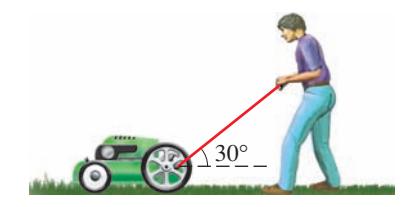
Work. A lawn mower is pushed a distance of 200 ft along a horizontal path by a constant force of 50 lb. The handle of the lawn mower is held at an angle of \(30^{\circ}\) from the horizontal (see the figure). Find the work done.
question image
48 Applications - Work and Gravity · Level 3
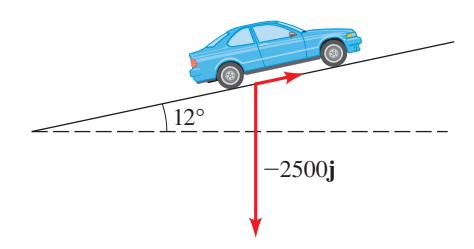
Work. A car drives 500 ft on a road that is inclined \(12^{\circ}\) to the horizontal, as shown in the figure. The car weighs 2500 lb. Thus gravity acts straight down on the car with a constant force \(\mathbf{F} = -2500 \mathbf{j}\). Find the work done by the car in overcoming gravity.
question image
49 Applications - Force on an Incline · Level 3
Force. A car is on a driveway that is inclined \(25^{\circ}\) to the horizontal. If the car weighs 2755 lb, find the force required to keep it from rolling down the driveway.
50 Applications - Force on an Incline · Level 3
Force. A car is on a driveway that is inclined \(10^{\circ}\) to the horizontal. A force of 490 lb is required to keep the car from rolling down the driveway. (a) Find the weight of the car. (b) Find the force the car exerts against the driveway.
51 Applications - Force on an Incline · Level 3
Force. A package that weighs 200 lb is placed on an inclined plane. If a force of 80 lb is just sufficient to keep the package from sliding, find the angle of inclination of the plane. (Ignore the effects of friction.)
52 Applications - Rope Tension on Incline · Level 4
Force. A cart weighing 40 lb is placed on a ramp inclined at \(15^{\circ}\) to the horizontal. The cart is held in place by a rope inclined at \(60^{\circ}\) to the horizontal, as shown in the figure. Find the force that the rope must exert on the cart to keep it from rolling down the ramp.
question image
53 Discovery - Distance from a Point to a Line · Level 4
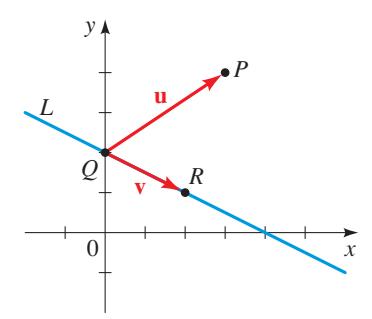
Distance from a Point to a Line. Let \(L\) be the line \(2 x + 4 y = 8\) and let \(P\) be the point \((3, 4)\). (a) Show that the points \(Q(0, 2)\) and \(R(2, 1)\) lie on \(L\). (b) Let \(\mathbf{u} = \overrightarrow{Q P}\) and \(\mathbf{v} = \overrightarrow{Q R}\), as shown in the figure. Find \(\mathbf{w} = \text{proj}_{\mathbf{v}} \mathbf{u}\). (c) Sketch a graph that explains why \(|\mathbf{u} - \mathbf{w}|\) is the distance from \(P\) to \(L\). Find this distance. (d) Write a short paragraph describing the steps you would take to find the distance from a given point to a given line.
question image
54 Example - Calculating Dot Products · Level 1
Calculate the dot product \(\mathbf{u} \cdot \mathbf{v}\) in each case.
(a) \(\mathbf{u} = \langle 3, -2 \rangle\) and \(\mathbf{v} = \langle 4, 5 \rangle\)
(b) \(\mathbf{u} = 2 \mathbf{i} + \mathbf{j}\) and \(\mathbf{v} = 5 \mathbf{i} - 6 \mathbf{j}\)

Enter your answer directly below each part above.

55 Example - Finding the Angle Between Two Vectors · Level 2
Find the angle between the vectors \(\mathbf{u} = \langle 2, 5 \rangle\) and \(\mathbf{v} = \langle 4, -3 \rangle\).
56 Example - Checking Vectors for Perpendicularity · Level 1
Determine whether the vectors in each pair are perpendicular.
(a) \(\mathbf{u} = \langle 3, 5 \rangle\) and \(\mathbf{v} = \langle 2, -8 \rangle\)
(b) \(\mathbf{u} = \langle 2, 1 \rangle\) and \(\mathbf{v} = \langle -1, 2 \rangle\)

Enter your answer directly below each part above.

57 Example - Resolving a Force into Components · Level 3
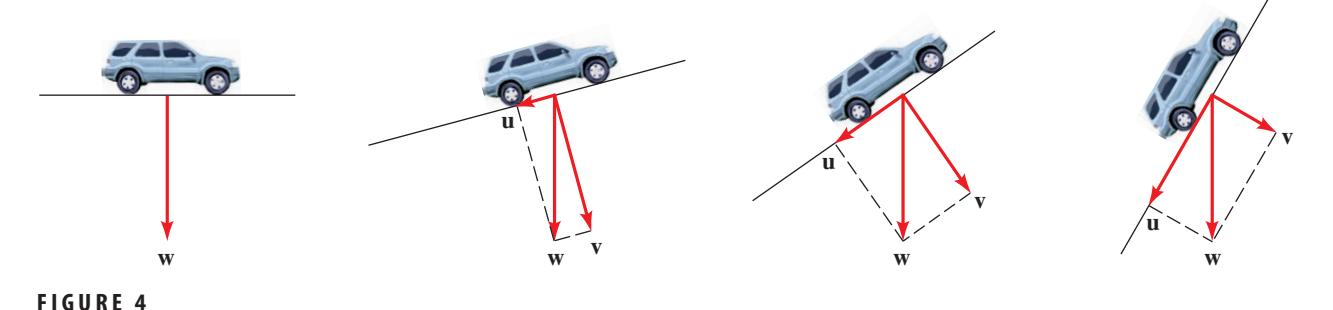
A car weighing \(3000\) lb is parked on a driveway that is inclined \(15^{\circ}\) to the horizontal.
question image
(a) Find the magnitude of the force required to prevent the car from rolling down the driveway.
(b) Find the magnitude of the force experienced by the driveway due to the weight of the car.

Enter your answer directly below each part above.

58 Example - Finding Components · Level 2
Let \(\mathbf{u} = \langle 1, 4 \rangle\) and \(\mathbf{v} = \langle -2, 1 \rangle\). Find the component of \(\mathbf{u}\) along \(\mathbf{v}\).
59 Example - Resolving a Vector into Orthogonal Vectors · Level 2
Let \(\mathbf{u} = \langle -2, 9 \rangle\) and \(\mathbf{v} = \langle -1, 2 \rangle\). (a) Find \(\text{proj}_{\mathbf{v}} \mathbf{u}\). (b) Resolve \(\mathbf{u}\) into \(\mathbf{u}_1\) and \(\mathbf{u}_2\), where \(\mathbf{u}_1\) is parallel to \(\mathbf{v}\) and \(\mathbf{u}_2\) is orthogonal to \(\mathbf{v}\).
60 Example - Calculating Work · Level 1
A force is given by the vector \(\mathbf{F} = \langle 2, 3 \rangle\) and moves an object from the point \((1, 3)\) to the point \((5, 9)\). Find the work done.
question image
61 Example - Calculating Work with Angled Force · Level 2
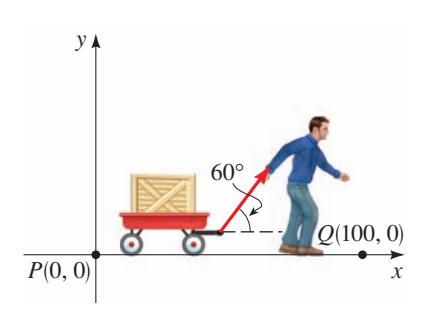
A man pulls a wagon horizontally by exerting a force of 20 lb on the handle. If the handle makes an angle of \(60^{\circ}\) with the horizontal, find the work done in moving the wagon 100 ft.
question image

Answered: 0 / 61