Stewart 9th Section 2.5: The Chain Rule

88 questions

--:--
0 / 88
Stewart 9th Section 2.5: The Chain Rule 0/88
1 Chain Rule - Composite Identification · Level 2
Write the composite function in the form \(f(g(x))\). [Identify the inner function \(u = g(x)\) and the outer function \(y = f(u)\).] Then find the derivative \(\dfrac{d y}{d x}\). \(y = (5 - x^4)^5\)
2 Chain Rule - Composite Identification · Level 2
Write the composite function in the form \(f(g(x))\). [Identify the inner function \(u = g(x)\) and the outer function \(y = f(u)\).] Then find the derivative \(\dfrac{d y}{d x}\). \(y = \sqrt{x^3 + 2}\)
3 Chain Rule - Composite Identification · Level 2
Write the composite function in the form \(f(g(x))\). [Identify the inner function \(u = g(x)\) and the outer function \(y = f(u)\).] Then find the derivative \(\dfrac{d y}{d x}\). \(y = \sin(\cos x)\)
4 Chain Rule - Composite Identification · Level 2
Write the composite function in the form \(f(g(x))\). [Identify the inner function \(u = g(x)\) and the outer function \(y = f(u)\).] Then find the derivative \(\dfrac{d y}{d x}\). \(y = \tan(x^2)\)
5 Chain Rule - Composite Identification · Level 2
Write the composite function in the form \(f(g(x))\). [Identify the inner function \(u = g(x)\) and the outer function \(y = f(u)\).] Then find the derivative \(\dfrac{d y}{d x}\). \(y = \sqrt{\sin x}\)
6 Chain Rule - Composite Identification · Level 2
Write the composite function in the form \(f(g(x))\). [Identify the inner function \(u = g(x)\) and the outer function \(y = f(u)\).] Then find the derivative \(\dfrac{d y}{d x}\). \(y = \sin(\sqrt{x})\)
7 Chain Rule - Basic · Level 2
\( f(x) = (2x^3 - 5x^2 + 4)^5 \)
8 Chain Rule - Basic · Level 2
\( f(x) = (x^5 + 3x^2 - x)^{50} \)
9 Chain Rule - Basic · Level 2
\( f(x) = \sqrt{5x + 1} \)
10 Chain Rule - Basic · Level 2
\( f(x) = \dfrac{1}{\sqrt{x^2 - 1}} \)
11 Chain Rule - Basic · Level 2
\( g(t) = \dfrac{1}{(2t + 1)^2} \)
12 Chain Rule - Basic · Level 2
\( F(t) = \left(\dfrac{1}{2t + 1}\right)^4 \)
13 Chain Rule - Basic · Level 3
\( A(t) = \dfrac{1}{(\cos t + \tan t)^2} \)
14 Chain Rule - Basic · Level 3
\( g(x) = (2 - \sin x)^{\dfrac{3}{2}} \)
15 Chain Rule - Basic · Level 2
\( f(\theta) = \cos(\theta^2) \)
16 Chain Rule - Basic · Level 2
\( g(\theta) = \cos^2 \theta \)
17 Chain Rule - Basic · Level 3
\( h(v) = v \sqrt[3]{1 + v^2} \)
18 Chain Rule - Basic · Level 2
\( f(t) = t \sin(\pi t) \)
19 Chain Rule - Product/Quotient Combo · Level 3
\( F(x) = (4x + 5)^3 (x^2 - 2x + 5)^4 \)
20 Chain Rule - Product/Quotient Combo · Level 3
\( G(z) = (1 - 4z)^2 \sqrt{z^2 + 1} \)
21 Chain Rule - Product/Quotient Combo · Level 3
\( h(t) = (t + 1)^{\dfrac{2}{3}} (2t^2 - 1)^3 \)
22 Chain Rule - Product/Quotient Combo · Level 3
\( F(t) = (3t - 1)^4 (2t + 1)^{-3} \)
23 Chain Rule - Product/Quotient Combo · Level 3
\( y = \sqrt{\dfrac{x}{x + 1}} \)
24 Chain Rule - Product/Quotient Combo · Level 3
\( y = \left(x + \dfrac{1}{x}\right)^5 \)
25 Chain Rule - Product/Quotient Combo · Level 4
\( g(u) = \left(\dfrac{u^3 - 1}{u^3 + 1}\right)^8 \)
26 Chain Rule - Product/Quotient Combo · Level 4
\( s(t) = \sqrt{\dfrac{1 + \sin t}{1 + \cos t}} \)
27 Chain Rule - Product/Quotient Combo · Level 4
\( H(r) = \dfrac{(r^2 - 1)^3}{(2r + 1)^5} \)
28 Chain Rule - Product/Quotient Combo · Level 3
\( F(t) = \dfrac{t^2}{\sqrt{t^3 + 1}} \)
29 Chain Rule - Trig Composition · Level 3
\( y = \cos(\sec 4x) \)
30 Chain Rule - Trig Composition · Level 3
\( J(\theta) = \tan^2(n \theta) \)
31 Chain Rule - Trig Composition · Level 3
\( y = \dfrac{\cos x}{\sqrt{1 + \sin x}} \)
32 Chain Rule - Trig Composition · Level 3
\( h(\theta) = \tan(\theta^2 \sin \theta) \)
33 Chain Rule - Trig Composition · Level 4
\( y = \left(\dfrac{1 - \cos 2x}{1 + \cos 2x}\right)^4 \)
34 Chain Rule - Trig Composition · Level 3
\( y = x \sin\left(\dfrac{1}{x}\right) \)
35 Chain Rule - Trig Composition · Level 3
\( f(x) = \sin x \cos(1 - x^2) \)
36 Chain Rule - Trig Composition · Level 4
\( y = \sin(t + \cos(\sqrt{t})) \)
37 Chain Rule - Complex Nested · Level 4
\( F(t) = \tan(\sqrt{1 + t^2}) \)
38 Chain Rule - Complex Nested · Level 3
\( G(z) = (1 + \cos^2 z)^3 \)
39 Chain Rule - Complex Nested · Level 4
\( y = \sin^2(x^2 + 1) \)
40 Chain Rule - Complex Nested · Level 4
\( g(u) = [(u^2 - 1)^6 - 3u]^4 \)
41 Chain Rule - Complex Nested · Level 4
\( y = \cos^4(\sin^3 x) \)
42 Chain Rule - Complex Nested · Level 4
\( y = \sin^3(\cos(x^2)) \)
43 Chain Rule - Complex Nested · Level 5
\( f(t) = \tan(\sec(\cos t)) \)
44 Chain Rule - Complex Nested · Level 5
\( y = \sqrt{x + \sqrt{x + \sqrt{x}}} \)
45 Chain Rule - Complex Nested · Level 4
\( g(x) = (2r \sin(r x) + n)^p \)
46 Chain Rule - Complex Nested · Level 5
\( y = \sin(\theta + \tan(\theta + \cos \theta)) \)
47 Chain Rule - Complex Nested · Level 5
\( y = \cos(\sqrt{\sin(\tan(\pi x))}) \)
48 Chain Rule - Complex Nested · Level 5
\( y = [x + (x + \sin^2 x)^3]^4 \)
49 Chain Rule - Higher Derivatives · Level 4
Find \(y'\) and \(y''\). \(y = \cos(\sin 3 \theta)\)
50 Chain Rule - Higher Derivatives · Level 3
Find \(y'\) and \(y''\). \(y = (1 + \sqrt{x})^3\)
51 Chain Rule - Higher Derivatives · Level 3
Find \(y'\) and \(y''\). \(y = \sqrt{\cos x}\)
52 Chain Rule - Higher Derivatives · Level 3
Find \(y'\) and \(y''\). \(y = \dfrac{4x}{\sqrt{x + 1}}\)
53 Chain Rule - Tangent Lines · Level 3
Find an equation of the tangent line to the curve at the given point. \(y = (3x - 1)^{-6}\), \((0, 1)\)
54 Chain Rule - Tangent Lines · Level 3
Find an equation of the tangent line to the curve at the given point. \(y = \sqrt{1 + x^3}\), \((2, 3)\)
55 Chain Rule - Tangent Lines · Level 3
Find an equation of the tangent line to the curve at the given point. \(y = \sin(\sin x)\), \((\pi, 0)\)
56 Chain Rule - Tangent Lines · Level 3
Find an equation of the tangent line to the curve at the given point. \(y = \sin^2 x \cos x\), \(\left(\dfrac{\pi}{2}, 0\right)\)
57 Chain Rule - Tangent Lines · Level 3
(a) Find an equation of the tangent line to the curve \(y = \tan\left(\dfrac{\pi x^2}{4}\right)\) at the point \((1, 1)\).
(b) Illustrate part (a) by graphing the curve and the tangent line on the same screen.

Enter your answer directly below each part above.

58 Chain Rule - Tangent Lines · Level 4
(a) The curve \(y = \dfrac{|x|}{\sqrt{2 - x^2}}\) is called a bullet-nose curve. Find an equation of the tangent line to this curve at the point \((1, 1)\).
(b) Illustrate part (a) by graphing the curve and the tangent line on the same screen.

Enter your answer directly below each part above.

59 Chain Rule - Graph Analysis · Level 3
(a) If \(f(x) = x \sqrt{2 - x^2}\), find \(f'(x)\).
(b) Check your answer to part (a) by comparing the graphs of \(f\) and \(f'\).

Enter your answer directly below each part above.

60 Chain Rule - Graph Analysis · Level 4
The function \(f(x) = \sin(x + \sin 2x)\), \(0 \leq x \leq \pi\), arises in applications to frequency modulation (FM) synthesis.
(a) Use a graph of \(f\) produced by a calculator or computer to make a rough sketch of the graph of \(f'\).
(b) Calculate \(f'(x)\) and use this to graph \(f'\). Compare with your sketch in part (a).

Enter your answer directly below each part above.

61 Chain Rule - Horizontal Tangent · Level 3
Find all points on the graph of the function \(f(x) = 2 \sin x + \sin^2 x\) at which the tangent line is horizontal.
62 Chain Rule - Horizontal Tangent · Level 4
At what point on the curve \(y = \sqrt{1 + 2x}\) is the tangent line perpendicular to the line \(6x + 2y = 1\)?
63 Chain Rule - Given Values · Level 3
If \(F(x) = f(g(x))\), where \(f(-2) = 8\), \(f'(-2) = 4\), \(f'(5) = 3\), \(g(5) = -2\), and \(g'(5) = 6\), find \(F'(5)\).
64 Chain Rule - Given Values · Level 3
If \(h(x) = \sqrt{4 + 3f(x)}\), where \(f(1) = 7\) and \(f'(1) = 4\), find \(h'(1)\).
65 Chain Rule - Given Values · Level 3
A table of values for \(f\), \(g\), \(f'\), and \(g'\) is given.
\(x\) \(f(x)\) \(g(x)\) \(f'(x)\) \(g'(x)\)
1 3 2 4 6
2 1 8 5 7
3 7 2 7 9
(a) If \(h(x) = f(g(x))\), find \(h'(1)\).
(b) If \(H(x) = g(f(x))\), find \(H'(1)\).

Enter your answer directly below each part above.

66 Chain Rule - Given Values · Level 3
Let \(f\) and \(g\) be the functions in Exercise 65.
(a) If \(F(x) = f(f(x))\), find \(F'(2)\).
(b) If \(G(x) = g(g(x))\), find \(G'(3)\).

Enter your answer directly below each part above.

67 Chain Rule - Given Values · Level 3
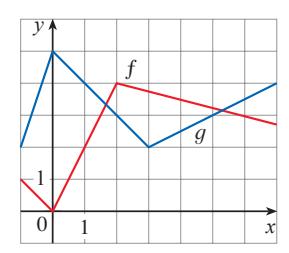
If \(f\) and \(g\) are the functions whose graphs are shown, let \(u(x) = f(g(x))\), \(v(x) = g(f(x))\), and \(w(x) = g(g(x))\). Find each derivative, if it exists. If it does not exist, explain why.
question image
(a) \(u'(1)\)
(b) \(v'(1)\)
(c) \(w'(1)\)

Enter your answer directly below each part above.

68 Chain Rule - Given Values · Level 3
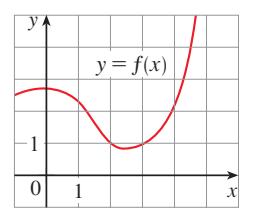
If \(f\) is the function whose graph is shown, let \(h(x) = f(f(x))\) and \(g(x) = f(x^2)\). Use the graph to estimate each derivative.
question image
(a) \(h'(2)\)
(b) \(g'(2)\)

Enter your answer directly below each part above.

69 Chain Rule - Given Values · Level 3
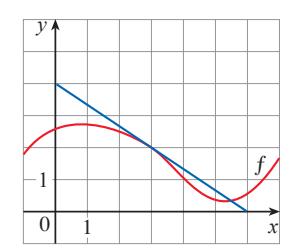
If \(g(x) = \sqrt{f(x)}\), where the graph of \(f\) is shown, evaluate \(g'(3)\).
question image
70 Chain Rule - Given Values · Level 4
Suppose \(f\) is differentiable on \(RR\) and \(\alpha\) is a real number. Let \(F(x) = f(x^\alpha)\) and \(G(x) = [f(x)]^\alpha\). Find expressions for (a) \(F'(x)\) and (b) \(G'(x)\).
71 Chain Rule - Given Values · Level 3
Let \(r(x) = f(g(h(x)))\), where \(h(1) = 2\), \(g(2) = 3\), \(h'(1) = 4\), \(g'(2) = 5\), and \(f'(3) = 6\). Find \(r'(1)\).
72 Chain Rule - Given Values · Level 5
If \(g\) is a twice differentiable function and \(f(x) = x g(x^2)\), find \(f''\) in terms of \(g\), \(g'\), and \(g''\).
73 Chain Rule - Given Values · Level 4
If \(F(x) = f(3f(4f(x)))\), where \(f(0) = 0\) and \(f'(0) = 2\), find \(F'(0)\).
74 Chain Rule - Given Values · Level 5
If \(F(x) = f(x f(x f(x)))\), where \(f(1) = 2\), \(f(2) = 3\), \(f'(1) = 4\), \(f'(2) = 5\), and \(f'(3) = 6\), find \(F'(1)\).
75 Chain Rule - Pattern/nth Derivative · Level 4
Find the given derivative by finding the first few derivatives and observing the pattern that occurs. \(D^{103} \cos 2x\)
76 Chain Rule - Pattern/nth Derivative · Level 5
Find the given derivative by finding the first few derivatives and observing the pattern that occurs. \(D^{35} x \sin(\pi x)\)
77 Chain Rule - Applied · Level 2
A vibrating string has displacement \(s(t) = 10 + \dfrac{1}{4} \sin(10 \pi t)\). Find the velocity of the string after \(t\) seconds.
78 Chain Rule - Applied · Level 3
An object moves along a horizontal line so that its position is given by \(s = A \cos(\omega t + \delta)\) (simple harmonic motion). Find the velocity of the object. When is the velocity 0?
79 Chain Rule - Applied · Level 3
The brightness of a Cepheid variable star is modeled by the function \(B(t) = 4.0 + 0.35 \sin\left(\dfrac{2 \pi t}{5.4}\right)\) where \(t\) is measured in days. Find the rate of change of brightness after \(t\) days.
80 Chain Rule - Applied · Level 3
In a model for the length of daylight (in hours) in Philadelphia on the \(t\)th day of the year: \(L(t) = 12 + 2.8 \sin[\dfrac{2 \pi}{365}(t - 80)]\) Use this model to compare how the number of hours of daylight is increasing in Philadelphia on March 21 \((t = 80)\) and May 21 \((t = 141)\).
81 Chain Rule - Applied · Level 3
A particle moves along a straight line with displacement \(s(t)\), velocity \(v(t)\), and acceleration \(a(t)\). Show that \(a(t) = v(t) \dfrac{d v}{d s}\). Explain the difference between the meanings of \(\dfrac{d v}{d t}\) and \(\dfrac{d v}{d s}\).
82 Chain Rule - Applied · Level 3
Air is being pumped into a spherical weather balloon. At any time \(t\), the volume of the balloon is \(V(t)\) and its radius is \(r(t)\).
(a) What do the derivatives \(\dfrac{d V}{d r}\) and \(\dfrac{d V}{d t}\) represent?
(b) Express \(\dfrac{d V}{d t}\) in terms of \(\dfrac{d r}{d t}\).

Enter your answer directly below each part above.

83 Chain Rule - Proof/Theory · Level 4
Use the Chain Rule to prove that the derivative of an even function is an odd function, and the derivative of an odd function is an even function.
84 Chain Rule - Proof/Theory · Level 4
Use the Chain Rule and the Product Rule to give an alternative proof of the Quotient Rule. [Hint: Write \(\dfrac{f(x)}{g(x)} = f(x)[g(x)]^{-1}\).]
85 Chain Rule - Proof/Theory · Level 4
Use the Chain Rule to show that if \(\theta\) is measured in degrees, then \(\dfrac{d}{d \theta}(\sin \theta) = \dfrac{\pi}{180} \cos \theta\) (This gives one reason for the convention of using radian measure.)
86 Chain Rule - Proof/Theory · Level 4
(a) Write \(|x| = \sqrt{x^2}\) and use the Chain Rule to show that \(\dfrac{d}{d x}|x| = \dfrac{x}{|x|}\).
(b) If \(f(x) = |\sin x|\), find \(f'(x)\) and sketch the graphs of \(f\) and \(f'\). Where is \(f\) not differentiable?
(c) If \(g(x) = \sin|x|\), find \(g'(x)\) and sketch the graphs of \(g\) and \(g'\). Where is \(g\) not differentiable?

Enter your answer directly below each part above.

87 Chain Rule - Proof/Theory · Level 5
If \(F = f \circ g \circ h\) and \(f\), \(g\), and \(h\) are differentiable, show that \(F'(x) = f'(g(h(x))) \cdot g'(h(x)) \cdot h'(x)\)
88 Chain Rule - Proof/Theory · Level 5
If \(F = f \circ g\) and \(f\) and \(g\) are twice differentiable, show that \(F''(x) = f''(g(x)) \cdot [g'(x)]^2 + f'(g(x)) \cdot g''(x)\)

Answered: 0 / 88