Stewart Precalc 6e Section 7.FM: Focus on Modeling: Traveling and Standing Waves

10 questions

--:--
0 / 10
Stewart Precalc 6e Section 7.FM: Focus on Modeling: Traveling and Standing Waves 0/10
1 Problem - Wave on a Canal · Level 3
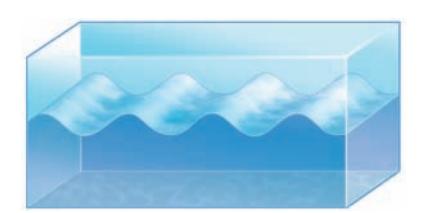
Wave on a Canal. A wave on the surface of a long canal is described by the function \(y(x, t) = 5 \sin\left(2 x - \dfrac{\pi}{2} t\right)\), \(x \geq 0\)
question image
(a) Find the function that models the position of the point \(x = 0\) at any time \(t\).
(b) Sketch the shape of the wave when \(t = 0, 0.4, 0.8, 1.2\), and \(1.6\). Is this a traveling wave?
(c) Find the velocity of the wave.

Enter your answer directly below each part above.

2 Problem - Wave in a Rope · Level 3
Wave in a Rope. Traveling waves are generated at each end of a tightly stretched rope 24 ft long, with equations \(y = 0.2 \sin(1.047 x - 0.524 t)\) and \(y = 0.2 \sin(1.047 x + 0.524 t)\)
(a) Find the equation of the combined wave, and find the nodes.
(b) Sketch the graph for \(t = 0, 1, 2, 3, 4, 5\), and \(6\). Is this a standing wave?

Enter your answer directly below each part above.

3 Problem - Traveling Wave from Graph · Level 3
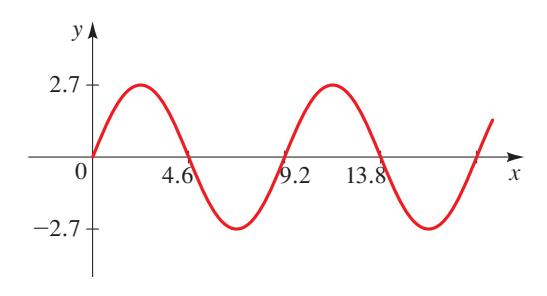
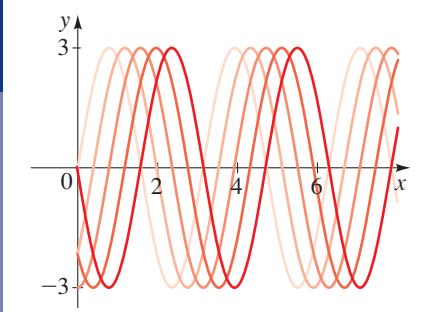
Traveling Wave. A traveling wave is graphed at the instant \(t = 0\). If it is moving to the right with velocity \(6\), find an equation of the form \(y(x, t) = A \sin(k x - k v t)\) for this wave.
question image
4 Problem - Traveling Wave from Parameters · Level 3
Traveling Wave. A traveling wave has period \(\dfrac{2 \pi}{3}\), amplitude \(5\), and velocity \(0.5\).
(a) Find the equation of the wave.
(b) Sketch the graph for \(t = 0, 0.5, 1, 1.5\), and \(2\).

Enter your answer directly below each part above.

5 Problem - Standing Wave with Frequency · Level 3
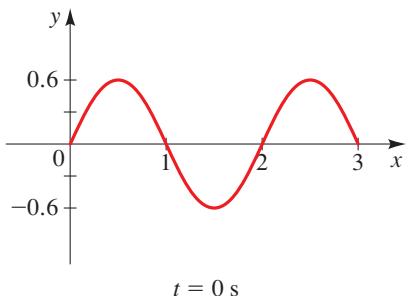
Standing Wave. A standing wave with amplitude \(0.6\) is graphed at several times \(t\) as shown in the figure. If the vibration has a frequency of \(20\) Hz, find an equation of the form \(y(x, t) = A \sin(\alpha x) \cos(\beta t)\) that models this wave.
question image
6 Problem - Standing Wave with Specified Nodes · Level 3
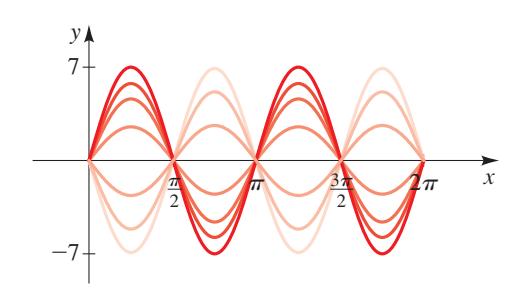
Standing Wave. A standing wave has maximum amplitude \(7\) and nodes at \(0, \dfrac{\pi}{2}, \pi, \dfrac{3 \pi}{2}, 2 \pi\), as shown in the figure. Each point that is not a node moves up and down with period \(4 \pi\). Find a function of the form \(y(x, t) = A \sin(\alpha x) \cos(\beta t)\) that models this wave.
question image
7 Problem - Vibrating String · Level 4
Vibrating String. When a violin string vibrates, the sound produced results from a combination of standing waves that have evenly placed nodes. The figure illustrates some of the possible standing waves. Let's assume that the string has length \(\pi\).
question image
(a) For fixed \(t\), the string has the shape of a sine curve \(y = A \sin(\alpha x)\). Find the appropriate value of \(\alpha\) for each of the illustrated standing waves.
(b) Do you notice a pattern in the values of \(\alpha\) that you found in part (a)? What would the next two values of \(\alpha\) be? Sketch rough graphs of the standing waves associated with these new values of \(\alpha\).
(c) Suppose that for fixed \(t\), each point on the string that is not a node vibrates with frequency \(440\) Hz. Find the value of \(\beta\) for which an equation of the form \(y = A \cos(\beta t)\) would model this motion.
(d) Combine your answers for parts (a) and (c) to find functions of the form \(y(x, t) = A \sin(\alpha x) \cos(\beta t)\) that model each of the standing waves in the figure. (Assume that \(A = 1\).)

Enter your answer directly below each part above.

8 Problem - Waves in a Tube · Level 4
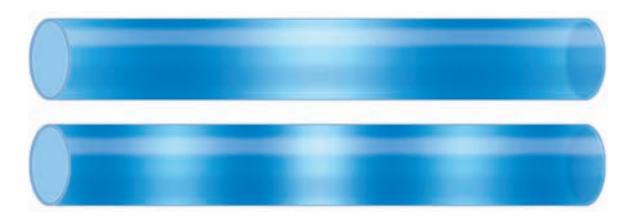
Waves in a Tube. Standing waves in a violin string must have nodes at the ends of the string because the string is fixed at its endpoints. But this need not be the case with sound waves in a tube (such as a flute or an organ pipe). The figure shows some possible standing waves in a tube. Suppose that a standing wave in a tube \(37.7\) ft long is modeled by the function \(y(x, t) = 0.3 \cos\left(\dfrac{x}{2}\right) \cos(50 \pi t)\) Here \(y(x, t)\) represents the variation from normal air pressure at the point \(x\) feet from the end of the tube, at time \(t\) seconds.
question image
(a) At what points \(x\) are the nodes located? Are the endpoints of the tube nodes?
(b) At what frequency does the air vibrate at points that are not nodes?

Enter your answer directly below each part above.

9 Example - A Traveling Wave · Level 2
A traveling wave is described by the function \(y(x, t) = 3 \sin\left(2 x - \dfrac{\pi}{2} t\right)\), \(x \geq 0\)
question image
(a) Find the function that models the position of the point \(x = \dfrac{\pi}{6}\) at any time \(t\). Observe that the point moves in simple harmonic motion.
(b) Sketch the shape of the wave when \(t = 0, 0.5, 1.0, 1.5\), and \(2.0\). Does the wave appear to be traveling to the right?
(c) Find the velocity of the wave.

Enter your answer directly below each part above.

10 Example - A Standing Wave · Level 2
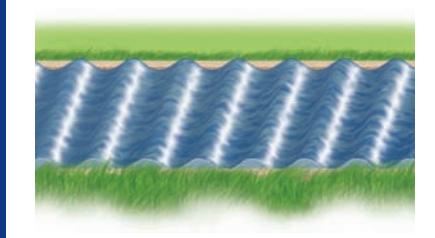
Traveling waves are generated at each end of a wave tank 30 ft long, with equations \(y = 1.5 \sin\left(\dfrac{\pi}{5} x - 3 t\right)\) and \(y = 1.5 \sin\left(\dfrac{\pi}{5} x + 3 t\right)\)
question image
(a) Find the equation of the combined wave, and find the nodes.
(b) Sketch the graph for \(t = 0, 0.17, 0.34, 0.51, 0.68, 0.85\), and \(1.02\). Is this a standing wave?

Enter your answer directly below each part above.

Answered: 0 / 10