Stewart 9th Section 1.5: The Limit of a Function

45 questions

--:--
0 / 45
Stewart 9th Section 1.5: The Limit of a Function 0/45
1 Limits - Definition · Level 1
Explain in your own words what is meant by the equation \(\operatorname*{lim}\limits_{x \rightarrow 2} f(x) = 5\). Is it possible for this statement to be true and yet \(f(2) = 3\)? Explain.
2 Limits - Definition · Level 1
Explain what it means to say that \(\operatorname*{lim}\limits_{x \rightarrow 1^-} f(x) = 3\) and \(\operatorname*{lim}\limits_{x \rightarrow 1^+} f(x) = 7\). In this situation is it possible that \(\operatorname*{lim}\limits_{x \rightarrow 1} f(x)\) exists? Explain.
3 Limits - Definition · Level 1
Explain the meaning of each of the following.
(a) \(\operatorname*{lim}\limits_{x \rightarrow -3} f(x) = \infty\)
(b) \(\operatorname*{lim}\limits_{x \rightarrow 4^+} f(x) = -\infty\)

Enter your answer directly below each part above.

4 Limits - Graph Reading · Level 2
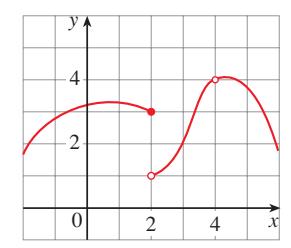
Use the given graph of \(f\) to state the value of each quantity, if it exists. If it does not exist, explain why.
question image
(a) \(\operatorname*{lim}\limits_{x \rightarrow 2^-} f(x)\)
(b) \(\operatorname*{lim}\limits_{x \rightarrow 2^+} f(x)\)
(c) \(\operatorname*{lim}\limits_{x \rightarrow 2} f(x)\)
(d) \(f(2)\)
(e) \(\operatorname*{lim}\limits_{x \rightarrow 4} f(x)\)
(f) \(f(4)\)

Enter your answer directly below each part above.

5 Limits - Graph Reading · Level 2
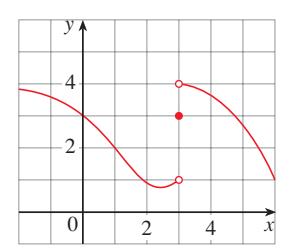
For the function \(f\) whose graph is given, state the value of each quantity, if it exists. If it does not exist, explain why.
question image
(a) \(\operatorname*{lim}\limits_{x \rightarrow 1} f(x)\)
(b) \(\operatorname*{lim}\limits_{x \rightarrow 3^-} f(x)\)
(c) \(\operatorname*{lim}\limits_{x \rightarrow 3^+} f(x)\)
(d) \(\operatorname*{lim}\limits_{x \rightarrow 3} f(x)\)
(e) \(f(3)\)

Enter your answer directly below each part above.

6 Limits - Graph Reading · Level 3
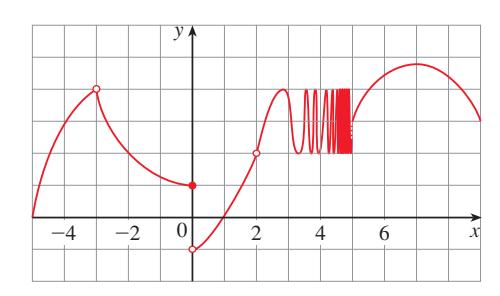
For the function \(h\) whose graph is given, state the value of each quantity, if it exists. If it does not exist, explain why.
question image
(a) \(\operatorname*{lim}\limits_{x \rightarrow -3^-} h(x)\)
(b) \(\operatorname*{lim}\limits_{x \rightarrow -3^+} h(x)\)
(c) \(\operatorname*{lim}\limits_{x \rightarrow -3} h(x)\)
(d) \(h(-3)\)
(e) \(\operatorname*{lim}\limits_{x \rightarrow 0^-} h(x)\)
(f) \(\operatorname*{lim}\limits_{x \rightarrow 0^+} h(x)\) (g) \(\operatorname*{lim}\limits_{x \rightarrow 0} h(x)\) (h) \(h(0)\) (i) \(\operatorname*{lim}\limits_{x \rightarrow 2} h(x)\) (j) \(h(2)\) (k) \(\operatorname*{lim}\limits_{x \rightarrow 5^+} h(x)\) (l) \(\operatorname*{lim}\limits_{x \rightarrow 5^-} h(x)\)

Enter your answer directly below each part above.

7 Limits - Graph Reading · Level 3
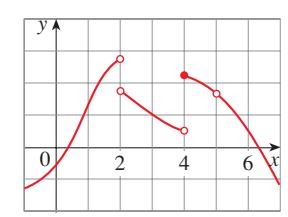
For the function \(g\) whose graph is shown, find a number \(a\) that satisfies the given description.
question image
(a) \(\operatorname*{lim}\limits_{x \rightarrow a} g(x)\) does not exist but \(g(a)\) is defined.
(b) \(\operatorname*{lim}\limits_{x \rightarrow a} g(x)\) exists but \(g(a)\) is not defined.
(c) \(\operatorname*{lim}\limits_{x \rightarrow a^-} g(x)\) and \(\operatorname*{lim}\limits_{x \rightarrow a^+} g(x)\) both exist but \(\operatorname*{lim}\limits_{x \rightarrow a} g(x)\) does not exist.
(d) \(\operatorname*{lim}\limits_{x \rightarrow a^+} g(x) = g(a)\) but \(\operatorname*{lim}\limits_{x \rightarrow a^-} g(x) \neq g(a)\).

Enter your answer directly below each part above.

8 Limits - Graph Reading · Level 2
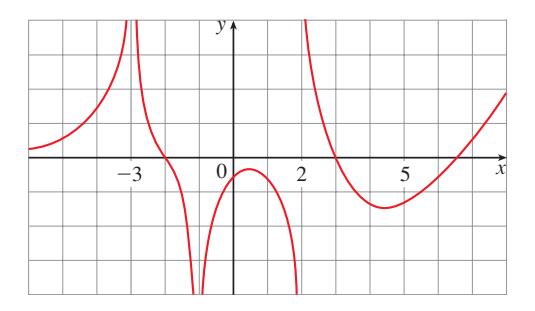
For the function \(A\) whose graph is shown, state the following.
question image
(a) \(\operatorname*{lim}\limits_{x \rightarrow -3} A(x)\)
(b) \(\operatorname*{lim}\limits_{x \rightarrow 2^-} A(x)\)
(c) \(\operatorname*{lim}\limits_{x \rightarrow 2^+} A(x)\)
(d) \(\operatorname*{lim}\limits_{x \rightarrow -1} A(x)\)
(e) The equations of the vertical asymptotes.

Enter your answer directly below each part above.

9 Limits - Graph Reading · Level 2
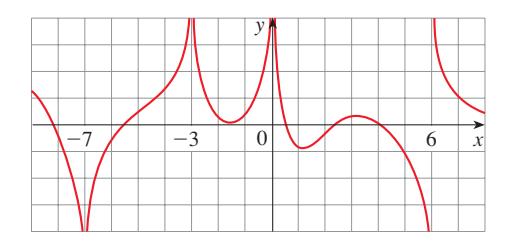
For the function \(f\) whose graph is shown, state the following.
question image
(a) \(\operatorname*{lim}\limits_{x \rightarrow -7} f(x)\)
(b) \(\operatorname*{lim}\limits_{x \rightarrow -3} f(x)\)
(c) \(\operatorname*{lim}\limits_{x \rightarrow 0} f(x)\)
(d) \(\operatorname*{lim}\limits_{x \rightarrow 6^-} f(x)\)
(e) \(\operatorname*{lim}\limits_{x \rightarrow 6^+} f(x)\)
(f) The equations of the vertical asymptotes.

Enter your answer directly below each part above.

10 Limits - Graph Reading · Level 2
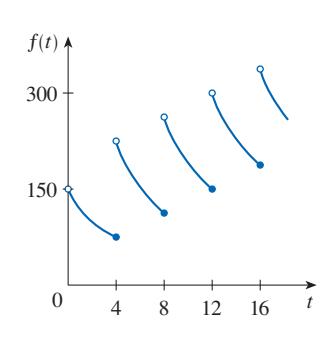
A patient receives a 150-mg injection of a drug every 4 hours. The graph shows the amount \(f(t)\) of the drug in the bloodstream after \(t\) hours. Find \(\operatorname*{lim}\limits_{t \rightarrow 12^-} f(t)\) and \(\operatorname*{lim}\limits_{t \rightarrow 12^+} f(t)\) and explain the significance of these one-sided limits.
question image
11 Limits - Piecewise · Level 2
Sketch the graph of the function and use it to determine the values of \(a\) for which \(\operatorname*{lim}\limits_{x \rightarrow a} f(x)\) exists. \( f(x) = \begin{cases} \cos x & \quad \text{if} x \leq 0 \\ 1 - x & \quad \text{if} 0 < x < 1 \\ \dfrac{1}{x} & \quad \text{if} x \geq 1 \end{cases} \)
12 Limits - Piecewise · Level 2
Sketch the graph of the function and use it to determine the values of \(a\) for which \(\operatorname*{lim}\limits_{x \rightarrow a} f(x)\) exists. \( f(x) = \begin{cases} \sqrt{-x} & \quad \text{if} x \leq -1 \\ x & \quad \text{if} -1 < x \leq 2 \\ (x - 1)^2 & \quad \text{if} x > 2 \end{cases} \)
13 Limits - Graph to Limit · Level 3
Use the graph of the function \(f(x) = x \sqrt{1 + x^{-2}}\) to state the value of each limit, if it exists. If it does not exist, explain why.
(a) \(\operatorname*{lim}\limits_{x \rightarrow 0^-} f(x)\)
(b) \(\operatorname*{lim}\limits_{x \rightarrow 0^+} f(x)\)
(c) \(\operatorname*{lim}\limits_{x \rightarrow 0} f(x)\)

Enter your answer directly below each part above.

14 Limits - Graph to Limit · Level 3
Use the graph of the function \(f(x) = \dfrac{3^{\dfrac{1}{x}} - 2}{3^{\dfrac{1}{x}} + 1}\) to state the value of each limit, if it exists. If it does not exist, explain why.
(a) \(\operatorname*{lim}\limits_{x \rightarrow 0^-} f(x)\)
(b) \(\operatorname*{lim}\limits_{x \rightarrow 0^+} f(x)\)
(c) \(\operatorname*{lim}\limits_{x \rightarrow 0} f(x)\)

Enter your answer directly below each part above.

15 Limits - Sketch · Level 2
Sketch the graph of an example of a function \(f\) that satisfies all of the given conditions. \(\operatorname*{lim}\limits_{x \rightarrow 1^-} f(x) = 3\), \(\operatorname*{lim}\limits_{x \rightarrow 1^+} f(x) = 0\), \(f(1) = 2\)
16 Limits - Sketch · Level 2
Sketch the graph of an example of a function \(f\) that satisfies all of the given conditions. \(\operatorname*{lim}\limits_{x \rightarrow 0} f(x) = 4\), \(\operatorname*{lim}\limits_{x \rightarrow 8^-} f(x) = 1\), \(\operatorname*{lim}\limits_{x \rightarrow 8^+} f(x) = -3\), \(f(0) = 6\), \(f(8) = -1\)
17 Limits - Sketch · Level 2
Sketch the graph of an example of a function \(f\) that satisfies all of the given conditions. \(\operatorname*{lim}\limits_{x \rightarrow -1^-} f(x) = 0\), \(\operatorname*{lim}\limits_{x \rightarrow -1^+} f(x) = 1\), \(\operatorname*{lim}\limits_{x \rightarrow 2} f(x) = 3\), \(f(-1) = 2\), \(f(2) = 1\)
18 Limits - Sketch · Level 3
Sketch the graph of an example of a function \(f\) that satisfies all of the given conditions. \(\operatorname*{lim}\limits_{x \rightarrow -3^-} f(x) = 3\), \(\operatorname*{lim}\limits_{x \rightarrow -3^+} f(x) = 2\), \(\operatorname*{lim}\limits_{x \rightarrow 3^-} f(x) = -1\), \(\operatorname*{lim}\limits_{x \rightarrow 3^+} f(x) = 2\), \(f(-3) = 2\), \(f(3) = 0\)
19 Limits - Numerical · Level 2
Guess the value of the limit (if it exists) by evaluating the function at the given numbers (correct to six decimal places). \(\operatorname*{lim}\limits_{x \rightarrow 3} \dfrac{x^2 - 3x}{x^2 - 9}\), \(x = 3.1, 3.05, 3.01, 3.001, 3.0001, 2.9, 2.95, 2.99, 2.999, 2.9999\)
20 Limits - Numerical · Level 2
Guess the value of the limit (if it exists) by evaluating the function at the given numbers (correct to six decimal places). \(\operatorname*{lim}\limits_{x \rightarrow -3} \dfrac{x^2 - 3x}{x^2 - 9}\), \(x = -2.5, -2.9, -2.95, -2.99, -2.999, -2.9999, -3.5, -3.1, -3.05, -3.01, -3.001, -3.0001\)
21 Limits - Numerical · Level 2
Guess the value of the limit (if it exists) by evaluating the function at the given numbers (correct to six decimal places). \(\operatorname*{lim}\limits_{x \rightarrow 0} \dfrac{\sin x}{x + \tan x}\), \(x = \pm 1, \pm 0.5, \pm 0.2, \pm 0.1, \pm 0.05, \pm 0.01\)
22 Limits - Numerical · Level 2
Guess the value of the limit (if it exists) by evaluating the function at the given numbers (correct to six decimal places). \(\operatorname*{lim}\limits_{h \rightarrow 0} \dfrac{(2 + h)^5 - 32}{h}\), \(h = \pm 0.5, \pm 0.1, \pm 0.01, \pm 0.001, \pm 0.0001\)
23 Limits - Table Estimation · Level 2
Use a table of values to estimate the value of the limit. If you have a graphing device, use it to confirm your result graphically. \(\operatorname*{lim}\limits_{\theta \rightarrow 0} \dfrac{\sin 3 \theta}{\tan 2 \theta}\)
24 Limits - Table Estimation · Level 2
Use a table of values to estimate the value of the limit. If you have a graphing device, use it to confirm your result graphically. \(\operatorname*{lim}\limits_{p \rightarrow -1} \dfrac{1 + p^9}{1 + p^{15}}\)
25 Limits - Table Estimation · Level 3
Use a table of values to estimate the value of the limit. If you have a graphing device, use it to confirm your result graphically. \(\operatorname*{lim}\limits_{x \rightarrow 0^+} x^x\)
26 Limits - Table Estimation · Level 2
Use a table of values to estimate the value of the limit. If you have a graphing device, use it to confirm your result graphically. \(\operatorname*{lim}\limits_{t \rightarrow 0} \dfrac{5^t - 1}{t}\)
27 Limits - Infinite Limits · Level 2
\( \operatorname*{lim}\limits_{x \rightarrow 5^+} \dfrac{x + 1}{x - 5} \)
28 Limits - Infinite Limits · Level 2
\( \operatorname*{lim}\limits_{x \rightarrow 5^-} \dfrac{x + 1}{x - 5} \)
29 Limits - Infinite Limits · Level 2
\( \operatorname*{lim}\limits_{x \rightarrow 2} \dfrac{x^2}{(x - 2)^2} \)
30 Limits - Infinite Limits · Level 2
\( \operatorname*{lim}\limits_{x \rightarrow 3^+} \dfrac{\sqrt{x}}{(x - 3)^5} \)
31 Limits - Infinite Limits · Level 3
\( \operatorname*{lim}\limits_{x \rightarrow -2^+} \dfrac{x - 1}{x^2 (x + 2)} \)
32 Limits - Infinite Limits · Level 3
\( \operatorname*{lim}\limits_{x \rightarrow 0} \dfrac{x - 1}{x^2 (x + 2)} \)
33 Limits - Infinite Limits · Level 3
\( \operatorname*{lim}\limits_{x \rightarrow \dfrac{\pi}{2}^+} \dfrac{1}{x} \sec x \)
34 Limits - Infinite Limits · Level 3
\( \operatorname*{lim}\limits_{x \rightarrow \pi^-} x \cot x \)
35 Limits - Infinite Limits · Level 3
\( \operatorname*{lim}\limits_{x \rightarrow 1^-} \dfrac{x^2 + 2x}{x^2 - 2x + 1} \)
36 Limits - Infinite Limits · Level 3
\(\operatorname*{lim}\limits_{x \rightarrow -3^+} \dfrac{x^2 + 4x}{x^2 - 2x - 3}\) (Note: \(x^2 - 2x - 3 = (x - 3)(x + 1)\) — verify the denominator factoring)
37 Limits - Vertical Asymptotes · Level 2
Find the vertical asymptote of the function \(f(x) = \dfrac{x - 1}{2x + 4}\).
38 Limits - Vertical Asymptotes · Level 2
(a) Find the vertical asymptotes of the function \(y = \dfrac{x^2 + 1}{3x - 2x^2}\).
(b) Confirm by graphing the function.

Enter your answer directly below each part above.

39 Limits - Investigation · Level 3
Determine \(\operatorname*{lim}\limits_{x \rightarrow 1^+} \dfrac{1}{x^3 - 1}\) and \(\operatorname*{lim}\limits_{x \rightarrow 1^-} \dfrac{1}{x^3 - 1}\)
(a) by evaluating \(f(x) = \dfrac{1}{x^3 - 1}\) for values of \(x\) that approach 1 from the right and from the left,
(b) by reasoning as in Example 7,
(c) from a graph of \(f\).

Enter your answer directly below each part above.

40 Limits - Investigation · Level 3
(a) By graphing the function \(f(x) = \dfrac{\cos 2x - \cos x}{x^2}\) and zooming in toward the origin, estimate the value of \(\operatorname*{lim}\limits_{x \rightarrow 0} f(x)\).
(b) Check your answer in part (a) by evaluating \(f(x)\) for values of \(x\) that approach 0.

Enter your answer directly below each part above.

41 Limits - Investigation · Level 3
(a) Evaluate \(f(x) = x^2 - \dfrac{2^x}{1000}\) for \(x = 1, 0.8, 0.6, 0.4, 0.2, 0.1\), and \(0.05\), and guess the value of \(\operatorname*{lim}\limits_{x \rightarrow 0} \left(x^2 - \dfrac{2^x}{1000}\right)\).
(b) Evaluate \(f(x)\) for \(x = 0.04, 0.02, 0.01, 0.005, 0.003\), and \(0.001\). Guess again.

Enter your answer directly below each part above.

42 Limits - Investigation · Level 4
(a) Evaluate \(h(x) = \dfrac{\tan x - x}{x^3}\) for \(x = 1, 0.5, 0.1, 0.05, 0.01\), and \(0.005\).
(b) Guess the value of \(\operatorname*{lim}\limits_{x \rightarrow 0} \dfrac{\tan x - x}{x^3}\).
(c) Evaluate \(h(x)\) for successively smaller values of \(x\) until you finally reach 0 values. Are you still confident about your guess? Explain.
(d) Graph \(h\) in the viewing rectangle \([-1, 1]\) by \([0, 1]\) and zoom in toward the point where the graph crosses the \(y\)-axis. What do you notice? Compare with your results in part (c).

Enter your answer directly below each part above.

43 Limits - Vertical Asymptotes · Level 4
Use a graph to estimate the equations of all the vertical asymptotes of \(y = \tan(2 \sin x)\), \(-\pi \leq x \leq \pi\). Then find the exact equations.
44 Limits - Investigation · Level 4
Consider the function \(f(x) = \tan\left(\dfrac{1}{x}\right)\).
(a) Show that \(f(x) = 0\) for \(x = \dfrac{1}{\pi}, \dfrac{1}{2 \pi}, \dfrac{1}{3 \pi}, \cdots\)
(b) Show that \(f(x) = 1\) for \(x = \dfrac{4}{\pi}, \dfrac{4}{5 \pi}, \dfrac{4}{9 \pi}, \cdots\)
(c) What can you conclude about \(\operatorname*{lim}\limits_{x \rightarrow 0^+} \tan\left(\dfrac{1}{x}\right)\)?

Enter your answer directly below each part above.

45 Limits - Applied · Level 3
In the theory of relativity, the mass of a particle with velocity \(v\) is \( m = \dfrac{m_0}{\sqrt{1 - \dfrac{v^2}{c^2}}} \) where \(m_0\) is the mass of the particle at rest and \(c\) is the speed of light. What happens as \(v \rightarrow c^-\)?

Answered: 0 / 45