Stewart Precalc 6e Chapter 13 Focus on Modeling: Interpretations of Area
6 questions
--:--
0 / 6
Stewart Precalc 6e Chapter 13 Focus on Modeling: Interpretations of Area
0/6
1
Problem - Work Done by a Winch
· Level 3
Select error type
selected
Work Done by a Winch. A motorized winch is being used to pull a felled tree to a logging truck. The motor exerts a force of \(f(x) = 1500 + 10 x - \dfrac{1}{2} x^2\) lb on the tree at the instant when the tree has moved \(x\) ft. The tree must be moved a distance of 40 ft, from \(x = 0\) to \(x = 40\). How much work is done by the winch in moving the tree?
Click to select photo
2
Problem - Work Done by a Spring
· Level 2
Select error type
selected
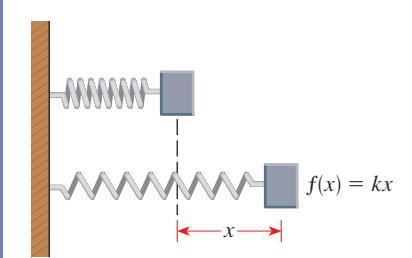
Work Done by a Spring. Hooke's law states that when a spring is stretched, it pulls back with a force proportional to the amount of the stretch. The constant of proportionality is a characteristic of the spring known as the *spring constant*. Thus a spring with spring constant \(k\) exerts a force \(f(x) = k x\) when it is stretched a distance \(x\).
A certain spring has spring constant \(k = 20\) lb/ft. Find the work done when the spring is pulled so that the amount by which it is stretched increases from \(x = 0\) to \(x = 2\) ft.
Click to select photo
3
Problem - Force of Water
· Level 4
Select error type
selected
Force of Water. As any diver knows, an object submerged in water experiences pressure, and as depth increases, so does the water pressure. At a depth of \(x\) ft, the water pressure is \(p(x) = 62.5 x\) lb/ft\(^2\). To find the force exerted by the water on a surface, we multiply the pressure by the area of the surface: force = pressure times area.
Suppose an aquarium that is 3 ft wide, 6 ft long, and 4 ft high is full of water. The bottom of the aquarium has area \(3 \times 6 = 18\) ft\(^2\), and it experiences water pressure of \(p(4) = 62.5 \times 4 = 250\) lb/ft\(^2\). Thus the total force exerted by the water on the bottom is \(250 \times 18 = 4500\) lb.
The water also exerts a force on the sides of the aquarium, but this is not as easy to calculate because the pressure increases from top to bottom. To calculate the force on one of the 4 ft by 6 ft sides, we divide its area into \(n\) thin horizontal strips of width \(\Delta x\), as shown in the figure. The area of each strip is length times width \(= 6 \Delta x\).
If the bottom of the \(k\)th strip is at the depth \(x_k\), then it experiences water pressure of approximately \(p(x_k) = 62.5 x_k\) lb/ft\(^2\)—the thinner the strip, the more accurate the approximation. Thus on each strip the water exerts a force of pressure times area \(= 62.5 x_k \times 6 \Delta x = 375 x_k \Delta x\) lb.
(a) Explain why the total force exerted by the water on the 4 ft by 6 ft sides of the aquarium is \(\operatorname*{lim}\limits_{n \rightarrow \infty} \displaystyle\sum_{k=1}^n 375 x_k \Delta x\) where \(\Delta x = \dfrac{4}{n}\) and \(x_k = \dfrac{4 k}{n}\).
(b) What area does the limit in part (a) represent?
(c) Evaluate the limit in part (a) to find the force exerted by the water on one of the 4 ft by 6 ft sides of the aquarium.
(d) Use the same technique to find the force exerted by the water on one of the 4 ft by 3 ft sides of the aquarium.
*Note:* Engineers use the technique outlined in this problem to find the total force exerted on a dam by the water in the reservoir behind the dam.
Enter your answer directly below each part above.
Click to select photo
4
Problem - Distance Traveled by a Car
· Level 3
Select error type
selected
Distance Traveled by a Car. Since distance \(=\) speed \(\times\) time, it is easy to see that a car moving, say, at 70 mi/h for 5 h will travel a distance of 350 mi. But what if the speed varies, as it usually does in practice?
(a) Suppose the speed of a moving object at time \(t\) is \(v(t)\). Explain why the distance traveled by the object between times \(t = a\) and \(t = b\) is the area under the graph of \(v\) between \(t = a\) and \(t = b\).
(b) The speed of a car \(t\) seconds after it starts moving is given by the function \(v(t) = 6 t + 0.1 t^3\) ft/s. Find the distance traveled by the car from \(t = 0\) to \(t = 5\) s.
Enter your answer directly below each part above.
Click to select photo
5
Problem - Heating Capacity
· Level 4
Select error type
selected
Heating Capacity. If the outdoor temperature reaches a maximum of 90°F one day and only 80°F the next, then we would probably say that the first day was hotter than the second. Suppose, however, that on the first day the temperature was below 60°F for most of the day, reaching the high only briefly, whereas on the second day the temperature stayed above 75°F all the time. Now which day is the hotter one? To better measure how hot a particular day is, scientists use the concept of *heating degree-hour*. If the temperature is a constant \(D\) degrees for \(t\) hours, then the "heating capacity" generated over this period is \(D t\) heating degree-hours.
heating degree-hours \(=\) temperature \(\times\) time
If the temperature is not constant, then the number of heating degree-hours equals the area under the graph of the temperature function over the time period in question.
(a) On a particular day the temperature (in °F) was modeled by the function \(D(t) = 61 + \dfrac{6}{5} t - \dfrac{1}{25} t^2\), where \(t\) was measured in hours since midnight. How many heating degree-hours were experienced on this day, from \(t = 0\) to \(t = 24\)?
(b) What was the maximum temperature on the day described in part (a)?
(c) On another day the temperature (in °F) was modeled by the function \(E(t) = 50 + 5 t - \dfrac{1}{4} t^2\). How many heating degree-hours were experienced on this day?
(d) What was the maximum temperature on the day described in part (c)?
(e) Which day was "hotter"?
Enter your answer directly below each part above.
Click to select photo
6
Example - The Work Done by a Variable Force
· Level 3
Select error type
selected
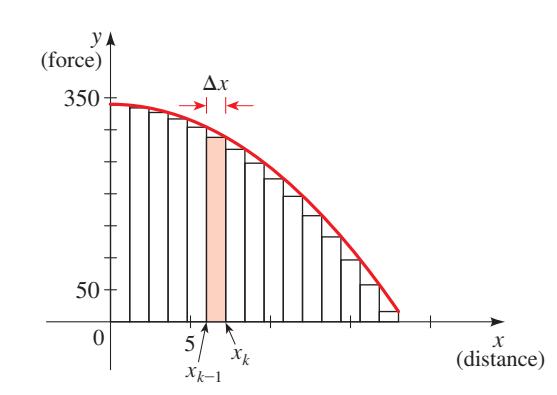
A man pushes a crate along a straight path a distance of 18 ft. At a distance \(x\) from his starting point, he applies a force given by \(f(x) = 340 - x^2\). Find the work done by the man.