Stewart Precalc 6e Section 10.1: Systems of Linear Equations in Two Variables

83 questions

--:--
0 / 83
Stewart Precalc 6e Section 10.1: Systems of Linear Equations in Two Variables 0/83
1 Concept - System of Two Equations · Level 1
The system of equations \(\begin{cases} 2x + 3y = 7 \\ 5x - y = 9 \end{cases}\) is a system of two equations in the two variables ____ and ____. To determine whether \((5, -1)\) is a solution of this system, we check whether \(x = 5\) and \(y = -1\) satisfy each ____ in the system. Which of the following are solutions of this system? \((5, -1)\), \((-1, 3)\), \((2, 1)\).
2 Concept - Solution Methods · Level 1
A system of equations in two variables can be solved by the ____ method, the ____ method, or the graphical method.
3 Concept - Number of Solutions · Level 1
A system of two linear equations in two variables can have one solution, ____ solution, or ____ solutions.
4 Concept - Infinitely Many Solutions · Level 1
The following is a system of two linear equations in two variables. \(\begin{cases} x + y = 1 \\ 2x + 2y = 2 \end{cases}\) The graph of the first equation is the same as the graph of the second equation, so the system has ____ solutions. We express these solutions by writing \(x = t\), \(y = \) ____, where \(t\) is any real number. Some of the solutions of this system are \((1, \) ____\()\), \((-3, \) ____\()\), and \((5, \) ____\()\).
5 Substitution Method · Level 2
Use the substitution method to find all solutions of the system of equations. \(\begin{cases} x - y = 1 \\ 4x + 3y = 18 \end{cases}\)
6 Substitution Method · Level 2
Use the substitution method to find all solutions of the system of equations. \(\begin{cases} 3x + y = 1 \\ 5x + 2y = 1 \end{cases}\)
7 Substitution Method · Level 2
Use the substitution method to find all solutions of the system of equations. \(\begin{cases} x - y = 2 \\ 2x + 3y = 9 \end{cases}\)
8 Substitution Method · Level 2
Use the substitution method to find all solutions of the system of equations. \(\begin{cases} 2x + y = 7 \\ x + 2y = 2 \end{cases}\)
9 Elimination Method · Level 2
Use the elimination method to find all solutions of the system of equations. \(\begin{cases} 3x + 4y = 10 \\ x - 4y = -2 \end{cases}\)
10 Elimination Method · Level 2
Use the elimination method to find all solutions of the system of equations. \(\begin{cases} 2x + 5y = 15 \\ 4x + y = 21 \end{cases}\)
11 Elimination Method · Level 2
Use the elimination method to find all solutions of the system of equations. \(\begin{cases} x + 2y = 5 \\ 2x + 3y = 8 \end{cases}\)
12 Elimination Method · Level 2
Use the elimination method to find all solutions of the system of equations. \(\begin{cases} 4x - 3y = 11 \\ 8x + 4y = 12 \end{cases}\)
13 Graph Intersection · Level 2
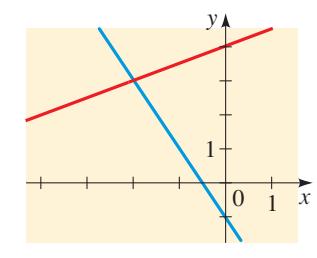
Two equations and their graphs are given (see figure). Find the intersection point(s) of the graphs by solving the system.
question image
14 Graph Intersection · Level 2
Two equations and their graphs are given (see figure). Find the intersection point(s) of the graphs by solving the system.
question image
15 Graph Linear System · Level 2
Graph the linear system, either by hand or using a graphing device. Use the graph to determine whether the system has one solution, no solution, or infinitely many solutions. If there is exactly one solution, use the graph to find it. \(\begin{cases} x - y = 4 \\ 2x + y = 2 \end{cases}\)
16 Graph Linear System · Level 2
Graph the linear system, either by hand or using a graphing device. Use the graph to determine whether the system has one solution, no solution, or infinitely many solutions. If there is exactly one solution, use the graph to find it. \(\begin{cases} 2x - y = 4 \\ 3x + y = 6 \end{cases}\)
17 Graph Linear System · Level 3
Graph the linear system, either by hand or using a graphing device. Use the graph to determine whether the system has one solution, no solution, or infinitely many solutions. If there is exactly one solution, use the graph to find it. \(\begin{cases} 2x - 3y = 12 \\ -x + \dfrac{3}{2} y = 4 \end{cases}\)
18 Graph Linear System · Level 2
Graph the linear system, either by hand or using a graphing device. Use the graph to determine whether the system has one solution, no solution, or infinitely many solutions. If there is exactly one solution, use the graph to find it. \(\begin{cases} 2x + 6y = 0 \\ -3x - 9y = 18 \end{cases}\)
19 Graph Linear System · Level 3
Graph the linear system, either by hand or using a graphing device. Use the graph to determine whether the system has one solution, no solution, or infinitely many solutions. If there is exactly one solution, use the graph to find it. \(\begin{cases} -x + \dfrac{1}{2} y = -5 \\ 2x - y = 10 \end{cases}\)
20 Graph Linear System · Level 3
Graph the linear system, either by hand or using a graphing device. Use the graph to determine whether the system has one solution, no solution, or infinitely many solutions. If there is exactly one solution, use the graph to find it. \(\begin{cases} 12x + 15y = -18 \\ 2x + \dfrac{5}{2} y = -3 \end{cases}\)
21 Solve Linear System · Level 2
Solve the system, or show that it has no solution. If the system has infinitely many solutions, express them in the ordered-pair form given in Example 6. \(\begin{cases} x + y = 4 \\ -x + y = 0 \end{cases}\)
22 Solve Linear System · Level 2
Solve the system, or show that it has no solution. If the system has infinitely many solutions, express them in the ordered-pair form given in Example 6. \(\begin{cases} x - y = 3 \\ x + 3y = 7 \end{cases}\)
23 Solve Linear System · Level 2
Solve the system, or show that it has no solution. If the system has infinitely many solutions, express them in the ordered-pair form given in Example 6. \(\begin{cases} 2x - 3y = 9 \\ 4x + 3y = 9 \end{cases}\)
24 Solve Linear System · Level 2
Solve the system, or show that it has no solution. If the system has infinitely many solutions, express them in the ordered-pair form given in Example 6. \(\begin{cases} 3x + 2y = 0 \\ -x - 2y = 8 \end{cases}\)
25 Solve Linear System · Level 2
Solve the system, or show that it has no solution. If the system has infinitely many solutions, express them in the ordered-pair form given in Example 6. \(\begin{cases} x + 3y = 5 \\ 2x - y = 3 \end{cases}\)
26 Solve Linear System · Level 2
Solve the system, or show that it has no solution. If the system has infinitely many solutions, express them in the ordered-pair form given in Example 6. \(\begin{cases} x + y = 0 \\ 2x - 3y = -1 \end{cases}\)
27 Solve Linear System · Level 2
Solve the system, or show that it has no solution. If the system has infinitely many solutions, express them in the ordered-pair form given in Example 6. \(\begin{cases} -x + y = 2 \\ 4x + 2y = 2 \end{cases}\)
28 Solve Linear System · Level 2
Solve the system, or show that it has no solution. If the system has infinitely many solutions, express them in the ordered-pair form given in Example 6. \(\begin{cases} 4x - 3y = 28 \\ 9x - y = -6 \end{cases}\)
29 Solve Linear System · Level 2
Solve the system, or show that it has no solution. If the system has infinitely many solutions, express them in the ordered-pair form given in Example 6. \(\begin{cases} x + 2y = 7 \\ 5x - y = 2 \end{cases}\)
30 Solve Linear System · Level 2
Solve the system, or show that it has no solution. If the system has infinitely many solutions, express them in the ordered-pair form given in Example 6. \(\begin{cases} -4x + 12y = 0 \\ 12x + 4y = 160 \end{cases}\)
31 Solve Linear System with Fractions · Level 3
Solve the system, or show that it has no solution. If the system has infinitely many solutions, express them in the ordered-pair form given in Example 6. \(\begin{cases} \dfrac{1}{2} x + \dfrac{1}{3} y = 2 \\ \dfrac{1}{2} x - \dfrac{2}{3} y = 8 \end{cases}\)
32 Solve Linear System with Decimals · Level 3
Solve the system, or show that it has no solution. If the system has infinitely many solutions, express them in the ordered-pair form given in Example 6. \(\begin{cases} 0.2 x - 0.2 y = -1.8 \\ -0.3 x + 0.5 y = 3.3 \end{cases}\)
33 Solve Linear System · Level 2
Solve the system, or show that it has no solution. If the system has infinitely many solutions, express them in the ordered-pair form given in Example 6. \(\begin{cases} 3x + 2y = 8 \\ x - 2y = 0 \end{cases}\)
34 Solve Linear System · Level 2
Solve the system, or show that it has no solution. If the system has infinitely many solutions, express them in the ordered-pair form given in Example 6. \(\begin{cases} 4x + 2y = 16 \\ x - 5y = 70 \end{cases}\)
35 Solve Linear System - No Solution · Level 2
Solve the system, or show that it has no solution. If the system has infinitely many solutions, express them in the ordered-pair form given in Example 6. \(\begin{cases} x + 4y = 8 \\ 3x + 12y = 2 \end{cases}\)
36 Solve Linear System - No Solution · Level 2
Solve the system, or show that it has no solution. If the system has infinitely many solutions, express them in the ordered-pair form given in Example 6. \(\begin{cases} -3x + 5y = 2 \\ 9x - 15y = 6 \end{cases}\)
37 Solve Linear System - Infinitely Many · Level 3
Solve the system, or show that it has no solution. If the system has infinitely many solutions, express them in the ordered-pair form given in Example 6. \(\begin{cases} 2x - 6y = 10 \\ -3x + 9y = -15 \end{cases}\)
38 Solve Linear System - No Solution · Level 2
Solve the system, or show that it has no solution. If the system has infinitely many solutions, express them in the ordered-pair form given in Example 6. \(\begin{cases} 2x - 3y = -8 \\ 14x - 21y = -3 \end{cases}\)
39 Exercise - Linear System (Elimination) · Level 2
Use the elimination method to find all solutions of the system. \(\begin{cases} 6x + 4y = 12 \\ 9x + 6y = 18 \end{cases}\)
40 Exercise - Linear System (Elimination) · Level 2
Use the elimination method to find all solutions of the system. \(\begin{cases} 25x - 75y = 100 \\ -10x + 30y = -40 \end{cases}\)
41 Exercise - Linear System (Elimination) · Level 2
Use the elimination method to find all solutions of the system. \(\begin{cases} 8s - 3t = -3 \\ 5s - 2t = -1 \end{cases}\)
42 Exercise - Linear System (Elimination) · Level 2
Use the elimination method to find all solutions of the system. \(\begin{cases} u - 30v = -5 \\ -3u + 80v = 5 \end{cases}\)
43 Exercise - Linear System (Elimination) · Level 2
Use the elimination method to find all solutions of the system. \(\begin{cases} \dfrac{1}{2} x + \dfrac{3}{5} y = 3 \\ \dfrac{5}{3} x + 2 y = 10 \end{cases}\)
44 Exercise - Linear System (Elimination) · Level 3
Use the elimination method to find all solutions of the system. \(\begin{cases} \dfrac{3}{2} x - \dfrac{1}{3} y = \dfrac{1}{2} \\ 2 x - \dfrac{1}{2} y = -\dfrac{1}{2} \end{cases}\)
45 Exercise - Linear System (Elimination) · Level 2
Use the elimination method to find all solutions of the system. \(\begin{cases} 0.4 x + 1.2 y = 14 \\ 12 x - 5 y = 10 \end{cases}\)
46 Exercise - Linear System (Elimination) · Level 2
Use the elimination method to find all solutions of the system. \(\begin{cases} 26 x - 10 y = -4 \\ -0.6 x + 1.2 y = 3 \end{cases}\)
47 Exercise - Linear System (Elimination) · Level 2
Use the elimination method to find all solutions of the system. \(\begin{cases} \dfrac{1}{3} x - \dfrac{1}{4} y = 2 \\ -8 x + 6 y = 10 \end{cases}\)
48 Exercise - Linear System (Elimination) · Level 2
Use the elimination method to find all solutions of the system. \(\begin{cases} -\dfrac{1}{10} x + \dfrac{1}{2} y = 4 \\ 2 x - 10 y = -80 \end{cases}\)
49 Exercise - Graphing Device · Level 2
Use a graphing device to graph both lines in the same viewing rectangle. Solve the system rounded to two decimal places. \(\begin{cases} 0.21 x + 3.17 y = 9.51 \\ 2.35 x - 1.17 y = 5.89 \end{cases}\)
50 Exercise - Graphing Device · Level 2
Use a graphing device to graph both lines in the same viewing rectangle. Solve the system rounded to two decimal places. \(\begin{cases} 18.72 x - 14.91 y = 12.33 \\ 6.21 x - 12.92 y = 17.82 \end{cases}\)
51 Exercise - Graphing Device · Level 3
Use a graphing device to graph both lines in the same viewing rectangle. Solve the system rounded to two decimal places. \(\begin{cases} 2371 x - 6552 y = 13591 \\ 9815 x + 992 y = 618555 \end{cases}\)
52 Exercise - Graphing Device · Level 2
Use a graphing device to graph both lines in the same viewing rectangle. Solve the system rounded to two decimal places. \(\begin{cases} -435 x + 912 y = 0 \\ 132 x + 455 y = 994 \end{cases}\)
53 Exercise - Parameter System · Level 3
Find \(x\) and \(y\) in terms of \(a\) and \(b\), where \(a \neq 1\). \(\begin{cases} x + y = 0 \\ x + a y = 1 \end{cases}\)
54 Exercise - Parameter System · Level 3
Find \(x\) and \(y\) in terms of \(a\) and \(b\), where \(a \neq b\). \(\begin{cases} a x + b y = 0 \\ x + y = 1 \end{cases}\)
55 Exercise - Parameter System · Level 3
Find \(x\) and \(y\) in terms of \(a\) and \(b\), where \(a^2 - b^2 \neq 0\). \(\begin{cases} a x + b y = 1 \\ b x + a y = 1 \end{cases}\)
56 Exercise - Parameter System · Level 4
Find \(x\) and \(y\) in terms of \(a\) and \(b\), where \(a \neq 0\), \(b \neq 0\), and \(a \neq b\). \(\begin{cases} a x + b y = 0 \\ a^2 x + b^2 y = 1 \end{cases}\)
57 Application - Number Problem · Level 2
Find two numbers whose sum is \(34\) and whose difference is \(10\).
58 Application - Number Problem · Level 3
The sum of two numbers is twice their difference. The larger number is \(6\) more than twice the smaller. Find the numbers.
59 Application - Value of Coins · Level 2
A man has \(14\) coins in his pocket, all of which are dimes and quarters. If the total value of his change is \$2.75, how many dimes and how many quarters does he have?
60 Application - Admission Fees · Level 3
The admission fee at an amusement park is \$1.50 for children and \$4.00 for adults. On a certain day, \(2200\) people entered the park, and the admission fees that were collected totaled \$5050. How many children and how many adults were admitted?
61 Application - Gas Station · Level 3
A gas station sells regular gas for \$2.20 per gallon and premium gas for \$3.00 a gallon. At the end of a business day \(280\) gallons of gas were sold, and receipts totaled \$680. How many gallons of each type of gas were sold?
62 Application - Fruit Stand · Level 3
A fruit stand sells two varieties of strawberries: standard and deluxe. A box of standard strawberries sells for \$7, and a box of deluxe strawberries sells for \$10. In one day the stand sells \(135\) boxes of strawberries for a total of \$1110. How many boxes of each type were sold?
63 Application - Airplane Speed · Level 3
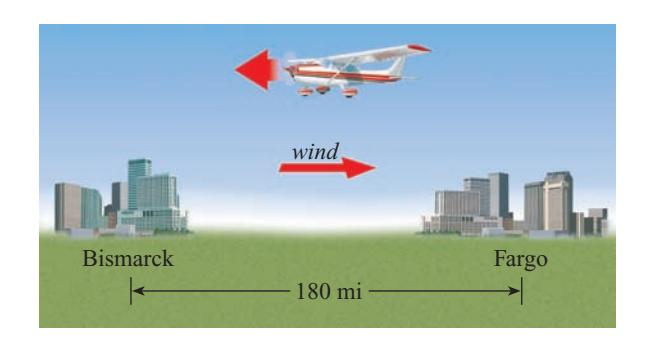
A man flies a small airplane from Fargo to Bismarck, North Dakota — a distance of \(180\) mi. Because he is flying into a head wind, the trip takes him \(2\) hours. On the way back, the wind is still blowing at the same speed, so the return trip takes only \(1\) h \(12\) min. What is his speed in still air, and how fast is the wind blowing?
question image
64 Application - Boat Speed · Level 3
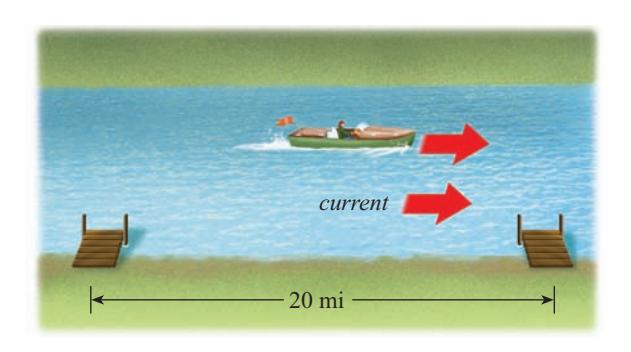
A boat on a river travels downstream between two points, \(20\) mi apart, in one hour. The return trip against the current takes \(2.5\) hours. What is the boat's speed, and how fast does the current in the river flow?
question image
65 Application - Nutrition · Level 4
A researcher performs an experiment to test a hypothesis that involves the nutrients niacin and retinol. She feeds one group of laboratory rats a daily diet of precisely \(32\) units of niacin and \(22{,}000\) units of retinol. She uses two types of commercial pellet foods. Food A contains \(0.12\) unit of niacin and \(100\) units of retinol per gram. Food B contains \(0.20\) unit of niacin and \(50\) units of retinol per gram. How many grams of each food does she feed this group of rats each day?
66 Application - Coffee Blends · Level 3
A customer in a coffee shop purchases a blend of two coffees: Kenyan, costing \$3.50 a pound, and Sri Lankan, costing \$5.60 a pound. He buys \(3\) lb of the blend, which costs him \$11.55. How many pounds of each kind went into the mixture?
67 Application - Mixture Problem · Level 3
A chemist has two large containers of sulfuric acid solution, with different concentrations of acid in each container. Blending \(300\) mL of the first solution and \(600\) mL of the second gives a mixture that is \(15%\) acid, whereas blending \(100\) mL of the first with \(500\) mL of the second gives a \(12.5%\) acid mixture. What are the concentrations of sulfuric acid in the original containers?
68 Application - Mixture Problem · Level 3
A biologist has two brine solutions, one containing \(5%\) salt and another containing \(20%\) salt. How many milliliters of each solution should she mix to obtain \(1\) L of a solution that contains \(14%\) salt?
69 Application - Investments · Level 3
A woman invests a total of \$20{,}000 in two accounts, one paying \(5%\) and the other paying \(8%\) simple interest per year. Her annual interest is \$1180. How much did she invest at each rate?
70 Application - Investments · Level 3
A man invests his savings in two accounts, one paying \(6%\) and the other paying \(10%\) simple interest per year. He puts twice as much in the lower-yielding account because it is less risky. His annual interest is \$3520. How much did he invest at each rate?
71 Application - Distance/Speed/Time · Level 3
John and Mary leave their house at the same time and drive in opposite directions. John drives at \(60\) mi/h and travels \(35\) mi farther than Mary, who drives at \(40\) mi/h. Mary's trip takes \(15\) min longer than John's. For what length of time does each of them drive?
72 Application - Aerobic Exercise · Level 3
A woman keeps fit by bicycling and running every day. On Monday she spends \(\dfrac{1}{2}\) hour at each activity, covering a total of \(12.5\) mi. On Tuesday she runs for \(12\) min and cycles for \(45\) min, covering a total of \(16\) mi. Assuming that her running and cycling speeds don't change from day to day, find these speeds.
73 Application - Number Problem · Level 3
The sum of the digits of a two-digit number is \(7\). When the digits are reversed, the number is increased by \(27\). Find the number.
74 Application - Area of Triangle · Level 3
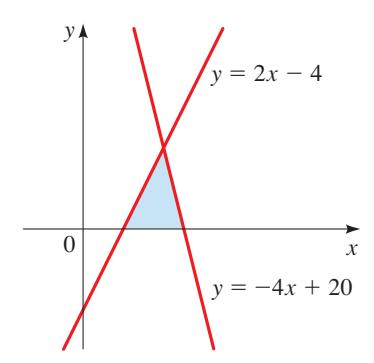
Find the area of the triangle that lies in the first quadrant (with its base on the \(x\)-axis) and that is bounded by the lines \(y = 2 x - 4\) and \(y = -4 x + 20\).
question image
75 Discovery - Least Squares Line · Level 4
The least squares line (regression line) is the line \(y = a x + b\) that best fits a set of \(n\) data points \((x_1, y_1), (x_2, y_2), \ldots, (x_n, y_n)\). Using calculus, it can be shown that the coefficients \(a\) and \(b\) satisfy the normal equations \( (\displaystyle\sum_{k=1}^{n} x_k) a + n b = \displaystyle\sum_{k=1}^{n} y_k \) and \( (\displaystyle\sum_{k=1}^{n} x_k^2) a + (\displaystyle\sum_{k=1}^{n} x_k) b = \displaystyle\sum_{k=1}^{n} x_k y_k. \) Use these equations to find the least squares line for a given set of data points, then sketch the points and your line to confirm that the line fits the data well.
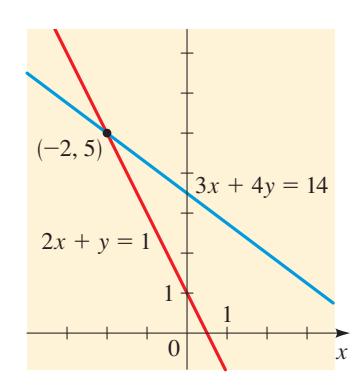
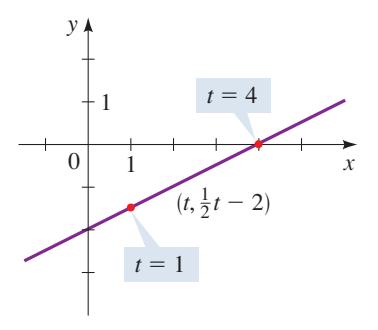
76 Example - Substitution Method · Level 2
Find all solutions of the system using the substitution method. \(\begin{cases} 2x + y = 1 \\ 3x + 4y = 14 \end{cases}\)
question image
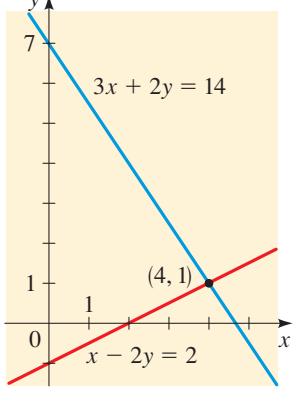
77 Example - Elimination Method · Level 2
Find all solutions of the system using the elimination method. \(\begin{cases} 3x + 2y = 14 \\ x - 2y = 2 \end{cases}\)
question image
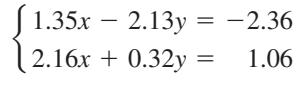
78 Example - Graphical Method · Level 2
Find all solutions of the system shown using the graphical method (use a graphing device).
question image
79 Example - A Linear System with One Solution · Level 2
Solve the system and graph the lines. \(\begin{cases} 3x - y = 0 \\ 5x + 2y = 22 \end{cases}\)
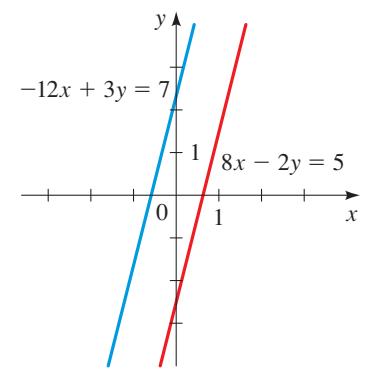
80 Example - Linear System with No Solution · Level 2
Solve the system. \(\begin{cases} 8x - 2y = 5 \\ -12x + 3y = 7 \end{cases}\)
question image
81 Example - Linear System with Infinitely Many Solutions · Level 2
Solve the system. \(\begin{cases} 3x - 6y = 12 \\ 4x - 8y = 16 \end{cases}\)
question image
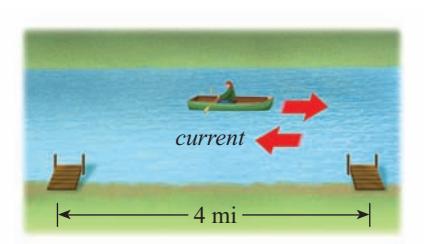
82 Example - Distance-Speed-Time Problem · Level 3
A woman rows a boat upstream from one point on a river to another point \(4\) mi away in \(\dfrac{3}{2}\) hours. The return trip, traveling with the current, takes only \(45\) min. How fast does she row relative to the water, and at what speed is the current flowing?
question image
83 Example - Mixture Problem · Level 3
A vintner fortifies wine that contains \(10%\) alcohol by adding a \(70%\) alcohol solution to it. The resulting mixture has an alcoholic strength of \(16%\) and fills \(1000\) one-liter bottles. How many liters (L) of the wine and of the alcohol solution does the vintner use?

Answered: 0 / 83