Stewart Precalc 6e Section 9.4: Vectors in Three Dimensions

59 questions

--:--
0 / 59
Stewart Precalc 6e Section 9.4: Vectors in Three Dimensions 0/59
1 Exercise - Concepts · Level 1
A vector in three dimensions can be written in either of two forms: in coordinate form as \(\mathbf{a} = \langle a_1, a_2, a_3 \rangle\) and in terms of the _____ vectors \(\mathbf{i}\), \(\mathbf{j}\), and \(\mathbf{k}\) as \(\mathbf{a} = \) _____. The magnitude of the vector \(\mathbf{a}\) is \(|\mathbf{a}| = \) _____. So \(\langle 4, -2, 4 \rangle = \) ___ \(\mathbf{i} + \) ___ \(\mathbf{j} + \) ___ \(\mathbf{k}\) and \(7 \mathbf{j} - 24 \mathbf{k} = \langle \) ___, ___, ___ \(\rangle\).
2 Exercise - Concepts · Level 1
The angle \(\theta\) between the vectors \(\mathbf{u}\) and \(\mathbf{v}\) satisfies \(\cos \theta = \) _____. So if \(\mathbf{u}\) and \(\mathbf{v}\) are perpendicular, then \(\mathbf{u} \cdot \mathbf{v} = \) _____. If \(\mathbf{u} = \langle 4, 5, 6 \rangle\) and \(\mathbf{v} = \langle 3, 0, -2 \rangle\) then \(\mathbf{u} \cdot \mathbf{v} = \) _____, so \(\mathbf{u}\) and \(\mathbf{v}\) are _____.
3 Exercise - Find Vector from Initial and Terminal Points · Level 1
Find the vector \(\mathbf{v}\) with initial point \(P\) and terminal point \(Q\). \(P(1, -1, 0)\), \(Q(0, -2, 5)\)
4 Exercise - Find Vector from Initial and Terminal Points · Level 1
Find the vector \(\mathbf{v}\) with initial point \(P\) and terminal point \(Q\). \(P(1, 2, -1)\), \(Q(3, -1, 2)\)
5 Exercise - Find Vector from Initial and Terminal Points · Level 1
Find the vector \(\mathbf{v}\) with initial point \(P\) and terminal point \(Q\). \(P(6, -1, 0)\), \(Q(0, -3, 0)\)
6 Exercise - Find Vector from Initial and Terminal Points · Level 1
Find the vector \(\mathbf{v}\) with initial point \(P\) and terminal point \(Q\). \(P(1, -1, -1)\), \(Q(0, 0, -1)\)
7 Exercise - Find Terminal Point · Level 1
If the vector \(\mathbf{v}\) has initial point \(P\), what is its terminal point? \(\mathbf{v} = \langle 3, 4, -2 \rangle\), \(P(2, 0, 1)\)
8 Exercise - Find Terminal Point · Level 1
If the vector \(\mathbf{v}\) has initial point \(P\), what is its terminal point? \(\mathbf{v} = \langle 0, 0, 1 \rangle\), \(P(0, 1, -1)\)
9 Exercise - Find Terminal Point · Level 1
If the vector \(\mathbf{v}\) has initial point \(P\), what is its terminal point? \(\mathbf{v} = \langle -2, 0, 2 \rangle\), \(P(3, 0, -3)\)
10 Exercise - Find Terminal Point · Level 1
If the vector \(\mathbf{v}\) has initial point \(P\), what is its terminal point? \(\mathbf{v} = \langle 23, -5, 12 \rangle\), \(P(-6, 4, 2)\)
11 Exercise - Magnitude of Vector · Level 1
Find the magnitude of the given vector. \(\langle -2, 1, 2 \rangle\)
12 Exercise - Magnitude of Vector · Level 1
Find the magnitude of the given vector. \(\langle 5, 0, -12 \rangle\)
13 Exercise - Magnitude of Vector · Level 1
Find the magnitude of the given vector. \(\langle 3, 5, -4 \rangle\)
14 Exercise - Magnitude of Vector · Level 1
Find the magnitude of the given vector. \(\langle 1, -6, 2 \sqrt{2} \rangle\)
15 Exercise - Vector Operations · Level 2
Find the vectors \(\mathbf{u} + \mathbf{v}\), \(\mathbf{u} - \mathbf{v}\), and \(3 \mathbf{u} - \dfrac{1}{2} \mathbf{v}\). \(\mathbf{u} = \langle 2, -7, 3 \rangle\), \(\mathbf{v} = \langle 0, 4, -1 \rangle\)
16 Exercise - Vector Operations · Level 2
Find the vectors \(\mathbf{u} + \mathbf{v}\), \(\mathbf{u} - \mathbf{v}\), and \(3 \mathbf{u} - \dfrac{1}{2} \mathbf{v}\). \(\mathbf{u} = \langle 0, 1, -3 \rangle\), \(\mathbf{v} = \langle 4, 2, 0 \rangle\)
17 Exercise - Vector Operations · Level 2
Find the vectors \(\mathbf{u} + \mathbf{v}\), \(\mathbf{u} - \mathbf{v}\), and \(3 \mathbf{u} - \dfrac{1}{2} \mathbf{v}\). \(\mathbf{u} = \mathbf{i} + \mathbf{j}\), \(\mathbf{v} = - \mathbf{j} - 2 \mathbf{k}\)
18 Exercise - Vector Operations · Level 2
Find the vectors \(\mathbf{u} + \mathbf{v}\), \(\mathbf{u} - \mathbf{v}\), and \(3 \mathbf{u} - \dfrac{1}{2} \mathbf{v}\). \(\mathbf{u} = \langle a, 2 b, 3 c \rangle\), \(\mathbf{v} = \langle -4 a, b, -2 c \rangle\)
19 Vectors in component form · Level 1
Express the given vector in terms of the unit vectors \(\mathbf{i}\), \(\mathbf{j}\), and \(\mathbf{k}\). \(\langle 12, 0, 2 \rangle\)
20 Vectors in component form · Level 1
Express the given vector in terms of the unit vectors \(\mathbf{i}\), \(\mathbf{j}\), and \(\mathbf{k}\). \(\langle 0, -3, 5 \rangle\)
21 Vectors in component form · Level 1
Express the given vector in terms of the unit vectors \(\mathbf{i}\), \(\mathbf{j}\), and \(\mathbf{k}\). \(\langle 3, -3, 0 \rangle\)
22 Vectors in component form · Level 2
Express the given vector in terms of the unit vectors \(\mathbf{i}\), \(\mathbf{j}\), and \(\mathbf{k}\). \(\langle -a, \dfrac{1}{3} a, 4 \rangle\)
23 Vector linear combinations · Level 2
Two vectors \(\mathbf{u}\) and \(\mathbf{v}\) are given. Express the vector \(-2 \mathbf{u} + 3 \mathbf{v}\) (a) in component form \(\langle a_1, a_2, a_3 \rangle\) and (b) in terms of the unit vectors \(\mathbf{i}\), \(\mathbf{j}\), and \(\mathbf{k}\). \(\mathbf{u} = \langle 0, -2, 1 \rangle\), \(\mathbf{v} = \langle 1, -1, 0 \rangle\)
24 Vector linear combinations · Level 2
Two vectors \(\mathbf{u}\) and \(\mathbf{v}\) are given. Express the vector \(-2 \mathbf{u} + 3 \mathbf{v}\) (a) in component form \(\langle a_1, a_2, a_3 \rangle\) and (b) in terms of the unit vectors \(\mathbf{i}\), \(\mathbf{j}\), and \(\mathbf{k}\). \(\mathbf{u} = \langle 3, 1, 0 \rangle\), \(\mathbf{v} = \langle 3, 0, -5 \rangle\)
25 Dot product · Level 2
Two vectors \(\mathbf{u}\) and \(\mathbf{v}\) are given. Find their dot product. \(\mathbf{u} = \langle 2, 5, 0 \rangle\), \(\mathbf{v} = \langle \dfrac{1}{2}, -1, 10 \rangle\)
26 Dot product · Level 2
Two vectors \(\mathbf{u}\) and \(\mathbf{v}\) are given. Find their dot product. \(\mathbf{u} = \langle -3, 0, 4 \rangle\), \(\mathbf{v} = \langle 2, 4, \dfrac{1}{2} \rangle\)
27 Dot product · Level 2
Two vectors \(\mathbf{u}\) and \(\mathbf{v}\) are given. Find their dot product. \(\mathbf{u} = 6 \mathbf{i} - 4 \mathbf{j} - 2 \mathbf{k}\), \(\mathbf{v} = \dfrac{5}{6} \mathbf{i} + \dfrac{3}{2} \mathbf{j} - \mathbf{k}\)
28 Dot product · Level 2
Two vectors \(\mathbf{u}\) and \(\mathbf{v}\) are given. Find their dot product. \(\mathbf{u} = 3 \mathbf{j} - 2 \mathbf{k}\), \(\mathbf{v} = \dfrac{5}{6} \mathbf{i} - \dfrac{5}{3} \mathbf{j}\)
29 Perpendicular vectors · Level 2
Determine whether or not the given vectors are perpendicular. \(\langle 4, -2, -4 \rangle\), \(\langle 1, -2, 2 \rangle\)
30 Perpendicular vectors · Level 2
Determine whether or not the given vectors are perpendicular. \(4 \mathbf{j} - \mathbf{k}\), \(\mathbf{i} + 2 \mathbf{j} + 9 \mathbf{k}\)
31 Perpendicular vectors · Level 2
Determine whether or not the given vectors are perpendicular. \(\langle 0.3, 1.2, -0.9 \rangle\), \(\langle 10, -5, 10 \rangle\)
32 Perpendicular vectors · Level 2
Determine whether or not the given vectors are perpendicular. \(\langle x, -2x, 3x \rangle\), \(\langle 5, 7, 3 \rangle\)
33 Angle between vectors · Level 3
Two vectors \(\mathbf{u}\) and \(\mathbf{v}\) are given. Find the angle (expressed in degrees) between \(\mathbf{u}\) and \(\mathbf{v}\). \(\mathbf{u} = \langle 2, -2, -1 \rangle\), \(\mathbf{v} = \langle 1, 2, 2 \rangle\)
34 Angle between vectors · Level 3
Two vectors \(\mathbf{u}\) and \(\mathbf{v}\) are given. Find the angle (expressed in degrees) between \(\mathbf{u}\) and \(\mathbf{v}\). \(\mathbf{u} = \langle 4, 0, 2 \rangle\), \(\mathbf{v} = \langle 2, -1, 0 \rangle\)
35 Angle between vectors · Level 3
Two vectors \(\mathbf{u}\) and \(\mathbf{v}\) are given. Find the angle (expressed in degrees) between \(\mathbf{u}\) and \(\mathbf{v}\). \(\mathbf{u} = \mathbf{j} + \mathbf{k}\), \(\mathbf{v} = \mathbf{i} + 2 \mathbf{j} - 3 \mathbf{k}\)
36 Angle between vectors · Level 3
Two vectors \(\mathbf{u}\) and \(\mathbf{v}\) are given. Find the angle (expressed in degrees) between \(\mathbf{u}\) and \(\mathbf{v}\). \(\mathbf{u} = \mathbf{i} + 2 \mathbf{j} - 2 \mathbf{k}\), \(\mathbf{v} = 4 \mathbf{i} - 3 \mathbf{k}\)
37 Direction angles · Level 3
Find the direction angles of the given vector, rounded to the nearest degree. \(3 \mathbf{i} + 4 \mathbf{j} + 5 \mathbf{k}\)
38 Direction angles · Level 3
Find the direction angles of the given vector, rounded to the nearest degree. \(\mathbf{i} - 2 \mathbf{j} - \mathbf{k}\)
39 Direction angles · Level 3
Find the direction angles of the given vector, rounded to the nearest degree. \(\langle 2, 3, -6 \rangle\)
40 Direction angles · Level 3
Find the direction angles of the given vector, rounded to the nearest degree. \(\langle 2, -1, 2 \rangle\)
41 Finding the third direction angle · Level 3
Two direction angles of a vector are given. Find the third direction angle, given that it is either obtuse or acute as indicated. \(\alpha = \dfrac{\pi}{3}\), \(\gamma = (2 \pi)/3\); \(\beta\) is acute
42 Finding the third direction angle · Level 3
Two direction angles of a vector are given. Find the third direction angle, given that it is either obtuse or acute as indicated. \(\beta = (2 \pi)/3\), \(\gamma = \dfrac{\pi}{4}\); \(\alpha\) is acute
43 Finding the third direction angle · Level 3
Two direction angles of a vector are given. Find the third direction angle, given that it is either obtuse or acute as indicated. \(\alpha = 60^{\circ}\), \(\beta = 50^{\circ}\); \(\gamma\) is obtuse
44 Finding the third direction angle · Level 3
Two direction angles of a vector are given. Find the third direction angle, given that it is either obtuse or acute as indicated. \(\alpha = 75^{\circ}, \gamma = 15^{\circ}\)
45 Impossible direction angles · Level 3
Explain why it is impossible for a vector to have the given direction angles. \(\alpha = 20^{\circ}, \beta = 45^{\circ}\)
46 Impossible direction angles · Level 3
Explain why it is impossible for a vector to have the given direction angles. \(\alpha = 150^{\circ}, \gamma = 25^{\circ}\)
47 Application - Resultant of four forces · Level 3
Resultant of Four Forces. An object located at the origin in a three-dimensional coordinate system is held in equilibrium by four forces. One has magnitude 7 lb and points in the direction of the positive \(x\)-axis, so it is represented by the vector \(7 \mathbf{i}\). The second has magnitude 24 lb and points in the direction of the positive \(y\)-axis. The third has magnitude 25 lb and points in the direction of the negative \(z\)-axis.
(a) Use the fact that the four forces are in equilibrium (that is, their sum is \(\mathbf{0}\)) to find the fourth force. Express it in terms of the unit vectors \(\mathbf{i}\), \(\mathbf{j}\), and \(\mathbf{k}\).
(b) What is the magnitude of the fourth force?

Enter your answer directly below each part above.

48 Application - Tetrahedron central angle · Level 4
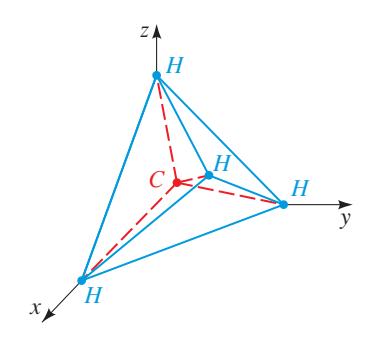
Central Angle of a Tetrahedron. A tetrahedron is a solid with four triangular faces, four vertices, and six edges, as shown in the figure. In a regular tetrahedron, the edges are all of the same length. Consider the tetrahedron with vertices \(A(1, 0, 0)\), \(B(0, 1, 0)\), \(C(0, 0, 1)\), and \(D(1, 1, 1)\).
question image
(a) Show that the tetrahedron is regular.
(b) The center of the tetrahedron is the point \(E\left(\dfrac{1}{2}, \dfrac{1}{2}, \dfrac{1}{2}\right)\) (the "average" of the vertices). Find the angle between the vectors that join the center to any two of the vertices (for instance, \(\angle \text{AEB}\)). This angle is called the central angle of the tetrahedron.

Enter your answer directly below each part above.

49 Discovery - Parallel vectors · Level 3
Parallel Vectors. Two nonzero vectors are parallel if they point in the same direction or in opposite directions. This means that if two vectors are parallel, one must be a scalar multiple of the other. Determine whether the given vectors \(\mathbf{u}\) and \(\mathbf{v}\) are parallel. If they are, express \(\mathbf{v}\) as a scalar multiple of \(\mathbf{u}\).
(a) \(\mathbf{u} = \langle 3, -2, 4 \rangle\), \(\mathbf{v} = \langle -6, 4, -8 \rangle\)
(b) \(\mathbf{u} = \langle -9, -6, 12 \rangle\), \(\mathbf{v} = \langle 12, 8, -16 \rangle\)
(c) \(\mathbf{u} = \mathbf{i} + \mathbf{j} + \mathbf{k}\), \(\mathbf{v} = 2 \mathbf{i} + 2 \mathbf{j} - 2 \mathbf{k}\)

Enter your answer directly below each part above.

50 Discovery - Unit vectors · Level 3
Unit Vectors. A unit vector is a vector of magnitude 1. Multiplying a vector by a scalar changes its magnitude but not its direction.
(a) If a vector \(\mathbf{v}\) has magnitude \(m\), what scalar multiple of \(\mathbf{v}\) has magnitude 1 (i.e., is a unit vector)?
(b) Find a unit vector having the same direction as each of the following vectors: \(\langle 1, -2, 2 \rangle\), \(\langle -6, 8, -10 \rangle\), \(\langle 6, 5, 9 \rangle\)

Enter your answer directly below each part above.

51 Discovery - Vector equation of a sphere · Level 4
Vector Equation of a Sphere. Let \(\mathbf{a} = \langle 2, 2, 2 \rangle\), \(\mathbf{b} = \langle -2, -2, 0 \rangle\), and \(\mathbf{r} = \langle x, y, z \rangle\).
(a) Show that the vector equation \((\mathbf{r} - \mathbf{a}) \cdot (\mathbf{r} - \mathbf{b}) = 0\) represents a sphere, by expanding the dot product and simplifying the resulting algebraic equation.
(b) Find the center and radius of the sphere.
(c) Interpret the result of part (a) geometrically, using the fact that the dot product of two vectors is 0 only if the vectors are perpendicular. [Hint: Draw a diagram showing the endpoints of the vectors \(\mathbf{a}\), \(\mathbf{b}\), and \(\mathbf{r}\), noting that the endpoints of \(\mathbf{a}\) and \(\mathbf{b}\) are the endpoints of a diameter and the endpoint of \(\mathbf{r}\) is an arbitrary point on the sphere.]
(d) Using your observations from part (a), find a vector equation for the sphere in which the points \((0, 1, 3)\) and \((2, -1, 4)\) form the endpoints of a diameter. Simplify the vector equation to obtain an algebraic equation for the sphere. What are its center and radius?

Enter your answer directly below each part above.

52 Example - Component Form of a Vector · Level 2
question image
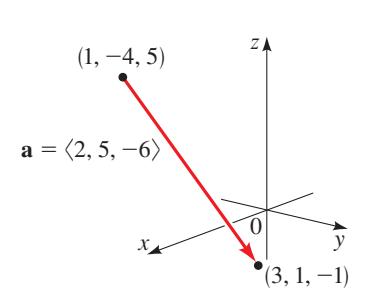
(a) Find the components of the vector \(\mathbf{a}\) with initial point \(P(1, -4, 5)\) and terminal point \(Q(3, 1, -1)\).
(b) If the vector \(\mathbf{b} = \langle -2, 1, 3 \rangle\) has initial point \((2, 1, -1)\), what is its terminal point?

Enter your answer directly below each part above.

53 Example - Magnitude of Vectors in Three Dimensions · Level 1
Find the magnitude of the given vector. (a) \(\mathbf{u} = \langle 3, 2, 5 \rangle\) (b) \(\mathbf{v} = \langle 0, 3, -1 \rangle\) (c) \(\mathbf{w} = \langle 0, 0, -1 \rangle\)
54 Example - Operations with Three-Dimensional Vectors · Level 1
If \(\mathbf{u} = \langle 1, -2, 4 \rangle\) and \(\mathbf{v} = \langle 6, -1, 1 \rangle\), find \(\mathbf{u} + \mathbf{v}\), \(\mathbf{u} - \mathbf{v}\), and \(5 \mathbf{u} - 3 \mathbf{v}\).
55 Example - Vectors in Terms of i, j, and k · Level 2
(a) Write the vector \(\mathbf{u} = \langle 5, -3, 6 \rangle\) in terms of \(\mathbf{i}\), \(\mathbf{j}\), and \(\mathbf{k}\). (b) If \(\mathbf{u} = \mathbf{i} + 2 \mathbf{j} - 3 \mathbf{k}\) and \(\mathbf{v} = 4 \mathbf{i} + 7 \mathbf{k}\), express the vector \(2 \mathbf{u} + 3 \mathbf{v}\) in terms of \(\mathbf{i}\), \(\mathbf{j}\), and \(\mathbf{k}\).
56 Example - Calculating Dot Products for Vectors in Three Dimensions · Level 2
Find the given dot product. (a) \(\langle -1, 2, 3 \rangle \cdot \langle 6, 5, -1 \rangle\) (b) \((2 \mathbf{i} - 3 \mathbf{j} - \mathbf{k}) \cdot (- \mathbf{i} + 2 \mathbf{j} + 8 \mathbf{k})\)
57 Example - Checking Vectors for Perpendicularity · Level 2
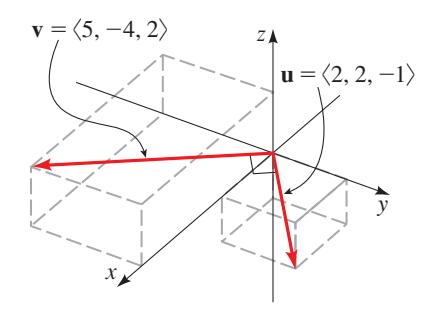
Show that the vector \(\mathbf{u} = 2 \mathbf{i} + 2 \mathbf{j} - \mathbf{k}\) is perpendicular to \(5 \mathbf{i} - 4 \mathbf{j} + 2 \mathbf{k}\).
question image
58 Example - Finding the Direction Angles of a Vector · Level 3
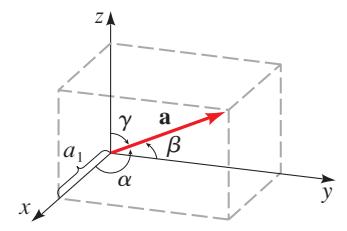
Find the direction angles of the vector \(\mathbf{a} = \mathbf{i} + 2 \mathbf{j} + 3 \mathbf{k}\).
question image
59 Example - Finding the Direction Angles of a Vector · Level 3
A vector makes an angle \(\alpha = \dfrac{\pi}{3}\) with the positive \(x\)-axis and an angle \(\beta = 3 \dfrac{\pi}{4}\) with the positive \(y\)-axis. Find the angle \(\gamma\) that the vector makes with the positive \(z\)-axis, given that \(\gamma\) is an obtuse angle.

Answered: 0 / 59