Stewart 9e Section 1.2: Mathematical Models: A Catalog of Essential Functions

43 questions

--:--
0 / 43
Stewart 9e Section 1.2: Mathematical Models: A Catalog of Essential Functions 0/43
1 Function Classification · Level 1
Classify each function as a power function, root function, polynomial (state its degree), rational function, algebraic function, trigonometric function, exponential function, or logarithmic function.
(a) \(f(x) = x^3 + 3 x^2\)
(b) \(g(t) = (\cos t)^2 - \sin t\)
(c) \(r(t) = t^{\sqrt{3}}\)
(d) \(v(t) = 8^t\)
(e) \(y = \dfrac{\sqrt{x}}{x^2 + 1}\)
(f) \(g(u) = \log_{10} u\)

Enter your answer directly below each part above.

2 Function Classification · Level 1
Classify each function as a power function, root function, polynomial (state its degree), rational function, algebraic function, trigonometric function, exponential function, or logarithmic function.
(a) \(f(t) = (3 t^2 + 2)/t\)
(b) \(h(r) = 2.3^r\)
(c) \(s(t) = \sqrt{t + 4}\)
(e) \(g(x) = \sqrt[3]{x}\)
(f) \(y = 1/x^2\)

Enter your answer directly below each part above.

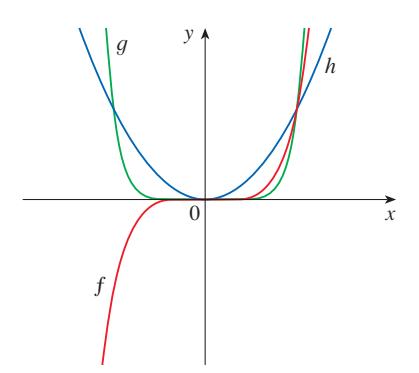
3 Match Equation to Graph · Level 1
Match each equation with its graph. Explain your choices. (Don't use a computer or graphing calculator.)
question image
(a) \(y = x^2\)
(b) \(y = x^5\)
(c) \(y = x^8\)

Enter your answer directly below each part above.

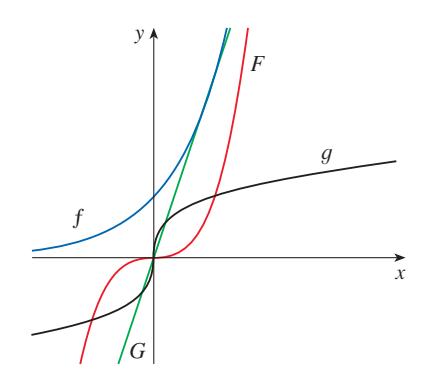
4 Match Equation to Graph · Level 1
Match each equation with its graph. Explain your choices. (Don't use a computer or graphing calculator.)
question image
(a) \(y = 3 x\)
(b) \(y = 3^x\)
(c) \(y = x^3\)
(d) \(y = \sqrt[3]{x}\)

Enter your answer directly below each part above.

5 Domain (Trigonometric) · Level 2
Find the domain of the function \(f(x) = \dfrac{\cos x}{1 - \sin x}\).
6 Domain (Trigonometric) · Level 2
Find the domain of the function \(g(x) = 1/(1 - \tan x)\).
7 Families of Linear Functions · Level 2
(a) Find an equation for the family of linear functions with slope 2 and sketch several members of the family.
(b) Find an equation for the family of linear functions such that \(f(2) = 1\). Sketch several members of the family.
(c) Which function belongs to both families?

Enter your answer directly below each part above.

8 Families of Linear Functions · Level 1
What do all members of the family of linear functions \(f(x) = 1 + m(x + 3)\) have in common? Sketch several members of the family.
9 Families of Linear Functions · Level 1
What do all members of the family of linear functions \(f(x) = c - x\) have in common? Sketch several members of the family.
10 Families of Polynomials · Level 2
Sketch several members of the family of polynomials \(P(x) = x^3 - c x^2\). How does the graph change when \(c\) changes?
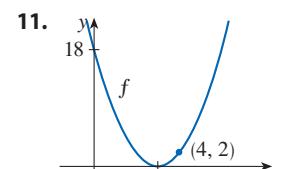
11 Quadratic from Graph · Level 2
Find a formula for the quadratic function whose graph is shown.
question image
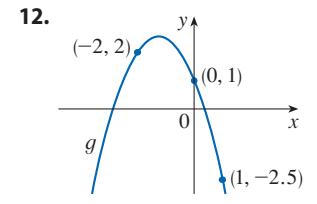
12 Quadratic from Graph · Level 2
Find a formula for the quadratic function whose graph is shown.
question image
13 Cubic Function from Conditions · Level 2
Find a formula for a cubic function \(f\) if \(f(1) = 6\) and \(f(-1) = f(0) = f(2) = 0\).
14 Linear Model (Global Temperature) · Level 2
Recent studies indicate that the average surface temperature of the earth has been rising steadily. Some scientists have modeled the temperature by the linear function \(T = 0.02 t + 8.50\), where \(T\) is temperature in °C and \(t\) represents years since 1900.
(a) What do the slope and \(T\)-intercept represent?
(b) Use the equation to predict the earth's average surface temperature in 2100.

Enter your answer directly below each part above.

15 Linear Model (Pharmacology) · Level 2
If the recommended adult dosage for a drug is \(D\) (in mg), then to determine the appropriate dosage \(c\) for a child of age \(a\), pharmacists use the equation \(c = 0.0417 D (a + 1)\). Suppose the dosage for an adult is 200 mg.
(a) Find the slope of the graph of \(c\). What does it represent?
(b) What is the dosage for a newborn?

Enter your answer directly below each part above.

16 Linear Model (Flea Market) · Level 2
The manager of a weekend flea market knows from past experience that if he charges \(x\) dollars for a rental space at the market, then the number \(y\) of spaces that will be rented is given by the equation \(y = 200 - 4 x\).
(a) Sketch a graph of this linear function. (Remember that the rental charge per space and the number of spaces rented can't be negative quantities.)
(b) What do the slope, the \(y\)-intercept, and the \(x\)-intercept of the graph represent?

Enter your answer directly below each part above.

17 Linear Model (Temperature Conversion) · Level 1
The relationship between the Fahrenheit (\(F\)) and Celsius (\(C\)) temperature scales is given by the linear function \(F = \left(\dfrac{9}{5}\right) C + 32\).
(a) Sketch a graph of this function.
(b) What is the slope of the graph and what does it represent? What is the \(F\)-intercept and what does it represent?

Enter your answer directly below each part above.

18 Linear Model (Two Drivers) · Level 2
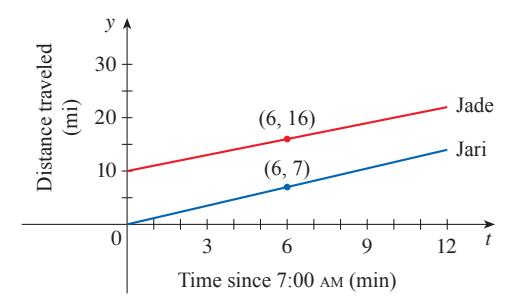
Jade and her roommate Jari commute to work each morning, traveling west on I-10. One morning Jade left for work at 6:50 AM, but Jari left 10 minutes later. Both drove at a constant speed. The graphs show the distance (in miles) each of them has traveled on I-10, \(t\) minutes after 7:00 AM.
question image
(a) Use the graph to decide which driver is traveling faster.
(b) Find the speed (in mi/h) at which each of them is driving.
(c) Find linear functions \(f\) and \(g\) that model the distances traveled by Jade and Jari as functions of \(t\) (in minutes).

Enter your answer directly below each part above.

19 Linear Model (Cost) · Level 2
The manager of a furniture factory finds that it costs \(\$2200 to manufacture 100 chairs \in one day and \)\$4800 to produce 300 chairs in one day.
(a) Express the cost as a function of the number of chairs produced, assuming that it is linear. Then sketch the graph.
(b) What is the slope of the graph and what does it represent?
(c) What is the \(y\)-intercept of the graph and what does it represent?

Enter your answer directly below each part above.

20 Linear Model (Cost) · Level 2
The monthly cost of driving a car depends on the number of miles driven. Lynn found that in May it cost her \(\$380 to drive 480 mi and \in June it cost her \)\$460 to drive 800 mi.
(a) Express the monthly cost \(C\) as a function of the distance driven \(d\), assuming that a linear relationship gives a suitable model.
(b) Use part (a) to predict the cost of driving 1500 miles per month.
(c) Draw the graph of the linear function. What does the slope represent?
(d) What does the \(C\)-intercept represent?
(e) Why does a linear function give a suitable model in this situation?

Enter your answer directly below each part above.

21 Linear Model (Water Pressure) · Level 2
At the surface of the ocean, the water pressure is the same as the air pressure above the water, 15 lb/in². Below the surface, the water pressure increases by 4.34 lb/in² for every 10 ft of descent.
(a) Express the water pressure as a function of the depth below the ocean surface.
(b) At what depth is the pressure 100 lb/in²?

Enter your answer directly below each part above.

22 Inverse Square Law (Wire Resistance) · Level 2
The resistance \(R\) of a wire of fixed length is related to its diameter \(x\) by an inverse square law, that is, by a function of the form \(R(x) = k x^{-2}\).
(a) A wire of fixed length and 0.005 meters in diameter has a resistance of 140 ohms. Find the value of \(k\).
(b) Find the resistance of a wire made of the same material and of the same length as the wire in part (a) but with a diameter of 0.008 meters.

Enter your answer directly below each part above.

23 Inverse Square Law (Illumination) · Level 1
The illumination of an object by a light source is related to the distance from the source by an inverse square law. Suppose that after dark you are sitting in a room with just one lamp, trying to read a book. The light is too dim, so you move your chair halfway to the lamp. How much brighter is the light?
24 Reciprocal Law (Boyle's Law) · Level 2
The pressure \(P\) of a sample of oxygen gas that is compressed at a constant temperature is related to the volume \(V\) of gas by a reciprocal function of the form \(P = \dfrac{k}{V}\).
(a) A sample of oxygen gas that occupies \(0.671\) m³ exerts a pressure of 39 kPa at a temperature of 293 K (absolute temperature measured on the Kelvin scale). Find the value of \(k\) in the given model.
(b) If the sample expands to a volume of \(0.916\) m³, find the new pressure.

Enter your answer directly below each part above.

25 Power Function (Wind Turbine) · Level 3
The power output of a wind turbine depends on many factors. It can be shown using physical principles that the power \(P\) generated by a wind turbine is modeled by \(P = k A v^3\), where \(v\) is the wind speed, \(A\) is the area swept out by the blades, and \(k\) is a constant that depends on air density, efficiency of the turbine, and the design of the wind turbine blades.
(a) If only wind speed is doubled, by what factor is the power output increased?
(b) If only the length of the blades is doubled, by what factor is the power output increased?
(c) For a particular wind turbine, the length of the blades is 30 m and \(k = 0.214\) kg/m³. Find the power output (in watts, W = m²·kg/s³) when the wind speed is 10 m/s, 15 m/s, and 25 m/s.

Enter your answer directly below each part above.

26 Power Function (Stefan-Boltzmann) · Level 2
Astronomers infer the radiant exitance (radiant flux emitted per unit area) of stars using the Stefan-Boltzmann Law: \(E(T) = (5.67 \times 10^{-8}) T^4\) where \(E\) is the energy radiated per unit of surface area measured in watts (W) and \(T\) is the absolute temperature measured in kelvins (K).
(a) Graph the function \(E\) for temperatures \(T\) between 100 K and 300 K.
(b) Use the graph to describe the change in energy \(E\) as the temperature \(T\) increases.

Enter your answer directly below each part above.

27 Identify Model Type from Scatter Plot · Level 2
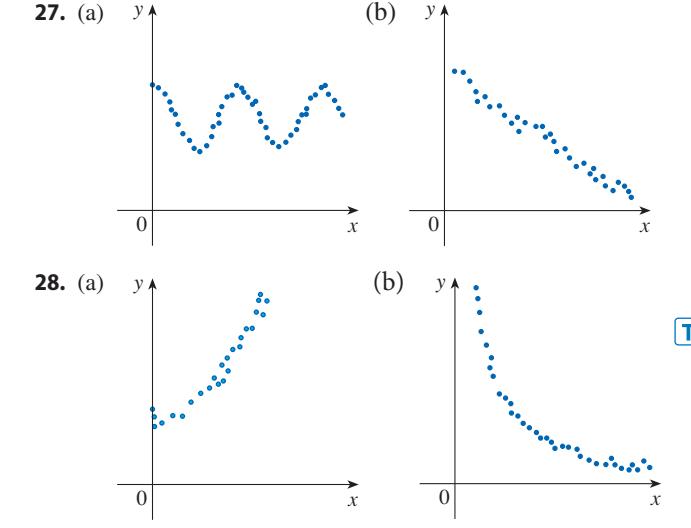
For the scatter plot shown, decide what type of function you might choose as a model for the data. Explain your choices.
question image
28 Identify Model Type from Scatter Plot · Level 2
For the scatter plot shown (see figure for Exercise 27-28), decide what type of function you might choose as a model for the data. Explain your choices.
29 Linear Regression (Peptic Ulcer Rates) · Level 3
The table shows (lifetime) peptic ulcer rates (per 100 population) for various family incomes as reported by the National Health Interview Survey.
Income Ulcer rate (per 100)
$\$4,000 14.1
$\$6,000 13.0
$\$8,000 13.4
$\$12,000 12.5
$\$16,000 12.0
$\$20,000 12.4
$\$30,000 10.5
$\$45,000 9.4
$\$60,000 8.2
(a) Make a scatter plot of these data and decide whether a linear model is appropriate.
(b) Find and graph a linear model using the first and last data points.
(c) Find and graph the regression line.
(d) Use the linear model in part (c) to estimate the ulcer rate for people with an income of $\$25,000.
(e) According to the model, how likely is someone with an income of $\$80,000 to suffer from peptic ulcers?
(f) Do you think it would be reasonable to apply the model to someone with an income of $\$200,000?

Enter your answer directly below each part above.

30 Linear Regression (Asbestos and Tumors) · Level 3
When laboratory rats are exposed to asbestos fibers, some of them develop lung tumors. The table lists the results of several experiments by different scientists.
Asbestos exposure (fibers/mL) Percent with lung tumors
50 2
400 6
500 5
900 10
1100 26
1600 42
1800 37
2000 38
3000 50
(a) Find the regression line for the data.
(b) Make a scatter plot and graph the regression line. Does the regression line appear to be a suitable model for the data?
(c) What does the \(y\)-intercept of the regression line represent?

Enter your answer directly below each part above.

31 Linear Regression (Femur Length and Height) · Level 3
Anthropologists use a linear model that relates human femur (thighbone) length to height. Find the model from the data and use it to estimate the height of someone with a femur of length 53 cm.
Femur (cm) Height (cm)
50.1 178.5
48.3 173.6
45.2 164.8
44.7 163.7
44.5 168.3
42.7 165.0
39.5 155.4
38.0 155.8
(a) Make a scatter plot of the data.
(b) Find and graph the regression line that models the data.
(c) An anthropologist finds a human femur of length 53 cm. How tall was the person?

Enter your answer directly below each part above.

32 Linear Regression (Electricity Prices) · Level 3
The table shows average US retail residential prices of electricity from 2000 to 2016, measured in cents per kilowatt hour.
Years since 2000 Cents/kWh
0 8.24
2 8.44
4 8.95
6 10.40
8 11.26
10 11.54
12 11.88
14 12.52
16 12.90
(a) Make a scatter plot. Is a linear model appropriate?
(b) Find and graph the regression line.
(c) Use your linear model from part (b) to estimate the average retail price of electricity in 2005 and 2017.

Enter your answer directly below each part above.

33 Linear Regression (Oil Consumption) · Level 3
The table shows world average daily oil consumption from 1985 to 2015, measured in thousands of barrels per day.
Year Thousands of barrels/day
1985 60,083
1990 66,533
1995 70,099
2000 76,784
2005 84,077
2010 87,302
2015 94,071
(a) Make a scatter plot and decide whether a linear model is appropriate.
(b) Find and graph the regression line.
(c) Use the linear model to estimate the oil consumption in 2002 and 2017.

Enter your answer directly below each part above.

34 Power Regression (Kepler's Law) · Level 3
The table shows the mean (average) distances \(d\) of the planets from the sun (taking the unit of measurement to be the distance from the earth to the sun) and their periods \(T\) (time of revolution in years).
Planet \(d\) \(T\)
Mercury 0.387 0.241
Venus 0.723 0.615
Earth 1.000 1.000
Mars 1.523 1.881
Jupiter 5.203 11.861
Saturn 9.541 29.457
Uranus 19.190 84.008
Neptune 30.086 164.784
(a) Fit a power model to the data.
(b) Kepler's Third Law of Planetary Motion states that 'The square of the period of revolution of a planet is proportional to the cube of its mean distance from the sun.' Does your model corroborate Kepler's Third Law?

Enter your answer directly below each part above.

35 Power Function (Species-Area, Bats) · Level 2
It makes sense that the larger the area of a region, the larger the number of species that inhabit the region. The number of species \(S\) of bats living in caves in central Mexico has been related to the surface area \(A\) of the caves by the equation \(S = 0.7 A^{0.3}\).
(a) The cave called Misión Imposible near Puebla, Mexico, has a surface area of \(A = 60\) m². How many species of bats would you expect to find in that cave?
(b) If you discover that four species of bats live in a cave, estimate the area of the cave.

Enter your answer directly below each part above.

36 Power Regression (Species-Area, Caribbean) · Level 3
The table shows the number \(N\) of species of reptiles and amphibians inhabiting Caribbean islands and the area \(A\) of the island in square miles.
Island \(A\) (mi²) \(N\)
Saba 4 5
Montserrat 40 9
Puerto Rico 3,459 40
Jamaica 4,411 39
Hispaniola 29,418 84
Cuba 44,218 76
(a) Use a power function to model \(N\) as a function of \(A\).
(b) The Caribbean island of Dominica has area 291 mi². How many species of reptiles and amphibians would you expect to find on Dominica?

Enter your answer directly below each part above.

37 Derivation - Inverse Square Law · Level 2
Suppose that a force or energy originates from a point source and spreads its influence equally in all directions, such as the light from a lightbulb or the gravitational force of a planet. So at a distance \(r\) from the source, the intensity \(I\) of the force or energy is equal to the source strength \(S\) divided by the surface area of a sphere of radius \(r\). Show that \(I\) satisfies the inverse square law \(I = k/r^2\), where \(k\) is a positive constant.
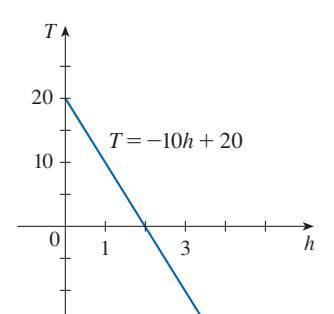
38 Example - Linear Model (Temperature vs Height) · Level 2
question image
(a) As dry air moves upward, it expands and cools. If the ground temperature is 20°C and the temperature at a height of 1 km is 10°C, express the temperature \(T\) (in °C) as a function of the height \(h\) (in kilometers), assuming that a linear model is appropriate.
(b) Draw the graph of the function in part (a). What does the slope represent?
(c) What is the temperature at a height of 2.5 km?

Enter your answer directly below each part above.

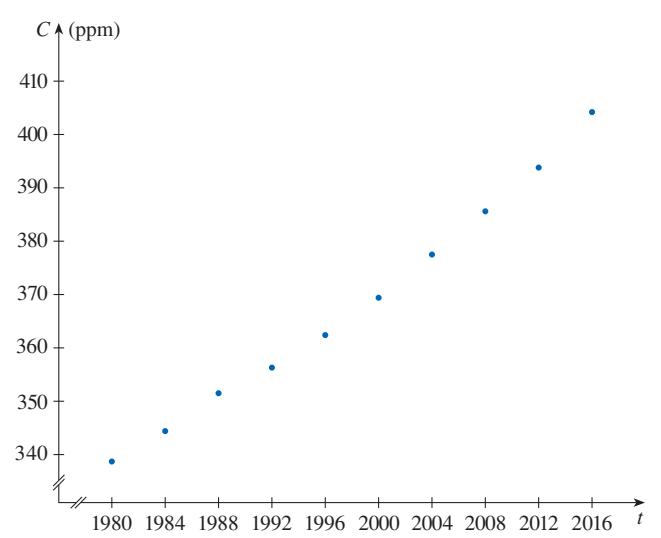
39 Example - Linear Regression (CO2 Levels) · Level 3
Table 1 lists the average carbon dioxide level in the atmosphere, measured in parts per million at Mauna Loa Observatory from 1980 to 2016. Use the data to find a linear model for the \(\text{CO}_2\) level. Year: 1980, 1984, 1988, 1992, 1996, 2000, 2004, 2008, 2012, 2016 \(\text{CO}_2\) level (ppm): 338.7, 344.4, 351.5, 356.3, 362.4, 369.4, 377.5, 385.6, 393.8, 404.2
question image
40 Example - Interpolation and Extrapolation · Level 2
Use the linear model \(C = 1.78242 t - 3192.90\) (where \(t\) is the year and \(C\) is the average \(\text{CO}_2\) level in ppm) to estimate the average \(\text{CO}_2\) level for 1987 and to predict the level for the year 2025. According to this model, when will the \(\text{CO}_2\) level exceed 440 parts per million?
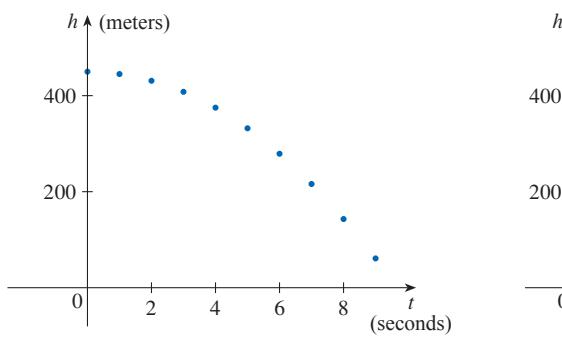
41 Example - Quadratic Model (Falling Ball) · Level 3
A ball is dropped from the upper observation deck of the CN Tower, 450 m above the ground, and its height \(h\) above the ground is recorded at 1-second intervals. Time \(t\) (s): 0, 1, 2, 3, 4, 5, 6, 7, 8, 9 Height \(h\) (m): 450, 445, 431, 408, 375, 332, 279, 216, 143, 61 Find a quadratic model to fit the data and use the model to predict the time at which the ball hits the ground.
question image
42 Example - Domain (Trigonometric) · Level 2
Find the domain of the function \(f(x) = 1/(1 - 2 \cos x)\).
43 Example - Function Classification · Level 1
Classify the following functions as one of the types of essential functions:
(a) \(f(x) = 5^x\)
(b) \(g(x) = x^5\)
(c) \(h(x) = \dfrac{1 + x}{1 - \sqrt{x}}\)
(d) \(u(t) = 1 - t + 5 t^4\)

Enter your answer directly below each part above.

Answered: 0 / 43