Exam Complete
|
Stewart Precalc 6e Section 2.6: Combining Functions
0.0%
0/70
Topic Breakdown
Find compositions
Weak
0/12 · 0%
Sum, difference, product, quotient
Weak
0/6 · 0%
Composition from graphs
Weak
0/6 · 0%
Express as composition
Weak
0/6 · 0%
Domain
Weak
0/4 · 0%
Graph addition with formula
Weak
0/4 · 0%
Composition evaluation
Weak
0/4 · 0%
Triple composition
Weak
0/4 · 0%
Express as triple composition
Weak
0/4 · 0%
Graphical addition
Weak
0/2 · 0%
Composition formula
Weak
0/2 · 0%
Applications - Multiple Discounts
Weak
0/2 · 0%
Concepts - Combining functions from graph
Weak
0/1 · 0%
Concepts - Composition definition
Weak
0/1 · 0%
Concepts - Composition rules
Weak
0/1 · 0%
Concepts - Composition algebra
Weak
0/1 · 0%
Applications - Revenue
Weak
0/1 · 0%
Applications - Profit
Weak
0/1 · 0%
Applications - Area of a Ripple
Weak
0/1 · 0%
Applications - Inflating a Balloon
Weak
0/1 · 0%
Applications - Area of a Balloon
Weak
0/1 · 0%
Applications - Airplane Trajectory
Weak
0/1 · 0%
Discovery - Compound Interest
Weak
0/1 · 0%
Discovery - Composing Linear Functions
Weak
0/1 · 0%
Discovery - Solving for Unknown Function
Weak
0/1 · 0%
Discovery - Odd and Even Compositions
Weak
0/1 · 0%
Target your weak topics with focused practice.
Practice weak topics →Results by Question
1
Concepts - Combining functions from graph
Wrong
From the graphs of \(f\) and \(g\) in the figure, find (a) \((f+g)(2)\), (b) \((f-g)(2)\), (c) \((f g)(2)\), (d) \(\left(\dfrac{f}{g}\right)(2)\).
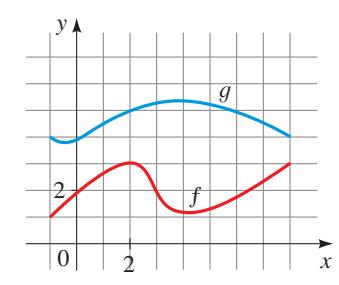
(No answer submitted)
Answer
(a) \(f(2) + g(2)\), (b) \(f(2) - g(2)\), (c) \(f(2) \cdot g(2)\), (d) \(f(2)/g(2)\)
Compare with the answer above and grade yourself:
Explanation
Read the values of \(f(2)\) and \(g(2)\) directly from the graphs, then apply the indicated operations: \((f+g)(x) = f(x) + g(x)\), \((f-g)(x) = f(x) - g(x)\), \((f g)(x) = f(x) g(x)\), and \(\left(\dfrac{f}{g}\right)(x) = f(x)/g(x)\).
2
Concepts - Composition definition
Wrong
By definition, \((f \circ g)(x) = \) ____. So if \(g(2) = 5\) and \(f(5) = 12\), then \((f \circ g)(2) = \) ____.
(No answer submitted)
Answer
\((f \circ g)(x) = f(g(x))\); \((f \circ g)(2) = 12\)
Compare with the answer above and grade yourself:
Explanation
By definition \((f \circ g)(x) = f(g(x))\), so \((f \circ g)(2) = f(g(2)) = f(5) = 12\).
3
Concepts - Composition rules
Wrong
If the rule of the function \(f\) is 'add one' and the rule of the function \(g\) is 'multiply by 2,' then state the rule of \(f \circ g\) and the rule of \(g \circ f\).
(No answer submitted)
Answer
Rule of \(f \circ g\): 'multiply by 2, then add 1.' Rule of \(g \circ f\): 'add 1, then multiply by 2.'
Compare with the answer above and grade yourself:
Explanation
\(f \circ g\) applies \(g\) first (multiply by 2), then applies \(f\) (add 1). \(g \circ f\) applies \(f\) first (add 1), then applies \(g\) (multiply by 2).
4
Concepts - Composition algebra
Wrong
Express the functions in Exercise 3 algebraically: \(f(x) = \) ____, \(g(x) = \) ____, \((f \circ g)(x) = \) ____, \((g \circ f)(x) = \) ____.
(No answer submitted)
Answer
\(f(x) = x + 1\), \(g(x) = 2x\), \((f \circ g)(x) = 2x + 1\), \((g \circ f)(x) = 2x + 2\)
Compare with the answer above and grade yourself:
Explanation
\((f \circ g)(x) = f(g(x)) = f(2x) = 2x + 1\). \((g \circ f)(x) = g(f(x)) = g(x + 1) = 2(x + 1) = 2x + 2\).
5
Sum, difference, product, quotient
Wrong
Find \(f + g\), \(f - g\), \(f g\), and \(\dfrac{f}{g}\) and their domains for \(f(x) = x - 3\), \(g(x) = x^2\).
(No answer submitted)
Answer
\((f+g)(x) = x^2 + x - 3\), domain \(RR\). \((f-g)(x) = -x^2 + x - 3\), domain \(RR\). \((f g)(x) = x^3 - 3x^2\), domain \(RR\). \(\left(\dfrac{f}{g}\right)(x) = (x-3)/x^2\), domain \(x \neq 0\).
Compare with the answer above and grade yourself:
Explanation
Both \(f\) and \(g\) have domain \(RR\). The sum, difference, and product also have domain \(RR\). For the quotient, exclude values where \(g(x) = 0\), i.e., \(x = 0\).
6
Sum, difference, product, quotient
Wrong
Find \(f + g\), \(f - g\), \(f g\), and \(\dfrac{f}{g}\) and their domains for \(f(x) = x^2 + 2x\), \(g(x) = 3x^2 - 1\).
(No answer submitted)
Answer
\((f+g)(x) = 4x^2 + 2x - 1\), \((f-g)(x) = -2x^2 + 2x + 1\), \((f g)(x) = (x^2 + 2x)(3x^2 - 1)\), \(\left(\dfrac{f}{g}\right)(x) = \dfrac{x^2 + 2x}{3x^2 - 1}\). Domain \(RR\) for the first three; \(x \neq \pm \dfrac{\sqrt{3}}{3}\) for the quotient.
Compare with the answer above and grade yourself:
Explanation
Both functions have domain \(RR\). Exclude \(x\) values where \(3x^2 - 1 = 0\), namely \(x = \pm \dfrac{1}{\sqrt{3}} = \pm \dfrac{\sqrt{3}}{3}\), from the quotient's domain.
7
Sum, difference, product, quotient
Wrong
Find \(f + g\), \(f - g\), \(f g\), and \(\dfrac{f}{g}\) and their domains for \(f(x) = \sqrt{4 - x^2}\), \(g(x) = \sqrt{1 + x}\).
(No answer submitted)
Answer
\((f+g)(x) = \sqrt{4 - x^2} + \sqrt{1 + x}\), \((f-g)(x) = \sqrt{4 - x^2} - \sqrt{1 + x}\), \((f g)(x) = \sqrt{(4 - x^2)(1 + x)}\), \(\left(\dfrac{f}{g}\right)(x) = \dfrac{\sqrt{4 - x^2}}{\sqrt{1 + x}}\). Domain \([-1, 2]\) for first three; \((-1, 2]\) for quotient.
Compare with the answer above and grade yourself:
Explanation
Domain of \(f\) is \([-2, 2]\) and of \(g\) is \([-1, \infty)\). The intersection is \([-1, 2]\). For the quotient, exclude \(x = -1\) where \(g(x) = 0\).
8
Sum, difference, product, quotient
Wrong
Find \(f + g\), \(f - g\), \(f g\), and \(\dfrac{f}{g}\) and their domains for \(f(x) = \sqrt{9 - x^2}\), \(g(x) = \sqrt{x^2 - 4}\).
(No answer submitted)
Answer
\((f+g)(x) = \sqrt{9 - x^2} + \sqrt{x^2 - 4}\), similar for \(f-g\), \(f g = \sqrt{(9 - x^2)(x^2 - 4)}\), \(\left(\dfrac{f}{g}\right)(x) = \dfrac{\sqrt{9 - x^2}}{\sqrt{x^2 - 4}}\). Domain \([-3, -2] \cup [2, 3]\); \((-3, -2) \cup (2, 3)\) for quotient.
Compare with the answer above and grade yourself:
Explanation
Domain of \(f\) is \([-3, 3]\) and of \(g\) is \((-\infty, -2] \cup [2, \infty)\). Their intersection is \([-3, -2] \cup [2, 3]\). For the quotient, exclude \(x = \pm 2\) where \(g(x) = 0\).
9
Sum, difference, product, quotient
Wrong
Find \(f + g\), \(f - g\), \(f g\), and \(\dfrac{f}{g}\) and their domains for \(f(x) = \dfrac{2}{x}\), \(g(x) = 4/(x + 4)\).
(No answer submitted)
Answer
\((f+g)(x) = \dfrac{6x + 8}{x(x + 4)}\), \((f-g)(x) = \dfrac{-2x + 8}{x(x + 4)}\), \((f g)(x) = 8/(x(x + 4))\), \(\left(\dfrac{f}{g}\right)(x) = \dfrac{x + 4}{2x}\). Domain: \(x \neq 0, -4\).
Compare with the answer above and grade yourself:
Explanation
Combine over common denominator \(x(x + 4)\). Exclude \(x = 0\) (from \(f\)) and \(x = -4\) (from \(g\)). The quotient simplifies after clearing fractions.
10
Sum, difference, product, quotient
Wrong
Find \(f + g\), \(f - g\), \(f g\), and \(\dfrac{f}{g}\) and their domains for \(f(x) = 2/(x + 1)\), \(g(x) = x/(x + 1)\).
(No answer submitted)
Answer
\((f+g)(x) = \dfrac{x + 2}{x + 1}\), \((f-g)(x) = \dfrac{2 - x}{x + 1}\), \((f g)(x) = 2x/(x + 1)^2\), \(\left(\dfrac{f}{g}\right)(x) = \dfrac{2}{x}\). Domain: \(x \neq -1\) (and \(x \neq 0\) for quotient).
Compare with the answer above and grade yourself:
Explanation
Both functions share the denominator \(x + 1\), so combinations simplify directly. Exclude \(x = -1\) throughout; for the quotient also exclude \(x = 0\) where \(g(x) = 0\).
11
Domain
Wrong
Find the domain of the function \(f(x) = \sqrt{x} + \sqrt{1 - x}\).
(No answer submitted)
Answer
\([0, 1]\)
Compare with the answer above and grade yourself:
Explanation
\(\sqrt{x}\) requires \(x \geq 0\), and \(\sqrt{1 - x}\) requires \(x \leq 1\). Intersecting these gives \(0 \leq x \leq 1\).
12
Domain
Wrong
Find the domain of the function \(g(x) = \sqrt{x + 1} - \dfrac{1}{x}\).
(No answer submitted)
Answer
\([-1, 0) \cup (0, \infty)\)
Compare with the answer above and grade yourself:
Explanation
\(\sqrt{x + 1}\) requires \(x \geq -1\), and \(\dfrac{1}{x}\) requires \(x \neq 0\). Combine: \(x \geq -1\) and \(x \neq 0\).
13
Domain
Wrong
Find the domain of the function \(h(x) = (x - 3)^{-\dfrac{1}{4}}\).
(No answer submitted)
Answer
\((3, \infty)\)
Compare with the answer above and grade yourself:
Explanation
\((x - 3)^{-\dfrac{1}{4}} = 1/\sqrt[4]{x - 3}\) requires \(x - 3 > 0\), i.e., \(x > 3\).
14
Domain
Wrong
Find the domain of the function \(k(x) = \dfrac{\sqrt{x + 3}}{x - 1}\).
(No answer submitted)
Answer
\([-3, 1) \cup (1, \infty)\)
Compare with the answer above and grade yourself:
Explanation
\(\sqrt{x + 3}\) requires \(x \geq -3\), and the denominator forces \(x \neq 1\).
15
Graphical addition
Wrong
Use graphical addition to sketch the graph of \(f + g\) from the figure.
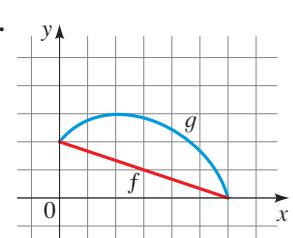
(No answer submitted)
Answer
At each \(x\), plot the point with \(y\)-value equal to the sum of the heights of \(f\) and \(g\) at that \(x\).
Compare with the answer above and grade yourself:
Explanation
Graphical addition: for each \(x\), add the \(y\)-coordinates of the two graphs to obtain the corresponding point on \(f + g\).
16
Graphical addition
Wrong
Use graphical addition to sketch the graph of \(f + g\) from the figure.
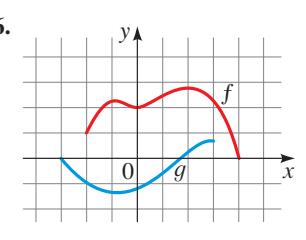
(No answer submitted)
Answer
At each \(x\), plot the point with \(y\)-value equal to the sum of the heights of \(f\) and \(g\) at that \(x\).
Compare with the answer above and grade yourself:
Explanation
Apply graphical addition: at each chosen \(x\), add the \(y\)-coordinates from both curves to get \((f + g)(x)\).
17
Graph addition with formula
Wrong
Draw the graphs of \(f\), \(g\), and \(f + g\) on a common screen to illustrate graphical addition for \(f(x) = \sqrt{1 + x}\), \(g(x) = \sqrt{1 - x}\).
(No answer submitted)
Answer
\(f\) has domain \([-1, \infty)\), \(g\) has domain \((-\infty, 1]\). \(f + g\) has domain \([-1, 1]\) and equals \(\sqrt{1 + x} + \sqrt{1 - x}\).
Compare with the answer above and grade yourself:
Explanation
Plot all three using a graphing utility on the common domain \([-1, 1]\). Verify \((f + g)(0) = 2\), the maximum value.
18
Graph addition with formula
Wrong
Draw the graphs of \(f\), \(g\), and \(f + g\) on a common screen for \(f(x) = x^2\), \(g(x) = \sqrt{x}\).
(No answer submitted)
Answer
\((f + g)(x) = x^2 + \sqrt{x}\), domain \([0, \infty)\).
Compare with the answer above and grade yourself:
Explanation
Plot \(f(x) = x^2\) (parabola), \(g(x) = \sqrt{x}\) (square root), and their sum on the domain \(x \geq 0\).
19
Graph addition with formula
Wrong
Draw the graphs of \(f\), \(g\), and \(f + g\) on a common screen for \(f(x) = x^2\), \(g(x) = \left(\dfrac{1}{3}\right) x^3\).
(No answer submitted)
Answer
\((f + g)(x) = x^2 + \left(\dfrac{1}{3}\right) x^3\), domain \(RR\).
Compare with the answer above and grade yourself:
Explanation
Plot \(f(x) = x^2\) (parabola), \(g(x) = x^3/3\) (cubic), and the sum \(x^2 + x^3/3\) together.
20
Graph addition with formula
Wrong
Draw the graphs of \(f\), \(g\), and \(f + g\) on a common screen for \(f(x) = \sqrt[4]{1 - x}\), \(g(x) = \sqrt{1 - x^2/9}\).
(No answer submitted)
Answer
\(f\) has domain \((-\infty, 1]\), \(g\) has domain \([-3, 3]\). \(f + g\) has domain \([-3, 1]\).
Compare with the answer above and grade yourself:
Explanation
Domains: \(f\) requires \(1 - x \geq 0\), i.e., \(x \leq 1\); \(g\) requires \(1 - x^2/9 \geq 0\), i.e., \(-3 \leq x \leq 3\). Intersection: \([-3, 1]\).
21
Composition evaluation
Wrong
Use \(f(x) = 3x - 5\) and \(g(x) = 2 - x^2\) to evaluate (a) \(f(g(0))\), (b) \(g(f(0))\).
(No answer submitted)
Answer
(a) \(1\), (b) \(-23\)
Compare with the answer above and grade yourself:
Explanation
(a) \(g(0) = 2\), so \(f(g(0)) = f(2) = 6 - 5 = 1\). (b) \(f(0) = -5\), so \(g(f(0)) = g(-5) = 2 - 25 = -23\).
22
Composition evaluation
Wrong
Use \(f(x) = 3x - 5\) and \(g(x) = 2 - x^2\) to evaluate (a) \(f(f(4))\), (b) \(g(g(3))\).
(No answer submitted)
Answer
(a) \(16\), (b) \(-47\)
Compare with the answer above and grade yourself:
Explanation
(a) \(f(4) = 7\), so \(f(f(4)) = f(7) = 21 - 5 = 16\). (b) \(g(3) = -7\), so \(g(g(3)) = g(-7) = 2 - 49 = -47\).
23
Composition evaluation
Wrong
Use \(f(x) = 3x - 5\) and \(g(x) = 2 - x^2\) to evaluate (a) \((f \circ g)(-2)\), (b) \((g \circ f)(-2)\).
(No answer submitted)
Answer
(a) \(-11\), (b) \(-119\)
Compare with the answer above and grade yourself:
Explanation
(a) \(g(-2) = -2\), so \((f \circ g)(-2) = f(-2) = -6 - 5 = -11\). (b) \(f(-2) = -11\), so \((g \circ f)(-2) = g(-11) = 2 - 121 = -119\).
24
Composition evaluation
Wrong
Use \(f(x) = 3x - 5\) and \(g(x) = 2 - x^2\) to evaluate (a) \((f \circ f)(-1)\), (b) \((g \circ g)(2)\).
(No answer submitted)
Answer
(a) \(-29\), (b) \(-2\)
Compare with the answer above and grade yourself:
Explanation
(a) \(f(-1) = -8\), so \((f \circ f)(-1) = f(-8) = -24 - 5 = -29\). (b) \(g(2) = -2\), so \((g \circ g)(2) = g(-2) = 2 - 4 = -2\).
25
Composition formula
Wrong
Use \(f(x) = 3x - 5\) and \(g(x) = 2 - x^2\) to find (a) \((f \circ g)(x)\), (b) \((g \circ f)(x)\).
(No answer submitted)
Answer
(a) \(1 - 3x^2\), (b) \(-9x^2 + 30x - 23\)
Compare with the answer above and grade yourself:
Explanation
(a) \((f \circ g)(x) = f(2 - x^2) = 3(2 - x^2) - 5 = 1 - 3x^2\). (b) \((g \circ f)(x) = g(3x - 5) = 2 - (3x - 5)^2 = -9x^2 + 30x - 23\).
26
Composition formula
Wrong
Use \(f(x) = 3x - 5\) and \(g(x) = 2 - x^2\) to find (a) \((f \circ f)(x)\), (b) \((g \circ g)(x)\).
(No answer submitted)
Answer
(a) \(9x - 20\), (b) \(-x^4 + 4x^2 - 2\)
Compare with the answer above and grade yourself:
Explanation
(a) \((f \circ f)(x) = f(3x - 5) = 3(3x - 5) - 5 = 9x - 20\). (b) \((g \circ g)(x) = g(2 - x^2) = 2 - (2 - x^2)^2 = -x^4 + 4x^2 - 2\).
27
Composition from graphs
Wrong
Use the given graphs of \(f\) and \(g\) to evaluate \(f(g(2))\).
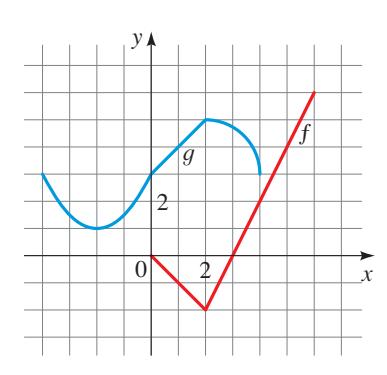
(No answer submitted)
Answer
Read \(g(2)\) from the graph of \(g\), then read \(f\) at that value from the graph of \(f\).
Compare with the answer above and grade yourself:
Explanation
First locate \(x = 2\) on the graph of \(g\) to obtain \(g(2)\). Then evaluate \(f\) at this output by reading the graph of \(f\).
28
Composition from graphs
Wrong
Use the given graphs of \(f\) and \(g\) to evaluate \(g(f(0))\).
(No answer submitted)
Answer
Read \(f(0)\) from the graph of \(f\), then read \(g\) at that value from the graph of \(g\).
Compare with the answer above and grade yourself:
Explanation
Find \(f(0)\) on the graph, then plug that result into \(g\) by reading the graph of \(g\).
29
Composition from graphs
Wrong
Use the given graphs of \(f\) and \(g\) to evaluate \((g \circ f)(4)\).
(No answer submitted)
Answer
Read \(f(4)\) from the graph of \(f\), then read \(g\) at that value from the graph of \(g\).
Compare with the answer above and grade yourself:
Explanation
\((g \circ f)(4) = g(f(4))\). First read \(f(4)\) from the graph; then evaluate \(g\) at that value.
30
Composition from graphs
Wrong
Use the given graphs of \(f\) and \(g\) to evaluate \((f \circ g)(0)\).
(No answer submitted)
Answer
Read \(g(0)\) from the graph of \(g\), then read \(f\) at that value from the graph of \(f\).
Compare with the answer above and grade yourself:
Explanation
\((f \circ g)(0) = f(g(0))\). Read \(g(0)\) from the graph; then evaluate \(f\) at that result.
31
Composition from graphs
Wrong
Use the given graphs of \(f\) and \(g\) to evaluate \((g \circ g)(-2)\).
(No answer submitted)
Answer
Read \(g(-2)\) from the graph of \(g\), then read \(g\) again at that value.
Compare with the answer above and grade yourself:
Explanation
\((g \circ g)(-2) = g(g(-2))\). Apply \(g\) twice using the graph: first to \(-2\), then to the resulting value.
32
Composition from graphs
Wrong
Use the given graphs of \(f\) and \(g\) to evaluate \((f \circ f)(4)\).
(No answer submitted)
Answer
Read \(f(4)\) from the graph of \(f\), then read \(f\) again at that value.
Compare with the answer above and grade yourself:
Explanation
\((f \circ f)(4) = f(f(4))\). Apply \(f\) twice using the graph: first to \(4\), then to the resulting value.
33
Find compositions
Wrong
Find \(f \circ g\), \(g \circ f\), \(f \circ f\), and \(g \circ g\), and their domains, for \(f(x) = 2x + 3\), \(g(x) = 4x - 1\).
(No answer submitted)
Answer
\((f \circ g)(x) = 8x + 1\), \((g \circ f)(x) = 8x + 11\), \((f \circ f)(x) = 4x + 9\), \((g \circ g)(x) = 16x - 5\). All domains are \(RR\).
Compare with the answer above and grade yourself:
Explanation
Substitute and simplify: \((f \circ g)(x) = 2(4x - 1) + 3 = 8x + 1\); \((g \circ f)(x) = 4(2x + 3) - 1 = 8x + 11\); \((f \circ f)(x) = 2(2x + 3) + 3 = 4x + 9\); \((g \circ g)(x) = 4(4x - 1) - 1 = 16x - 5\).
34
Find compositions
Wrong
Find \(f \circ g\), \(g \circ f\), \(f \circ f\), and \(g \circ g\), and their domains, for \(f(x) = 6x - 5\), \(g(x) = \dfrac{x}{2}\).
(No answer submitted)
Answer
\((f \circ g)(x) = 3x - 5\), \((g \circ f)(x) = 3x - \dfrac{5}{2}\), \((f \circ f)(x) = 36x - 35\), \((g \circ g)(x) = \dfrac{x}{4}\). All domains are \(RR\).
Compare with the answer above and grade yourself:
Explanation
\((f \circ g)(x) = 6\left(\dfrac{x}{2}\right) - 5 = 3x - 5\); \((g \circ f)(x) = (6x - 5)/2 = 3x - \dfrac{5}{2}\); \((f \circ f)(x) = 6(6x - 5) - 5 = 36x - 35\); \((g \circ g)(x) = \left(\dfrac{x}{2}\right)/2 = \dfrac{x}{4}\).
35
Find compositions
Wrong
Find \(f \circ g\), \(g \circ f\), \(f \circ f\), and \(g \circ g\), and their domains, for \(f(x) = x^2\), \(g(x) = x + 1\).
(No answer submitted)
Answer
\((f \circ g)(x) = (x + 1)^2\), \((g \circ f)(x) = x^2 + 1\), \((f \circ f)(x) = x^4\), \((g \circ g)(x) = x + 2\). All domains are \(RR\).
Compare with the answer above and grade yourself:
Explanation
\((f \circ g)(x) = (x + 1)^2\); \((g \circ f)(x) = x^2 + 1\); \((f \circ f)(x) = (x^2)^2 = x^4\); \((g \circ g)(x) = (x + 1) + 1 = x + 2\).
36
Find compositions
Wrong
Find \(f \circ g\), \(g \circ f\), \(f \circ f\), and \(g \circ g\), and their domains, for \(f(x) = x^3 + 2\), \(g(x) = \sqrt[3]{x}\).
(No answer submitted)
Answer
\((f \circ g)(x) = x + 2\), \((g \circ f)(x) = \sqrt[3]{x^3 + 2}\), \((f \circ f)(x) = (x^3 + 2)^3 + 2\), \((g \circ g)(x) = \sqrt[9]{x}\). All domains are \(RR\).
Compare with the answer above and grade yourself:
Explanation
\((f \circ g)(x) = (\sqrt[3]{x})^3 + 2 = x + 2\); \((g \circ f)(x) = \sqrt[3]{x^3 + 2}\); \((f \circ f)(x) = (x^3 + 2)^3 + 2\); \((g \circ g)(x) = \sqrt[3]{\sqrt[3]{x}} = \sqrt[9]{x}\).
37
Find compositions
Wrong
Find \(f \circ g\), \(g \circ f\), \(f \circ f\), and \(g \circ g\), and their domains, for \(f(x) = \dfrac{1}{x}\), \(g(x) = 2x + 4\).
(No answer submitted)
Answer
\((f \circ g)(x) = 1/(2x + 4)\), domain \(x \neq -2\). \((g \circ f)(x) = \dfrac{2}{x} + 4\), domain \(x \neq 0\). \((f \circ f)(x) = x\), domain \(x \neq 0\). \((g \circ g)(x) = 4x + 12\), domain \(RR\).
Compare with the answer above and grade yourself:
Explanation
\((f \circ g)(x) = 1/(2x + 4)\); exclude \(x = -2\). \((g \circ f)(x) = 2\left(\dfrac{1}{x}\right) + 4 = \dfrac{2}{x} + 4\); exclude \(x = 0\). \((f \circ f)(x) = 1/\left(\dfrac{1}{x}\right) = x\) for \(x \neq 0\). \((g \circ g)(x) = 2(2x + 4) + 4 = 4x + 12\).
38
Find compositions
Wrong
Find \(f \circ g\), \(g \circ f\), \(f \circ f\), and \(g \circ g\), and their domains, for \(f(x) = x^2\), \(g(x) = \sqrt{x - 3}\).
(No answer submitted)
Answer
\((f \circ g)(x) = x - 3\), domain \(x \geq 3\). \((g \circ f)(x) = \sqrt{x^2 - 3}\), domain \(|x| \geq \sqrt{3}\). \((f \circ f)(x) = x^4\), domain \(RR\). \((g \circ g)(x) = \sqrt{\sqrt{x - 3} - 3}\), domain \(x \geq 12\).
Compare with the answer above and grade yourself:
Explanation
\((f \circ g)(x) = (\sqrt{x - 3})^2 = x - 3\) for \(x \geq 3\). \((g \circ f)(x) = \sqrt{x^2 - 3}\) requires \(x^2 \geq 3\). \((f \circ f)(x) = x^4\). \((g \circ g)(x)\) requires \(\sqrt{x - 3} \geq 3\), i.e., \(x \geq 12\).
39
Find compositions
Wrong
Find \(f \circ g\), \(g \circ f\), \(f \circ f\), and \(g \circ g\), and their domains, for \(f(x) = |x|\), \(g(x) = 2x + 3\).
(No answer submitted)
Answer
\((f \circ g)(x) = |2x + 3|\), \((g \circ f)(x) = 2 |x| + 3\), \((f \circ f)(x) = |x|\), \((g \circ g)(x) = 4x + 9\). All domains are \(RR\).
Compare with the answer above and grade yourself:
Explanation
\((f \circ g)(x) = |2x + 3|\); \((g \circ f)(x) = 2 |x| + 3\); \((f \circ f)(x) = |abs(x)| = |x|\); \((g \circ g)(x) = 2(2x + 3) + 3 = 4x + 9\).
40
Find compositions
Wrong
Find \(f \circ g\), \(g \circ f\), \(f \circ f\), and \(g \circ g\), and their domains, for \(f(x) = x - 4\), \(g(x) = |x + 4|\).
(No answer submitted)
Answer
\((f \circ g)(x) = |x + 4| - 4\), \((g \circ f)(x) = |x|\), \((f \circ f)(x) = x - 8\), \((g \circ g)(x) = |abs(x + 4) + 4| = |x + 4| + 4\). All domains are \(RR\).
Compare with the answer above and grade yourself:
Explanation
\((f \circ g)(x) = |x + 4| - 4\); \((g \circ f)(x) = |(x - 4) + 4| = |x|\); \((f \circ f)(x) = (x - 4) - 4 = x - 8\); \((g \circ g)(x) = |abs(x + 4) + 4|\), and since \(|x + 4| + 4 \geq 0\), this equals \(|x + 4| + 4\).
41
Find compositions
Wrong
Find \(f \circ g\), \(g \circ f\), \(f \circ f\), and \(g \circ g\), and their domains, for \(f(x) = x/(x + 1)\), \(g(x) = 2x - 1\).
(No answer submitted)
Answer
\((f \circ g)(x) = \dfrac{2x - 1}{2x}\), domain \(x \neq 0\). \((g \circ f)(x) = \dfrac{x - 1}{x + 1}\), domain \(x \neq -1\). \((f \circ f)(x) = x/(2x + 1)\), domain \(x \neq -1, -\dfrac{1}{2}\). \((g \circ g)(x) = 4x - 3\), domain \(RR\).
Compare with the answer above and grade yourself:
Explanation
\((f \circ g)(x) = \dfrac{2x - 1}{(2x - 1) + 1} = \dfrac{2x - 1}{2x}\). \((g \circ f)(x) = 2(x/(x+1)) - 1 = \dfrac{x - 1}{x + 1}\). \((f \circ f)(x) = \dfrac{x/(x+1)}{(x/(x+1)) + 1} = x/(2x + 1)\). \((g \circ g)(x) = 2(2x - 1) - 1 = 4x - 3\).
42
Find compositions
Wrong
Find \(f \circ g\), \(g \circ f\), \(f \circ f\), and \(g \circ g\), and their domains, for \(f(x) = \dfrac{1}{\sqrt{x}}\), \(g(x) = x^2 - 4x\).
(No answer submitted)
Answer
\((f \circ g)(x) = \dfrac{1}{\sqrt{x^2 - 4x}}\), domain \(x < 0\) or \(x > 4\). \((g \circ f)(x) = \dfrac{1}{x} - \dfrac{4}{\sqrt{x}}\), domain \(x > 0\). \((f \circ f)(x) = \sqrt[4]{x}\), domain \(x > 0\). \((g \circ g)(x) = (x^2 - 4x)^2 - 4(x^2 - 4x)\), domain \(RR\).
Compare with the answer above and grade yourself:
Explanation
\(f\) requires \(x > 0\) and \(g\) has domain \(RR\). \((f \circ g)\) requires \(g(x) > 0\), i.e., \(x(x - 4) > 0\), giving \(x < 0\) or \(x > 4\). \((g \circ f)\) requires \(x > 0\). \((f \circ f)(x) = 1/\sqrt{\dfrac{1}{\sqrt{x}}} = x^{\dfrac{1}{4}}\) for \(x > 0\).
43
Find compositions
Wrong
Find \(f \circ g\), \(g \circ f\), \(f \circ f\), and \(g \circ g\), and their domains, for \(f(x) = x/(x + 1)\), \(g(x) = \dfrac{1}{x}\).
(No answer submitted)
Answer
\((f \circ g)(x) = 1/(1 + x)\), domain \(x \neq 0, -1\). \((g \circ f)(x) = (x + 1)/x\), domain \(x \neq 0, -1\). \((f \circ f)(x) = x/(2x + 1)\), domain \(x \neq -1, -\dfrac{1}{2}\). \((g \circ g)(x) = x\), domain \(x \neq 0\).
Compare with the answer above and grade yourself:
Explanation
\((f \circ g)(x) = \dfrac{\dfrac{1}{x}}{\left(\dfrac{1}{x}\right) + 1} = 1/(1 + x)\). \((g \circ f)(x) = 1/(x/(x+1)) = (x + 1)/x\). \((f \circ f)(x) = \dfrac{x/(x+1)}{(x/(x+1)) + 1} = x/(2x + 1)\). \((g \circ g)(x) = 1/\left(\dfrac{1}{x}\right) = x\).
44
Find compositions
Wrong
Find \(f \circ g\), \(g \circ f\), \(f \circ f\), and \(g \circ g\), and their domains, for \(f(x) = \dfrac{2}{x}\), \(g(x) = x/(x + 2)\).
(No answer submitted)
Answer
\((f \circ g)(x) = (2(x + 2))/x = 2 + \dfrac{4}{x}\), domain \(x \neq 0, -2\). \((g \circ f)(x) = 2/(2 + 2x) = 1/(1 + x)\), domain \(x \neq 0, -1\). \((f \circ f)(x) = x\), domain \(x \neq 0\). \((g \circ g)(x) = x/(3x + 4)\), domain \(x \neq -2, -\dfrac{4}{3}\).
Compare with the answer above and grade yourself:
Explanation
\((f \circ g)(x) = 2/(x/(x + 2)) = 2(x + 2)/x\). \((g \circ f)(x) = \dfrac{\dfrac{2}{x}}{\left(\dfrac{2}{x}\right) + 2} = 2/(2 + 2x) = 1/(1 + x)\). \((f \circ f)(x) = 2/\left(\dfrac{2}{x}\right) = x\). \((g \circ g)(x) = \dfrac{x/(x+2)}{(x/(x+2)) + 2} = x/(3x + 4)\).
45
Triple composition
Wrong
Find \(f \circ g \circ h\) for \(f(x) = x - 1\), \(g(x) = \sqrt{x}\), \(h(x) = x - 1\).
(No answer submitted)
Answer
\((f \circ g \circ h)(x) = \sqrt{x - 1} - 1\)
Compare with the answer above and grade yourself:
Explanation
\(h(x) = x - 1\), then \(g(h(x)) = \sqrt{x - 1}\), then \(f(g(h(x))) = \sqrt{x - 1} - 1\). Domain: \(x \geq 1\).
46
Triple composition
Wrong
Find \(f \circ g \circ h\) for \(f(x) = \dfrac{1}{x}\), \(g(x) = x^3\), \(h(x) = x^2 + 2\).
(No answer submitted)
Answer
\((f \circ g \circ h)(x) = 1/(x^2 + 2)^3\)
Compare with the answer above and grade yourself:
Explanation
\(h(x) = x^2 + 2\), then \(g(h(x)) = (x^2 + 2)^3\), then \(f(g(h(x))) = 1/(x^2 + 2)^3\). Domain: \(RR\).
47
Triple composition
Wrong
Find \(f \circ g \circ h\) for \(f(x) = x^4 + 1\), \(g(x) = x - 5\), \(h(x) = \sqrt{x}\).
(No answer submitted)
Answer
\((f \circ g \circ h)(x) = (\sqrt{x} - 5)^4 + 1\)
Compare with the answer above and grade yourself:
Explanation
\(h(x) = \sqrt{x}\), then \(g(h(x)) = \sqrt{x} - 5\), then \(f(g(h(x))) = (\sqrt{x} - 5)^4 + 1\). Domain: \(x \geq 0\).
48
Triple composition
Wrong
Find \(f \circ g \circ h\) for \(f(x) = \sqrt{x}\), \(g(x) = x/(x - 1)\), \(h(x) = \sqrt[3]{x}\).
(No answer submitted)
Answer
\((f \circ g \circ h)(x) = \sqrt{\sqrt[3]{x}/(\sqrt[3]{x} - 1)}\)
Compare with the answer above and grade yourself:
Explanation
\(h(x) = \sqrt[3]{x}\), then \(g(h(x)) = \sqrt[3]{x}/(\sqrt[3]{x} - 1)\), then \(f(g(h(x))) = \sqrt{\sqrt[3]{x}/(\sqrt[3]{x} - 1)}\). Domain requires the radicand non-negative and \(\sqrt[3]{x} \neq 1\).
49
Express as composition
Wrong
Express the function \(F(x) = (x - 9)^5\) in the form \(f \circ g\).
(No answer submitted)
Answer
\(g(x) = x - 9\), \(f(x) = x^5\)
Compare with the answer above and grade yourself:
Explanation
Let the inner function \(g(x) = x - 9\) and the outer \(f(x) = x^5\). Then \(f(g(x)) = (x - 9)^5 = F(x)\).
50
Express as composition
Wrong
Express the function \(F(x) = \sqrt{x} + 1\) in the form \(f \circ g\).
(No answer submitted)
Answer
\(g(x) = \sqrt{x}\), \(f(x) = x + 1\)
Compare with the answer above and grade yourself:
Explanation
Let \(g(x) = \sqrt{x}\) and \(f(x) = x + 1\). Then \(f(g(x)) = \sqrt{x} + 1 = F(x)\).
51
Express as composition
Wrong
Express the function \(G(x) = x^2/(x^2 + 4)\) in the form \(f \circ g\).
(No answer submitted)
Answer
\(g(x) = x^2\), \(f(x) = x/(x + 4)\)
Compare with the answer above and grade yourself:
Explanation
Let \(g(x) = x^2\) and \(f(x) = x/(x + 4)\). Then \(f(g(x)) = x^2/(x^2 + 4) = G(x)\).
52
Express as composition
Wrong
Express the function \(G(x) = 1/(x + 3)\) in the form \(f \circ g\).
(No answer submitted)
Answer
\(g(x) = x + 3\), \(f(x) = \dfrac{1}{x}\)
Compare with the answer above and grade yourself:
Explanation
Let \(g(x) = x + 3\) and \(f(x) = \dfrac{1}{x}\). Then \(f(g(x)) = 1/(x + 3) = G(x)\).
53
Express as composition
Wrong
Express the function \(H(x) = |1 - x^3|\) in the form \(f \circ g\).
(No answer submitted)
Answer
\(g(x) = 1 - x^3\), \(f(x) = |x|\)
Compare with the answer above and grade yourself:
Explanation
Let \(g(x) = 1 - x^3\) and \(f(x) = |x|\). Then \(f(g(x)) = |1 - x^3| = H(x)\).
54
Express as composition
Wrong
Express the function \(H(x) = \sqrt{1 + \sqrt{x}}\) in the form \(f \circ g\).
(No answer submitted)
Answer
\(g(x) = 1 + \sqrt{x}\), \(f(x) = \sqrt{x}\)
Compare with the answer above and grade yourself:
Explanation
Let \(g(x) = 1 + \sqrt{x}\) and \(f(x) = \sqrt{x}\). Then \(f(g(x)) = \sqrt{1 + \sqrt{x}} = H(x)\).
55
Express as triple composition
Wrong
Express the function \(F(x) = 1/(x^2 + 1)\) in the form \(f \circ g \circ h\).
(No answer submitted)
Answer
\(h(x) = x^2\), \(g(x) = x + 1\), \(f(x) = \dfrac{1}{x}\)
Compare with the answer above and grade yourself:
Explanation
Let \(h(x) = x^2\), \(g(x) = x + 1\), \(f(x) = \dfrac{1}{x}\). Then \(f(g(h(x))) = 1/(x^2 + 1) = F(x)\).
56
Express as triple composition
Wrong
Express the function \(F(x) = \sqrt[3]{\sqrt{x} - 1}\) in the form \(f \circ g \circ h\).
(No answer submitted)
Answer
\(h(x) = \sqrt{x}\), \(g(x) = x - 1\), \(f(x) = \sqrt[3]{x}\)
Compare with the answer above and grade yourself:
Explanation
Let \(h(x) = \sqrt{x}\), \(g(x) = x - 1\), \(f(x) = \sqrt[3]{x}\). Then \(f(g(h(x))) = \sqrt[3]{\sqrt{x} - 1} = F(x)\).
57
Express as triple composition
Wrong
Express the function \(G(x) = (4 + \sqrt[3]{x})^9\) in the form \(f \circ g \circ h\).
(No answer submitted)
Answer
\(h(x) = \sqrt[3]{x}\), \(g(x) = 4 + x\), \(f(x) = x^9\)
Compare with the answer above and grade yourself:
Explanation
Let \(h(x) = \sqrt[3]{x}\), \(g(x) = 4 + x\), \(f(x) = x^9\). Then \(f(g(h(x))) = (4 + \sqrt[3]{x})^9 = G(x)\).
58
Express as triple composition
Wrong
Express the function \(G(x) = 2/(3 + \sqrt{x})^2\) in the form \(f \circ g \circ h\).
(No answer submitted)
Answer
\(h(x) = \sqrt{x}\), \(g(x) = (3 + x)^2\), \(f(x) = \dfrac{2}{x}\)
Compare with the answer above and grade yourself:
Explanation
Let \(h(x) = \sqrt{x}\), \(g(x) = (3 + x)^2\), \(f(x) = \dfrac{2}{x}\). Then \(f(g(h(x))) = 2/(3 + \sqrt{x})^2 = G(x)\).
59
Applications - Revenue
Wrong
A print shop makes bumper stickers for election campaigns. If \(x\) stickers are ordered (where \(x < 10000\)), then the price per bumper sticker is \(0.15 - 0.000002 x\) dollars, and the total cost of producing the order is \(0.095 x - 0.0000005 x^2\) dollars. Use the fact that revenue \(=\) price per item \(\times\) number of items sold to express \(R(x)\), the revenue from an order of \(x\) stickers, as a product of two functions of \(x\).
(No answer submitted)
Answer
\(R(x) = (0.15 - 0.000002 x) \cdot x = 0.15 x - 0.000002 x^2\)
Compare with the answer above and grade yourself:
Explanation
Revenue equals price per sticker times number of stickers: \(R(x) = (0.15 - 0.000002 x)(x)\).
60
Applications - Profit
Wrong
Use the fact that profit \(=\) revenue \(-\) cost to express \(P(x)\), the profit on an order of \(x\) stickers, as a difference of two functions of \(x\). (See Exercise 59.)
(No answer submitted)
Answer
\(P(x) = R(x) - C(x) = (0.15 x - 0.000002 x^2) - (0.095 x - 0.0000005 x^2) = 0.055 x - 0.0000015 x^2\)
Compare with the answer above and grade yourself:
Explanation
Subtract cost from revenue: \(P(x) = (0.15 - 0.000002 x) x - (0.095 x - 0.0000005 x^2) = 0.055 x - 0.0000015 x^2\).
61
Applications - Area of a Ripple
Wrong
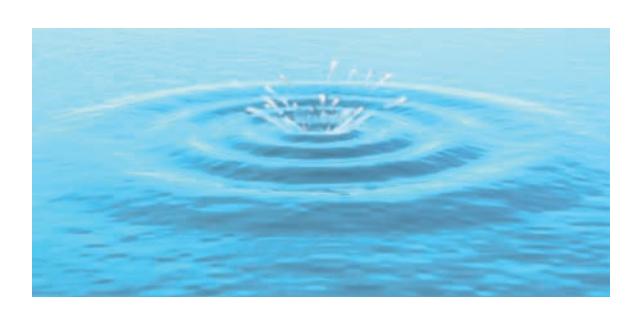
A stone is dropped in a lake, creating a circular ripple that travels outward at a speed of \(60\) cm/s. (a) Find a function \(g\) that models the radius as a function of time. (b) Find a function \(f\) that models the area of the circle as a function of the radius. (c) Find \(f \circ g\). What does this function represent?
(No answer submitted)
Answer
(a) \(g(t) = 60 t\), (b) \(f(r) = \pi r^2\), (c) \((f \circ g)(t) = 3600 \pi t^2\), the area of the ripple at time \(t\) (cm\(^2\)).
Compare with the answer above and grade yourself:
Explanation
Radius grows at \(60\) cm/s, so \(g(t) = 60 t\). Circle area: \(f(r) = \pi r^2\). Composition: \(f(g(t)) = \pi (60 t)^2 = 3600 \pi t^2\).
62
Applications - Inflating a Balloon
Wrong
A spherical balloon is being inflated. The radius of the balloon is increasing at the rate of \(1\) cm/s. (a) Find a function \(f\) that models the radius as a function of time. (b) Find a function \(g\) that models the volume as a function of the radius. (c) Find \(g \circ f\). What does this function represent?
(No answer submitted)
Answer
(a) \(f(t) = t\), (b) \(g(r) = \left(\dfrac{4}{3}\right) \pi r^3\), (c) \((g \circ f)(t) = \left(\dfrac{4}{3}\right) \pi t^3\), the volume of the balloon at time \(t\) (cm\(^3\)).
Compare with the answer above and grade yourself:
Explanation
Radius increases at \(1\) cm/s, so \(f(t) = t\). Sphere volume: \(g(r) = \left(\dfrac{4}{3}\right) \pi r^3\). Composition: \(g(f(t)) = \left(\dfrac{4}{3}\right) \pi t^3\).
63
Applications - Area of a Balloon
Wrong
A spherical weather balloon is being inflated. The radius of the balloon is increasing at the rate of \(2\) cm/s. Express the surface area of the balloon as a function of time \(t\) (in seconds).
(No answer submitted)
Answer
\(S(t) = 16 \pi t^2\)
Compare with the answer above and grade yourself:
Explanation
Radius: \(r(t) = 2 t\). Sphere surface area: \(S = 4 \pi r^2 = 4 \pi (2 t)^2 = 16 \pi t^2\).
64
Applications - Multiple Discounts
Wrong
You have a \(\$50\) coupon from the manufacturer good for the purchase of a cell phone. The store where you are purchasing your cell phone is offering a \(20%\) discount on all cell phones. Let \(x\) represent the regular price of the cell phone. (a) Suppose only the \(20%\) discount applies. Find a function \(f\) that models the purchase price. (b) Suppose only the \(\$50\) coupon applies. Find a function \(g\) that models the purchase price. (c) Find both \((f \circ g)(x)\) and \((g \circ f)(x)\). Which composition gives the lower price?
(No answer submitted)
Answer
(a) \(f(x) = 0.8 x\), (b) \(g(x) = x - 50\), (c) \((f \circ g)(x) = 0.8(x - 50) = 0.8 x - 40\), \((g \circ f)(x) = 0.8 x - 50\). \((g \circ f)(x)\) gives the lower price.
Compare with the answer above and grade yourself:
Explanation
Comparing the two: \((g \circ f)(x) - (f \circ g)(x) = -10\), so \((g \circ f)\) is \(\$10\) cheaper. Apply the discount first, then the coupon.
65
Applications - Multiple Discounts
Wrong
An appliance dealer advertises a \(10%\) discount on all his washing machines. In addition, the manufacturer offers a \(\$100\) rebate on the purchase of a washing machine. Let \(x\) represent the sticker price. (a) Find \(f\) for the \(10%\) discount only. (b) Find \(g\) for the \(\$100\) rebate only. (c) Find \(f \circ g\) and \(g \circ f\). Which is the better deal?
(No answer submitted)
Answer
(a) \(f(x) = 0.9 x\), (b) \(g(x) = x - 100\), (c) \((f \circ g)(x) = 0.9 x - 90\), \((g \circ f)(x) = 0.9 x - 100\). \((g \circ f)\) is the better deal.
Compare with the answer above and grade yourself:
Explanation
\((g \circ f)(x) - (f \circ g)(x) = -10\), so applying the \(10%\) discount first then the rebate saves \(\$10\) more than the reverse order.
66
Applications - Airplane Trajectory
Wrong
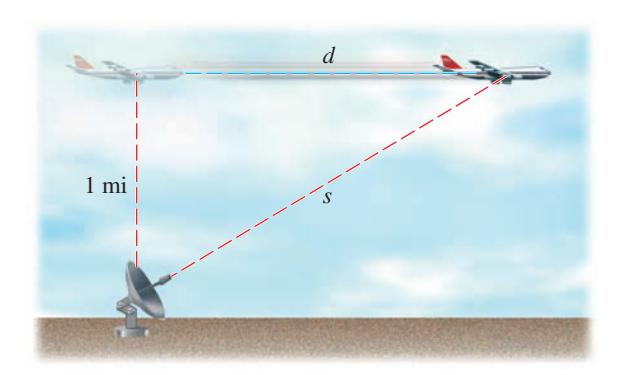
An airplane is flying at a speed of \(350\) mi/h at an altitude of one mile. The plane passes directly above a radar station at time \(t = 0\). (a) Express the distance \(s\) (in miles) between the plane and the radar station as a function of the horizontal distance \(d\). (b) Express \(d\) as a function of time \(t\) (in hours). (c) Use composition to express \(s\) as a function of \(t\).
(No answer submitted)
Answer
(a) \(s(d) = \sqrt{d^2 + 1}\), (b) \(d(t) = 350 t\), (c) \(s(t) = \sqrt{122500 t^2 + 1}\)
Compare with the answer above and grade yourself:
Explanation
By the Pythagorean theorem with vertical leg \(1\) and horizontal leg \(d\): \(s = \sqrt{d^2 + 1}\). Distance traveled: \(d = 350 t\). Composition: \(s(t) = \sqrt{(350 t)^2 + 1} = \sqrt{122500 t^2 + 1}\).
67
Discovery - Compound Interest
Wrong
A savings account earns \(5%\) interest compounded annually. If you invest \(x\) dollars, then \(A(x) = x + 0.05 x = 1.05 x\) is the amount after one year. Find \(A \circ A\), \(A \circ A \circ A\), and \(A \circ A \circ A \circ A\). What do these compositions represent? Find a formula for the composition of \(n\) copies of \(A\).
(No answer submitted)
Answer
\((A \circ A)(x) = 1.05^2 x\), \((A \circ A \circ A)(x) = 1.05^3 x\), \((A \circ A \circ A \circ A)(x) = 1.05^4 x\). The \(n\)-fold composition: \(A^n(x) = 1.05^n x\), the value after \(n\) years.
Compare with the answer above and grade yourself:
Explanation
Each composition multiplies by \(1.05\), so the \(n\)-fold composition multiplies by \(1.05^n\). This is the amount in the account after \(n\) years of compounding.
68
Discovery - Composing Linear Functions
Wrong
The graphs of \(f(x) = m_1 x + b_1\) and \(g(x) = m_2 x + b_2\) are lines with slopes \(m_1\) and \(m_2\), respectively. Is the graph of \(f \circ g\) a line? If so, what is its slope?
(No answer submitted)
Answer
Yes, \(f \circ g\) is a line with slope \(m_1 m_2\).
Compare with the answer above and grade yourself:
Explanation
\((f \circ g)(x) = m_1(m_2 x + b_2) + b_1 = m_1 m_2 x + (m_1 b_2 + b_1)\). This is linear with slope equal to the product of the two slopes.
69
Discovery - Solving for Unknown Function
Wrong
Suppose \(g(x) = 2x + 1\) and \(h(x) = 4x^2 + 4x + 7\). Find a function \(f\) such that \(f \circ g = h\). Now suppose \(f(x) = 3x + 5\) and \(h(x) = 3x^2 + 3x + 2\). Find a function \(g\) such that \(f \circ g = h\).
(No answer submitted)
Answer
First: \(f(x) = x^2 + 6\). Second: \(g(x) = x^2 + x - 1\).
Compare with the answer above and grade yourself:
Explanation
First part: \(h(x) = 4x^2 + 4x + 7 = (2x + 1)^2 + 6 = (g(x))^2 + 6\), so \(f(x) = x^2 + 6\). Second part: solve \(3 g(x) + 5 = 3 x^2 + 3 x + 2\), giving \(g(x) = (3 x^2 + 3 x - 3)/3 = x^2 + x - 1\).
70
Discovery - Odd and Even Compositions
Wrong
Suppose \(h = f \circ g\). (a) If \(g\) is even, is \(h\) necessarily even? (b) If \(g\) is odd, is \(h\) odd? (c) What if \(g\) is odd and \(f\) is odd? (d) What if \(g\) is odd and \(f\) is even?
(No answer submitted)
Answer
(a) Yes, \(h\) is even. (b) Not necessarily. (c) \(h\) is odd. (d) \(h\) is even.
Compare with the answer above and grade yourself:
Explanation
(a) If \(g\) even: \(h(-x) = f(g(-x)) = f(g(x)) = h(x)\), even. (b) Just \(g\) odd: \(h(-x) = f(-g(x))\), no general property. (c) Both odd: \(h(-x) = f(-g(x)) = -f(g(x)) = -h(x)\), odd. (d) \(g\) odd, \(f\) even: \(h(-x) = f(-g(x)) = f(g(x)) = h(x)\), even.
Score History (Last 2)
0%
7/23
0%
7/28
| # | Date | Score | Accuracy | |
|---|---|---|---|---|
| Current | 2026-07-28 11:42 | 0 / 70 | 0% | |
| 2 | 2026-07-23 20:35 | 0 / 70 | 0% | View |