Exam Complete
|
Stewart Precalc 6e Section 6.3: Trigonometric Functions of Angles
0.0%
0/81
Topic Breakdown
Exact Values
Weak
0/24 · 0%
Reference Angles
Weak
0/8 · 0%
All Trigonometric Function Values
Weak
0/8 · 0%
Express in Terms of Another Function
Weak
0/6 · 0%
Find the Quadrant
Weak
0/4 · 0%
Area of a Triangle
Weak
0/3 · 0%
Inverse Application of Area Formula
Weak
0/2 · 0%
Area of Shaded Region
Weak
0/2 · 0%
Pythagorean Identity Proof
Weak
0/2 · 0%
Example - Using the Reference Angle to Evaluate Trigonometric Functions
Weak
0/2 · 0%
Concept - Trigonometric Function Definitions
Weak
0/1 · 0%
Concept - Signs of Trigonometric Functions
Weak
0/1 · 0%
Function Notation Pitfalls
Weak
0/1 · 0%
Application - Height of a Rocket
Weak
0/1 · 0%
Application - Rain Gutter
Weak
0/1 · 0%
Application - Wooden Beam
Weak
0/1 · 0%
Application - Strength of a Beam
Weak
0/1 · 0%
Application - Shot Put Trajectory
Weak
0/1 · 0%
Application - Sledding Down an Incline
Weak
0/1 · 0%
Application - Beehive Wax Optimization
Weak
0/1 · 0%
Application - Turning a Corner with a Pipe
Weak
0/1 · 0%
Application - Angle of Elevation of a Rainbow
Weak
0/1 · 0%
Discussion - Calculator Mode Error
Weak
0/1 · 0%
Discovery - Viète's Trigonometric Diagram
Weak
0/1 · 0%
Example - Finding Trigonometric Functions of Angles
Weak
0/1 · 0%
Example - Finding Reference Angles
Weak
0/1 · 0%
Example - Expressing One Trigonometric Function in Terms of Another
Weak
0/1 · 0%
Example - Evaluating a Trigonometric Function
Weak
0/1 · 0%
Example - Evaluating Trigonometric Functions
Weak
0/1 · 0%
Example - Finding the Area of a Triangle
Weak
0/1 · 0%
Target your weak topics with focused practice.
Practice weak topics →Results by Question
1
Concept - Trigonometric Function Definitions
Wrong
If the angle \(\theta\) is in standard position and \(P(x, y)\) is a point on the terminal side of \(\theta\), and \(r\) is the distance from the origin to \(P\), then \(\sin \theta = \) _____, \(\cos \theta = \) _____, \(\tan \theta = \) _____.
(No answer submitted)
Answer
\(\sin \theta = \dfrac{y}{r}\), \(\cos \theta = \dfrac{x}{r}\), \(\tan \theta = \dfrac{y}{x}\)
Compare with the answer above and grade yourself:
Explanation
These are the standard definitions of the trigonometric functions for an angle in standard position using a point \((x, y)\) on the terminal side at distance \(r = \sqrt{x^2 + y^2}\) from the origin.
2
Concept - Signs of Trigonometric Functions
Wrong
The sign of a trigonometric function of \(\theta\) depends on the _____ in which the terminal side of the angle \(\theta\) lies. In Quadrant II, \(\sin \theta\) is _____ (positive / negative). In Quadrant III, \(\cos \theta\) is _____ (positive / negative). In Quadrant IV, \(\sin \theta\) is _____ (positive / negative).
(No answer submitted)
Answer
quadrant; positive; negative; negative
Compare with the answer above and grade yourself:
Explanation
The sign of each trig function depends on which quadrant the terminal side lies in. In Quadrant II: \(\sin > 0\), \(\cos < 0\). In Quadrant III: \(\sin < 0\), \(\cos < 0\). In Quadrant IV: \(\sin < 0\), \(\cos > 0\).
3
Reference Angles
Wrong
Find the reference angle for the given angle. (a) \(150^{\circ}\) (b) \(330^{\circ}\) (c) \(780^{\circ}\)
(No answer submitted)
Answer
(a) \(30^{\circ}\) (b) \(30^{\circ}\) (c) \(60^{\circ}\)
Compare with the answer above and grade yourself:
Explanation
(a) \(150^{\circ}\) is in Quadrant II: \(180^{\circ} - 150^{\circ} = 30^{\circ}\). (b) \(330^{\circ}\) is in Quadrant IV: \(360^{\circ} - 330^{\circ} = 30^{\circ}\). (c) \(780^{\circ} - 720^{\circ} = 60^{\circ}\), which is in Quadrant I.
4
Reference Angles
Wrong
Find the reference angle for the given angle. (a) \(120^{\circ}\) (b) \(-210^{\circ}\) (c) \(-105^{\circ}\)
(No answer submitted)
Answer
(a) \(60^{\circ}\) (b) \(30^{\circ}\) (c) \(75^{\circ}\)
Compare with the answer above and grade yourself:
Explanation
(a) \(120^{\circ}\) is in Quadrant II: \(180^{\circ} - 120^{\circ} = 60^{\circ}\). (b) \(-210^{\circ}\) is coterminal with \(150^{\circ}\): reference \(= 30^{\circ}\). (c) \(-105^{\circ}\) is coterminal with \(255^{\circ}\) in Quadrant III: \(255^{\circ} - 180^{\circ} = 75^{\circ}\).
5
Reference Angles
Wrong
Find the reference angle for the given angle. (a) \(225^{\circ}\) (b) \(810^{\circ}\) (c) \(-30^{\circ}\)
(No answer submitted)
Answer
(a) \(45^{\circ}\) (b) \(90^{\circ}\) (c) \(30^{\circ}\)
Compare with the answer above and grade yourself:
Explanation
(a) \(225^{\circ}\) is in Quadrant III: \(225^{\circ} - 180^{\circ} = 45^{\circ}\). (b) \(810^{\circ} - 720^{\circ} = 90^{\circ}\) (quadrantal). (c) \(-30^{\circ}\) is coterminal with \(330^{\circ}\): reference \(= 30^{\circ}\).
6
Reference Angles
Wrong
Find the reference angle for the given angle. (a) \(99^{\circ}\) (b) \(-199^{\circ}\) (c) \(359^{\circ}\)
(No answer submitted)
Answer
(a) \(81^{\circ}\) (b) \(19^{\circ}\) (c) \(1^{\circ}\)
Compare with the answer above and grade yourself:
Explanation
(a) Q II: \(180^{\circ} - 99^{\circ} = 81^{\circ}\). (b) \(-199^{\circ}\) is coterminal with \(161^{\circ}\) in Q II: \(180^{\circ} - 161^{\circ} = 19^{\circ}\). (c) Q IV: \(360^{\circ} - 359^{\circ} = 1^{\circ}\).
7
Reference Angles
Wrong
Find the reference angle for the given angle. (a) \(\dfrac{11 \pi}{4}\) (b) \(-\dfrac{11 \pi}{6}\) (c) \(\dfrac{11 \pi}{3}\)
(No answer submitted)
Answer
(a) \(\dfrac{\pi}{4}\) (b) \(\dfrac{\pi}{6}\) (c) \(\dfrac{\pi}{3}\)
Compare with the answer above and grade yourself:
Explanation
(a) \(\dfrac{11 \pi}{4} - 2 \pi = \dfrac{3 \pi}{4}\) in Q II: reference \(= \pi - \dfrac{3 \pi}{4} = \dfrac{\pi}{4}\). (b) \(-\dfrac{11 \pi}{6} + 2 \pi = \dfrac{\pi}{6}\) in Q I: reference \(= \dfrac{\pi}{6}\). (c) \(\dfrac{11 \pi}{3} - 2 \pi = \dfrac{5 \pi}{3}\) in Q IV: reference \(= 2 \pi - \dfrac{5 \pi}{3} = \dfrac{\pi}{3}\).
8
Reference Angles
Wrong
Find the reference angle for the given angle. (a) \(\dfrac{4 \pi}{3}\) (b) \(\dfrac{33 \pi}{4}\) (c) \(-\dfrac{23 \pi}{6}\)
(No answer submitted)
Answer
(a) \(\dfrac{\pi}{3}\) (b) \(\dfrac{\pi}{4}\) (c) \(\dfrac{\pi}{6}\)
Compare with the answer above and grade yourself:
Explanation
(a) \(\dfrac{4 \pi}{3}\) in Q III: reference \(= \dfrac{4 \pi}{3} - \pi = \dfrac{\pi}{3}\). (b) \(\dfrac{33 \pi}{4} - 8 \pi = \dfrac{\pi}{4}\) in Q
I. (c) \(-\dfrac{23 \pi}{6} + 4 \pi = \dfrac{\pi}{6}\) in Q I.
I. (c) \(-\dfrac{23 \pi}{6} + 4 \pi = \dfrac{\pi}{6}\) in Q I.
9
Reference Angles
Wrong
Find the reference angle for the given angle. (a) \(\dfrac{5 \pi}{7}\) (b) \(-1.4 \pi\) (c) \(1.4\)
(No answer submitted)
Answer
(a) \(\dfrac{2 \pi}{7}\) (b) \(0.4 \pi\) (c) \(1.4\)
Compare with the answer above and grade yourself:
Explanation
(a) \(\dfrac{5 \pi}{7}\) in Q II: reference \(= \pi - \dfrac{5 \pi}{7} = \dfrac{2 \pi}{7}\). (b) \(-1.4 \pi + 2 \pi = 0.6 \pi\) in Q II: reference \(= \pi - 0.6 \pi = 0.4 \pi\). (c) \(1.4\) rad \(< \dfrac{\pi}{2} \approx 1.5708\), so \(1.4\) is in Q I and the reference angle is itself.
10
Reference Angles
Wrong
Find the reference angle for the given angle. (a) \(2.3 \pi\) (b) \(2.3\) (c) \(-10 \pi\)
(No answer submitted)
Answer
(a) \(0.3 \pi\) (b) \(\pi - 2.3 \approx 0.842\) (c) \(0\)
Compare with the answer above and grade yourself:
Explanation
(a) \(2.3 \pi - 2 \pi = 0.3 \pi\) in Q I: reference \(= 0.3 \pi\). (b) \(\dfrac{\pi}{2} \approx 1.571 < 2.3 < \pi \approx 3.142\), so \(2.3\) is in Q II: reference \(= \pi - 2.3 \approx 0.842\). (c) \(-10 \pi\) is coterminal with \(0\), a quadrantal angle: reference \(= 0\).
11
Exact Values
Wrong
Find the exact value of the trigonometric function: \(\sin 150^{\circ}\)
(No answer submitted)
Answer
\(\dfrac{1}{2}\)
Compare with the answer above and grade yourself:
Explanation
\(150^{\circ}\) is in Q II (sine positive) with reference angle \(30^{\circ}\): \(\sin 150^{\circ} = \sin 30^{\circ} = \dfrac{1}{2}\).
12
Exact Values
Wrong
Find the exact value of the trigonometric function: \(\sin 225^{\circ}\)
(No answer submitted)
Answer
\(-\dfrac{\sqrt{2}}{2}\)
Compare with the answer above and grade yourself:
Explanation
\(225^{\circ}\) is in Q III (sine negative) with reference angle \(45^{\circ}\): \(\sin 225^{\circ} = -\sin 45^{\circ} = -\dfrac{\sqrt{2}}{2}\).
13
Exact Values
Wrong
Find the exact value of the trigonometric function: \(\cos 210^{\circ}\)
(No answer submitted)
Answer
\(-\dfrac{\sqrt{3}}{2}\)
Compare with the answer above and grade yourself:
Explanation
\(210^{\circ}\) is in Q III (cosine negative) with reference angle \(30^{\circ}\): \(\cos 210^{\circ} = -\cos 30^{\circ} = -\dfrac{\sqrt{3}}{2}\).
14
Exact Values
Wrong
Find the exact value of the trigonometric function: \(\cos(-60^{\circ})\)
(No answer submitted)
Answer
\(\dfrac{1}{2}\)
Compare with the answer above and grade yourself:
Explanation
Cosine is an even function: \(\cos(-60^{\circ}) = \cos 60^{\circ} = \dfrac{1}{2}\).
15
Exact Values
Wrong
Find the exact value of the trigonometric function: \(\tan(-60^{\circ})\)
(No answer submitted)
Answer
\(-\sqrt{3}\)
Compare with the answer above and grade yourself:
Explanation
Tangent is an odd function: \(\tan(-60^{\circ}) = -\tan 60^{\circ} = -\sqrt{3}\).
16
Exact Values
Wrong
Find the exact value of the trigonometric function: \(\sec 300^{\circ}\)
(No answer submitted)
Answer
\(2\)
Compare with the answer above and grade yourself:
Explanation
\(300^{\circ}\) is in Q IV (cosine positive) with reference angle \(60^{\circ}\): \(\sec 300^{\circ} = \sec 60^{\circ} = 2\).
17
Exact Values
Wrong
Find the exact value of the trigonometric function: \(\csc(-630^{\circ})\)
(No answer submitted)
Answer
\(1\)
Compare with the answer above and grade yourself:
Explanation
\(-630^{\circ} + 720^{\circ} = 90^{\circ}\), so \(\csc(-630^{\circ}) = \csc 90^{\circ} = \dfrac{1}{\sin 90^{\circ}} = 1\).
18
Exact Values
Wrong
Find the exact value of the trigonometric function: \(\cot 210^{\circ}\)
(No answer submitted)
Answer
\(\sqrt{3}\)
Compare with the answer above and grade yourself:
Explanation
\(210^{\circ}\) is in Q III (tangent and cotangent positive) with reference angle \(30^{\circ}\): \(\cot 210^{\circ} = \cot 30^{\circ} = \sqrt{3}\).
19
Exact Values
Wrong
Find the exact value of the trigonometric function: \(\cos 570^{\circ}\)
(No answer submitted)
Answer
\(-\dfrac{\sqrt{3}}{2}\)
Compare with the answer above and grade yourself:
Explanation
\(570^{\circ} - 360^{\circ} = 210^{\circ}\) in Q III (cosine negative) with reference angle \(30^{\circ}\): \(\cos 570^{\circ} = -\cos 30^{\circ} = -\dfrac{\sqrt{3}}{2}\).
20
Exact Values
Wrong
Find the exact value of the trigonometric function: \(\sec 120^{\circ}\)
(No answer submitted)
Answer
\(-2\)
Compare with the answer above and grade yourself:
Explanation
\(120^{\circ}\) is in Q II (cosine negative) with reference angle \(60^{\circ}\): \(\sec 120^{\circ} = -\sec 60^{\circ} = -2\).
21
Exact Values
Wrong
Find the exact value of the trigonometric function: \(\tan 750^{\circ}\)
(No answer submitted)
Answer
\(\dfrac{\sqrt{3}}{3}\)
Compare with the answer above and grade yourself:
Explanation
\(750^{\circ} - 720^{\circ} = 30^{\circ}\): \(\tan 750^{\circ} = \tan 30^{\circ} = \dfrac{\sqrt{3}}{3}\).
22
Exact Values
Wrong
Find the exact value of the trigonometric function: \(\cos 660^{\circ}\)
(No answer submitted)
Answer
\(\dfrac{1}{2}\)
Compare with the answer above and grade yourself:
Explanation
\(660^{\circ} - 360^{\circ} = 300^{\circ}\) in Q IV (cosine positive) with reference angle \(60^{\circ}\): \(\cos 660^{\circ} = \cos 60^{\circ} = \dfrac{1}{2}\).
23
Exact Values
Wrong
Find the exact value of the trigonometric function: \(\sin \dfrac{2 \pi}{3}\)
(No answer submitted)
Answer
\(\dfrac{\sqrt{3}}{2}\)
Compare with the answer above and grade yourself:
Explanation
\(\dfrac{2 \pi}{3}\) is in Q II (sine positive) with reference angle \(\dfrac{\pi}{3}\): \(\sin \dfrac{2 \pi}{3} = \sin \dfrac{\pi}{3} = \dfrac{\sqrt{3}}{2}\).
24
Exact Values
Wrong
Find the exact value of the trigonometric function: \(\sin \dfrac{5 \pi}{3}\)
(No answer submitted)
Answer
\(-\dfrac{\sqrt{3}}{2}\)
Compare with the answer above and grade yourself:
Explanation
\(\dfrac{5 \pi}{3}\) is in Q IV (sine negative) with reference angle \(\dfrac{\pi}{3}\): \(\sin \dfrac{5 \pi}{3} = -\sin \dfrac{\pi}{3} = -\dfrac{\sqrt{3}}{2}\).
25
Exact Values
Wrong
Find the exact value of the trigonometric function: \(\sin \dfrac{3 \pi}{2}\)
(No answer submitted)
Answer
\(-1\)
Compare with the answer above and grade yourself:
Explanation
\(\dfrac{3 \pi}{2}\) is a quadrantal angle on the negative y-axis: \(\sin \dfrac{3 \pi}{2} = -1\).
26
Exact Values
Wrong
Find the exact value of the trigonometric function: \(\cos \dfrac{7 \pi}{3}\)
(No answer submitted)
Answer
\(\dfrac{1}{2}\)
Compare with the answer above and grade yourself:
Explanation
\(\dfrac{7 \pi}{3} - 2 \pi = \dfrac{\pi}{3}\): \(\cos \dfrac{7 \pi}{3} = \cos \dfrac{\pi}{3} = \dfrac{1}{2}\).
27
Exact Values
Wrong
Find the exact value of the trigonometric function: \(\cos\left(-\dfrac{7 \pi}{3}\right)\)
(No answer submitted)
Answer
\(\dfrac{1}{2}\)
Compare with the answer above and grade yourself:
Explanation
Cosine is even: \(\cos\left(-\dfrac{7 \pi}{3}\right) = \cos \dfrac{7 \pi}{3} = \cos \dfrac{\pi}{3} = \dfrac{1}{2}\).
28
Exact Values
Wrong
Find the exact value of the trigonometric function: \(\tan \dfrac{5 \pi}{6}\)
(No answer submitted)
Answer
\(-\dfrac{\sqrt{3}}{3}\)
Compare with the answer above and grade yourself:
Explanation
\(\dfrac{5 \pi}{6}\) is in Q II (tangent negative) with reference angle \(\dfrac{\pi}{6}\): \(\tan \dfrac{5 \pi}{6} = -\tan \dfrac{\pi}{6} = -\dfrac{\sqrt{3}}{3}\).
29
Exact Values
Wrong
Find the exact value of the trigonometric function: \(\sec \dfrac{17 \pi}{3}\)
(No answer submitted)
Answer
\(2\)
Compare with the answer above and grade yourself:
Explanation
\(\dfrac{17 \pi}{3} - 4 \pi = \dfrac{5 \pi}{3}\) in Q IV (cosine positive) with reference angle \(\dfrac{\pi}{3}\): \(\sec \dfrac{17 \pi}{3} = \sec \dfrac{\pi}{3} = 2\).
30
Exact Values
Wrong
Find the exact value of the trigonometric function: \(\csc \dfrac{5 \pi}{4}\)
(No answer submitted)
Answer
\(-\sqrt{2}\)
Compare with the answer above and grade yourself:
Explanation
\(\dfrac{5 \pi}{4}\) is in Q III (sine negative) with reference angle \(\dfrac{\pi}{4}\): \(\csc \dfrac{5 \pi}{4} = -\csc \dfrac{\pi}{4} = -\sqrt{2}\).
31
Exact Values
Wrong
Find the exact value of the trigonometric function: \(\cot\left(-\dfrac{\pi}{4}\right)\)
(No answer submitted)
Answer
\(-1\)
Compare with the answer above and grade yourself:
Explanation
Cotangent is odd: \(\cot\left(-\dfrac{\pi}{4}\right) = -\cot \dfrac{\pi}{4} = -1\).
32
Exact Values
Wrong
Find the exact value of the trigonometric function: \(\cos \dfrac{7 \pi}{4}\)
(No answer submitted)
Answer
\(\dfrac{\sqrt{2}}{2}\)
Compare with the answer above and grade yourself:
Explanation
\(\dfrac{7 \pi}{4}\) is in Q IV (cosine positive) with reference angle \(\dfrac{\pi}{4}\): \(\cos \dfrac{7 \pi}{4} = \cos \dfrac{\pi}{4} = \dfrac{\sqrt{2}}{2}\).
33
Exact Values
Wrong
Find the exact value of the trigonometric function: \(\tan \dfrac{5 \pi}{2}\)
(No answer submitted)
Answer
undefined
Compare with the answer above and grade yourself:
Explanation
\(\dfrac{5 \pi}{2} - 2 \pi = \dfrac{\pi}{2}\), and tangent is undefined at \(\dfrac{\pi}{2}\) because \(\cos \dfrac{\pi}{2} = 0\).
34
Exact Values
Wrong
Find the exact value of the trigonometric function: \(\sin \dfrac{11 \pi}{6}\)
(No answer submitted)
Answer
\(-\dfrac{1}{2}\)
Compare with the answer above and grade yourself:
Explanation
\(\dfrac{11 \pi}{6}\) is in Q IV (sine negative) with reference angle \(\dfrac{\pi}{6}\): \(\sin \dfrac{11 \pi}{6} = -\sin \dfrac{\pi}{6} = -\dfrac{1}{2}\).
35
Find the Quadrant
Wrong
Find the quadrant in which \(\theta\) lies from the information given: \(\sin \theta < 0\) and \(\cos \theta < 0\).
(No answer submitted)
Answer
Quadrant III
Compare with the answer above and grade yourself:
Explanation
Both sine and cosine are negative only in Quadrant III.
36
Find the Quadrant
Wrong
Find the quadrant in which \(\theta\) lies from the information given: \(\tan \theta < 0\) and \(\sin \theta < 0\).
(No answer submitted)
Answer
Quadrant IV
Compare with the answer above and grade yourself:
Explanation
Tangent is negative in Q II and Q
IV. Sine is negative in Q III and Q
IV. The intersection is Q IV.
IV. Sine is negative in Q III and Q
IV. The intersection is Q IV.
37
Find the Quadrant
Wrong
Find the quadrant in which \(\theta\) lies from the information given: \(\sec \theta > 0\) and \(\tan \theta < 0\).
(No answer submitted)
Answer
Quadrant IV
Compare with the answer above and grade yourself:
Explanation
Secant is positive in Q I and Q IV (where cosine is positive). Tangent is negative in Q II and Q
IV. The intersection is Q IV.
IV. The intersection is Q IV.
38
Find the Quadrant
Wrong
Find the quadrant in which \(\theta\) lies from the information given: \(\csc \theta > 0\) and \(\cos \theta < 0\).
(No answer submitted)
Answer
Quadrant II
Compare with the answer above and grade yourself:
Explanation
Cosecant is positive in Q I and Q II (where sine is positive). Cosine is negative in Q II and Q
III. The intersection is Q II.
III. The intersection is Q II.
39
Express in Terms of Another Function
Wrong
Write the first trigonometric function in terms of the second for \(\theta\) in the given quadrant: \(\tan \theta\), \(\cos \theta\); \(\theta\) in Quadrant III.
(No answer submitted)
Answer
\(\tan \theta = -\dfrac{\sqrt{1 - \cos^2 \theta}}{\cos \theta}\)
Compare with the answer above and grade yourself:
Explanation
From \(\sin^2 \theta + \cos^2 \theta = 1\), \(\sin \theta = \pm \sqrt{1 - \cos^2 \theta}\). In Q III, \(\sin \theta < 0\), so \(\sin \theta = -\sqrt{1 - \cos^2 \theta}\). Thus \(\tan \theta = \dfrac{\sin \theta}{\cos \theta} = -\dfrac{\sqrt{1 - \cos^2 \theta}}{\cos \theta}\).
40
Express in Terms of Another Function
Wrong
Write the first trigonometric function in terms of the second for \(\theta\) in the given quadrant: \(\cot \theta\), \(\sin \theta\); \(\theta\) in Quadrant II.
(No answer submitted)
Answer
\(\cot \theta = -\dfrac{\sqrt{1 - \sin^2 \theta}}{\sin \theta}\)
Compare with the answer above and grade yourself:
Explanation
From \(\sin^2 \theta + \cos^2 \theta = 1\), \(\cos \theta = \pm \sqrt{1 - \sin^2 \theta}\). In Q II, \(\cos \theta < 0\), so \(\cos \theta = -\sqrt{1 - \sin^2 \theta}\). Thus \(\cot \theta = \dfrac{\cos \theta}{\sin \theta} = -\dfrac{\sqrt{1 - \sin^2 \theta}}{\sin \theta}\).
41
Express in Terms of Another Function
Wrong
Write the first trigonometric function in terms of the second for \(\theta\) in the given quadrant: \(\cos \theta\), \(\sin \theta\); \(\theta\) in Quadrant IV.
(No answer submitted)
Answer
\(\cos \theta = \sqrt{1 - \sin^2 \theta}\)
Compare with the answer above and grade yourself:
Explanation
From \(\sin^2 \theta + \cos^2 \theta = 1\), \(\cos \theta = \pm \sqrt{1 - \sin^2 \theta}\). In Q IV, \(\cos \theta > 0\), so \(\cos \theta = \sqrt{1 - \sin^2 \theta}\).
42
Express in Terms of Another Function
Wrong
Write the first trigonometric function in terms of the second for \(\theta\) in the given quadrant: \(\sec \theta\), \(\sin \theta\); \(\theta\) in Quadrant I.
(No answer submitted)
Answer
\(\sec \theta = \dfrac{1}{\sqrt{1 - \sin^2 \theta}}\)
Compare with the answer above and grade yourself:
Explanation
In Q I, \(\cos \theta > 0\), so \(\cos \theta = \sqrt{1 - \sin^2 \theta}\). Then \(\sec \theta = \dfrac{1}{\cos \theta} = \dfrac{1}{\sqrt{1 - \sin^2 \theta}}\).
43
Express in Terms of Another Function
Wrong
Write the first trigonometric function in terms of the second for \(\theta\) in the given quadrant: \(\sec \theta\), \(\tan \theta\); \(\theta\) in Quadrant II.
(No answer submitted)
Answer
\(\sec \theta = -\sqrt{1 + \tan^2 \theta}\)
Compare with the answer above and grade yourself:
Explanation
From \(\tan^2 \theta + 1 = \sec^2 \theta\), \(\sec \theta = \pm \sqrt{1 + \tan^2 \theta}\). In Q II, \(\sec \theta < 0\), so \(\sec \theta = -\sqrt{1 + \tan^2 \theta}\).
44
Express in Terms of Another Function
Wrong
Write the first trigonometric function in terms of the second for \(\theta\) in the given quadrant: \(\csc \theta\), \(\cot \theta\); \(\theta\) in Quadrant III.
(No answer submitted)
Answer
\(\csc \theta = -\sqrt{1 + \cot^2 \theta}\)
Compare with the answer above and grade yourself:
Explanation
From \(1 + \cot^2 \theta = \csc^2 \theta\), \(\csc \theta = \pm \sqrt{1 + \cot^2 \theta}\). In Q III, \(\csc \theta < 0\), so \(\csc \theta = -\sqrt{1 + \cot^2 \theta}\).
45
All Trigonometric Function Values
Wrong
Find the values of the trigonometric functions of \(\theta\) from the information given: \(\sin \theta = \dfrac{3}{5}\), \(\theta\) in Quadrant II.
(No answer submitted)
Answer
\(\sin \theta = \dfrac{3}{5}\), \(\cos \theta = -\dfrac{4}{5}\), \(\tan \theta = -\dfrac{3}{4}\), \(\csc \theta = \dfrac{5}{3}\), \(\sec \theta = -\dfrac{5}{4}\), \(\cot \theta = -\dfrac{4}{3}\)
Compare with the answer above and grade yourself:
Explanation
Using \(\sin^2 \theta + \cos^2 \theta = 1\): \(\cos^2 \theta = 1 - \dfrac{9}{25} = \dfrac{16}{25}\), so \(\cos \theta = \pm \dfrac{4}{5}\). In Q II, \(\cos \theta < 0\), so \(\cos \theta = -\dfrac{4}{5}\). The remaining functions follow from these values.
46
All Trigonometric Function Values
Wrong
Find the values of the trigonometric functions of \(\theta\) from the information given: \(\cos \theta = -\dfrac{7}{12}\), \(\theta\) in Quadrant III.
(No answer submitted)
Answer
\(\sin \theta = -\dfrac{\sqrt{95}}{12}\), \(\cos \theta = -\dfrac{7}{12}\), \(\tan \theta = \dfrac{\sqrt{95}}{7}\), \(\csc \theta = -\dfrac{12 \sqrt{95}}{95}\), \(\sec \theta = -\dfrac{12}{7}\), \(\cot \theta = \dfrac{7 \sqrt{95}}{95}\)
Compare with the answer above and grade yourself:
Explanation
\(\sin^2 \theta = 1 - \dfrac{49}{144} = \dfrac{95}{144}\), so \(\sin \theta = \pm \dfrac{\sqrt{95}}{12}\). In Q III, \(\sin \theta < 0\), so \(\sin \theta = -\dfrac{\sqrt{95}}{12}\). The remaining functions follow.
47
All Trigonometric Function Values
Wrong
Find the values of the trigonometric functions of \(\theta\) from the information given: \(\tan \theta = -\dfrac{3}{4}\), \(\cos \theta > 0\).
(No answer submitted)
Answer
\(\sin \theta = -\dfrac{3}{5}\), \(\cos \theta = \dfrac{4}{5}\), \(\tan \theta = -\dfrac{3}{4}\), \(\csc \theta = -\dfrac{5}{3}\), \(\sec \theta = \dfrac{5}{4}\), \(\cot \theta = -\dfrac{4}{3}\)
Compare with the answer above and grade yourself:
Explanation
\(\tan \theta < 0\) and \(\cos \theta > 0\) means \(\theta\) is in Q IV (sine negative). Sketch a right triangle with opposite \(= -3\), adjacent \(= 4\), hypotenuse \(= 5\), then \(\sin \theta = -\dfrac{3}{5}\), \(\cos \theta = \dfrac{4}{5}\).
48
All Trigonometric Function Values
Wrong
Find the values of the trigonometric functions of \(\theta\) from the information given: \(\sec \theta = 5\), \(\sin \theta < 0\).
(No answer submitted)
Answer
\(\sin \theta = -\dfrac{2 \sqrt{6}}{5}\), \(\cos \theta = \dfrac{1}{5}\), \(\tan \theta = -2 \sqrt{6}\), \(\csc \theta = -\dfrac{5 \sqrt{6}}{12}\), \(\sec \theta = 5\), \(\cot \theta = -\dfrac{\sqrt{6}}{12}\)
Compare with the answer above and grade yourself:
Explanation
\(\sec \theta > 0\) means \(\cos \theta > 0\) and \(\sin \theta < 0\) places \(\theta\) in Q
IV. \(\cos \theta = \dfrac{1}{5}\). Then \(\sin^2 \theta = 1 - \dfrac{1}{25} = \dfrac{24}{25}\), so \(\sin \theta = -\dfrac{2 \sqrt{6}}{5}\).
IV. \(\cos \theta = \dfrac{1}{5}\). Then \(\sin^2 \theta = 1 - \dfrac{1}{25} = \dfrac{24}{25}\), so \(\sin \theta = -\dfrac{2 \sqrt{6}}{5}\).
49
All Trigonometric Function Values
Wrong
Find the values of the trigonometric functions of \(\theta\) from the information given: \(\csc \theta = 2\), \(\theta\) in Quadrant I.
(No answer submitted)
Answer
\(\sin \theta = \dfrac{1}{2}\), \(\cos \theta = \dfrac{\sqrt{3}}{2}\), \(\tan \theta = \dfrac{\sqrt{3}}{3}\), \(\csc \theta = 2\), \(\sec \theta = \dfrac{2 \sqrt{3}}{3}\), \(\cot \theta = \sqrt{3}\)
Compare with the answer above and grade yourself:
Explanation
\(\sin \theta = \dfrac{1}{\csc \theta} = \dfrac{1}{2}\). In Q I, \(\cos \theta > 0\), so \(\cos \theta = \sqrt{1 - \dfrac{1}{4}} = \dfrac{\sqrt{3}}{2}\). The remaining functions follow. Note \(\theta = \dfrac{\pi}{6}\) (i.e., \(30^{\circ}\)).
50
All Trigonometric Function Values
Wrong
Find the values of the trigonometric functions of \(\theta\) from the information given: \(\cot \theta = \dfrac{1}{4}\), \(\sin \theta < 0\).
(No answer submitted)
Answer
\(\sin \theta = -\dfrac{4 \sqrt{17}}{17}\), \(\cos \theta = -\dfrac{\sqrt{17}}{17}\), \(\tan \theta = 4\), \(\csc \theta = -\dfrac{\sqrt{17}}{4}\), \(\sec \theta = -\sqrt{17}\), \(\cot \theta = \dfrac{1}{4}\)
Compare with the answer above and grade yourself:
Explanation
\(\cot \theta > 0\) and \(\sin \theta < 0\) places \(\theta\) in Q III, where both sine and cosine are negative. \(\tan \theta = 4\) and \(\sec^2 \theta = 1 + \tan^2 \theta = 17\), so \(\sec \theta = -\sqrt{17}\), giving \(\cos \theta = -\dfrac{1}{\sqrt{17}}\) and \(\sin \theta = -\dfrac{4}{\sqrt{17}}\) (rationalized).
51
All Trigonometric Function Values
Wrong
Find the values of the trigonometric functions of \(\theta\) from the information given: \(\cos \theta = -\dfrac{2}{7}\), \(\tan \theta < 0\).
(No answer submitted)
Answer
\(\sin \theta = \dfrac{3 \sqrt{5}}{7}\), \(\cos \theta = -\dfrac{2}{7}\), \(\tan \theta = -\dfrac{3 \sqrt{5}}{2}\), \(\csc \theta = \dfrac{7 \sqrt{5}}{15}\), \(\sec \theta = -\dfrac{7}{2}\), \(\cot \theta = -\dfrac{2 \sqrt{5}}{15}\)
Compare with the answer above and grade yourself:
Explanation
\(\cos \theta < 0\) and \(\tan \theta < 0\) places \(\theta\) in Q II, where \(\sin \theta > 0\). \(\sin^2 \theta = 1 - \dfrac{4}{49} = \dfrac{45}{49}\), so \(\sin \theta = \dfrac{3 \sqrt{5}}{7}\). The remaining functions follow.
52
All Trigonometric Function Values
Wrong
Find the values of the trigonometric functions of \(\theta\) from the information given: \(\tan \theta = -4\), \(\sin \theta > 0\).
(No answer submitted)
Answer
\(\sin \theta = \dfrac{4 \sqrt{17}}{17}\), \(\cos \theta = -\dfrac{\sqrt{17}}{17}\), \(\tan \theta = -4\), \(\csc \theta = \dfrac{\sqrt{17}}{4}\), \(\sec \theta = -\sqrt{17}\), \(\cot \theta = -\dfrac{1}{4}\)
Compare with the answer above and grade yourself:
Explanation
\(\tan \theta < 0\) and \(\sin \theta > 0\) places \(\theta\) in Q II, where \(\cos \theta < 0\). \(\sec^2 \theta = 1 + 16 = 17\), so \(\sec \theta = -\sqrt{17}\), \(\cos \theta = -\dfrac{1}{\sqrt{17}}\), and \(\sin \theta = \tan \theta \cdot \cos \theta = \dfrac{4}{\sqrt{17}}\) (rationalized).
53
Function Notation Pitfalls
Wrong
If \(\theta = \dfrac{\pi}{3}\), find the value of each expression. (a) \(\sin 2 \theta\), \(2 \sin \theta\) (b) \(\sin \dfrac{1}{2} \theta\), \(\dfrac{1}{2} \sin \theta\) (c) \(\sin^2 \theta\), \(\sin(\theta^2)\)
(No answer submitted)
Answer
(a) \(\sin 2 \theta = \sin \dfrac{2 \pi}{3} = \dfrac{\sqrt{3}}{2}\); \(2 \sin \theta = 2 \sin \dfrac{\pi}{3} = \sqrt{3}\). (b) \(\sin \dfrac{1}{2} \theta = \sin \dfrac{\pi}{6} = \dfrac{1}{2}\); \(\dfrac{1}{2} \sin \theta = \dfrac{1}{2} \cdot \dfrac{\sqrt{3}}{2} = \dfrac{\sqrt{3}}{4}\). (c) \(\sin^2 \theta = \left(\dfrac{\sqrt{3}}{2}\right)^2 = \dfrac{3}{4}\); \(\sin(\theta^2) = \sin\left(\dfrac{\pi^2}{9}\right) \approx 0.890\).
Compare with the answer above and grade yourself:
Explanation
These pairs illustrate that \(\sin 2 \theta \neq 2 \sin \theta\), \(\sin \dfrac{\theta}{2} \neq \dfrac{1}{2} \sin \theta\), and \(\sin^2 \theta \neq \sin(\theta^2)\). Function notation must be applied carefully.
54
Area of a Triangle
Wrong
Find the area of a triangle with sides of length 7 and 9 and included angle \(72^{\circ}\).
(No answer submitted)
Answer
\(cal(A) = \dfrac{1}{2}(7)(9) \sin 72^{\circ} \approx 29.97\) square units
Compare with the answer above and grade yourself:
Explanation
Using \(cal(A) = \dfrac{1}{2} a b \sin \theta\) with \(a = 7\), \(b = 9\), \(\theta = 72^{\circ}\): \(cal(A) = \dfrac{63}{2} \sin 72^{\circ} \approx 31.5 \cdot 0.9511 \approx 29.97\).
55
Area of a Triangle
Wrong
Find the area of a triangle with sides of length 10 and 22 and included angle \(10^{\circ}\).
(No answer submitted)
Answer
\(cal(A) = \dfrac{1}{2}(10)(22) \sin 10^{\circ} \approx 19.10\) square units
Compare with the answer above and grade yourself:
Explanation
Using \(cal(A) = \dfrac{1}{2} a b \sin \theta\) with \(a = 10\), \(b = 22\), \(\theta = 10^{\circ}\): \(cal(A) = 110 \sin 10^{\circ} \approx 110 \cdot 0.1736 \approx 19.10\).
56
Area of a Triangle
Wrong
Find the area of an equilateral triangle with side of length 10.
(No answer submitted)
Answer
\(cal(A) = 25 \sqrt{3} \approx 43.30\) square units
Compare with the answer above and grade yourself:
Explanation
An equilateral triangle has all angles \(60^{\circ}\). \(cal(A) = \dfrac{1}{2}(10)(10) \sin 60^{\circ} = 50 \cdot \dfrac{\sqrt{3}}{2} = 25 \sqrt{3} \approx 43.30\).
57
Inverse Application of Area Formula
Wrong
A triangle has an area of \(16\) \(\in^2\), and two of the sides of the triangle have lengths \(5\) in. and \(7\) in. Find the angle included by these two sides.
(No answer submitted)
Answer
\(\theta = \arcsin\left(\dfrac{32}{35}\right) \approx 66.0^{\circ}\) or \(\theta \approx 114.0^{\circ}\)
Compare with the answer above and grade yourself:
Explanation
From \(cal(A) = \dfrac{1}{2} a b \sin \theta\): \(16 = \dfrac{1}{2}(5)(7) \sin \theta = \dfrac{35}{2} \sin \theta\), so \(\sin \theta = \dfrac{32}{35} \approx 0.9143\). Thus \(\theta \approx 66.0^{\circ}\) or \(\theta \approx 180^{\circ} - 66.0^{\circ} = 114.0^{\circ}\).
58
Inverse Application of Area Formula
Wrong
An isosceles triangle has an area of \(24\) \(cm^2\), and the angle between the two equal sides is \(\dfrac{5 \pi}{6}\). What is the length of the two equal sides?
(No answer submitted)
Answer
\(a = 4 \sqrt{6} \approx 9.80\) cm
Compare with the answer above and grade yourself:
Explanation
Let \(a\) be the length of each equal side. Then \(cal(A) = \dfrac{1}{2} a^2 \sin \dfrac{5 \pi}{6} = \dfrac{1}{2} a^2 \cdot \dfrac{1}{2} = \dfrac{a^2}{4} = 24\), so \(a^2 = 96\) and \(a = \sqrt{96} = 4 \sqrt{6} \approx 9.80\) cm.
59
Area of Shaded Region
Wrong
Find the area of the shaded region in the figure.
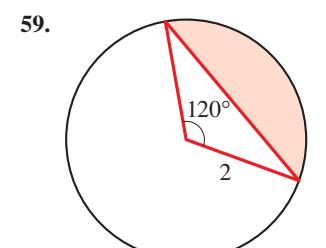
(No answer submitted)
Answer
The area is computed using the area-of-a-triangle formula \(cal(A) = \dfrac{1}{2} a b \sin \theta\) applied to the regions in the figure, then subtracting overlapping pieces.
Compare with the answer above and grade yourself:
Explanation
Identify each triangular region by its two sides and included angle, compute each area using \(\dfrac{1}{2} a b \sin \theta\), then combine appropriately for the shaded region.
60
Area of Shaded Region
Wrong
Find the area of the shaded region in the figure.
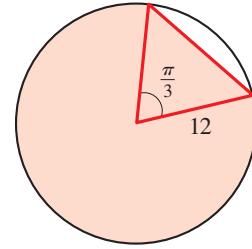
(No answer submitted)
Answer
The area is computed using the area-of-a-triangle formula \(cal(A) = \dfrac{1}{2} a b \sin \theta\) applied to the regions in the figure, then subtracting overlapping pieces.
Compare with the answer above and grade yourself:
Explanation
Identify each triangular region by its two sides and included angle, compute each area using \(\dfrac{1}{2} a b \sin \theta\), then combine appropriately for the shaded region.
61
Pythagorean Identity Proof
Wrong
Use the first Pythagorean identity to prove the second. [Hint: Divide by \(\cos^2 \theta\).]
(No answer submitted)
Answer
\(\tan^2 \theta + 1 = \sec^2 \theta\)
Compare with the answer above and grade yourself:
Explanation
Start with \(\sin^2 \theta + \cos^2 \theta = 1\). Divide both sides by \(\cos^2 \theta\) (assuming \(\cos \theta \neq 0\)): \(\dfrac{\sin^2 \theta}{\cos^2 \theta} + \dfrac{\cos^2 \theta}{\cos^2 \theta} = \dfrac{1}{\cos^2 \theta}\), which gives \(\tan^2 \theta + 1 = \sec^2 \theta\).
62
Pythagorean Identity Proof
Wrong
Use the first Pythagorean identity to prove the third.
(No answer submitted)
Answer
\(1 + \cot^2 \theta = \csc^2 \theta\)
Compare with the answer above and grade yourself:
Explanation
Start with \(\sin^2 \theta + \cos^2 \theta = 1\). Divide both sides by \(\sin^2 \theta\) (assuming \(\sin \theta \neq 0\)): \(\dfrac{\sin^2 \theta}{\sin^2 \theta} + \dfrac{\cos^2 \theta}{\sin^2 \theta} = \dfrac{1}{\sin^2 \theta}\), which gives \(1 + \cot^2 \theta = \csc^2 \theta\).
63
Application - Height of a Rocket
Wrong
Height of a Rocket. A rocket fired straight up is tracked by an observer on the ground a mile away. (a) Show that when the angle of elevation is \(\theta\), the height of the rocket in feet is \(h = 5280 \tan \theta\). (b) Complete the table to find the height of the rocket at the given angles of elevation: \(20^{\circ}\), \(60^{\circ}\), \(80^{\circ}\), \(85^{\circ}\).
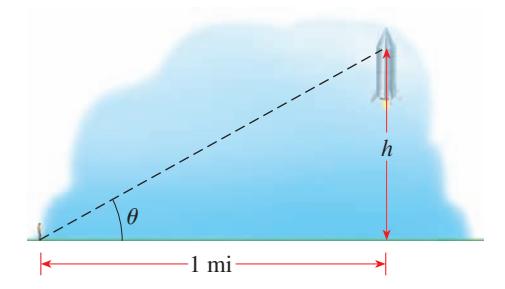
(No answer submitted)
Answer
(a) \(h = 5280 \tan \theta\). (b) \(h(20^{\circ}) \approx 1922\) ft; \(h(60^{\circ}) \approx 9145\) ft; \(h(80^{\circ}) \approx 29944\) ft; \(h(85^{\circ}) \approx 60351\) ft.
Compare with the answer above and grade yourself:
Explanation
(a) In the right triangle, the opposite side is \(h\) and the adjacent side is \(5280\) ft (1 mile), so \(\tan \theta = \dfrac{h}{5280}\), giving \(h = 5280 \tan \theta\). (b) Substitute each angle: \(h(20^{\circ}) = 5280 \tan 20^{\circ} \approx 1922\) ft, \(h(60^{\circ}) = 5280 \sqrt{3} \approx 9145\) ft, \(h(80^{\circ}) \approx 29944\) ft, \(h(85^{\circ}) \approx 60351\) ft.
64
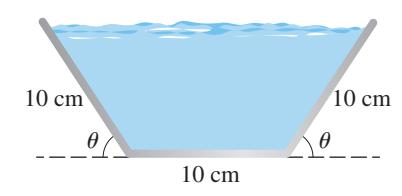
Application - Rain Gutter
Wrong
Rain Gutter. A rain gutter is to be constructed from a metal sheet of width \(30\) cm by bending up one-third of the sheet on each side through an angle \(\theta\). (a) Show that the cross-sectional area of the gutter is modeled by the function \(A(\theta) = 100 \sin \theta + 100 \sin \theta \cos \theta\). (b) Graph the function \(A\) for \(0 \leq \theta \leq \dfrac{\pi}{2}\). (c) For what angle \(\theta\) is the largest cross-sectional area achieved?
(No answer submitted)
Answer
(a) Cross-section is a trapezoid with bottom \(10\) cm, top \(10 + 20 \cos \theta\) cm, and height \(10 \sin \theta\) cm, giving \(A(\theta) = \dfrac{1}{2}(10 + 10 + 20 \cos \theta)(10 \sin \theta) = 100 \sin \theta + 100 \sin \theta \cos \theta\). (c) Maximum at \(\theta = \dfrac{\pi}{3}\) (i.e., \(60^{\circ}\)), with \(A \approx 129.9\) \(cm^2\).
Compare with the answer above and grade yourself:
Explanation
(a) The three sections each have width \(10\) cm. The bottom stays horizontal; each side is bent up at angle \(\theta\). The trapezoidal cross-section has parallel sides \(10\) (bottom) and \(10 + 2(10 \cos \theta)\) (top) and height \(10 \sin \theta\). Area: \(A = \dfrac{1}{2}(10 + 10 + 20 \cos \theta)(10 \sin \theta) = 100 \sin \theta + 100 \sin \theta \cos \theta\). (c) Setting \(A'(\theta) = 100 \cos \theta + 100 \cos 2 \theta = 0\) and solving yields \(\cos \theta = \dfrac{1}{2}\), so \(\theta = \dfrac{\pi}{3}\).
65
Application - Wooden Beam
Wrong
Wooden Beam. A rectangular beam is to be cut from a cylindrical log of diameter \(20\) cm. (a) Express the cross-sectional area of the beam as a function of the angle \(\theta\) in the figures. (b) Graph the function you found in part (a). (c) Find the dimensions of the beam with largest cross-sectional area.
(No answer submitted)
Answer
(a) \(A(\theta) = 400 \sin \theta \cos \theta = 200 \sin 2 \theta\) for \(0 < \theta < \dfrac{\pi}{2}\). (c) Maximum at \(\theta = \dfrac{\pi}{4}\) (i.e., \(45^{\circ}\)), giving a square cross-section of dimensions \(10 \sqrt{2}\) cm \(\times 10 \sqrt{2}\) cm with maximum area \(200\) \(cm^2\).
Compare with the answer above and grade yourself:
Explanation
(a) The rectangle is inscribed in a circle of radius \(10\) cm. If \(\theta\) is the angle from the center to a corner, the rectangle has width \(20 \cos \theta\) and height \(20 \sin \theta\), so \(A(\theta) = 20 \cos \theta \cdot 20 \sin \theta = 400 \sin \theta \cos \theta = 200 \sin 2 \theta\). (c) \(\sin 2 \theta\) is maximized when \(2 \theta = \dfrac{\pi}{2}\), giving \(\theta = \dfrac{\pi}{4}\). The dimensions are both \(20 \sin \dfrac{\pi}{4} = 10 \sqrt{2}\) cm, so the beam is square.
66
Application - Strength of a Beam
Wrong
Strength of a Beam. The strength of a beam is proportional to the width and the square of the depth. A beam is cut from a log as in Exercise 65. Express the strength of the beam as a function of the angle \(\theta\) in the figures.
(No answer submitted)
Answer
\(S(\theta) = k (20 \sin \theta)(20 \cos \theta)^2 = 8000 k \sin \theta \cos^2 \theta\), where \(k\) is the constant of proportionality.
Compare with the answer above and grade yourself:
Explanation
Width \(w = 20 \sin \theta\) and depth \(d = 20 \cos \theta\). Then strength \(S = k w d^2 = k (20 \sin \theta)(20 \cos \theta)^2 = 8000 k \sin \theta \cos^2 \theta\).
67
Application - Shot Put Trajectory
Wrong
Throwing a Shot Put. The range \(R\) and height \(H\) of a shot put thrown with an initial velocity of \(v_0\) ft/s at an angle \(\theta\) are given by \(R = \dfrac{v_0^2 \sin(2 \theta)}{g}\) and \(H = \dfrac{v_0^2 \sin^2 \theta}{2 g}\). On the earth \(g \approx 32\) ft/s\(^2\) and on the moon \(g \approx 5.2\) ft/s\(^2\). Find the range and height of a shot put thrown under the given conditions. (a) On the earth with \(v_0 = 12\) ft/s and \(\theta = \dfrac{\pi}{6}\). (b) On the moon with \(v_0 = 12\) ft/s and \(\theta = \dfrac{\pi}{6}\).
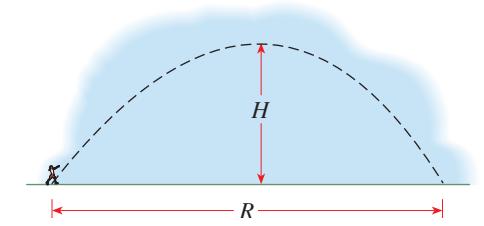
(No answer submitted)
Answer
(a) Earth: \(R = \dfrac{144 \sin\left(\dfrac{\pi}{3}\right)}{32} = \dfrac{9 \sqrt{3}}{4} \approx 3.90\) ft; \(H = \dfrac{144 \left(\dfrac{1}{4}\right)}{64} = \dfrac{9}{16} \approx 0.56\) ft. (b) Moon: \(R = \dfrac{144 \sin\left(\dfrac{\pi}{3}\right)}{5.2} \approx 23.98\) ft; \(H = \dfrac{144 \left(\dfrac{1}{4}\right)}{10.4} \approx 3.46\) ft.
Compare with the answer above and grade yourself:
Explanation
Substitute \(v_0 = 12\), \(\theta = \dfrac{\pi}{6}\), \(\sin(2 \theta) = \sin\left(\dfrac{\pi}{3}\right) = \dfrac{\sqrt{3}}{2}\), \(\sin^2 \theta = \sin^2\left(\dfrac{\pi}{6}\right) = \dfrac{1}{4}\) into the given formulas with the appropriate value of \(g\) for earth and moon.
68
Application - Sledding Down an Incline
Wrong
Sledding. The time in seconds that it takes for a sled to slide down a hillside inclined at an angle \(\theta\) is \(t = \sqrt{\dfrac{d}{16 \sin \theta}}\), where \(d\) is the length of the slope in feet. Find the time it takes to slide down a 2000-ft slope inclined at \(30^{\circ}\).
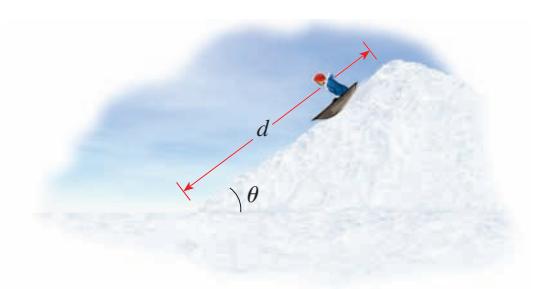
(No answer submitted)
Answer
\(t = \sqrt{250} \approx 15.81\) seconds
Compare with the answer above and grade yourself:
Explanation
\(t = \sqrt{\dfrac{2000}{16 \sin(30^{\circ})}} = \sqrt{\dfrac{2000}{16 \cdot \dfrac{1}{2}}} = \sqrt{\dfrac{2000}{8}} = \sqrt{250} \approx 15.81\) s.
69
Application - Beehive Wax Optimization
Wrong
Beehives. In a beehive each cell is a regular hexagonal prism. The amount of wax \(W\) in the cell depends on the apex angle \(\theta\) and is given by \(W = 3.02 - 0.38 \cot \theta + 0.65 \csc \theta\). Bees instinctively choose \(\theta\) so as to use the least amount of wax possible. (a) Use a graphing device to graph \(W\) as a function of \(\theta\) for \(0 < \theta < \pi\). (b) For what value of \(\theta\) does \(W\) attain its minimum value?
(No answer submitted)
Answer
The minimum occurs at \(\theta \approx 0.955\) rad \(\approx 54.7^{\circ}\).
Compare with the answer above and grade yourself:
Explanation
Setting \(W'(\theta) = 0.38 \csc^2 \theta - 0.65 \csc \theta \cot \theta = 0\) gives \(0.38 = 0.65 \cos \theta\), so \(\cos \theta = \dfrac{0.38}{0.65} \approx 0.5846\). Therefore \(\theta \approx 0.955\) rad.
70
Application - Turning a Corner with a Pipe
Wrong
Turning a Corner. A steel pipe is being carried down a hallway that is 9 ft wide. At the end of the hall there is a right-angled turn into a narrower hallway 6 ft wide. (a) Show that the length of the pipe in the figure is modeled by the function \(L(\theta) = 9 \csc \theta + 6 \sec \theta\). (b) Graph the function \(L\) for \(0 < \theta < \dfrac{\pi}{2}\). (c) Find the minimum value of the function \(L\). (d) Explain why the value of \(L\) you found in part (c) is the length of the longest pipe that can be carried around the corner.
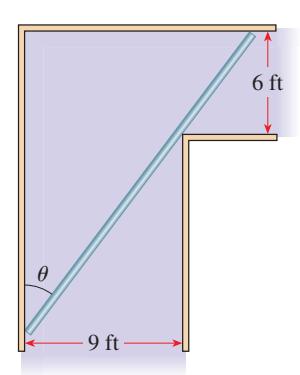
(No answer submitted)
Answer
(a) The pipe touches both walls and the inside corner; its length splits into \(9 \csc \theta\) (segment in the 9-ft hall) and \(6 \sec \theta\) (segment in the 6-ft hall). (b) Graph is U-shaped on \(\left(0, \dfrac{\pi}{2}\right)\). (c) Minimum at \(\tan \theta = \sqrt[3]{\dfrac{3}{2}}\), giving \(L_{\min} \approx 21.07\) ft. (d) Any longer pipe will not fit, since at the limiting angle the pipe just clears both walls and the corner.
Compare with the answer above and grade yourself:
Explanation
(c) Set \(L'(\theta) = -9 \csc \theta \cot \theta + 6 \sec \theta \tan \theta = 0\). This simplifies to \(\tan^3 \theta = \dfrac{3}{2}\), so \(\tan \theta = \sqrt[3]{\dfrac{3}{2}} \approx 1.145\), giving \(\theta \approx 0.848\) rad. Substituting back yields \(L_{\min} \approx 21.07\) ft. (d) The longest pipe is the smallest value of \(L(\theta)\) because longer pipes will exceed the available diagonal at some intermediate angle.
71
Application - Angle of Elevation of a Rainbow
Wrong
Rainbows. Rainbows are created when sunlight of different wavelengths (colors) is refracted and reflected in raindrops. The angle of elevation \(\theta\) of a rainbow is always the same. It can be shown that \(\theta = 4 \beta - 2 \alpha\), where \(\sin \alpha = k \sin \beta\) and \(\alpha = 59.4^{\circ}\) and \(k = 1.33\) is the index of refraction of water. Use the given information to find the angle of elevation \(\theta\) of a rainbow.
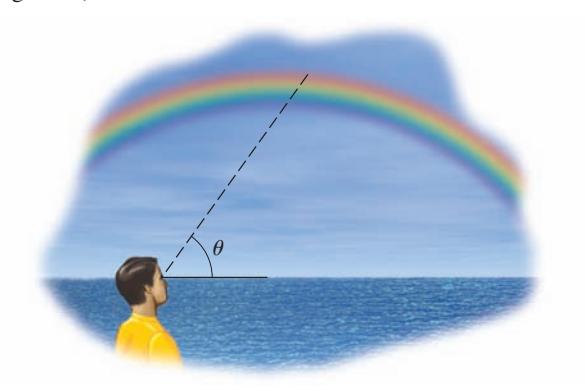
(No answer submitted)
Answer
\(\theta \approx 42.4^{\circ}\)
Compare with the answer above and grade yourself:
Explanation
From \(\sin(59.4^{\circ}) = 1.33 \sin \beta\), \(\sin \beta = \dfrac{\sin(59.4^{\circ})}{1.33} \approx 0.6471\), so \(\beta \approx 40.3^{\circ}\). Then \(\theta = 4(40.3^{\circ}) - 2(59.4^{\circ}) \approx 161.2^{\circ} - 118.8^{\circ} = 42.4^{\circ}\).
72
Discussion - Calculator Mode Error
Wrong
Using a Calculator. To solve a certain problem, you need to find the sine of 4 rad. Your study partner uses his calculator and tells you that \(\sin 4 = 0.0697564737\). On your calculator you get \(\sin 4 = -0.7568024953\). What is wrong? What mistake did your partner make?
(No answer submitted)
Answer
The study partner had the calculator set to degree mode and so computed \(\sin(4^{\circ}) \approx 0.0698\). The correct value for \(\sin 4\) rad is \(\approx -0.7568\), as obtained when the calculator is set to radian mode.
Compare with the answer above and grade yourself:
Explanation
An angle of 4 radians is about \(229.2^{\circ}\), which lies in Quadrant III, so \(\sin 4\) is negative. The partner's calculator was in degree mode, producing \(\sin(4^{\circ})\), a small positive number.
73
Discovery - Viète's Trigonometric Diagram
Wrong
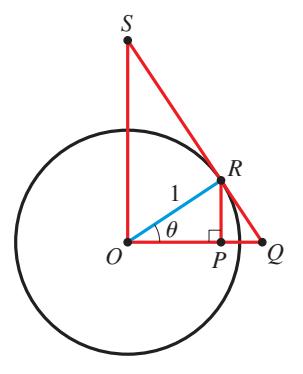
Viète's Trigonometric Diagram. Each of the six trigonometric functions of \(\theta\) is equal to the length of a line segment in the figure. For instance, \(\sin \theta = |\text{PR}|\) since from triangle \(\text{OPR}\) we have \(\sin \theta = \dfrac{\text{opp}}{\text{hyp}} = \dfrac{|\text{PR}|}{|\text{OR}|} = \dfrac{|\text{PR}|}{1} = |\text{PR}|\). For each of the five other trigonometric functions, find a line segment in the figure whose length equals the value of the function at \(\theta\). (Note: The radius of the circle is 1, the center is \(O\), segment \(\text{QS}\) is tangent to the circle at \(R\), and \(\angle \text{SOQ}\) is a right angle.)
(No answer submitted)
Answer
\(\cos \theta = |\text{OP}|\), \(\tan \theta = |\text{RQ}|\), \(\cot \theta = |\text{RS}|\), \(\sec \theta = |\text{OQ}|\), \(\csc \theta = |\text{OS}|\).
Compare with the answer above and grade yourself:
Explanation
On the unit circle of radius 1: in right triangle \(\text{OPR}\), \(\cos \theta = |\text{OP}|\). Using right triangles formed with the tangent line at \(R\) and the radii \(\text{OQ}\) and \(\text{OS}\), similar triangles give \(\tan \theta = |\text{RQ}|\), \(\cot \theta = |\text{RS}|\), \(\sec \theta = |\text{OQ}|\), and \(\csc \theta = |\text{OS}|\).
74
Example - Finding Trigonometric Functions of Angles
Wrong
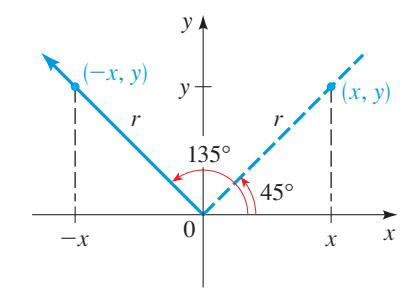
Find (a) \(\cos 135^{\circ}\) and (b) \(\tan 390^{\circ}\).
(No answer submitted)
Answer
(a) \(\cos 135^{\circ} = -\dfrac{\sqrt{2}}{2}\). (b) \(\tan 390^{\circ} = \dfrac{\sqrt{3}}{3}\).
Compare with the answer above and grade yourself:
Explanation
(a) From Figure 4 we see that \(\cos 135^{\circ} = -\dfrac{x}{r}\). But \(\cos 45^{\circ} = \dfrac{x}{r}\), and since \(\cos 45^{\circ} = \dfrac{\sqrt{2}}{2}\), we have \(\cos 135^{\circ} = -\dfrac{\sqrt{2}}{2}\).
(b) The angles \(390^{\circ}\) and \(30^{\circ}\) are coterminal. From Figure 5 it is clear that \(\tan 390^{\circ} = \tan 30^{\circ}\), and since \(\tan 30^{\circ} = \dfrac{\sqrt{3}}{3}\), we have \(\tan 390^{\circ} = \dfrac{\sqrt{3}}{3}\).
75
Example - Finding Reference Angles
Wrong
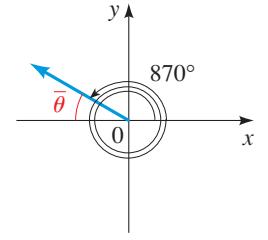
Find the reference angle \(\overline{\theta}\) for (a) \(\theta = \dfrac{5 \pi}{3}\) and (b) \(\theta = 870^{\circ}\).
(No answer submitted)
Answer
(a) \(\overline{\theta} = \dfrac{\pi}{3}\). (b) \(\overline{\theta} = 30^{\circ}\).
Compare with the answer above and grade yourself:
Explanation
(a) The reference angle is the acute angle formed by the terminal side of the angle \(\dfrac{5 \pi}{3}\) and the \(x\)-axis (see Figure 7). Since the terminal side of this angle is in Quadrant IV, the reference angle is \(\overline{\theta} = 2 \pi - \dfrac{5 \pi}{3} = \dfrac{\pi}{3}\).
(b) The angles \(870^{\circ}\) and \(150^{\circ}\) are coterminal because \(870 - 2(360) = 150\). The terminal side of this angle is in Quadrant II (see Figure 8). So the reference angle is \(\overline{\theta} = 180^{\circ} - 150^{\circ} = 30^{\circ}\).
76
Example - Using the Reference Angle to Evaluate Trigonometric Functions
Wrong
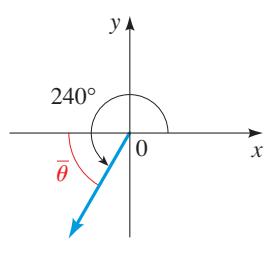
Find (a) \(\sin 240^{\circ}\) and (b) \(\cot 495^{\circ}\).
(No answer submitted)
Answer
(a) \(\sin 240^{\circ} = -\dfrac{\sqrt{3}}{2}\). (b) \(\cot 495^{\circ} = -1\).
Compare with the answer above and grade yourself:
Explanation
(a) This angle has its terminal side in Quadrant III, as shown in Figure 9. The reference angle is therefore \(240^{\circ} - 180^{\circ} = 60^{\circ}\), and the value of \(\sin 240^{\circ}\) is negative. Thus \(\sin 240^{\circ} = -\sin 60^{\circ} = -\dfrac{\sqrt{3}}{2}\).
(b) The angle \(495^{\circ}\) is coterminal with the angle \(135^{\circ}\), and the terminal side of this angle is in Quadrant II, as shown in Figure 10. So the reference angle is \(180^{\circ} - 135^{\circ} = 45^{\circ}\), and the value of \(\cot 495^{\circ}\) is negative. We have \(\cot 495^{\circ} = \cot 135^{\circ} = -\cot 45^{\circ} = -1\).
77
Example - Using the Reference Angle to Evaluate Trigonometric Functions
Wrong
Find (a) \(\sin \dfrac{16 \pi}{3}\) and (b) \(\sec\left(-\dfrac{\pi}{4}\right)\).
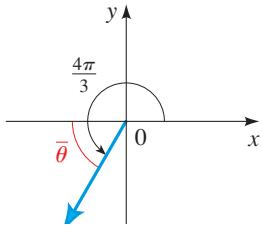
(No answer submitted)
Answer
(a) \(\sin \dfrac{16 \pi}{3} = -\dfrac{\sqrt{3}}{2}\). (b) \(\sec\left(-\dfrac{\pi}{4}\right) = \sqrt{2}\).
Compare with the answer above and grade yourself:
Explanation
(a) The angle \(\dfrac{16 \pi}{3}\) is coterminal with \(\dfrac{4 \pi}{3}\), and these angles are in Quadrant III (see Figure 11). Thus, the reference angle is \(\dfrac{4 \pi}{3} - \pi = \dfrac{\pi}{3}\). Since the value of sine is negative in Quadrant III, we have \(\sin \dfrac{16 \pi}{3} = \sin \dfrac{4 \pi}{3} = -\sin \dfrac{\pi}{3} = -\dfrac{\sqrt{3}}{2}\).
(b) The angle \(-\dfrac{\pi}{4}\) is in Quadrant IV, and its reference angle is \(\dfrac{\pi}{4}\) (see Figure 12). Since secant is positive in this quadrant, we get \(\sec\left(-\dfrac{\pi}{4}\right) = +\sec \dfrac{\pi}{4} = \sqrt{2}\).
78
Example - Expressing One Trigonometric Function in Terms of Another
Wrong
(a) Express \(\sin \theta\) in terms of \(\cos \theta\). (b) Express \(\tan \theta\) in terms of \(\sin \theta\), where \(\theta\) is in Quadrant II.
(No answer submitted)
Answer
(a) \(\sin \theta = \pm \sqrt{1 - \cos^2 \theta}\), with sign determined by the quadrant: positive in Quadrants I and II, negative in Quadrants III and
IV. (b) \(\tan \theta = \dfrac{\sin \theta}{-\sqrt{1 - \sin^2 \theta}}\).
IV. (b) \(\tan \theta = \dfrac{\sin \theta}{-\sqrt{1 - \sin^2 \theta}}\).
Compare with the answer above and grade yourself:
Explanation
(a) From the first Pythagorean identity \(\sin^2 \theta + \cos^2 \theta = 1\) we get \(\sin \theta = \pm \sqrt{1 - \cos^2 \theta}\), where the sign depends on the quadrant. If \(\theta\) is in Quadrant I or II, then \(\sin \theta\) is positive, so \(\sin \theta = \sqrt{1 - \cos^2 \theta}\); if \(\theta\) is in Quadrant III or IV, \(\sin \theta\) is negative, so \(\sin \theta = -\sqrt{1 - \cos^2 \theta}\).
(b) Since \(\tan \theta = \dfrac{\sin \theta}{\cos \theta}\), we need to write \(\cos \theta\) in terms of \(\sin \theta\). By part (a), \(\cos \theta = \pm \sqrt{1 - \sin^2 \theta}\), and since \(\cos \theta\) is negative in Quadrant II, the negative sign applies. Thus \(\tan \theta = \dfrac{\sin \theta}{\cos \theta} = \dfrac{\sin \theta}{-\sqrt{1 - \sin^2 \theta}}\).
79
Example - Evaluating a Trigonometric Function
Wrong
If \(\tan \theta = \dfrac{2}{3}\) and \(\theta\) is in Quadrant III, find \(\cos \theta\).
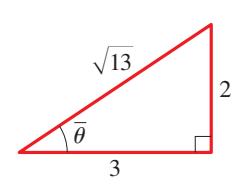
(No answer submitted)
Answer
\(\cos \theta = -\dfrac{3}{\sqrt{13}} = -\dfrac{3 \sqrt{13}}{13}\)
Compare with the answer above and grade yourself:
Explanation
Solution 1: From the identity \(\tan^2 \theta + 1 = \sec^2 \theta\) we get \(\sec \theta = \pm \sqrt{\tan^2 \theta + 1}\). In Quadrant III, \(\sec \theta\) is negative, so \(\sec \theta = -\sqrt{\tan^2 \theta + 1}\). Then \(\cos \theta = \dfrac{1}{\sec \theta} = \dfrac{1}{-\sqrt{\left(\dfrac{2}{3}\right)^2 + 1}} = \dfrac{1}{-\sqrt{\dfrac{13}{9}}} = -\dfrac{3}{\sqrt{13}} = -\dfrac{3 \sqrt{13}}{13}\). Solution 2: Sketch a right triangle with acute reference angle \(\overline{\theta}\) where \(\tan \overline{\theta} = \dfrac{2}{3}\). By the Pythagorean Theorem the hypotenuse is \(\sqrt{13}\), so \(\cos \overline{\theta} = \dfrac{3}{\sqrt{13}}\). Since \(\theta\) is in Quadrant III, \(\cos \theta = -\dfrac{3}{\sqrt{13}}\).
80
Example - Evaluating Trigonometric Functions
Wrong
If \(\sec \theta = 2\) and \(\theta\) is in Quadrant IV, find the other five trigonometric functions of \(\theta\).
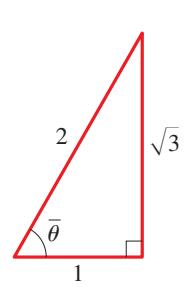
(No answer submitted)
Answer
\(\sin \theta = -\dfrac{\sqrt{3}}{2}\), \(\cos \theta = \dfrac{1}{2}\), \(\tan \theta = -\sqrt{3}\), \(\csc \theta = -\dfrac{2}{\sqrt{3}} = -\dfrac{2 \sqrt{3}}{3}\), \(\sec \theta = 2\), \(\cot \theta = -\dfrac{1}{\sqrt{3}} = -\dfrac{\sqrt{3}}{3}\)
Compare with the answer above and grade yourself:
Explanation
Sketch a right triangle with reference angle \(\overline{\theta}\) such that \(\sec \overline{\theta} = 2\), so the hypotenuse is 2 and the adjacent side is 1. By the Pythagorean Theorem the opposite side has length \(\sqrt{3}\). Since \(\theta\) is in Quadrant IV, sine and tangent (and their reciprocals) are negative while cosine and secant are positive.
81
Example - Finding the Area of a Triangle
Wrong
Find the area of triangle \(ABC\) with sides of length \(10\) cm and \(3\) cm and included angle \(120^{\circ}\).
(No answer submitted)
Answer
\(cal(A) = \dfrac{15 \sqrt{3}}{2} \approx 13 cm^2\)
Compare with the answer above and grade yourself:
Explanation
Using the area formula \(cal(A) = \dfrac{1}{2} a b \sin \theta\) with the reference angle \(60^{\circ}\) for \(120^{\circ}\): \(cal(A) = \dfrac{1}{2}(10)(3) \sin 120^{\circ} = 15 \sin 60^{\circ} = 15 \cdot \dfrac{\sqrt{3}}{2} = \dfrac{15 \sqrt{3}}{2} \approx 13 cm^2\).
Score History (Last 2)
0%
7/23
0%
7/28
| # | Date | Score | Accuracy | |
|---|---|---|---|---|
| Current | 2026-07-28 07:20 | 0 / 81 | 0% | |
| 2 | 2026-07-23 19:42 | 0 / 81 | 0% | View |