Exam Complete
|
SAT Diagnostic
0.0%
0/15
Diagnostic Result
1 students took this. You ranked #1.
100%
percentile
Ready to improve? Get unlimited exams, weakness analysis, and AI grading.
Topic Breakdown
Information and Ideas
Weak
0/4 · 0%
Algebra
Weak
0/3 · 0%
Craft and Structure
Weak
0/2 · 0%
Advanced Math
Weak
0/2 · 0%
Statistics
Weak
0/1 · 0%
Ratios, Rates and Percentages
Weak
0/1 · 0%
Geometry
Weak
0/1 · 0%
Expression of Ideas
Weak
0/1 · 0%
Target your weak topics with focused practice.
Practice weak topics →Results by Question
1
Information and Ideas
Wrong
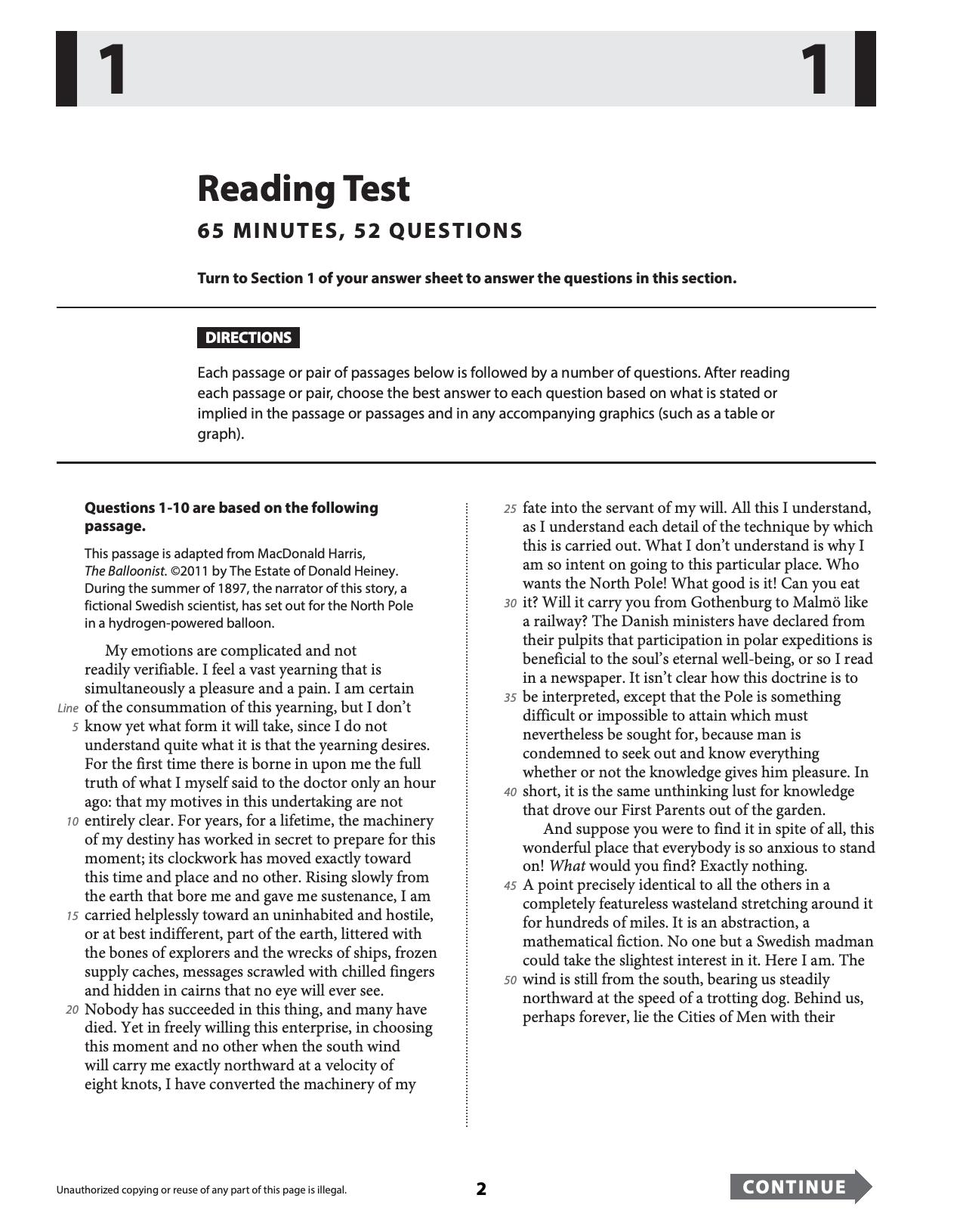
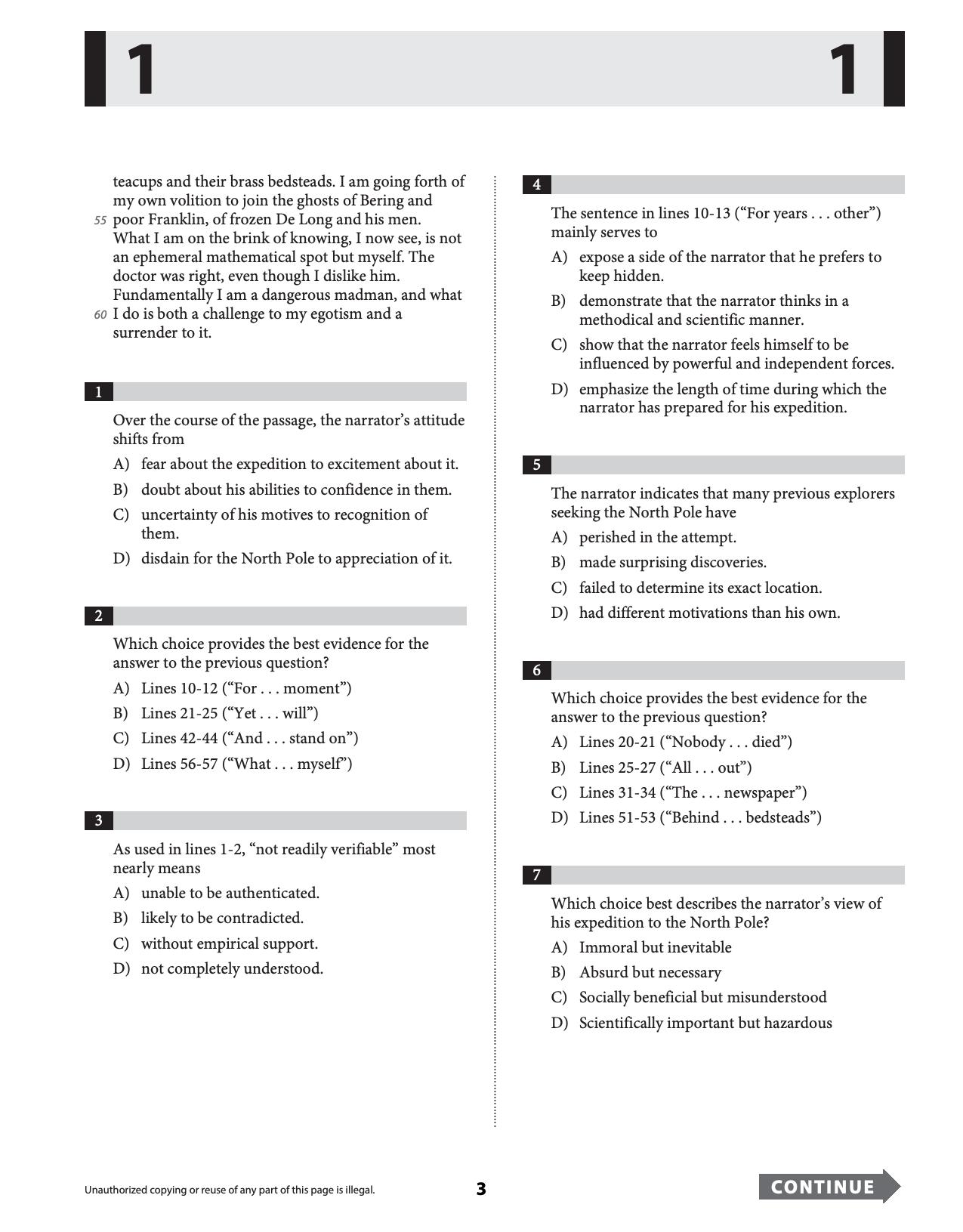
Which choice best describes the narrator's view of his expedition to the North Pole?
A
Immoral but inevitable
Absurd but necessary
Correct Answer
C
Socially beneficial but misunderstood
D
Scientifically important but hazardous
Explanation
Choice B is the best answer. In lines 27-39, the narrator states that he is
“intent” on traveling to the North Pole but acknowledges that the journey
is absurd: “Who wants the North Pole! What good is it! Can you eat it? Will
it carry you from Gothenburg to Malmö like a railway?” By asking these
questions, the narrator recognizes that the North Pole has no practical value.
Still, the narrator admits that finding the North Pole is necessary, as it “must
nevertheless be sought for.”
Choices A, C, and D are incorrect because the narrator does not view his
expedition to the North Pole as immoral, socially beneficial, or scientifically
important.
2
Statistics
Wrong
Nick surveyed a random sample of the freshman class of his high school to determine whether the Fall Festival should be held in October or November. Of the \(90\) students surveyed, \(25.6%\) preferred October. Based on this information, about how many students in the entire \(225\)-person class would be expected to prefer having the Fall Festival in October?
A
\(50\)
\(60\)
Correct Answer
C
\(75\)
D
\(80\)
Explanation
Choice B is correct. Because Nick surveyed a random sample of the fresh-
man class, his sample was representative of the entire freshman class. Thus,
the percent of students in the entire freshman class expected to prefer the
Fall Festival in October is appropriately estimated by the percent of students
who preferred it in the sample, 25.6%. Thus, of the 225 students in the fresh-
man class, approximately 225 × 0.256 = 57.6 students would be expected
to prefer having the Fall Festival in October. Of the choices given, this is
closest to 60.
Choices A, C, and D are incorrect. These choices may be the result of misap-
plying the concept of percent or of calculation errors.
3
Algebra
Wrong
\(f(x) = 7x + 1\)
The function gives the total number of people on a company retreat with \(x\) managers. What is the total number of people on a company retreat with 7 managers?
(No answer submitted)
Answer
50
No explanation
4
Algebra
Wrong
The system of equations \(\dfrac{1}{2}y = 4x - 1\) and \(\dfrac{1}{2}y = 2\) has solution \((x, y)\). What is the value of \(x\) ?
A
\(3\)
B
\(\dfrac{7}{2}\)
C
\(4\)
\(6\)
Correct Answer
Explanation
Choice D is correct. Adding the two equations side by side eliminates y and yields x = 6, as
shown.
y
x
y
x
If (x, y) is a solution to the system, then (x, y) satisfies both equations in the system and any
equation derived from them. Therefore, x = 6.
Choices A, B, and C are incorrect and may be the result of errors when solving the system.
5
Algebra
Wrong
In the equation \(\dfrac{a}{b} = \dfrac{a}{c}\) above, if \(a\) is negative and \(b\) is positive, which of the following must be true?
\(c > 1\)
Correct Answer
B
\(c = 1\)
C
\(c = -1\)
D
\(c < -1\)
Explanation
Choice A is correct. The equation can be rewritten as 1
b
c
a
, or equivalently 1
.
b
c
a Since a
< 0 and b > 0, it follows that
b
a
, and so 1 − c < 0, or equivalently c > 1.
Choice B is incorrect. If c = 1, then a − b = a, or b = 0. But it is given that b > 0, so c = 1 cannot be
true. Choice C is incorrect. If c = −1, then a − b = −a, or 2a = b. But this equation contradicts the
premise that a < 0 and b > 0, so c = −1 cannot be true. Choice D is incorrect. For example, if c =
−2, then a − b = −2a, or 3a = b. But this contradicts the fact that a and b have opposite signs, so
c < −1 cannot be true.
6
Ratios, Rates and Percentages
Wrong
One method of calculating the approximate age, in years, of a tree of a particular species is to multiply the diameter of the tree, in inches, by a constant called the growth factor for that species. The table gives the growth factors for eight species of trees: Red maple \(4.5\), River birch \(3.5\), Cottonwood \(2.0\), Black walnut \(4.5\), White birch \(5.0\), American elm \(4.0\), Pin oak \(3.0\), Shagbark hickory \(7.5\). According to the information in the table, what is the approximate age of an American elm tree with a diameter of \(12\) inches?
A
\(24\) years
B
\(36\) years
C
\(40\) years
\(48\) years
Correct Answer
Explanation
Choice D is correct. According to the given information, multiplying a tree species’ growth
factor by the tree’s diameter is a method to approximate the age of the tree. Multiplying the
growth factor, 4.0, of the American elm given in the table by the given diameter of 12 inches
yields an approximate age of 48 years.
Choices A, B, and C are incorrect because they do not result from multiplying the given
diameter of an American elm tree with that tree species’ growth factor..
7
Craft and Structure
Wrong
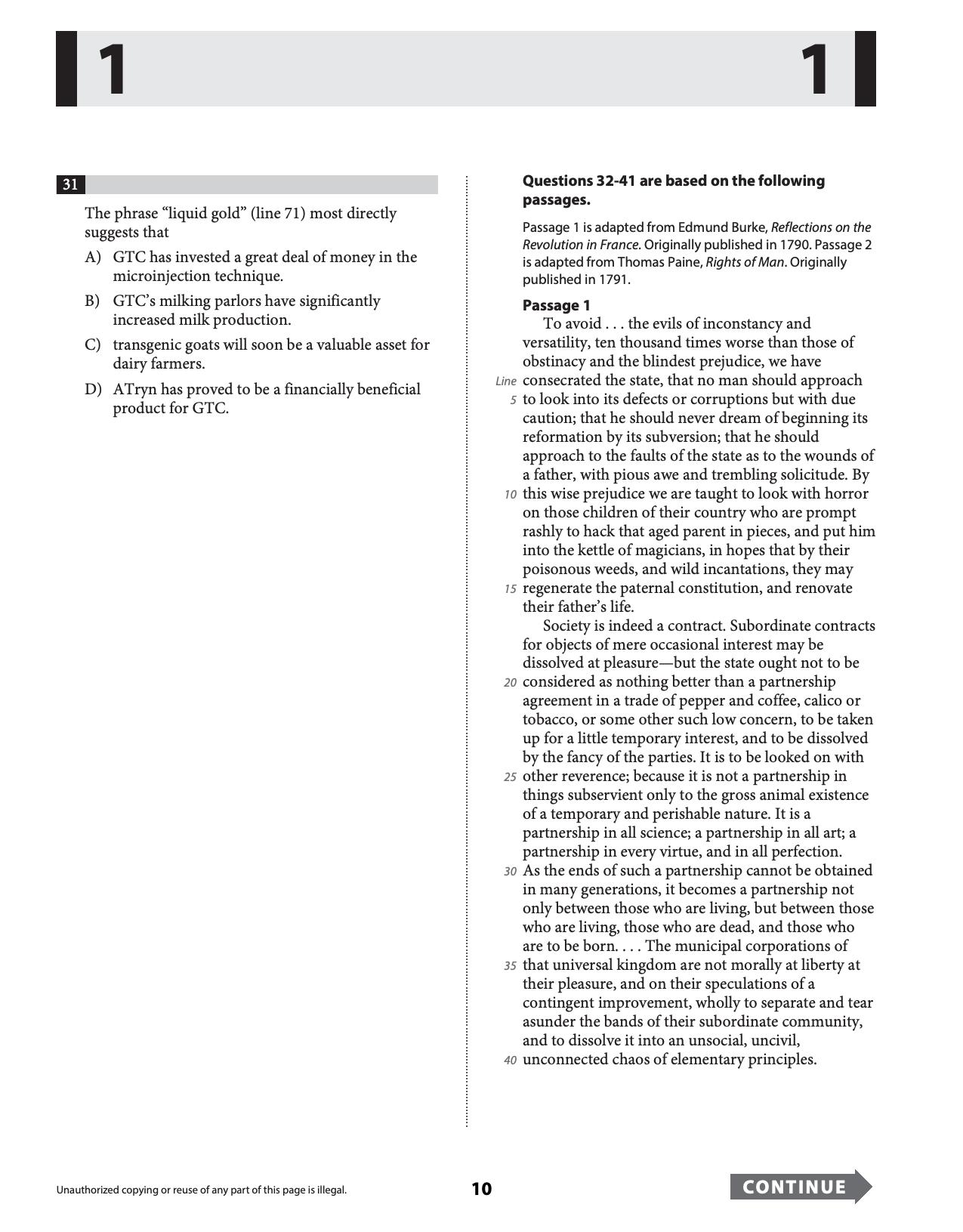
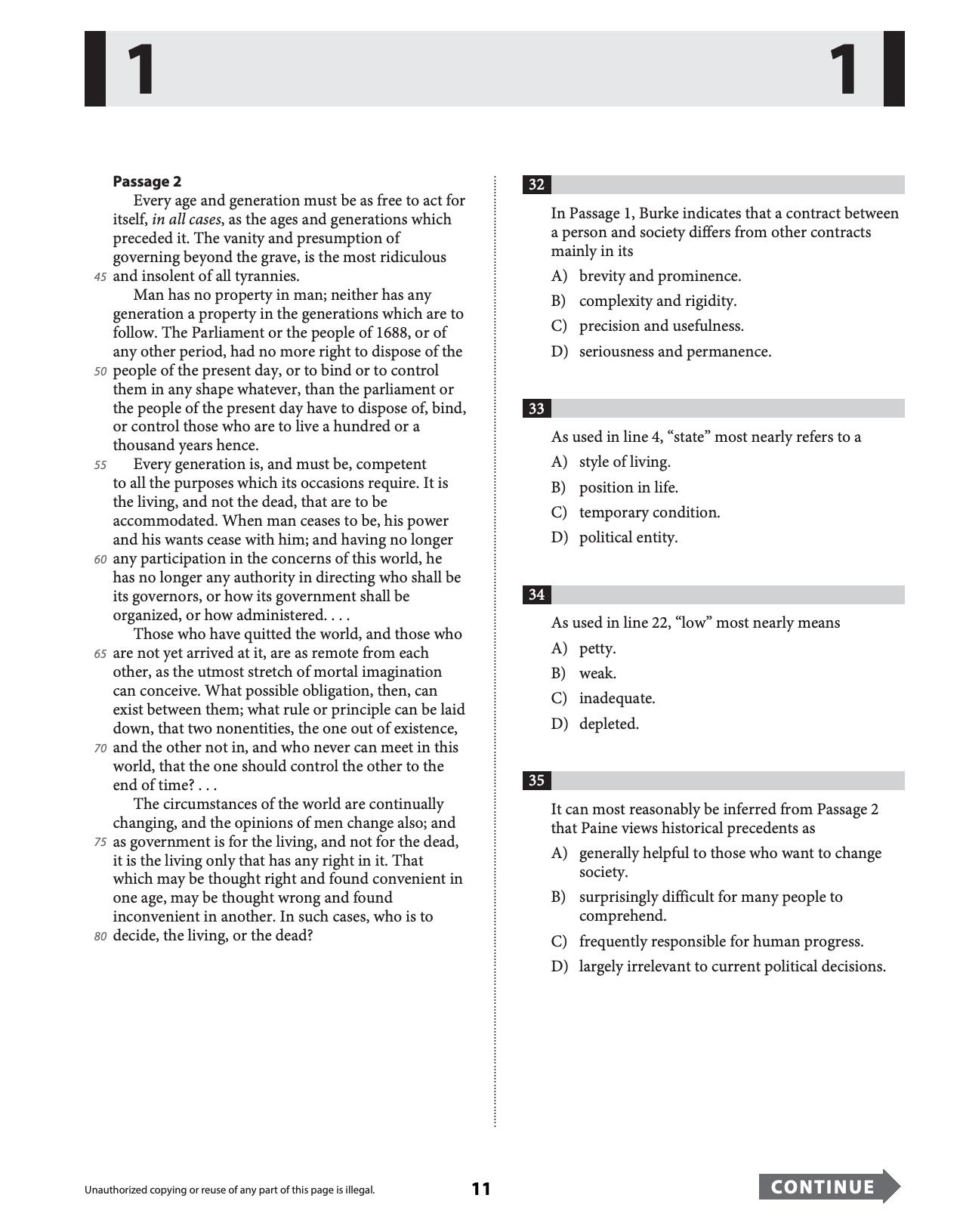
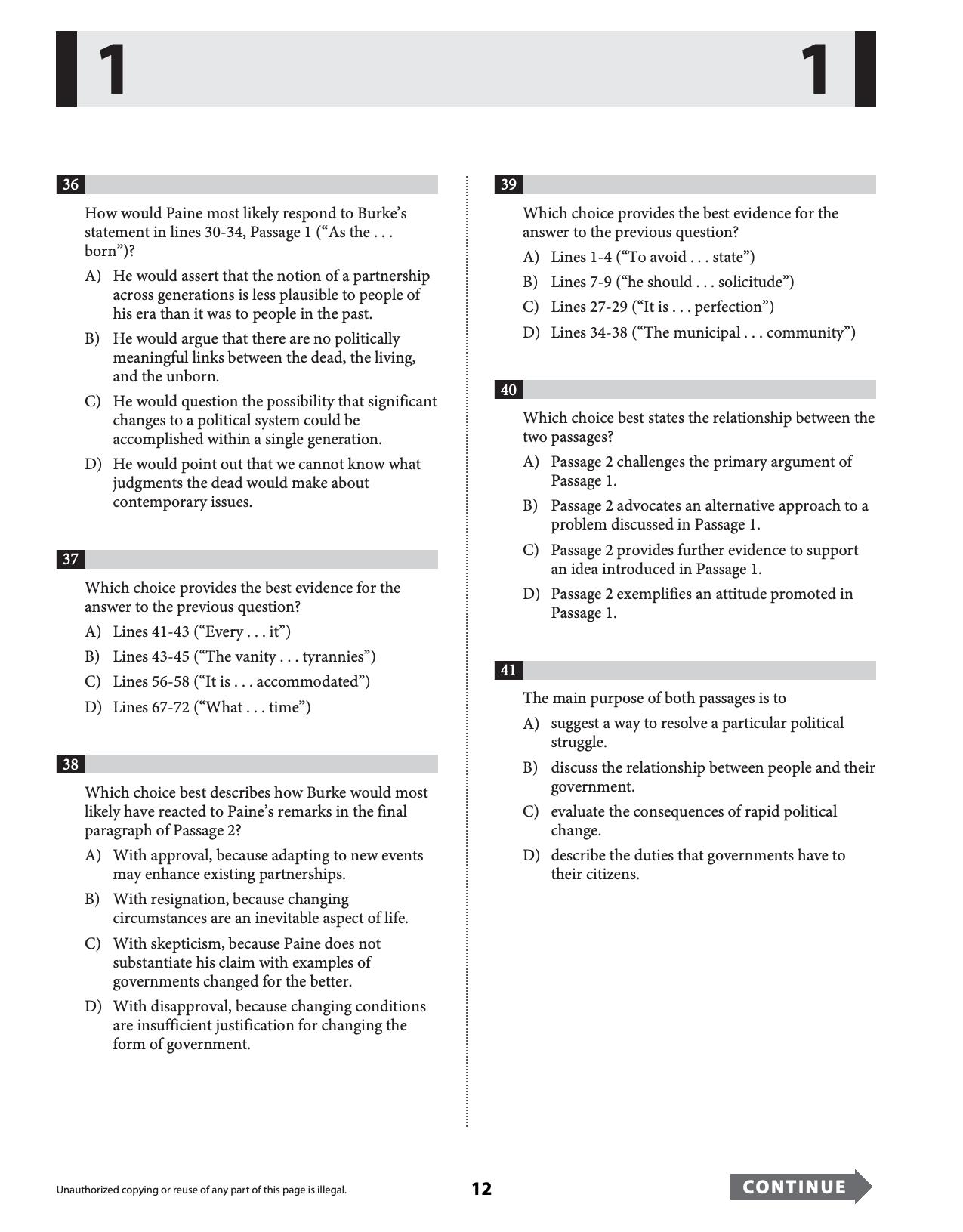
As used in line 4, “state” most nearly refers to a
A
style of living.
B
position in life.
C
temporary condition.
political entity.
Correct Answer
Explanation
Choice D is the best answer. In lines 1-9, Burke explains that people have
“consecrated the state” to “avoid . . . the evils of inconstancy and versatility,”
and that people should examine “the faults of the state . . . with pious awe
and trembling solitude.” Burke then explains that society is taught to “look
with horror on those children of their country who want to hack that aged
parent in pieces” (lines 10-12). Burke is arguing that children want to revise
the state, or “this aged parent,” by amending its faults. In this context, “state”
refers to a political entity, or government, that attempts to protect its citizens
from “the evils of inconstancy and versatility.”
Choices A, B, and C are incorrect because in this context, “state” does not
mean style of living, position in life, or temporary condition.
8
Information and Ideas
Wrong
"The Young Girl" is a 1920 short story by Katherine Mansfield. In the story, the narrator takes an unnamed seventeen-year-old girl and her younger brother out for a meal. In describing the teenager, Mansfield frequently contrasts the character's pleasant appearance with her unpleasant attitude, as when Mansfield writes of the teenager, ______
Which quotation from "The Young Girl" most effectively illustrates the claim?
A
"I heard her murmur, 'I can't bear flowers on a table.' They had evidently been giving her intense pain, for she positively closed her eyes as I moved them away."
"While we waited she took out a little, gold powder-box with a mirror in the lid, shook the poor little puff as though she loathed it, and dabbed her lovely nose."
Correct Answer
C
"I saw, after that, she couldn't stand this place a moment longer, and, indeed, she jumped up and turned away while I went through the vulgar act of paying for the tea."
D
"She didn't even take her gloves off. She lowered her eyes and drummed on the table. When a faint violin sounded she winced and bit her lip again. Silence."
No explanation
9
Craft and Structure
Wrong
Which choice best describes how Burke would most likely have reacted to Paine’s remarks in the final paragraph of Passage 2?
A
With approval, because adapting to new events may enhance existing partnerships.
B
With resignation, because changing circumstances are an inevitable aspect of life.
C
With skepticism, because Paine does not substantiate his claim with examples of governments changed for the better.
With disapproval, because changing conditions are insufficient justification for changing the form of government.
Correct Answer
Explanation
Choice D is the best answer. Paine concludes Passage 2 with the argument
that because social issues change over time, the living should not try to
adhere to decisions made by former generations (lines 73-80). Burke, how-
ever, states that living citizens exist within a “universal kingdom” (line 35)
comprised of the living, the dead, and those who are not yet born. Burke
argues that the living do not have the right to change their government
based on “their speculations of a contingent improvement” (lines 36-37).
Therefore, Burke would disapprove of Paine’s concluding argument, as he
believes the living do not have sufficient justification for changing the exist-
ing governmental structure.
Choices A, B, and C are incorrect because they do not accurately describe
how Burke would likely have responded to Paine’s remarks in the final para-
graph of Passage 2.
10
Advanced Math
Wrong
\(\dfrac{14x}{7y} = 2 \sqrt{w + 19}\)
The given equation relates the distinct positive real numbers \(w\), \(x\), and \(y\). Which equation correctly expresses \(w\) in terms of \(x\) and \(y\)?
A
\(w = \sqrt{\dfrac{x}{y}} - 19\)
B
\(w = \sqrt{\dfrac{28x}{14y}} - 19\)
\(w = \left(\dfrac{x}{y}\right)^2 - 19\)
Correct Answer
D
\(w = \left(\dfrac{28x}{14y}\right)^2 - 19\)
No explanation
11
Advanced Math
Wrong
\(f(x) = 5470(0.64)^{\dfrac{x}{12}}\)
The function \(f\) gives the value, in dollars, of a certain piece of equipment after \(x\) months of use. If the value of the equipment decreases each year by \(p\)% of its value the preceding year, what is the value of \(p\)?
A
4
B
5
36
Correct Answer
D
64
No explanation
12
Geometry
Wrong
Two identical rectangular prisms each have a height of 90 centimeters (cm). The base of each prism is a square, and the surface area of each prism is \(K\) cm\({}^2\). If the prisms are glued together along a square base, the resulting prism has a surface area of \(\dfrac{92}{47} K\) cm\({}^2\). What is the side length, in cm, of each square base?
A
4
8
Correct Answer
C
9
D
16
No explanation
13
Information and Ideas
Wrong
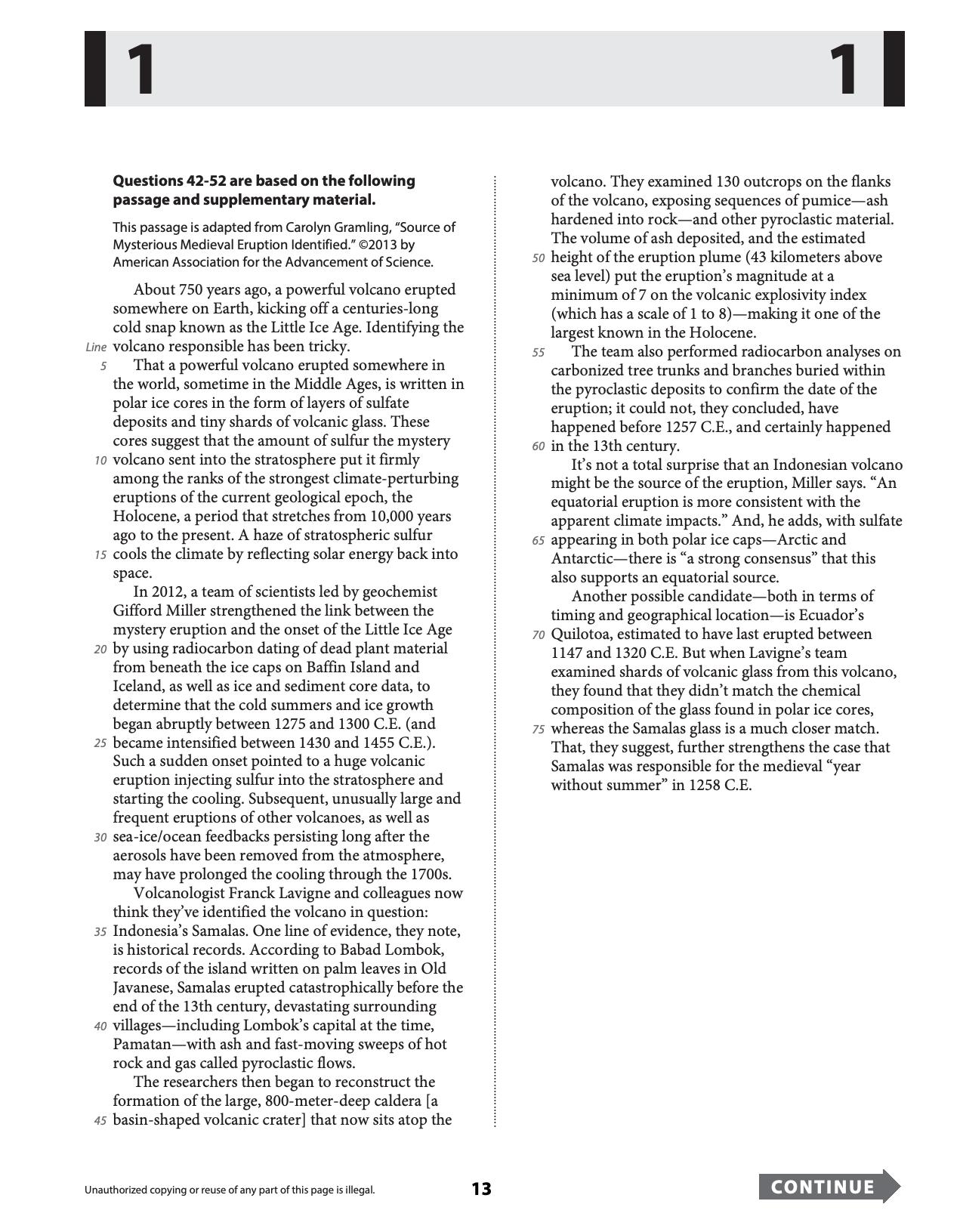
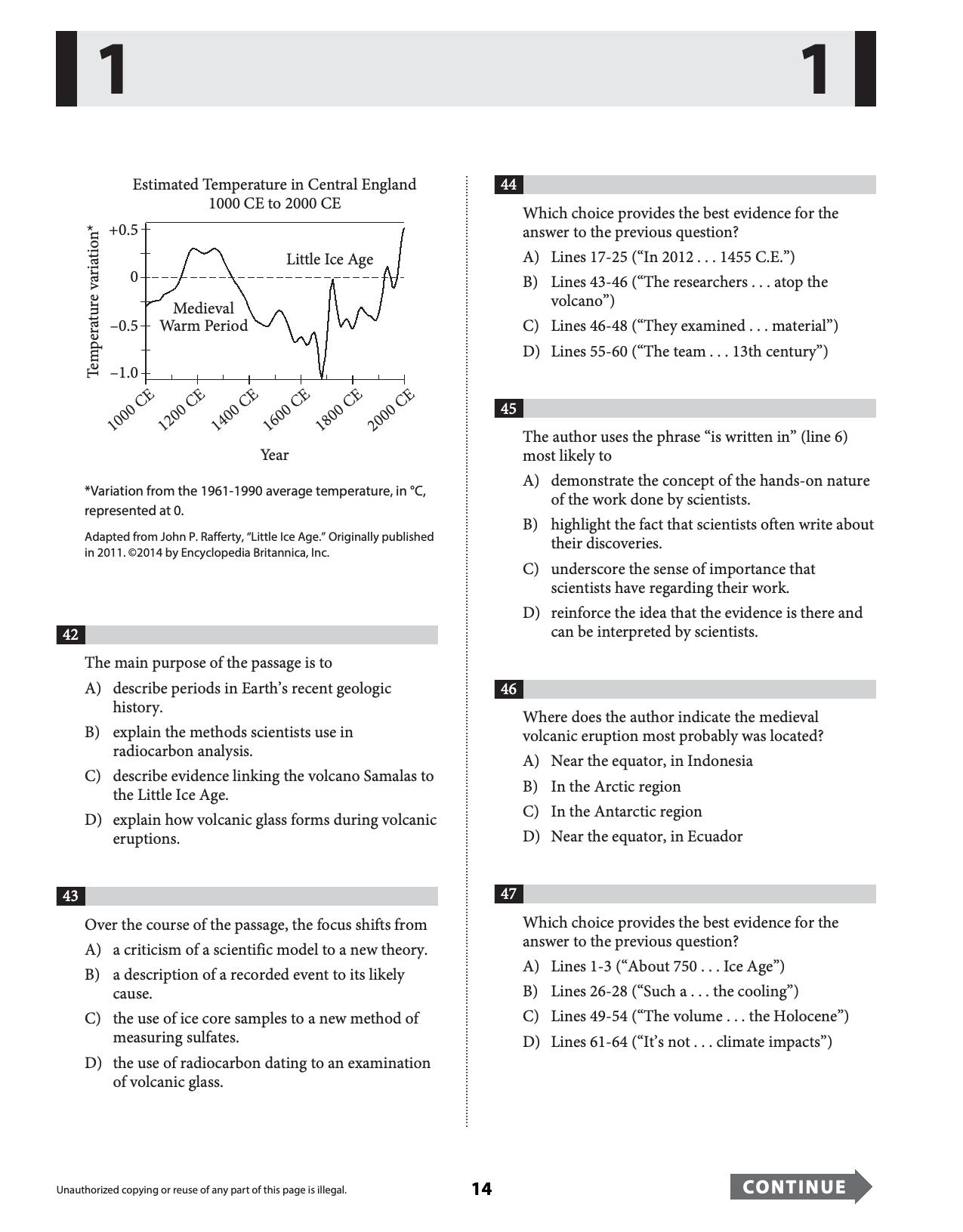
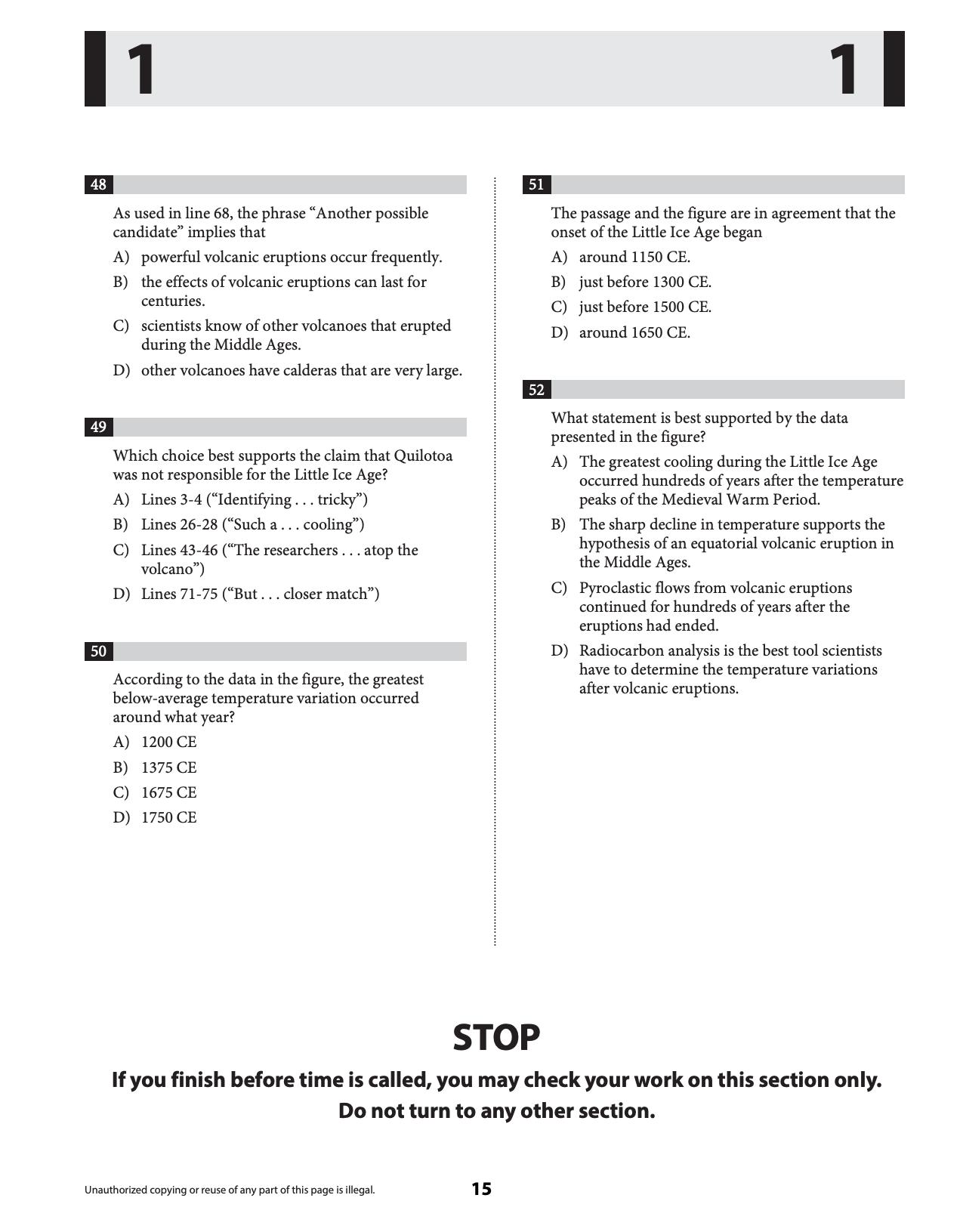
Which choice best supports the claim that Quilotoa was not responsible for the Little Ice Age?
A
Lines 3-4 ("Identifying . . . tricky")
B
Lines 26-28 ("Such a . . . cooling")
C
Lines 43-46 ("The researchers . . . atop the volcano")
Lines 71-75 ("But . . . closer match")
Correct Answer
Explanation
Choice D is the best answer. In lines 71-75, the author explains how
Lavigne’s team proved that Quilotoa’s eruption did not cause the Little
Ice Age:
“But when Lavigne’s team examined shards of volcanic glass from this vol-
cano, they found that they didn’t match the chemical composition of the
glass found in polar ice cores, whereas the Samalas glass is a much closer
match.” These findings show that Samalas, not Quilotoa, was responsible for
the onset of the Little Ice Age.
Choices A, B, and C are incorrect because they focus on the difficulty of
identifying the volcano responsible for the Little Ice Age, the magnitude of
the volcanic eruption, and the researchers’ experiment.
14
Expression of Ideas
Wrong
While researching a topic, a student has taken the following notes:
- The *Atlantic Monthly* magazine was first published in 1857.
- The magazine focused on politics, art, and literature.
- In 2019, historian Cathryn Halverson published the book *Faraway Women and the "Atlantic Monthly."*
- Its subject is female authors whose autobiographies appeared in the magazine in the early 1900s.
- One of the authors discussed is Juanita Harrison.
The student wants to introduce Cathryn Halverson's book to an audience already familiar with the *Atlantic Monthly*. Which choice most effectively uses relevant information from the notes to accomplish this goal?
Cathryn Halverson's *Faraway Women and the "Atlantic Monthly"* discusses female authors whose autobiographies appeared in the magazine in the early 1900s.
Correct Answer
B
A magazine called the *Atlantic Monthly*, referred to in Cathryn Halverson's book title, was first published in 1857.
C
*Faraway Women and the "Atlantic Monthly"* features contributors to the *Atlantic Monthly*, first published in 1857 as a magazine focusing on politics, art, and literature.
D
An author discussed by Cathryn Halverson is Juanita Harrison, whose autobiography appeared in the *Atlantic Monthly* in the early 1900s.
No explanation
15
Information and Ideas
Wrong
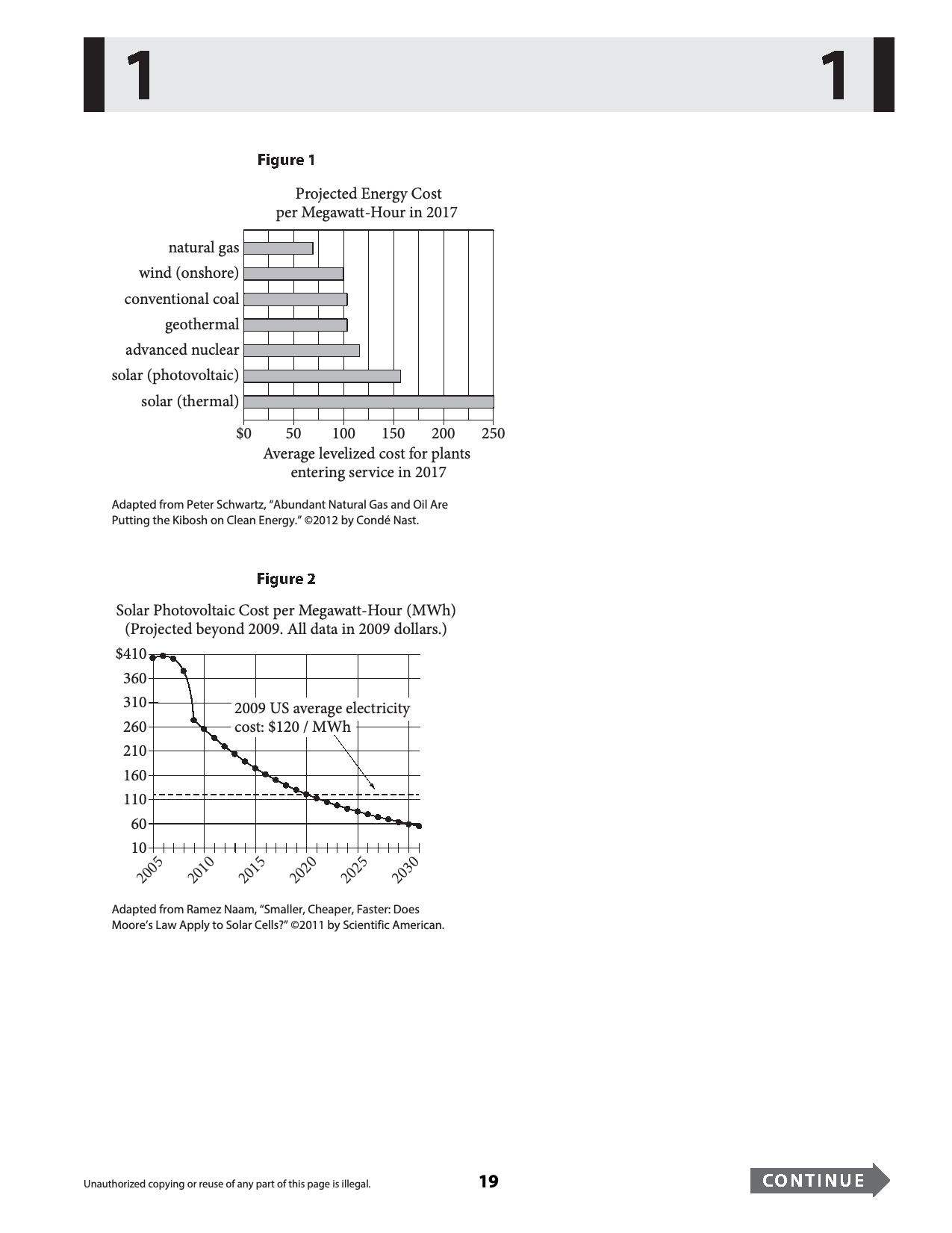
According to figure 1, in 2017, the cost of which of the following fuels is projected to be closest to the 2009 US average electricity cost shown in figure 2?
A
Natural gas
B
Wind (onshore)
C
Conventional coal
Advanced nuclear
Correct Answer
Explanation
Choice D is the best answer. Figure 2 shows that in 2009, the US average electricity cost per megawatt-
hour (MWh) was $120. Of the projected 2017 energy costs for fuels listed in figure 1, the one closest to
the 2009 US average electricity cost 120 dollars per megawatt-hour is the projected cost of advanced
nuclear energy, estimated at just below 125 dollars per megawatt-hour.
Choices A, B, and C are incorrect because figure 1 shows the projected energy costs of natural gas, wind
(onshore), and conventional coal as just below 75 dollars per megawatt-hour, 100 dollars per
megawatt-hour, and approximately 105 dollars per megawatt-hour, respectively. None of these costs is
as close to the 2009 US average electricity cost of 120 dollars per megawatt-hour as the projected 2017
cost of advanced nuclear energy, which is just below 125 dollars per megawatt-hour.